TL;DR:
- Only NJDEP-approved agencies with ASSE 5000 certification can legally certify backflow devices in New Jersey.
- Annual testing by certified testers is required for all backflow prevention devices to ensure water safety.
- Verifying tester credentials and maintaining proper documentation helps property owners avoid fines and water shutoffs.
Many New Jersey property owners assume that any licensed plumber can test and certify a backflow prevention device. That assumption is wrong, and it can cost you. State regulations under N.J.A.C. 7:10 are specific: only testers holding credentials from a NJDEP-approved certifying agency are legally authorized to perform tests and submit reports. Getting this wrong means fines, potential water shutoff, and unresolved liability. This guide walks you through exactly who can certify your devices, what the law requires, how to verify credentials, and what the testing process actually looks like from start to finish.
Table of Contents
- Backflow device certification: What the law requires in New Jersey
- Who can certify your backflow device? Agencies, credentials, and verification
- Types of backflow prevention devices and testing requirements
- The testing and reporting process: Steps and common mistakes
- The overlooked risks: Why NJ property owners can’t afford to ‘wing it’
- Get compliant with certified backflow testing in New Jersey
- Frequently asked questions
Key Takeaways
| Point | Details |
|---|---|
| Certified testers required | Only NJDEP-approved and agency-certified professionals can certify backflow devices in New Jersey. |
| Annual testing is mandatory | State law requires all backflow prevention devices to be officially tested and reported every year. |
| Verify before hiring | Always check your tester’s credentials with NJDEP or your local water supplier to avoid compliance risks. |
| Report submission matters | Test results must be reported directly to the township or supplier within 30 days to stay compliant. |
Backflow device certification: What the law requires in New Jersey
New Jersey takes cross-connection control seriously. The state’s backflow prevention regulations are built around protecting the public water supply from contamination caused by backflow events. These happen when water flows backward through a pipe, pulling pollutants or chemicals into the drinking water system. Annual testing is the primary defense against that risk.
Under state law, backflow devices must be tested annually by certified testers holding ASSE Series 5000 certification or an equivalent accepted by the local water purveyor. That means your tester cannot simply hold a plumbing license and call it a day. Plumbing licenses and backflow tester certifications are two separate credentials entirely.
Here is what New Jersey law specifically requires:
- Annual testing of all certified backflow prevention devices
- Testers must hold credentials from a NJDEP-approved agency under N.J.A.C. 7:10-10.8
- A plumbing license alone does not qualify someone to certify a device
- Reports must be submitted to the local authority or water supplier after each test
- Local townships and water purveyors may impose additional requirements beyond state minimums
Important: NJDEP approves certifying agencies under N.J.A.C. 7:10-10.8, not individual testers. The state does not maintain a public list of certified individuals. Your local water purveyor is the right place to confirm whether a specific tester is accepted in your area.
Non-compliance is not a minor issue. Failing to have your device tested on time, or using an unqualified tester, can result in financial penalties or even water shutoff by your supplier. The importance of backflow certification goes beyond paperwork. It is a direct public health obligation tied to your property.
One thing that surprises many property owners is that local water purveyors like New Jersey American Water operate their own cross-connection control programs with specific requirements. Even if you meet state minimums, your local supplier may require more. Always check with your purveyor first.
Who can certify your backflow device? Agencies, credentials, and verification
With the legal framework in mind, here is how you confirm that your chosen tester is actually qualified.
Only testers certified through a NJDEP-approved certifying agency can legally submit official test reports in New Jersey. The most widely recognized credential is ASSE 5000 certification, which is accepted by most water purveyors across the state. Some local purveyors may accept equivalents, but ASSE 5000 is the standard to look for.
Here is what distinguishes a qualified tester from someone who is simply licensed:
| Credential | Legal authority to certify backflow devices in NJ |
|---|---|
| NJ plumbing license only | No |
| General contractor license | No |
| ASSE 5000 or equivalent from NJDEP-approved agency | Yes |
| Certification from non-approved agency | No |
Verifying your tester before scheduling the job is not optional. Follow these steps:
- Ask the tester for their certification card and the name of their certifying agency.
- Confirm that the agency appears on NJDEP’s approved agency list under N.J.A.C. 7:10-10.8.
- Contact your local water purveyor to confirm they accept that specific certification.
- Confirm that the tester uses calibrated gauges and can submit reports directly to your township or supplier.
- Request a copy of the completed test report after service.
Pro Tip: A tester who offers to submit the report directly to your water supplier or township saves you a step and reduces the risk of missed deadlines. Make that part of your selection criteria.
One detail many property owners overlook: certified testers are required to use calibrated gauges that meet annual calibration standards. If a tester cannot confirm their gauge calibration status, that is a red flag. You can learn more about proper backflow certification in NJ and what makes a test valid. Our step-by-step backflow prevention guide also breaks down the full process from device selection to final report.
Types of backflow prevention devices and testing requirements
Understanding who can certify is just step one. Knowing your device type ensures proper compliance.
Not every building uses the same backflow prevention device. The type installed on your property depends on the hazard level, whether backpressure is a concern, and where the device is located within the system. Each device type has distinct testing requirements, but all require annual testing by a certified professional under NJDEP N.J.A.C. 7:10.
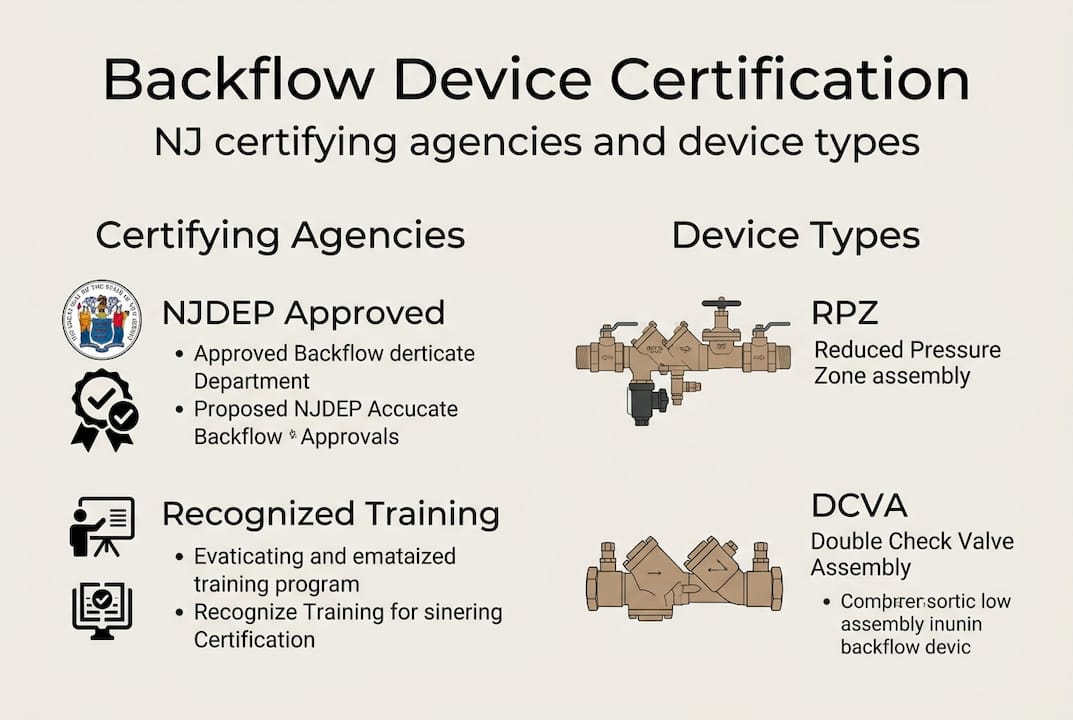
Here is a breakdown of the main device types used in New Jersey:
| Device type | Hazard level | Common application |
|---|---|---|
| Reduced Pressure Zone (RPZ) | High hazard, backpressure risk | Irrigation, fire suppression, boilers |
| Double Check Valve Assembly (DCVA) | Low to moderate hazard | Commercial buildings, light industrial |
| Pressure Vacuum Breaker (PVB) | Siphonage, no backpressure | Outdoor irrigation, hose connections |
| Atmospheric Vacuum Breaker (AVB) | Low hazard, siphonage only | Individual fixture protection |
Device selection by hazard level is a structured process based on the degree of hazard, whether backpressure exists, and the physical location of the device. A high-hazard system like a chemical boiler requires an RPZ. A simple lawn irrigation connection at a residential property may use a PVB.
Here is what matters most for property owners and managers:
- RPZ devices must be installed above ground and require a licensed professional for installation and certified tester for annual testing
- DCVA devices are common in commercial settings where moderate protection is required without an above-ground installation
- PVB and AVB devices work only where backpressure is not a factor; using them in high-hazard situations is a violation
Pro Tip: If you manage multiple properties with different system types, create a device inventory that lists the type, location, and last test date for each device. This makes annual scheduling straightforward and keeps you audit-ready. Understanding how backflow preventers work at a mechanical level also helps you catch early signs of wear before testing day.
Commercial properties with fire suppression systems, irrigation, or boilers are the most common locations where certified testing catches real problems. A failed device on a fire system is not just a compliance issue. It is a safety issue.
The testing and reporting process: Steps and common mistakes
Once your device type is confirmed, here is what to expect during testing and submission.
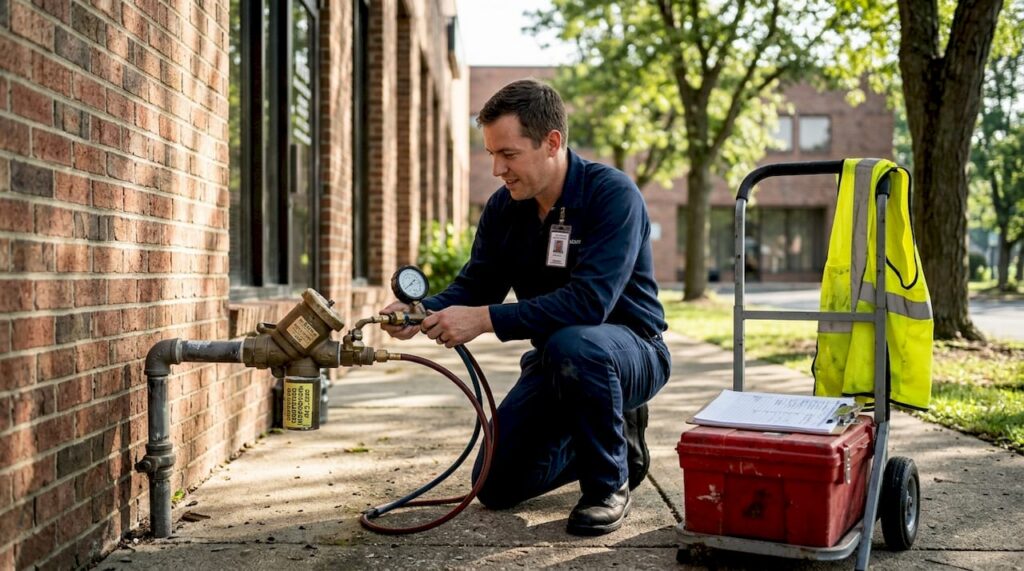
Backflow testing is a precise, protocol-driven process. The tester uses calibrated gauges to measure pressure differentials across the device and verify that each internal component functions correctly. Testing follows ASSE/NJ standards, and completed reports must be submitted to the local township or water supplier, typically within 30 days of the test.
Here is the standard workflow:
- Schedule a certified tester before your annual deadline.
- The tester arrives with calibrated gauge equipment and performs the field test.
- The tester documents results on the official test report form.
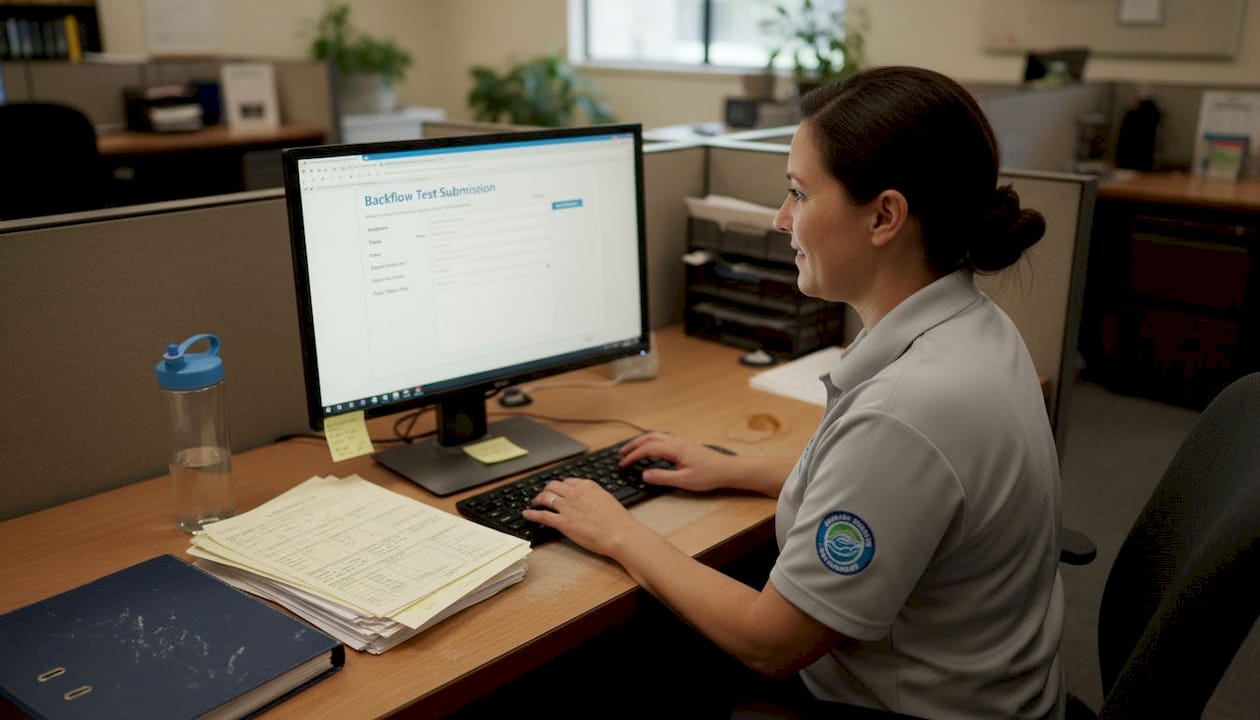
- The completed report is submitted to your local authority or water purveyor within 30 days.
- You retain a copy of the report for your property records.
Common mistake: Many property owners wait until they receive a notice from their water supplier before scheduling a test. By then, you may already be out of compliance, and deadlines can be tight.
The most frequent compliance failures we see come down to a few avoidable problems:
- Hiring a contractor without verifying tester certification first
- Missing the annual deadline because no reminder system was in place
- Using a tester whose gauge was not calibrated, invalidating the test results
- Failing to confirm that the report was actually submitted by the tester
Pro Tip: Set a calendar reminder 60 days before your expected test deadline. This gives you enough time to verify credentials, schedule service, and confirm submission without scrambling.
For detailed guidance on passing backflow testing and understanding testing frequency in NJ, both resources break down exactly what is expected at each stage. Getting the process right the first time avoids the costly cycle of re-testing and missed report windows.
The overlooked risks: Why NJ property owners can’t afford to ‘wing it’
Putting all the pieces together, here is what most guides do not tell you about backflow compliance in NJ.
The biggest compliance gap we see is not ignorance of the rules. It is confidence in the wrong assumption. Property owners who have worked with the same plumber for years naturally trust that person to handle everything, including backflow testing. But plumbing experience and backflow tester certification are not the same thing, and the consequences of that mix-up fall entirely on the property owner.
A non-certified test is legally invalid. That means if your water supplier audits your records, there is no compliant test on file, regardless of how thorough the work appeared. You are exposed to fines, potential water shutoff, and in cases involving cross-connection incidents, real liability.
The smarter approach is to understand what NJ property owners need before a problem occurs, then build a consistent relationship with a certified tester who knows your property, your device types, and your local purveyor’s specific requirements. That relationship pays for itself the first time it keeps you out of a compliance notice.
Get compliant with certified backflow testing in New Jersey
Compliance does not have to be stressful when you work with people who already know the rules, the devices, and the reporting requirements inside and out.
Our team provides certified backflow testing across New Jersey, covering all device types for residential and commercial properties. We handle report submission directly to your local authority, so nothing slips through the cracks. If you want a clear walkthrough before booking, our guide on passing backflow testing gives you the full picture. When you are ready to schedule or just want to confirm your compliance status, reach out to our team and we will take it from there.
Frequently asked questions
Can any licensed plumber certify backflow devices in NJ?
No. A plumbing license is not the same as backflow tester certification. Only testers holding credentials from a NJDEP-approved agency, such as ASSE 5000 or a recognized equivalent, can legally perform and report official tests in New Jersey.
How can I verify if my backflow tester is certified in New Jersey?
Ask for the tester’s certifying agency name and confirm it appears on NJDEP’s approved agency list. You should also verify with your local water purveyor that the certification is accepted in your specific service area.
Do all types of backflow devices require annual testing?
Yes. All commonly used device types in New Jersey, including RPZ, DCVA, PVB, and AVB, must be tested annually under N.J.A.C. 7:10 by a tester with approved credentials.
What happens if my backflow device is not tested on time?
Missed or overdue tests can lead to fines and water shutoff by your water supplier. The consequences apply regardless of whether the device itself is functioning correctly.
Where is the official list of approved backflow tester certifying agencies?
NJDEP maintains a public list of approved certifying agencies under N.J.A.C. 7:10-10.8 on their online portal, which you can access directly to confirm agency status before hiring a tester.
Pingback: Backflow device installation guide for NJ property owners
Pingback: Complying with backflow inspection requirements in New Jersey
Pingback: Backflow compliance guide for NJ commercial properties
Pingback: Certified Backflow Tester Explained: NJ Compliance Made Simple
Pingback: NJ residential backflow protection guide for homeowners
Pingback: NJ backflow certification: The complete owner's guide
Pingback: Backflow inspection: Protect your NJ water supply
Pingback: NJ water meter and backflow compliance guide