TL;DR:
- Backflow risk involves contaminated water flowing in reverse, threatening public health and compliance.
- Proper devices like RPZ, DCVA, or air gaps are essential based on hazard levels and require annual testing.
- Maintaining records, scheduling tests early, and collaborating with certified testers help ensure continuous compliance.
Regular plumbing maintenance keeps pipes flowing and fixtures functional, but it does not protect your commercial property from one of the most serious water safety threats in the code book: backflow. Many property managers in New Jersey assume that passing a standard plumbing inspection means all boxes are checked. That assumption is wrong, and it can cost you. Backflow is a separate legal requirement, governed by its own state rules under N.J.A.C. 7:10, enforced by local water authorities, and tied directly to the health of everyone who uses water in your building. This guide walks you through the full picture.
Table of Contents
- What is backflow and why it matters in commercial properties
- Common backflow prevention devices for New Jersey commercial properties
- New Jersey backflow compliance: Testing, submission, and what inspectors look for
- Common backflow compliance pitfalls and how to avoid them
- What most property managers miss about backflow compliance
- Next steps: Reliable backflow compliance for your New Jersey property
- Frequently asked questions
Key Takeaways
| Point | Details |
|---|---|
| Annual testing is mandatory | Every New Jersey commercial property must test backflow devices annually with certified professionals. |
| Right device for right risk | Choosing the appropriate device (RPZ for high hazard, DCVA for low hazard) is key to compliance. |
| Compliance prevents penalties | Consistent testing and proper reporting help you avoid fines and protect your water supply. |
| Proactive maintenance saves money | Scheduled maintenance and edge-case awareness reduce failures and costly emergencies. |
What is backflow and why it matters in commercial properties
Backflow happens when water flows in the wrong direction through a plumbing system, pushing potentially contaminated water back into the clean supply. There are two mechanisms behind this. Backpressure occurs when downstream pressure exceeds supply pressure, forcing water backward. Backsiphonage happens during a pressure drop in the supply line, essentially creating a suction effect that pulls water back from fixtures, hoses, or equipment.
Commercial properties face significantly higher risk than residential buildings for several reasons. The plumbing systems are more complex, often connecting boilers, cooling towers, irrigation systems, chemical dosing equipment, and multiple water-use zones. Large water demands create pressure fluctuations that residential systems rarely experience. Add in equipment like autoclaves, commercial dishwashers, or chemical injection systems, and you have multiple potential contamination sources all tied into the same supply line.
The consequences of backflow reach far beyond a failed inspection. Water contamination from backflow incidents can cause illness among tenants, employees, or customers. It can trigger regulatory violations, fines, and in serious cases, a water shutoff order from your local authority. As NJ backflow regulations make clear, the state treats commercial backflow incidents as public health events, not minor plumbing issues.
Common sources of backflow in commercial settings include:
- Boilers and HVAC systems with chemical treatment additives
- Irrigation and fire suppression connections
- Commercial kitchen equipment with submerged inlets
- Car wash equipment and hose bibs without vacuum breakers
- Swimming pool and spa fill connections
- Laboratory or medical equipment using process water
“Backflow poses serious risks to commercial water supplies, requiring specific prevention devices.”
New Jersey law takes this especially seriously because the state’s dense urban and suburban environment means a single contamination event can affect large numbers of people quickly. A failure at a multi-tenant commercial building is not just a problem for that property owner. It becomes a municipal water supply issue.
Now that you understand the importance of backflow, let’s break down how New Jersey handles prevention and which devices you’re required to use.
Common backflow prevention devices for New Jersey commercial properties
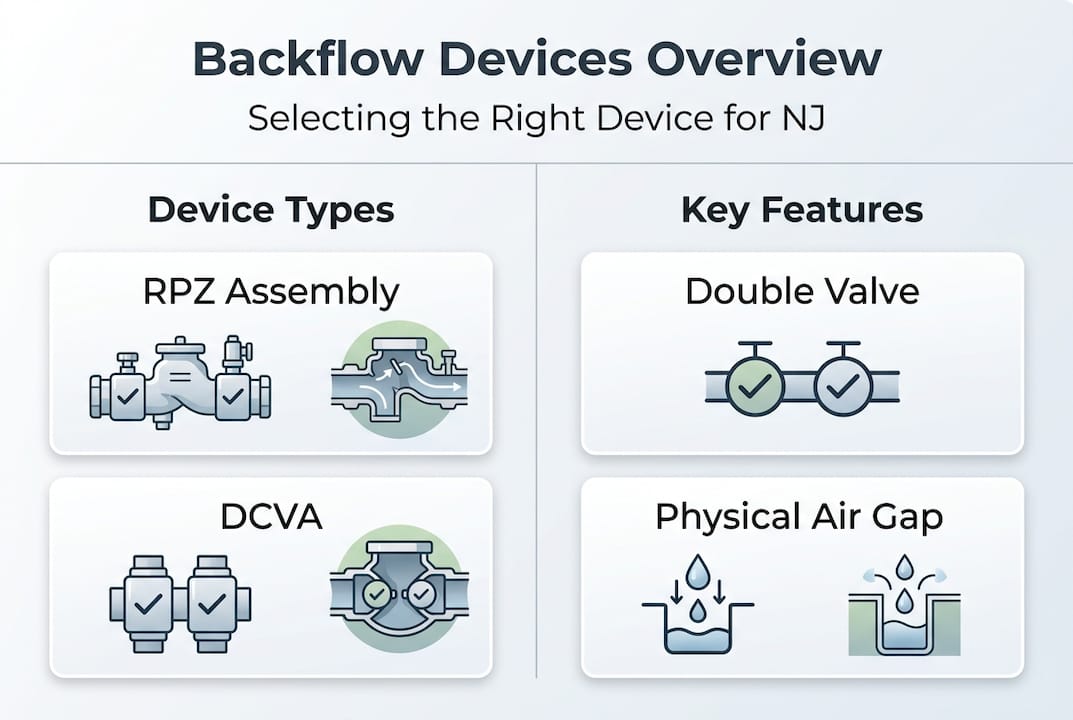
Selecting the right backflow prevention device is not optional, and it is not a one-size-fits-all decision. The types of backflow devices approved for commercial use in New Jersey fall into three primary categories, each suited to different hazard levels and applications.
Reduced Pressure Zone (RPZ) assemblies are the highest level of mechanical protection available. They use two independently acting check valves with a pressure differential relief valve between them. If either check valve fails, the relief valve opens and discharges water rather than allowing contaminated water to enter the supply. RPZ assemblies are required for high-hazard applications.
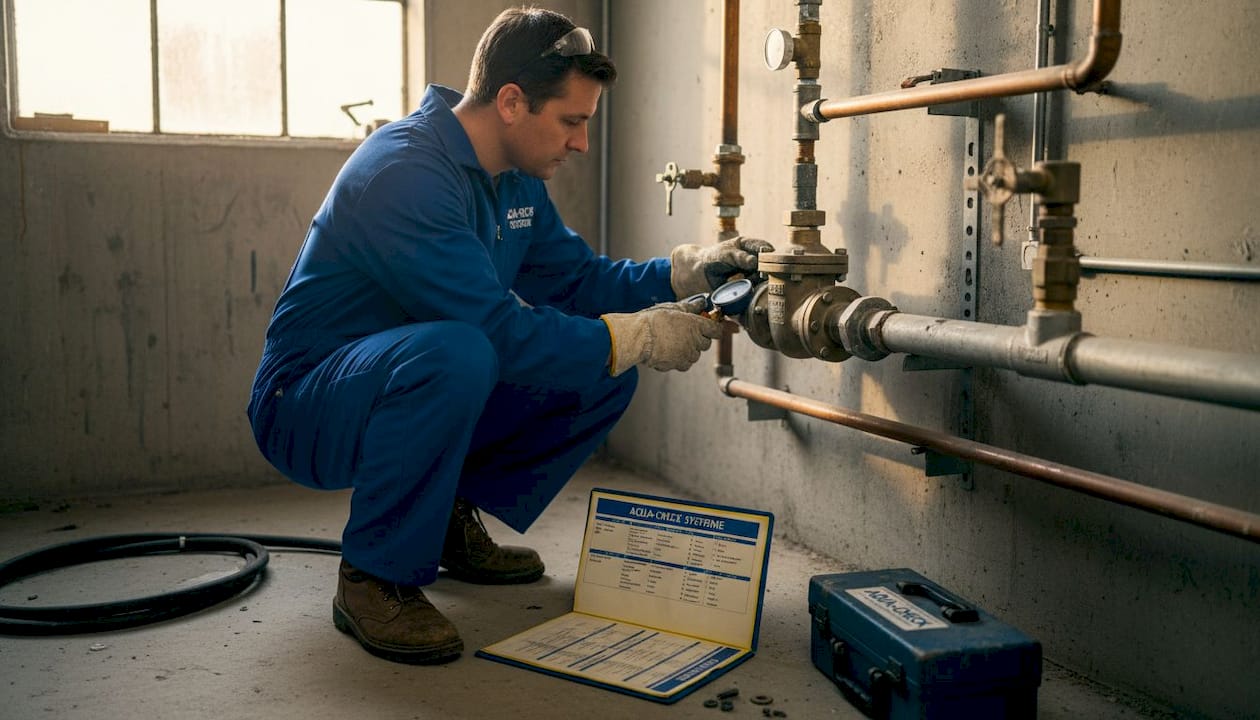
Double Check Valve Assemblies (DCVA) consist of two independently operating spring-loaded check valves. They are suitable for low-to-moderate hazard applications and are more compact and easier to install in tight mechanical rooms. As NJDEP backflow rules specify, common backflow prevention devices in commercial properties include RPZ assemblies for high-hazard applications and DCVAs for low-hazard use.
Air gaps are the simplest and most absolute form of protection. They require a physical space between the water outlet and the flood level rim of a receiving vessel. Air gaps cannot fail mechanically, but they interrupt flow continuity, which limits their use to specific fill situations like tanks or reservoirs.
| Device type | Hazard level | Typical NJ commercial application | Annual test required |
|---|---|---|---|
| RPZ assembly | High | Boilers, chemical injection, HVAC | Yes |
| DCVA | Low to moderate | Irrigation, general plumbing | Yes |
| Air gap | All levels | Tank fills, emergency supplies | Visual inspection |
| Pressure vacuum breaker | Low | Hose bibs, lawn irrigation | Yes |
Common scenarios where each device applies in commercial buildings:
- RPZ: A building with a boiler using corrosion inhibitor chemicals
- RPZ: A medical or laboratory facility with process water connections
- DCVA: A retail building with a dedicated irrigation supply
- Air gap: A large water storage tank used for fire suppression makeup water
- Pressure vacuum breaker: Exterior hose connections in a low-rise office park
The backflow FAQ for New Jersey properties is a useful starting point if you are unsure which device your specific application requires.
Pro Tip: Even if the state minimum allows a DCVA for your property type, your local water authority in high-density zones like Hudson County or Bergen County may require an RPZ. Always confirm with your municipality before installing any device. Upgrading after the fact costs more than getting it right the first time.
With a clear understanding of device types, the next step is to navigate New Jersey’s specific testing and compliance rules.
New Jersey backflow compliance: Testing, submission, and what inspectors look for
Annual testing is not a suggestion. New Jersey requires annual backflow device testing in commercial properties by certified testers, with results submitted to local water authorities within 30 days per N.J.A.C. 7:10-10. Missing this deadline is one of the most common and most avoidable compliance failures property managers face.
The testing process is technical. Backflow testing methodology involves using calibrated differential pressure gauges on test cocks to measure check valve differentials and relief valve function per ASSE 1013 standards. Only NJ certified testers registered with local water authorities can perform and certify this work. Hiring an uncertified individual to run the test invalidates the results entirely and puts you back at square one.
Here is the step-by-step compliance process for commercial properties:
- Identify every backflow prevention device on your property and confirm it is on the local water authority’s registry.
- Schedule a certified tester at least 30 days before your annual deadline to allow time for repairs if the device fails.
- The tester uses calibrated gauges on each test cock to measure check valve performance and relief valve opening pressure.
- If the device passes, the tester completes a standardized test report form.
- The signed report is submitted to your local water authority, typically within 30 days of the test date.
- Retain a copy of the test report in your property records for at least three years.
- If the device fails, schedule repairs immediately. A second test is required after repair before the result is submitted.
| Compliance element | Responsible party | Deadline | Submission method |
|---|---|---|---|
| Annual test scheduling | Property owner/manager | Before annual due date | Internal coordination |
| Device testing | NJ certified tester | Within test window | On-site visit |
| Report submission | Certified tester or owner | Within 30 days of test | Local water authority |
| Record retention | Property owner | 3 years minimum | On-site files |
Inspectors look at more than just the current year’s test report. They review maintenance records, device installation documentation, and whether the device type matches the hazard level of the connected equipment. A DCVA installed on a high-hazard boiler system is a red flag even if it passed its last test. For guidance on passing NJ backflow testing, reviewing the submission requirements for your specific municipality in advance saves significant headaches.
“Inspectors focus on device type appropriateness, calibrated test results, and maintenance history, not just whether the paperwork was filed on time.”
Understanding compliance is only step one. The real challenge is staying ahead of common issues that can lead to failure or extra costs.
Common backflow compliance pitfalls and how to avoid them
Even experienced property managers run into backflow compliance problems. Most failures are entirely preventable with the right preparation and a consistent maintenance mindset. Understanding where things go wrong is the fastest route to making sure they do not go wrong for you.
The most frequent reasons commercial backflow devices fail inspection:
- Wear and internal degradation: Check valve springs lose tension over time, especially in buildings with high water usage cycles.
- Sediment and debris buildup: Commercial water supplies carry particulates that accumulate on valve seats, preventing full closure.
- Corrosion and rust: Devices installed in damp mechanical rooms or near chemical exposure points corrode faster than expected.
- Improper installation: Devices installed without proper orientation, isolation valves, or test cock access create immediate test failures.
- Missed deadlines: Local water authority records show a lapse, triggering a compliance notice even if the device itself is functioning.
- Wrong device for the hazard: Installing a DCVA where an RPZ is required is a code violation, regardless of the device’s mechanical condition.
Edge cases in New Jersey include high-hazard commercial boilers and HVAC systems that require RPZ assemblies regardless of building size. Local authorities in high-density areas consistently apply requirements stricter than the state baseline. Asking your inspector specifically what the local authority in your area requires, not just what the state code says, is a question that routinely saves property managers from surprise violations.
“Non-compliance penalties in New Jersey can include significant fines and, in persistent cases, water service interruption. The cost of compliance is always lower than the cost of enforcement.”
Practical fixes for each common problem:
- Schedule preventive maintenance mid-year, between annual tests, to catch spring fatigue or debris before the formal inspection.
- Ask your certified tester to document any marginal readings, not just outright failures. Marginal readings predict future failures.
- Store all device documentation, including original installation records and manufacturer specifications, in a binder at the property.
- Use a compliance calendar with 60-day advance reminders for annual test deadlines across all your properties.
Pro Tip: Build a working relationship with your certified tester, not just a transactional one. A tester who knows your building’s history can flag edge cases specific to your equipment before they become violations. That early warning is worth more than any compliance checklist.
Connecting with resources on backflow issues and fixes helps property managers build internal knowledge so that they recognize warning signs between annual visits. A well-documented maintenance workflow makes this practical at scale, even for managers overseeing multiple properties.
Now let’s turn from avoiding pitfalls to gaining real peace of mind with an expert perspective on what actually works in commercial backflow compliance.
What most property managers miss about backflow compliance
Most commercial property managers treat backflow compliance as an annual checkbox. Get the test done, file the report, move on. That mindset gets you to the legal minimum, but it does not protect you from the situations that actually create liability.
Here is the reality we see on the ground in New Jersey: the properties that run into serious problems are rarely the ones that skipped the test entirely. They are the ones that passed the test on paper but had devices operating at the marginal edge of acceptable performance. A check valve registering at the lowest acceptable differential is not a passing grade you should feel good about. It is a warning that failure is coming before next year’s inspection.
The importance of backflow certification in New Jersey goes beyond the certificate itself. Certification creates accountability. When you choose a tester who knows your property’s specific hazard profile, understands the local authority’s expectations in your municipality, and proactively communicates marginal readings, you convert a compliance exercise into an actual risk management practice.
Choosing a device rated one level above the legal minimum is not overcorrecting. For properties with any high-hazard equipment, it is often the financially smart move. The cost difference between a DCVA and an RPZ is small compared to the cost of a failed inspection, emergency repairs, or a contamination incident.
Approach backflow compliance as a water safety investment. The annual test is the floor, not the ceiling.
Next steps: Reliable backflow compliance for your New Jersey property
Waiting until you receive a compliance notice from your local water authority is not a strategy. The risks are real, the deadlines are firm, and the cost of reacting is always higher than the cost of planning ahead. Property managers who schedule annual testing early, maintain complete records, and build relationships with qualified local testers consistently avoid the fines, emergency repairs, and liability exposures that catch others off guard.
If you are ready to schedule a certified inspection, confirm your device type is correct for your specific hazard level, or just need guidance on getting NJ backflow help, our team is ready to assist. South Jersey Backflow provides certified testing services for commercial properties throughout New Jersey, with timely submission handling and documentation support built into every inspection. Compliance should give you confidence, not anxiety.
Frequently asked questions
How often does New Jersey law require backflow testing for commercial properties?
Annual backflow testing is required in New Jersey for all commercial properties, and results must be submitted to the local water authority within 30 days of the test.
What are the most common reasons backflow devices fail their inspection?
Backflow device failures are most often caused by wear, sediment accumulation, rust, or improper installation, all of which are preventable with routine mid-year maintenance.
Who is allowed to test and certify backflow preventers in New Jersey?
Only certified testers registered with local water authorities can legally perform and certify backflow testing in New Jersey. Results submitted by unregistered individuals are not accepted.
Can a local authority require more frequent or stricter backflow testing than the state minimum?
Yes. Local authorities in high-density areas like Hudson and Bergen counties routinely impose stricter device requirements and more rigorous compliance standards than the state baseline.
What happens if a commercial property misses the annual backflow test deadline?
Missing the annual deadline can result in fines, a notice of violation, or water service interruption depending on your local authority’s enforcement practices. Proactive scheduling is the only reliable way to avoid this outcome.
Pingback: NJ commercial backflow compliance: what you need to know
Pingback: NJ backflow codes: your compliance roadmap for 2026
Pingback: Backflow report filing guide for NJ property managers