
TL;DR:
- Proper backflow recordkeeping and timely submission are crucial for compliance in New Jersey.
- Missing submission deadlines can lead to fines or water shutoff, regardless of device condition.
- Organizing accurate records and verifying tester credentials help prevent enforcement actions.
Imagine getting a call that your property’s water supply has been shut off, not because of a broken pipe, but because a backflow testing record was never submitted. It happens more often than you might think in New Jersey, and the consequences ripple fast: tenants without water, operations halted, and an enforcement notice waiting at your door. Staying compliant with New Jersey’s backflow prevention requirements is not just a box to check. It is an active, ongoing responsibility. This guide walks you through exactly what records you need, how to organize them, and how to submit them on time, every time.
Table of Contents
- Understanding New Jersey backflow testing and recordkeeping regulations
- Preparing for recordkeeping: What information you need and how to organize it
- Step-by-step: How to document backflow testing and submit compliant records
- Troubleshooting and avoiding common pitfalls in backflow recordkeeping
- Editorial perspective: Why rigorous recordkeeping is your strongest compliance defense
- Connect with local experts for hassle-free backflow compliance
- Frequently asked questions
Key Takeaways
| Point | Details |
|---|---|
| Annual testing required | All public water-connected properties in New Jersey must test backflow preventers each year. |
| Prompt record submission | Records must be submitted to water purveyors within 30 days to avoid penalties. |
| Certified testers matter | Only testers with ASSE 5000 certification or equivalent can conduct valid backflow tests. |
| Organize documents | Maintaining well-filed records is crucial for compliance and passing inspections. |
| Avoid common mistakes | Missing deadlines or details are the main causes of enforcement; proactive organization prevents issues. |
Understanding New Jersey backflow testing and recordkeeping regulations
New Jersey takes water safety seriously, and backflow prevention is one of the most actively enforced areas of public health regulation in the state. Whether you own a commercial building, manage a multi-family property, or operate an industrial facility connected to a public water supply, these rules apply to you.
The New Jersey Department of Environmental Protection (NJDEP) sets the rules, but your local water purveyor (the utility that delivers your water) and municipal authorities are the ones who enforce them day to day. This means enforcement looks different depending on your location, but the baseline requirements are statewide.
Who must comply:
- Commercial and industrial properties connected to public water
- Multi-family residential buildings
- Properties with irrigation systems, fire suppression sprinklers, or boiler connections
- Any facility where a cross-connection hazard exists
Under NJ backflow regulations, annual testing is required for virtually all backflow prevention assemblies. The one exception is air gap devices, which are inspected differently. Missing that annual window is not a gray area.
Once testing is complete, results must be submitted to your water purveyor within 30 days. That deadline is firm. Late submissions or missing records can result in fines or, in more serious cases, water shutoff orders.
| Requirement | Detail |
|---|---|
| Testing frequency | Annually (all assemblies except air gaps) |
| Submission window | Within 30 days of test date |
| Governing authority | NJDEP, local water purveyors |
| Enforcement actions | Fines, water service shutoff |
| Tester qualification | ASSE Series 5000 or equivalent |
Here is something many property managers overlook: enforcement actions are not reserved for properties that fail the test itself. You can have a perfectly functioning backflow preventer and still face a shutoff notice if your paperwork was never filed. The test result matters, but so does the paper trail.
“Failure to submit test results within the required 30-day window can trigger enforcement, regardless of whether the device passed inspection.” — N.J.A.C. 7:10
For a broader look at how backflow prevention guidance fits into your overall property compliance strategy, reviewing the full regulatory picture helps you stay ahead of any surprises from your local water authority.
Preparing for recordkeeping: What information you need and how to organize it
Once you understand what the regulations require, the next move is getting your records in order before test day, not after. Scrambling to find documentation while a deadline is ticking is how small oversights turn into big enforcement problems.
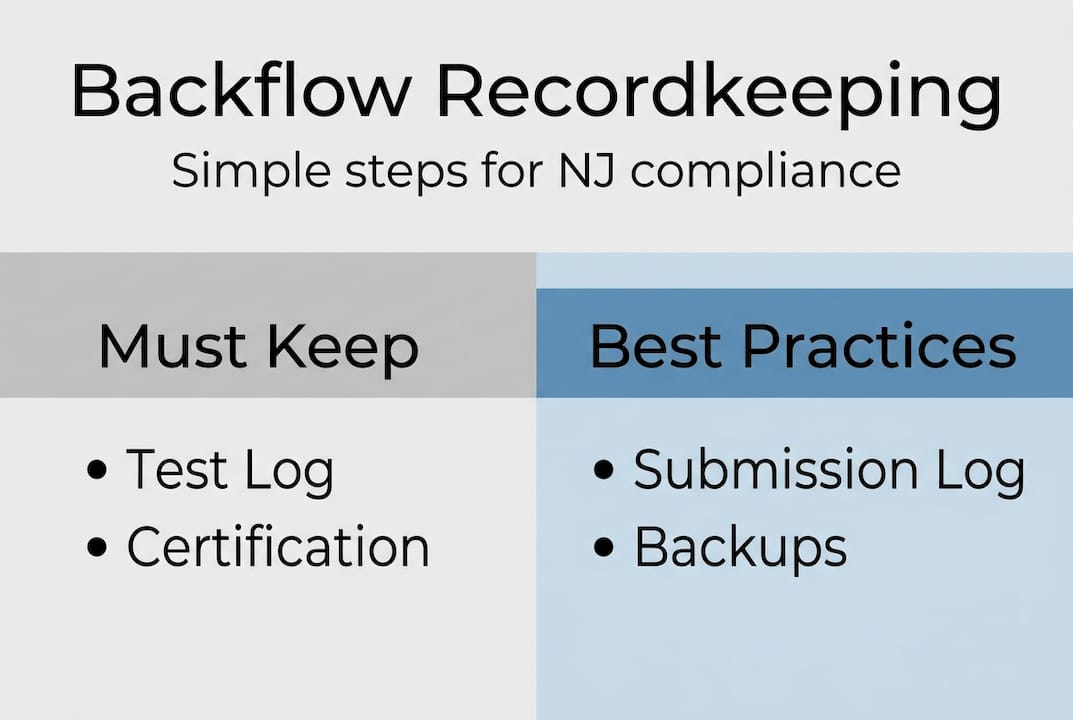
Essential records every property must maintain:
- Device details: manufacturer, model, serial number, and installation location
- Annual test reports with pass or fail results
- Tester certification confirming ASSE Series 5000 or equivalent status
- Submission confirmations from your water purveyor
- Any repair or maintenance records tied to a failed test
Certified testers must hold ASSE Series 5000 or equivalent certification, and that documentation belongs in your file alongside the test results. If you cannot prove your tester was qualified, the report may not be accepted.
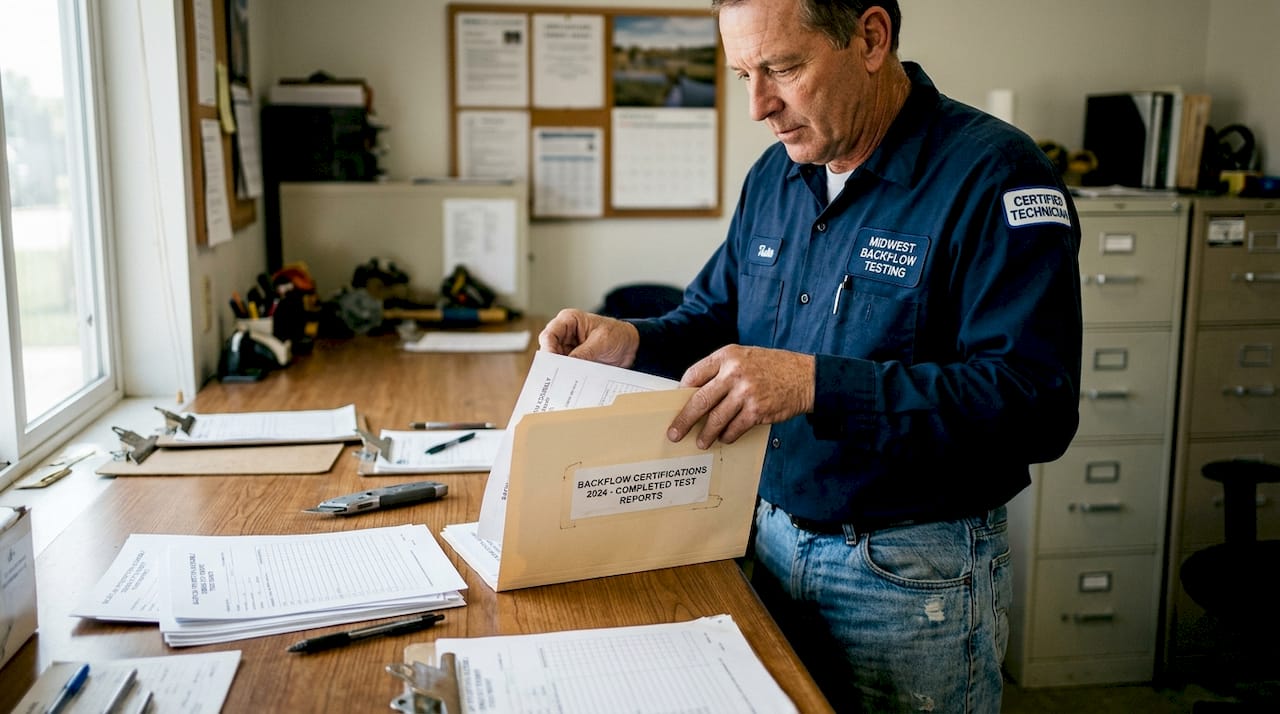
Organizing these records does not require expensive software. A simple folder system, either physical or digital, works well as long as it is consistent. Label folders by property address, then by device ID or location within the building. Cloud storage gives you access anywhere and protects against lost paperwork.
| Method | Pros | Cons |
|---|---|---|
| Physical folders | Simple, no tech needed | Vulnerable to damage or loss |
| Digital folder system | Searchable, shareable | Requires discipline to maintain |
| Automated management tool | Sends reminders, tracks deadlines | May have subscription costs |
For properties managing multiple devices or multiple sites, an automated tool pays for itself quickly. You can schedule reminders for upcoming test anniversaries, flag unsubmitted results, and generate submission logs on demand.
Pro Tip: Create a one-page submission log for each device that tracks the test date, tester name and certification number, submission date, and confirmation receipt. Keep it updated after every test cycle. This single document can save you in an audit.
If you have questions about passing backflow testing and what the process looks like from start to finish, reviewing common steps ahead of time will make your organization system that much more effective. You can also reference backflow testing FAQs for quick answers on device types and submission questions.
Step-by-step: How to document backflow testing and submit compliant records
Documentation is only as good as the process behind it. If any step is skipped or recorded incorrectly, the whole submission could be rejected or flagged for follow-up.
Here is the workflow that keeps property managers compliant and out of trouble:
- Schedule your annual test at least 30 days before your compliance anniversary to allow time for any repairs and resubmission if the device fails.
- Confirm tester credentials before the appointment. Ask for their ASSE Series 5000 certification number and verify it is current.
- Record the device details at the time of testing: exact location within the property, device type (reduced pressure zone, double check valve, etc.), manufacturer, model, and serial number.
- Document the outcome clearly: pass or fail. If the device fails, note the specific deficiency and what repair or replacement is required.
- Complete the official report form with all required fields filled in. Incomplete forms are a top reason for rejected submissions.
- Submit to your water purveyor within the required window. Records must be submitted within 30 days of the test date under N.J.A.C. 7:10.
- Save the confirmation from your water purveyor. This is your proof of compliance and should be filed immediately.
“The 30-day submission requirement is not a soft deadline. Water purveyors track these dates and act on missing records.”
Pro Tip: Set a calendar reminder 25 days after each test date. This gives you a five-day buffer to catch any submission issues before the deadline passes.
For properties with multiple buildings or complex systems, reviewing a commercial backflow workflow can help you build a scalable process. Understanding backflow testing frequency across different device types also prevents gaps in multi-device properties.
Troubleshooting and avoiding common pitfalls in backflow recordkeeping
Even experienced property managers run into recordkeeping problems. The good news is that the most common mistakes are also the most preventable.
The most frequent compliance failures include:
- Missing the 30-day submission window after testing
- Submitting incomplete forms with missing device details or tester information
- Failing to save confirmation receipts from the water purveyor
- Not updating records after a repair follows a failed test
- Losing track of multiple devices across a large property
Local enforcement may include fines or water shutoff for missing records, and high-hazard sites such as hospitals, chemical facilities, and food processing plants face even stricter scrutiny. At these locations, inspectors may request records with little notice, making organized documentation non-negotiable.
“The properties that end up with enforcement actions are usually not the ones with failing devices. They are the ones with failing paperwork systems.”
Maintaining a backup copy of every document in cloud storage is one of the simplest ways to protect yourself. If your physical records are lost in a flood or fire, digital copies ensure you can still demonstrate compliance.
Pro Tip: Designate one person on your team as the compliance point of contact for backflow records. When everyone is responsible, no one is. Assign the role, document the process, and review it once a year.
Understanding the importance of regular testing goes hand in hand with understanding why your records need to match that testing schedule exactly. Reviewing common backflow issues also helps staff recognize when a device may need attention between scheduled tests.
Editorial perspective: Why rigorous recordkeeping is your strongest compliance defense
Here is a truth most property managers learn the hard way: the physical condition of your backflow preventer is almost never the reason enforcement shows up at your door. It is the paperwork. Or more accurately, the missing paperwork.
In our experience working with property owners across New Jersey, the properties that face the most compliance headaches are not running neglected equipment. They are running fine equipment with no documentation trail to prove it. That is a losing position in any enforcement conversation.
The conventional wisdom is to focus energy on the device itself: schedule the test, make the repair, move on. But documentation is what actually protects you when a water authority questions your compliance history or when a new property manager inherits a building with no records. A well-maintained filing system, consistent submission logs, and a simple review routine are worth more than the most advanced backflow assembly on the market.
Our take: treat your recordkeeping system like infrastructure. Build it once, maintain it regularly, and it will carry you through inspections, ownership transitions, and audits without a crisis. The step-by-step prevention guide gives you a strong foundation to build that system on.
Connect with local experts for hassle-free backflow compliance
Handling backflow compliance on your own is possible, but there is a real cost to managing testing schedules, recordkeeping systems, and submission deadlines across multiple devices and properties. Mistakes are expensive, and enforcement actions cost far more than professional help.

South Jersey Backflow works with property owners and managers across New Jersey to handle the entire process: certified testing, proper documentation, timely submission, and reminders for annual renewals. When you work with a team that lives in this regulatory environment every day, compliance becomes routine instead of stressful. Whether you need NJ backflow testing help or are ready to set up NJ backflow certification services for your property, the South Jersey Backflow experts are ready to help you stay protected.
Frequently asked questions
What records must I keep for backflow testing in New Jersey?
You must keep test reports, tester certifications, device details, and submission confirmations for each installed backflow device. Annual testing and recordkeeping are mandated under NJDEP regulations.
How soon after testing must I submit records to the water purveyor?
Records must be submitted within 30 days of testing as required by New Jersey regulations. The 30-day submission deadline is outlined in N.J.A.C. 7:10-10.
What happens if I miss the submission deadline?
You risk fines, water shutoff, and enforcement actions from local authorities if deadlines are missed. Municipalities may impose fines or shut off water service for non-compliance.
Who can test and certify my backflow preventer in New Jersey?
Only testers with ASSE Series 5000 or equivalent certification are authorized to test and certify backflow preventers. This certification requirement is outlined in New Jersey regulations and applies to all annual inspections.
Pingback: How to Update Backflow Records in New Jersey