TL;DR:
- RPZ backflow preventers stop contaminated water from reversing into drinking water systems, ensuring safety.
- High-hazard properties in New Jersey must install and annually test RPZ devices to stay compliant.
- Regular testing, proper maintenance, and record-keeping are crucial to prevent legal penalties and water service disruptions.
If your New Jersey property has a boiler with chemical additives, an irrigation system, or a healthcare connection to public water, a reduced pressure zone (RPZ) backflow preventer is not optional. It is the law. Missing your annual test can trigger fines, water service interruptions, or worse, a court order to shut down operations. This guide breaks down exactly what an RPZ device is, how it works, who needs one under NJ law, and how to stay compliant year after year without scrambling at the last minute.
Table of Contents
- What is a reduced pressure zone backflow device and how does it work?
- New Jersey requirements: Who needs RPZ backflow prevention?
- RPZ vs. DCVA: Which device is right for your property?
- What annual testing and maintenance really means for property owners
- The real challenge: Why property owners leave RPZ compliance to chance (and how to avoid it)
- Taking the next step: Expert help for RPZ compliance in New Jersey
- Frequently asked questions
Key Takeaways
| Point | Details |
|---|---|
| Highest protection device | RPZ backflow devices offer the strongest defense against water contamination for high-risk New Jersey properties. |
| Annual testing required | New Jersey law requires yearly compliance checks by certified testers to ensure safety and avoid penalties. |
| Cost vs. safety | While more expensive than DCVA, RPZ devices are essential where health threats exist and provide unmatched protection. |
| Regulations drive action | Strict state oversight and growing regulations mean noncompliance risks fines, shutoffs, or legal action. |
What is a reduced pressure zone backflow device and how does it work?
Now that you know what’s at stake, let’s break down how RPZ devices actually function and their core components.
An RPZ backflow preventer is a mechanical assembly installed on your water supply line to stop contaminated water from flowing backward into the clean, potable water supply. This backward flow, called backflow, can happen two ways: backpressure (when downstream pressure exceeds supply pressure) or backsiphonage (when supply pressure drops suddenly, creating a vacuum). Either scenario can pull chemicals, bacteria, or other hazardous substances into the drinking water system.
What makes the RPZ design uniquely reliable is its fail-safe architecture. It contains three key components working together:
- Two independent check valves that block reverse flow under normal and abnormal conditions
- A differential pressure relief valve (DPRV) positioned between the two check valves, which opens and discharges water if pressure in the middle zone drops below a safe threshold
- Four test cocks that allow a certified tester to measure pressure differentials across each component
Here is what makes the RPZ stand apart from simpler devices: how RPZ devices stop backflow is a function of redundancy. If the first check valve fails, the second one holds. If both checks fail simultaneously, the DPRV opens and spills water to the atmosphere, physically breaking the connection between contaminated and clean water. As described by the device’s engineering standard, during backpressure or backsiphonage, the RPZ closes; if a check fails, the device discharges to protect the water supply.
That discharge is intentional. It is the device doing exactly what it was designed to do. However, the discharge outlet must drain to a location that cannot flood back into the device and cannot freeze in winter. If water pools around the discharge point or the drain line ices over, the safety mechanism is neutralized.
Important: A properly installed RPZ must have its relief valve discharge piped to a visible, non-floodable location. If you see water pooling under your device, that is your signal to call a certified technician immediately.
| Component | Function | Failure mode |
|---|---|---|
| First check valve | Blocks reverse flow | Worn seat, debris |
| Second check valve | Backup reverse flow block | Worn seat, debris |
| Differential pressure relief valve | Opens if zone pressure drops | Fouled seat, spring failure |
| Test cocks | Allow pressure measurement | Leaking, corroded |
Understanding backflow hazards in plumbing helps you appreciate why this layered design is required for high-hazard properties. A single point of failure in a simpler device could mean contaminated water reaching your tenants, employees, or patients.
Pro Tip: Ask your installer to show you where the relief valve discharge drains. If it drains into a floor drain that could back up, that needs to be corrected before your next annual test.
New Jersey requirements: Who needs RPZ backflow prevention?
With a basic understanding in place, let’s look at how New Jersey law outlines exactly who must install RPZ devices and what steps must be taken every year.
New Jersey’s backflow prevention rules are built around the concept of hazard level. Not every property needs an RPZ. But if your property has what regulators classify as a high-hazard cross-connection, an RPZ is mandatory, no exceptions.
High-hazard cross-connections in NJ include:
- Boilers that use chemical additives (corrosion inhibitors, antifreeze)
- Irrigation systems with chemigation (fertilizer or pesticide injection)
- Healthcare facilities with medical equipment tied to the water supply
- Industrial processes where chemicals contact the water line
- Any connection where a contaminant could cause illness or death if it entered the potable supply
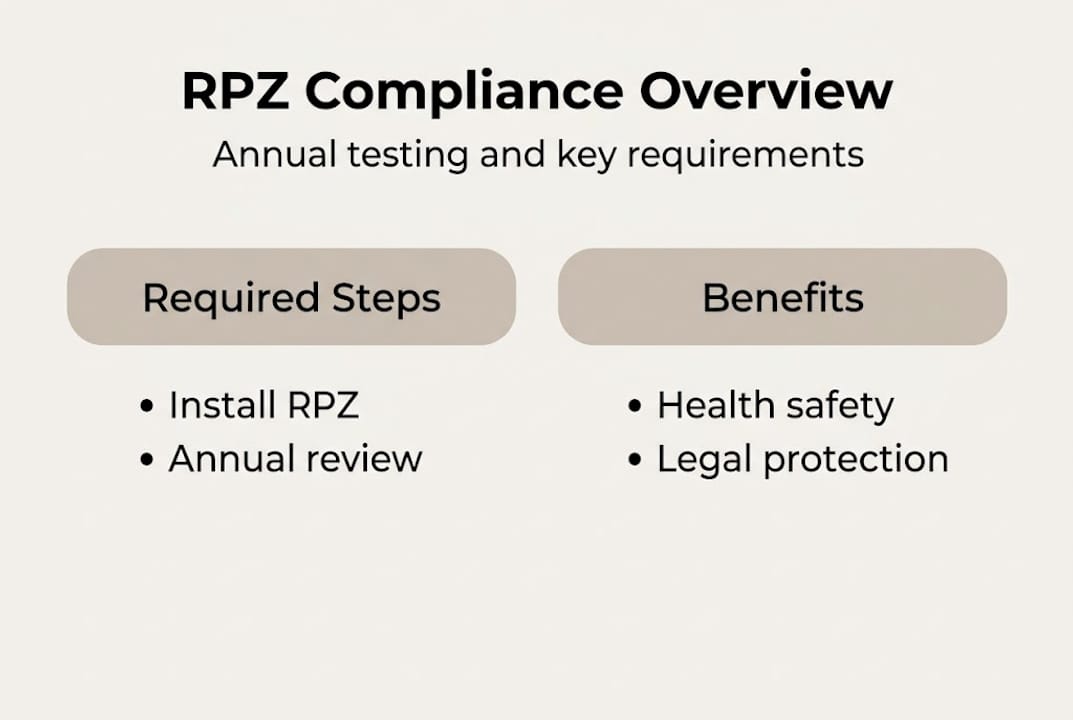
NJ requires RPZ for high-hazard cross-connections, including boilers with additives, chemigation irrigation, and healthcare connections, with annual testing at installation and every year after, and results submitted to the water purveyor within 30 days.
That 30-day reporting window is not flexible. Your certified tester completes the inspection, fills out the official test report, and you are responsible for making sure it reaches your water utility on time. Late submissions can trigger the same penalties as a missed test.
The testing itself is technical. A certified tester uses calibrated differential pressure gauges to check that each check valve holds the correct pressure and that the DPRV opens at the right threshold. This is not a visual inspection. It requires hands-on manipulation of the test cocks and precise gauge readings. Only an ASSE Series 5000 certified tester is legally authorized to perform this work in New Jersey.
Commercial and healthcare properties face additional scrutiny. Local water utilities in NJ conduct periodic surveys of commercial accounts, and failure to produce current test records can result in water service interruption, not just a fine.
Statistic: New Jersey water utilities are required to maintain backflow prevention programs under the Safe Drinking Water Act, and non-compliant properties can face fines and mandatory shutoff orders.
Pro Tip: Keep a digital copy of every test report in a shared folder accessible to your property manager and your compliance contact. If your tester sends paper forms, scan them the same day.
For a full walkthrough of your obligations, the step-by-step NJ compliance guide covers the entire process from installation through annual reporting.
RPZ vs. DCVA: Which device is right for your property?
Understanding the choices, let’s compare RPZs to the next most common device, the DCVA, to help you select the right solution.
The Double Check Valve Assembly (DCVA) is the other widely used backflow preventer in New Jersey. It also contains two check valves, but it lacks the differential pressure relief valve that makes an RPZ fail-safe. That difference is critical when it comes to regulatory approval.
| Feature | RPZ | DCVA |
|---|---|---|
| Check valves | Two independent | Two independent |
| Relief valve | Yes (DPRV) | No |
| Fail-safe discharge | Yes | No |
| Approved for high hazard | Yes | No |
| Typical installed cost | $600 to $2,000+ | $300 to $900 |
| Maintenance complexity | Higher | Lower |
| Allowed for irrigation with chemicals | Yes | No |
RPZ provides the highest protection for health hazards and is required by NJ for dangerous cross-connections, while a DCVA may suffice only for lesser, non-health risks.
Here is the practical reality for property owners: if your property qualifies as high hazard under NJ rules, installing a DCVA instead of an RPZ is not a cost-saving move. It is a compliance violation. Your water utility will flag it during their survey, and you will be required to replace it at your own expense, plus any fines that apply.
DCVAs are appropriate for properties with pollutant-level risks, meaning the contamination would be unpleasant but not life-threatening. Think of a standard commercial irrigation system with no chemical injection. That may qualify for a DCVA. Add fertilizer injection, and it becomes a high-hazard connection requiring an RPZ.
Key differences to keep in mind:
- RPZs protect against both backpressure and backsiphonage even when a check valve fails
- DCVAs offer no discharge protection if both checks fail simultaneously
- RPZ installations require more space due to the relief valve and drain connection
- RPZ annual testing is more involved and typically costs more than DCVA testing
Pro Tip: If you are unsure which device your property needs, do not guess. Have a certified backflow specialist assess your cross-connections before purchasing any equipment. Installing the wrong device costs more to fix than getting it right the first time.
For a broader look at your options, backflow prevention methods covers the full range of devices used across NJ properties.
What annual testing and maintenance really means for property owners
Selecting your device is only the start; let’s clarify what ongoing maintenance and compliance mean for long-term property protection.
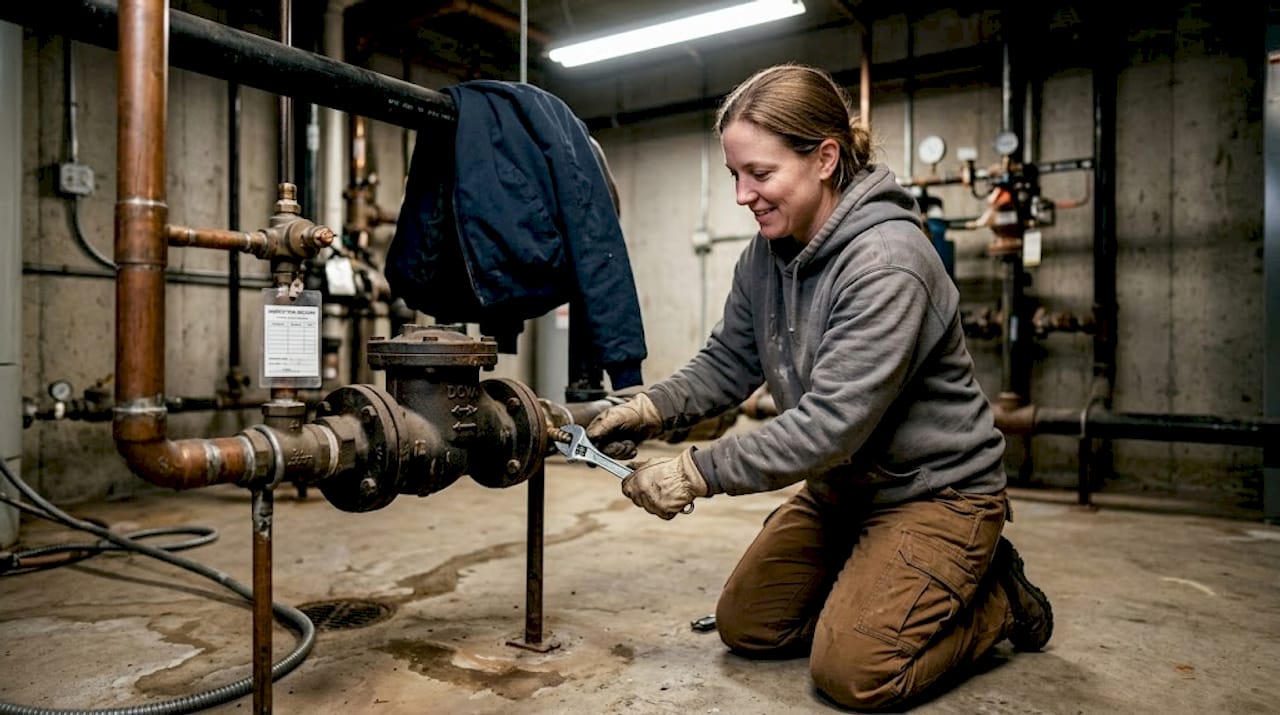
Annual RPZ testing is not a formality. It is the only reliable way to detect internal failures that give no outward warning signs. A check valve can degrade silently over months. The DPRV spring can weaken without any visible leak. Only a pressure differential test will catch these issues before they become a contamination event.
Discharge during low supply pressure may be normal device behavior, but failures require prompt attention, and annual testing is the mechanism that detects those failures reliably.
The RPZ market is growing due to tightening regulations globally, which means more certified testers, more scrutiny from utilities, and higher expectations for documentation from property owners.
Here is what a complete annual maintenance cycle looks like for a NJ property:
- Schedule your test at least 30 days before your annual deadline to allow time for repairs if needed
- Certified tester visits and performs differential pressure checks on both check valves and the DPRV
- Test report completed on-site with pass or fail status for each component
- Repairs made immediately if any component fails, followed by a retest
- Report submitted to your water purveyor within 30 days of the test date
- Records stored digitally and backed up for at least three years
For a clear breakdown of how often testing is required and what triggers additional inspections, that resource covers the specifics for NJ properties.
Maintenance also includes physical care of the device. RPZ assemblies installed outdoors or in unheated spaces need freeze protection, either insulated enclosures or heat tape. A frozen relief valve will not discharge when needed, defeating the entire purpose of the device.
Pro Tip: Set a recurring calendar reminder 60 days before your annual test deadline. That gives you time to book a certified tester, complete any repairs, and still submit your report within the 30-day window.
Understanding why regular testing matters goes beyond compliance. It protects your tenants, limits your liability, and keeps your water service uninterrupted. For a look at what goes wrong when maintenance lapses, common backflow issues documents the most frequent failure patterns seen in NJ properties.
The real challenge: Why property owners leave RPZ compliance to chance (and how to avoid it)
Stepping back from the technical requirements, here is what actually gets NJ property owners into trouble with RPZ compliance, and it is rarely ignorance of the rules.
The most common failure pattern we see is institutional drift. A property changes hands, a maintenance manager leaves, or records get stored in a system nobody checks. The RPZ test deadline passes quietly, and nobody notices until the water utility sends a notice or a tenant reports a problem. By then, the situation has escalated from a scheduling issue to a legal one.
Many owners treat annual testing as box-checking until the first time they face a real consequence. A water shutoff order on a commercial property is not an abstract penalty. It can halt operations, trigger lease disputes, and create liability exposure that far exceeds the cost of a single test.
The mental model that works: treat RPZ compliance exactly like fire alarm inspections. You would not skip a fire alarm test because it felt like paperwork. Apply the same discipline here. Work with a certified provider that tracks your deadlines, handles your reporting, and contacts you before the window closes. Passing NJ compliance consistently is a systems problem, not a knowledge problem. Build the system, and compliance takes care of itself.
Taking the next step: Expert help for RPZ compliance in New Jersey
If you manage one property or twenty, RPZ compliance does not have to be something you chase every year. Our team handles backflow testing and certification for NJ property owners and managers, from the annual test through report submission to your water utility.
We schedule around your operations, flag repair needs before they become violations, and keep your records organized so you are never caught off guard. If you have questions before booking, our backflow preventer FAQs cover the most common concerns we hear from property owners across New Jersey. For a deeper look at protecting your building’s water supply, preventing backflow contamination walks through the full picture for both commercial and residential properties.
Frequently asked questions
What are the signs my RPZ backflow device needs repair?
Continuous water discharge from the relief valve, visible leaks at the body or test cocks, or a failed annual test result all indicate your RPZ needs servicing by a certified technician.
How much does an RPZ backflow preventer cost in New Jersey?
RPZ devices typically cost between $400 and $2,000 or more depending on pipe size and installation complexity; the higher cost reflects the relief valve fail-safe and superior protection required for high-hazard connections.
Who can perform RPZ backflow testing for compliance in NJ?
Only an ASSE Series 5000 certified tester is authorized to perform annual RPZ testing required for New Jersey public water connections.
What properties are considered high hazard for mandatory RPZ installation?
Any property with chemical boilers, chemigation irrigation, or healthcare cross-connections to the public water supply must install an RPZ under New Jersey law.
Recommended
- Protect Your Property: Understanding Backflow Hazards
- Understanding Backflow Regulations in New Jersey: What Property Owners Need to Know –
- NJ water backflow prevention guide: step-by-step
- Understanding New Jersey’s Backflow Prevention Regulations –
- Backflow Preventer Testing & Installation GTA | Proper Plumbing