
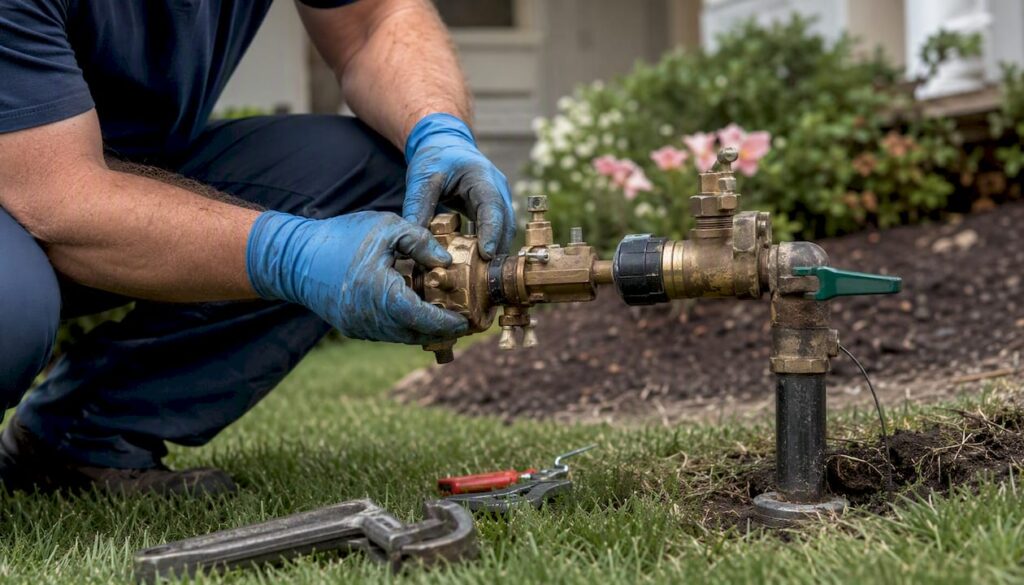
If your backflow preventer has failed a test, your water utility has issued a cross-connection notice, or you’ve added irrigation or a fire line to your property, schedule a certified tester assessment now. Backflow assembly upgrades are not cosmetic swaps. They are protection-level decisions governed by your local cross-connection control program, NFPA device standards, and in New Jersey, the NJDEP physical-connection permit rules. The right next step is to contact your water utility or authority having jurisdiction (AHJ), confirm what device type your hazard requires, and get a line-item quote from a certified service like Southjerseybackflow before touching anything.
Key Takeaways
Backflow assembly upgrades are protection-level decisions: the internal architecture of the device, not its age or appearance, determines whether it meets code for your hazard classification.
| Point | Details |
|---|---|
| Match device to hazard | RPZ/RPZA for high-hazard connections; DCVA for low-to-moderate; confirm with your AHJ before specifying. |
| Failed tests trigger a 30-day clock | Under NJ regulations, a failed device must be repaired and retested within 30 days or permit action follows. |
| Retrofit before replacing | A smart monitoring kit on a functioning RP assembly costs far less than full replacement and preserves the protection class. |
| Permits and filings are not optional | NJ permitted connections require quarterly test submissions and permit renewals; a certified service should handle both. |
| Southjerseybackflow | Provides assessment, rebuild, monitored retrofit, enclosure installation, and direct report filing across New Jersey. |
Table of Contents
- What types of backflow assemblies are there, and how do they differ?
- When do backflow assembly upgrades become necessary?
- How do you choose the right assembly for your property?
- What installation and retrofit challenges should you plan for?
- Can you add remote monitoring to an existing assembly?
- What do backflow assembly upgrades typically cost, and how long does work take?
- What does testing and certification require after an upgrade?
- Should you rebuild, repair, or replace an existing assembly?
- What changes when the assembly protects a fire line?
- How does a certified backflow service handle upgrades in New Jersey?
- What field experience actually teaches about upgrade decisions
- Southjerseybackflow handles assessments, upgrades, and filings across New Jersey
- Sources
What types of backflow assemblies are there, and how do they differ?
The protection a backflow preventer provides comes from its internal architecture, not its size or brand. NFPA’s device taxonomy identifies four main assembly types used in field-testable installations, and understanding the differences is the first step in any upgrade decision.
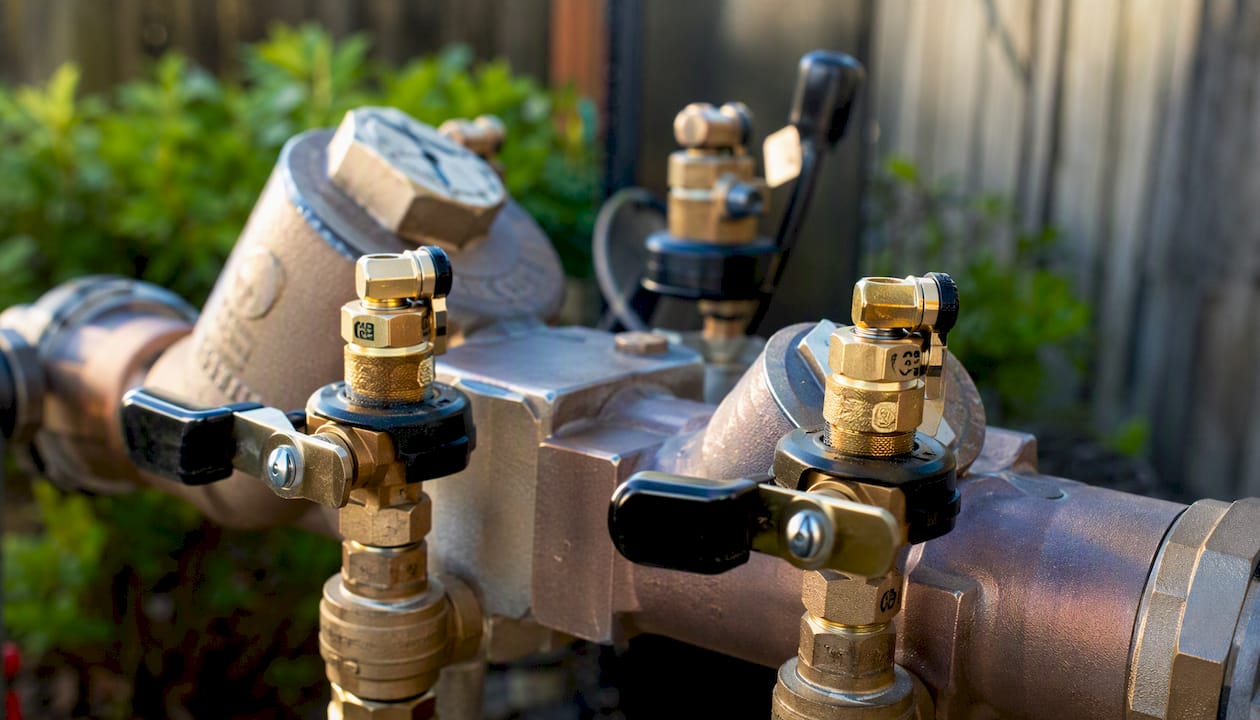
Reduced Pressure Zone Assembly (RPZA/RPBA) uses two spring-loaded check valves separated by a pressure-differential relief valve. If either check fails, the relief valve opens and discharges to atmosphere rather than allowing backflow. This is the highest protection level available in a testable assembly and is required for high-hazard connections.
Double Check Valve Assembly (DCVA/DCDA) uses two independently operating check valves in series with no relief valve. It handles low-to-moderate hazard applications well. Without a relief valve, a failed check does not produce a visible discharge, which is why it cannot be used where high-hazard contamination is possible.
Pressure Vacuum Breaker (PVB) protects against backsiphonage only. It must be installed above the highest downstream outlet and is common on irrigation systems. It cannot handle backpressure, so it is not appropriate for all irrigation configurations.
Atmospheric Vacuum Breaker (AVB) is the simplest device, used for low-hazard, non-continuous-pressure applications. It is not field-testable and is not accepted by most utilities as a substitute for a testable assembly on permitted connections.
Detector assemblies (DCDA-II or RPDA) add a small bypass meter around the main assembly to detect unauthorized use or leaks on fire service lines. They combine the protection of a DCVA or RPZA with metering capability.
All testable assemblies include test cocks and shutoff valves so a certified tester can perform field tests without interrupting service. That testability is what makes them acceptable under most cross-connection programs, including the EPA Cross-Connection Control Manual framework.
| Assembly type | Protection level | Typical applications | Installation complexity | Maintenance burden | Retrofit/monitoring availability |
|---|---|---|---|---|---|
| RPZA/RPBA | High (relief valve) | Industrial, high-hazard, fire lines | Moderate to high (drain required) | Annual test + relief check | Yes (e.g., Zurn RFK-375W1) |
| DCVA/DCDA | Moderate (no relief) | Domestic, low-hazard irrigation | Low to moderate | Annual test | Limited |
| PVB | Backsiphonage only | Residential irrigation | Low | Annual test | Minimal |
| AVB | Lowest (non-testable) | Hose bibs, low-hazard | Very low | None (not field-testable) | None |
| Detector assembly | High or moderate + metering | Fire service lines | High | Annual test + meter read | Moderate |
For a plain-language overview of device types and what they mean for NJ residential properties, the protection-level difference between RPZA and DCVA is the single most important thing to understand before requesting a quote.
When do backflow assembly upgrades become necessary?
Not every aging device needs replacing, but several triggers make an upgrade necessary rather than optional.
Regulatory triggers are the most common. Your water utility or AHJ may issue a cross-connection control order requiring a specific device type for your hazard classification. A device that fails its required annual or quarterly test must be repaired and retested, and if it cannot be brought back into compliance, replacement is required. Under N.J. Admin. Code § 7:10-10.6, failed devices must be repaired and retested within 30 days.
Hazard changes are frequently overlooked. Adding an irrigation system, a boiler, a chemical injection point, or a fire-line tap to a property changes the hazard classification of the connection. A DCVA that was acceptable for a domestic connection may no longer meet the protection level required once irrigation is added. This is the scenario where a protection-level upgrade, not just a rebuild, is required.
End-of-life conditions include repeated internal inspection failures, recurring leaks at the relief port or body seals, and obsolete models for which replacement parts are no longer available. Watts, Wilkins, and Febco all have product lines with long service histories, but older models eventually lose parts support.
Operational triggers matter more than most property managers expect. A device installed in a pit with no working clearance cannot be properly tested. A device with no event logging creates compliance gaps when a utility asks for historical records. These are upgrade drivers even when the device is technically functional.
Pro Tip: If you’ve received a compliance letter from your water utility, check what it requires before assuming you need a full replacement. Many notices require only a certified test and filed report, not a new device.
How do you choose the right assembly for your property?
Matching the assembly to the hazard is the core decision. Everything else, including brand, size, and monitoring features, follows from that.
- Identify the hazard level first. High-hazard connections (chemical feed, boilers, irrigation with fertilizer injection, medical equipment) require an RPZA. Low-to-moderate hazard domestic connections can use a DCVA. Your water utility or AHJ makes the final call on hazard classification.
- Confirm the service type. Irrigation, domestic, fire-line, and industrial connections each have different code requirements. Fire lines often require detector assemblies with bypass metering. Irrigation systems above the highest outlet may accept a PVB, but check your utility’s approved device list.
- Check site constraints before specifying a model. Orientation matters: some assemblies are rated for horizontal installation only, others for vertical. Clearance requirements for testing access, freeze protection needs, and available drain locations for RPZ relief discharge all affect which model fits the space.
- Verify local code and AHJ requirements. New Jersey’s approved device construction rules specify test-port requirements, relief-port routing, and pressure-differential standards. What’s accepted in one municipality may not be accepted in another.
- Ask the right questions before signing a quote. Can the installer provide the specific model number and approval listing? Is there a bypass for service continuity during testing? Are test cocks accessible without removing the enclosure? Will a certified tester file the report directly with your water authority?
The backflow preventer FAQ resource covers many of the device-selection questions property owners ask most often, including NFPA guidance on when an RPZ is required versus a double-check.
What installation and retrofit challenges should you plan for?
Physical installation is where upgrade projects most often run over budget or schedule. Understanding the site requirements before work starts prevents most surprises.
- Bypass piping and shutoffs. Any testable assembly requires upstream and downstream shutoff valves. A bypass loop allows water service to continue during testing or repair, which matters for commercial properties that cannot tolerate interruptions. Plan for this in the initial layout, not as an afterthought.
- Clearances and enclosures. Above-ground assemblies need working clearance on all sides for a certified tester to attach test equipment. Vaults and pits must meet minimum dimensions. For freeze protection, above-ground enclosures with insulation or heat tape are often more accessible than buried vaults, which can fill with water and corrode hardware.
- RPZ relief port drain routing. An RPZ relief valve discharges water when it operates. That discharge must drain to an air gap, not a direct connection to a drain line. Routing this correctly requires planning the drain location during design, not during installation.
- Electrical and connectivity needs. If you are adding smart monitoring, the gateway device needs power and a communications path (cellular, Wi-Fi, or hardwired Ethernet). Conduit routing and power source location should be confirmed during the site assessment, before procurement.
- Permits and inspections. Most jurisdictions require a permit for backflow preventer installation or replacement. Some require witness testing by a municipal inspector in addition to the certified tester’s report. Portland Water’s installation guidance and programs like Denver Water’s contractor program illustrate how municipal requirements vary and why confirming local rules before starting work matters.
Pro Tip: When selecting an enclosure, choose one that a tester can work inside without removing the device. Enclosures that require disassembly to access test cocks add time and cost to every annual test for the life of the assembly.
Can you add remote monitoring to an existing assembly?
Yes, and for many properties it is the most cost-effective upgrade path when the existing assembly’s protection level already matches the hazard.
Two retrofit approaches exist. The first is a mechanical rebuild, which replaces internal components (check valves, seats, springs, diaphragms) to restore the assembly to its original performance specification. This preserves the device type and protection class without changing the footprint or piping.
The second is a smart monitoring retrofit kit, which adds pressure sensors and a gateway to an existing assembly to enable event logging, alarm notifications, and portal or BMS integration. Zurn’s RFK-375W1 retrofit kit is a documented example: it adds pressure and relief-discharge sensing to existing reduced-pressure backflow preventers and connects to a portal for remote reporting. The kit is sized to specific assembly models and requires a compatible gateway for BMS or alarm integration.
Retrofitting monitoring to a functioning RP assembly preserves the assembly’s protection class while adding event logging and alarm capability. This is often the right move when the device is mechanically sound but the property needs documented proof of continuous compliance for a utility audit or insurance requirement.
Before specifying a monitoring retrofit, confirm:
- Kit-to-assembly compatibility. Not every monitoring kit fits every assembly model. Confirm the kit is rated for your specific Zurn, Watts, Wilkins, or Febco model.
- Gateway requirements. Most kits require a separate gateway device for cloud or BMS connectivity. Confirm power source, communications protocol, and whether the gateway needs a dedicated network connection.
- Effect on testability. A properly installed retrofit kit should not interfere with the certified tester’s ability to perform the standard field test. Confirm this with the installer before purchase.
- Warranty implications. Adding a third-party kit to a manufacturer assembly may affect the assembly’s warranty. Check with the manufacturer before installation.
For properties exploring smart monitoring alternatives, a monitoring retrofit is worth comparing against full replacement on total cost of ownership, not just upfront price.
What do backflow assembly upgrades typically cost, and how long does work take?
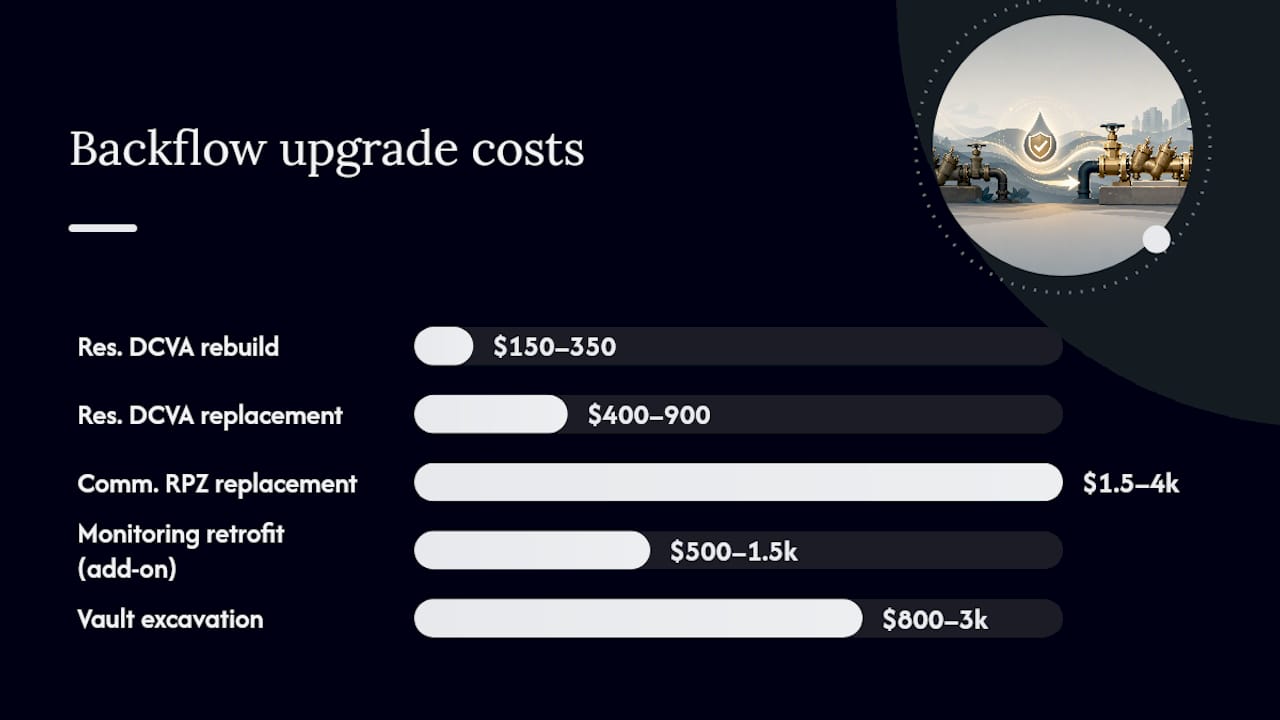
Cost varies significantly by device type, site conditions, and scope. The ranges below reflect typical US market conditions and should be treated as planning benchmarks, not fixed quotes.
Primary cost drivers:
- Device type and size: an RPZ assembly costs more than a DCVA of the same pipe size, and larger pipe sizes increase cost substantially
- Site prep: vault excavation, concrete work, or enclosure fabrication adds labor and materials
- Bypass plumbing: adding a service bypass loop requires additional pipe, fittings, and shutoffs
- Permit and inspection fees: vary by municipality, typically $50–$300 for residential, higher for commercial
- Labor rates: regional variation is significant; urban New Jersey rates differ from rural markets
- Electrical and connectivity work for monitoring: conduit, power supply, and gateway installation add cost
Typical price bands (parts and labor combined, US market):
- Residential DCVA rebuild: $150–$350
- Residential DCVA replacement (new assembly, standard installation): $400–$900
- Commercial RPZ replacement (2-inch, above-ground with enclosure): $1,500–$4,000
- Commercial RPZ with monitoring retrofit kit added: add $500–$1,500 to the base replacement cost
- Vault excavation and restoration: $800–$3,000 depending on depth and access
Typical project timeline:
| Stage | Typical duration | Common delay points |
|---|---|---|
| Site assessment and hazard determination | 1–3 days | AHJ availability, utility response time |
| Proposal and owner approval | 1–5 days | Multi-stakeholder approvals for commercial |
| Permit application and approval | 3–10 business days | Municipal backlog, incomplete submittals |
| Parts procurement | 1–10 business days | Specialty sizes, monitoring kit lead times |
| Installation fieldwork | 1–2 days | Site access, weather, unforeseen repairs |
| Certified test and report filing | Same day or next day | Tester scheduling |
| Final AHJ inspection (if required) | 1–10 business days | Inspector availability |
Ask for a line-item quote that separates device cost, labor, permit fees, enclosure or vault work, and any monitoring components. A single lump-sum number makes it impossible to evaluate where costs are concentrated or to compare quotes fairly.
What does testing and certification require after an upgrade?
Testing requirements apply from the moment a new or upgraded assembly is placed in service, and they continue annually or more frequently depending on the connection type.
- Use a certified tester. Testing must be performed by a tester certified by your state or local program. In New Jersey, the NJDEP maintains a list of approved certified testers. A property owner cannot self-certify a test result.
- Understand what the field test covers. For an RPZ, the standard three-step procedure tests check valve #1, check valve #2, and relief valve operation independently. For a DCVA, both check valves are tested for differential pressure. N.J. Admin. Code § 7:10-10.6 specifies these procedures in detail.
- File the test report with your water authority. The certified tester completes a standardized test form and submits it to the water authority or AHJ. The property owner should retain a copy. Filing is not optional; an unfiled test is treated as a missing test.
- Act on failures within 30 days. Under New Jersey regulations, a failed device must be repaired and retested within 30 days. Missing this window can trigger permit suspension or utility action.
- Maintain records. Keep all test reports, permit documents, and repair records in a single file. Smart monitoring systems can supplement paper records with timestamped event logs, which is useful during utility audits.
| Test type | Devices covered | Frequency (NJ example) | Filing destination |
|---|---|---|---|
| Field test (RPZ three-step) | RPZA/RPBA | Quarterly (permitted) or annual | Water authority / NJDEP |
| Field test (double-check) | DCVA/DCDA | Quarterly (permitted) or annual | Water authority / NJDEP |
| Internal inspection | All testable assemblies | Per regulatory schedule | AHJ / utility |
| Retest after repair | Any failed device | Within 30 days of failure | Water authority / NJDEP |
Should you rebuild, repair, or replace an existing assembly?
The answer depends on four factors: whether the current device type still meets the hazard requirement, parts availability, the cost differential between rebuild and replacement, and what the site work looks like either way.
Rebuild makes sense when:
- The assembly type (RPZA or DCVA) still matches the hazard classification for the connection
- Internal inspection shows repairable wear: worn seats, degraded O-rings, or a fatigued spring, all of which are standard rebuild components for Watts, Wilkins, and Febco assemblies
- The cost of a rebuild kit and labor is materially lower than a new assembly
- The assembly body is in good condition with no cracks, corrosion, or thread damage
Replacement is the right call when:
- The hazard has changed and the current device type no longer provides adequate protection (a DCVA on a connection that now requires an RPZ)
- The model is obsolete and rebuild parts are no longer available from the manufacturer
- The assembly has failed repeatedly, suggesting a body or seat defect that rebuild kits cannot fix
- The site work required for replacement (new enclosure, bypass piping, drain routing) is being done anyway, making a new assembly the more practical choice
Two illustrative scenarios:
A small residential DCVA with worn seat discs and a leaking O-ring is a straightforward rebuild. Parts are available, the hazard hasn’t changed, and the cost difference versus a new assembly is significant. A commercial RPZ on a fire line that has discharged repeatedly from the relief valve, has a model number no longer supported by the manufacturer, and sits in a vault that needs excavation anyway is a replacement job. The signs your backflow preventer needs maintenance guide covers the inspection indicators that point toward each path.
Rebuilt assemblies may carry shorter warranties than new units. Ask your installer what warranty applies to rebuilt internal components versus a new assembly, and factor that into the total cost comparison.
What changes when the assembly protects a fire line?
Fire-line backflow assemblies involve coordination that domestic or irrigation installations do not require, and the stakes for getting it wrong are higher.
- Device type selection. NFPA recognizes both DCVA and RPZA as acceptable for fire protection systems, but the hazard level of the water source and the system design determine which is required. An RPZ provides higher protection but its relief valve will discharge if the differential pressure drops, which can affect system pressure and must be accounted for in the hydraulic design.
- Coordinate with the fire protection designer and AHJ. Installing or replacing a fire-line backflow assembly without notifying the fire protection designer risks creating a pressure condition the sprinkler system was not designed for. The AHJ must approve the device type and installation before work begins.
- Detector assemblies for fire service. Most fire service connections use a detector assembly (DCDA or RPDA) rather than a standard DCVA or RPZA. The bypass meter detects low-flow events that indicate unauthorized use or system leaks, which is a utility requirement on most fire service meters.
- Permitting and witness testing. Fire-line installations typically require a separate permit from the fire marshal or AHJ in addition to the plumbing permit. Witness testing by the AHJ or fire marshal is common and must be scheduled in advance.
- Isolation strategy during testing. Testing a fire-line assembly requires taking the sprinkler system offline or confirming that a bypass maintains system pressure. This must be coordinated with the building’s fire alarm monitoring company to avoid false alarms.
How does a certified backflow service handle upgrades in New Jersey?
A well-run certified service follows a defined workflow from first contact to final filing, and knowing what that looks like helps you evaluate proposals and avoid surprises.
- Initial site assessment and hazard determination. A certified tester visits the property, identifies the existing assembly type, evaluates the hazard classification of the connection, and checks the current permit status with the water authority.
- Proposal with options. The proposal should include at minimum: the recommended device type and model, a rebuild-versus-replace recommendation with rationale, line-item pricing, and the permit requirement.
- Installation or retrofit. The installer completes the physical work, including bypass piping, enclosure, drain routing, and any monitoring hardware. NJ regulations under N.J. Admin. Code § 7:10-10.3 specify construction requirements for approved installations.
- Certified test and report submission. Immediately after installation, the certified tester performs the field test and submits the completed test form to the water authority. For NJ permitted devices, quarterly submissions follow.
- Record retention and maintenance plan. The owner receives copies of all test reports and permit documents. A good service will also flag the next test due date and provide a maintenance schedule.
NJ property owners with permitted physical connections should expect quarterly test-result submissions and permit renewal requirements as part of the ongoing compliance cycle, not just a one-time installation event.
Pro Tip: Keep a single folder, both digital and paper, containing every test report, permit document, and repair record for each assembly on your property. Municipal audits and utility inspections go much faster when you can produce the full compliance history in minutes.
What field experience actually teaches about upgrade decisions
The most common mistake on upgrade jobs is treating a backflow assembly upgrade as a plumbing swap rather than a protection-level decision. A newer-looking valve that is the wrong assembly type will fail inspection just as reliably as the old one it replaced. The NFPA’s point is worth repeating: backflow preventers are not interchangeable, and the internal architecture, specifically whether a relief valve is present, determines whether the device is appropriate for the hazard.
Two site conditions show up repeatedly on jobs that go sideways. First, assemblies installed in pits or vaults with no working clearance. The device passes its first test because the tester can just barely reach the test cocks, but by year three the vault has settled, the lid is harder to open, and the tester is working in six inches of standing water. Choosing the enclosure with testing access in mind, not just freeze protection, saves real money over the life of the assembly. Second, missing strainers upstream of the assembly. Debris in the line damages check valve seats and causes early failures. A strainer upstream of the first shutoff is a small addition that extends assembly life significantly.
On the monitoring side, the instinct to replace a functioning RPZ with a new monitored assembly is often the wrong call. If the assembly’s protection level matches the hazard and the body is in good condition, a retrofit kit that adds pressure sensing and portal reporting costs a fraction of full replacement and preserves the existing piping configuration.
Southjerseybackflow handles assessments, upgrades, and filings across New Jersey
Southjerseybackflow offers the full upgrade cycle under one service: site assessment and hazard determination, certified testing and repair, assembly rebuilds, monitored retrofit installations, enclosure installation, and direct filing of test reports with your water authority. For multi-property managers, consolidated billing and a single point of contact for all compliance filings simplifies what is otherwise a scheduling and paperwork problem spread across multiple vendors.

The process is straightforward: a certified tester visits your property, evaluates the existing assembly and hazard classification, and provides a line-item proposal covering device, labor, permit, enclosure, and any monitoring components. After installation, the certified test report goes directly to your water authority. You get a copy for your records and a reminder when the next test is due.
For a step-by-step look at how NJ backflow testing, filing, and compliance works from assessment to final approval, or to request a site assessment, contact Southjerseybackflow directly through the website.
Sources
- Backflow preventer types | NFPA
- EPA Cross-Connection Control Manual
- N.J. Admin. Code § 7:10-10.6 – Inspection and testing requirements and procedures for physical connection installations | LII
- Cross-Connection Control and Backflow Prevention Program | Denver Water
Pingback: Property Owners: Avoid Permit Delays on Lead Free Backflow Upgrades
Pingback: Avoid Fines: South Jersey Backflow Retest After Repair in 5–10 Days