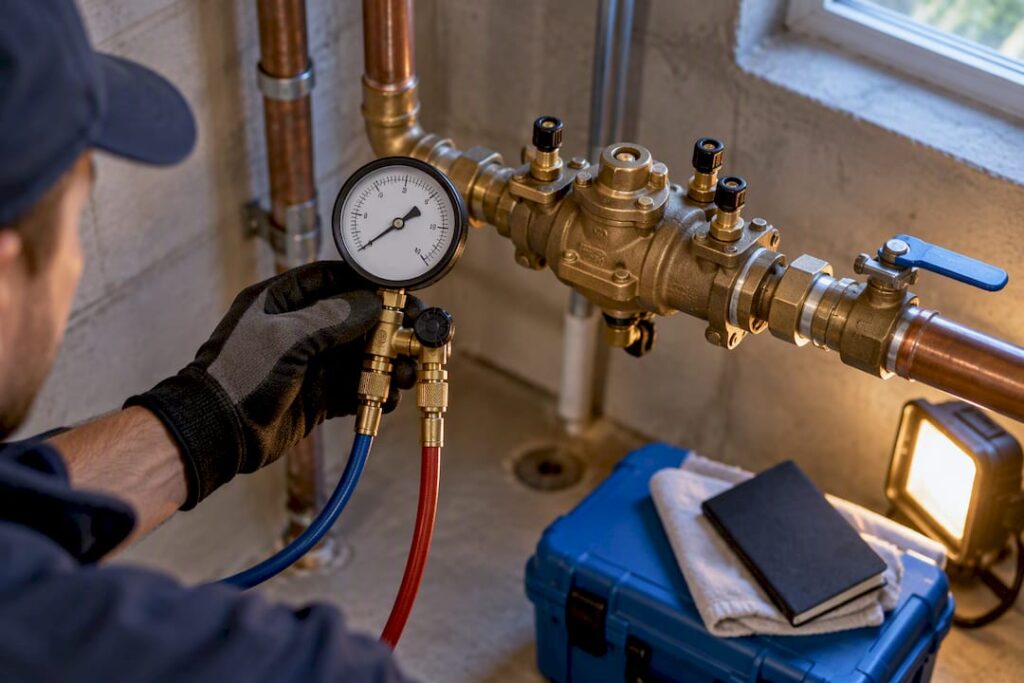
Property owners are typically the ones who pay for backflow testing, since they own the assembly and carry the legal duty to maintain it. Two common exceptions apply: a lease that assigns testing costs to the tenant, or a utility billing program that charges the account holder directly. Testing happens annually and must be done by a certified tester who files results with the local water authority.
TL;DR:
- Most property owners are responsible for backflow testing costs, unless a lease or utility billing program assigns that responsibility to tenants or account holders.
- Charges may appear as a direct invoice from certified testers, a separate utility administrative fee, or through municipal contract testing if the owner fails to schedule the test.
- Testing costs generally range from $30 to $300 per device, influenced by device type, accessibility, repairs needed, and local labor rates.
- Testing must be done by certified technicians who submit results directly to the water utility, with unfiled tests risking penalties or service shutoff.
- Clear lease language, itemized quotes, and early scheduling help prevent disputes and surprise fees related to backflow testing.
Table of Contents
- 1. Who is legally responsible for backflow testing costs?
- 2. How backflow testing charges actually show up on a bill
- 3. What backflow testing typically costs and what drives the price
- 4. Who is qualified to test a backflow device and file the report
- 5. What happens if a test is skipped or a fee goes unpaid
- 6. How to get an accurate quote and avoid surprise fees
- 7. What South Jersey Backflow expects property owners to see on a quote
- Why clear lease language and early scheduling save money
- How South Jersey Backflow can help with testing and compliance
- Sources
- FAQ
1. Who is legally responsible for backflow testing costs?
Municipal codes generally point to the property owner as the responsible party, because the owner holds title to the backflow assembly and is the one legally required to keep it functioning. Portland Water Bureau states this plainly: owners must install, test, and maintain required backflow prevention assemblies, and they must schedule the annual test with a certified tester.
That said, leases can shift who actually pays and schedules the work, even though the owner usually stays the compliance name on record. A lease might list backflow testing as a tenant utility responsibility, similar to how some leases assign lawn care or pest control. When that happens, the owner is still the one the water utility contacts if something is missed, so vague lease language creates risk for both parties.
Before assuming who owes what, check these places:
- The deed or property record, which identifies the legal owner tied to the water account.
- The lease agreement, specifically any utilities or maintenance clause naming backflow testing.
- Any notice from the water utility, which usually names the account holder as the responsible party.
Renters who get a compliance notice should confirm with their landlord immediately rather than assume they owe the fee. Landlords who use standard lease templates should add a specific clause naming backflow testing rather than lumping it into general maintenance language, since that ambiguity is where most disputes start.
2. How backflow testing charges actually show up on a bill
Most property owners encounter one of three billing paths, and knowing which applies helps avoid a surprise invoice.
- Direct tester invoice. A certified tester bills the property owner (or property manager) directly for the visit, the test itself, and often a filing fee. This is the most common arrangement for residential and small commercial properties, and the invoice should break out labor, any parts, and administrative costs separately.
- Utility administrative or submission fee. Some water utilities add a separate charge to the water bill regardless of what the tester charges. Los Angeles County Public Health notes that some jurisdictions charge an additional annual administrative fee on top of the professional testing cost, so a property owner may see two separate charges tied to the same device.
- Municipal contract testing. When a property fails to schedule its own test, some municipalities hire a contractor to do it and bill the owner, often at a higher rate than a self-arranged test. City of Raleigh describes this exact scenario: if an owner does not comply, the county can contract a tester and charge the property owner for it.
To avoid confusion, ask two questions before the test happens. First, ask the tester whether filing the report with the utility is included in the quoted price or billed separately. Second, check any letter or portal notice from the utility for a line item labeled administrative, submission, or compliance fee, since that charge often arrives independent of the testing invoice itself.
3. What backflow testing typically costs and what drives the price
Backflow testing in the United States typically runs about $30 to $300 per device, with a national average near $165, according to HomeGuide. Where a specific job lands in that range depends on the device and what the tester finds on site.
- Device type: a residential irrigation PVB (pressure vacuum breaker) usually costs less to test than a commercial-grade RPZ (reduced pressure zone) or detector assembly.
- Access: devices buried in a pit, mounted high, or located behind locked mechanical rooms take longer to reach and cost more to test.
- Repairs found during testing: a failed rubber seal or check valve adds parts and labor beyond the base test fee.
- Filing and admin fees: some utilities add a separate charge for processing the test report, as noted above.
- Retest costs: if a device fails, a second visit after repairs is often billed again.
Regional labor rates and local filing requirements also move the number. A dense metro utility with a mandatory portal submission and a per-tag fee tends to land at the higher end of the range, while a rural system with looser tracking often costs less overall. Multi-device commercial properties see the biggest swings, since each additional assembly adds its own test fee, and repairs on an aging system can push a single job well past the average for a single device.
4. Who is qualified to test a backflow device and file the report
Testing is not a general handyman task. It has to be performed by a certified backflow assembly tester, and most municipal programs publish which certifications they accept.
- Testers use calibrated gauges to measure pressure differentials across the assembly, and that calibration has to stay current for the results to count.
- Results get submitted to the water utility, usually through an online portal, within a set deadline after the test date. City of Boulder requires certified testers to submit annual test reports online, and missed filings can trigger penalties or administrative action even if the test itself happened on time.
- Some cities issue physical tags for compliant devices and charge a fee for the tag or its exchange, which shows up as a small line item separate from the test itself.
Property owners should never assume a test “counts” just because someone showed up with a gauge. Confirming that the tester holds current certification and that they will personally file the report (rather than leaving that step to the property owner) prevents a compliant test from turning into a missed filing.
5. What happens if a test is skipped or a fee goes unpaid
Utilities do not typically profit from enforcement. The costs that follow a missed test are usually private testing fees and municipal administrative charges, not utility revenue, according to Fort Wayne City Utilities, which requires annual testing because internal components degrade over time.
Consequences for missing a deadline typically escalate in stages:
- A first notice, often with a short grace period to schedule the test.
- A follow-up notice that may include a fine or a municipal contract-testing charge, as described earlier.
- In persistent cases, a water service shutoff until compliance is restored.
If you receive a final notice, confirm first whether a certified test was actually filed. Sometimes the test happened but the tester never submitted the report, which is a filing problem rather than a testing problem. Contact the utility or the tester directly, and schedule the correction immediately rather than waiting for the next notice. Keeping a copy of every filed report and any retest confirmation is the simplest way to avoid this escalation entirely.
6. How to get an accurate quote and avoid surprise fees
A clear quote protects you from add-on charges after the work is done. Ask for these items in writing before booking:
- Price per device tested, not a flat “backflow testing” quote if you have multiple assemblies.
- Confirmation that filing with the utility is included, not billed as an extra step.
- Any travel or service call fee, especially for properties outside a tester’s normal coverage area.
- The retest policy and cost if a device fails on the first attempt.
- Estimated repair rates for common parts, so a failed seal doesn’t turn into a blank-check repair bill.
For property managers handling several buildings, bundling multiple devices into one visit or one contract often lowers the per-device cost and simplifies scheduling. For an aging device with repeated failures, replacement can end up cheaper than repeated repair and retest cycles.
Pro Tip: Ask the tester to show you their certification card and the calibration date on their gauge before the test starts. It takes thirty seconds and confirms the results will actually be accepted by your utility.
7. What South Jersey Backflow expects property owners to see on a quote
An itemized quote should separate the test fee, the filing step, any travel charge, and an estimate for likely repairs, rather than bundling everything into one number. South Jersey Backflow structures quotes this way so property owners in New Jersey know exactly what they’re paying for before the tester arrives, and handles filing directly with the water utility as part of the service.

When a device fails a test, the practical next step is a short repair window followed by a retest, rather than leaving the assembly out of service for weeks. Owners should ask any tester three things: will they file the report themselves, what happens if the device fails, and what the retest timeline looks like. A tester who can’t answer all three clearly is one more thing to worry about on top of the compliance deadline itself.
Why clear lease language and early scheduling save money
My honest read after looking at how these disputes usually start: most backflow payment arguments come from vague lease wording, not from bad faith on either side. Owners should keep default responsibility but spell out any tenant obligation in specific terms, not general maintenance language. Itemized quotes and saved proof of filing settle disputes before they start. When state or municipal rules seem unclear, check your local utility’s own backflow page before assuming a generic answer applies.
— Jordan
How South Jersey Backflow can help with testing and compliance
Property owners juggling test scheduling, filing deadlines, and repair estimates get a simpler path with a company that handles all three. South Jersey Backflow offers:
- Backflow Preventer Testing & Certification, with filing submitted directly to the utility.
- Backflow Preventer Rebuilds & Repairs and Residential Installation for devices that fail inspection.
- Custom Backflow Preventer Enclosures for exposed or freeze-prone assemblies.
- Consolidated billing for property managers handling multiple addresses.
Every quote is itemized before work begins, so you know what covers testing, filing, and any repairs. Property managers can also use this property-management-focused guide to compare options across several buildings. To get a quote or schedule a test, visit the South Jersey Backflow FAQ and service page.
Sources
For rules specific to your address, check your water utility’s own backflow prevention page, which usually lists accepted certifications and filing deadlines. Municipal examples like Boulder’s program and Raleigh’s FAQ show how enforcement and contract testing typically work. For cost comparisons, HomeGuide’s cost breakdown is a useful reference point. Landlords managing turnovers can also review this landlord turnover checklist for building compliance tasks into lease transitions.
- Los Angeles County Public Health — Backflow prevention device FAQ
- Fort Wayne City Utilities — Backflow prevention
- Portland Water Bureau — Backflow prevention
- City of Boulder — Backflow prevention
- HomeGuide — Backflow testing cost
FAQ
What is the average cost of a backflow test?
Backflow testing typically costs between $30 and $300 per device in the United States, with a national average around $165. The exact price depends on the device type, how accessible it is, and whether the utility charges a separate filing or administrative fee.
Who pays for backflow testing, the tenant or the landlord?
The property owner or landlord is typically responsible, since they own the backflow assembly and are the legal contact on the water account, as Portland Water Bureau outlines. A lease can assign the cost or scheduling to the tenant instead, but that arrangement should be written into the lease explicitly rather than assumed.
Can I do my own backflow test?
No, testing must be performed by a certified backflow assembly tester using calibrated equipment, not by the property owner or a general handyman. Utilities only accept results filed by testers who hold the required certification for that jurisdiction.
What is a backflow test charge?
A backflow test charge is the fee billed for testing a device, which can include the site visit, the test itself, and sometimes a separate filing or administrative fee charged by the utility. Los Angeles County is one example of a jurisdiction that adds its own annual administrative fee on top of the tester’s charge.
Pingback: Backflow Testing Budget for Property Managers: $150–$450 Per Device