
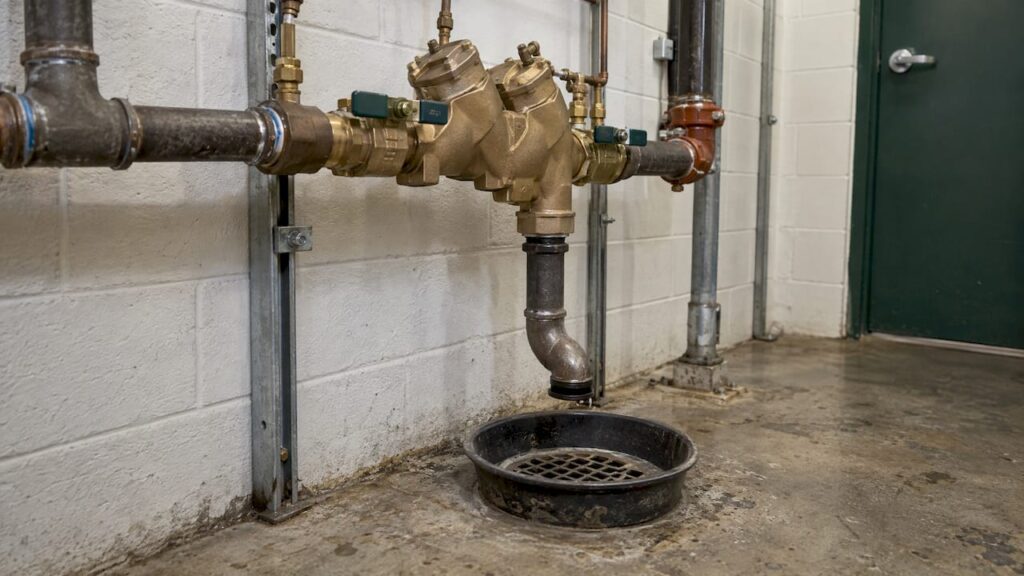
Yes, an RPZ needs a drain in New Jersey. The relief port must discharge through an air gap into a drain pipe that is at least as large as the port, and the whole assembly has to be installed where a discharge can leave safely. N.J.A.C. 7:10-10.3 sets the air gap and pipe size rule. The state’s permit checklist adds clearances. Your local water utility can then layer its own requirements on top.
This guide walks through each requirement in plain terms, so you can check an existing installation or plan a new one before an inspector or tester does it for you.
TL;DR
- An RPZ’s relief port must discharge through an air gap into a drain pipe the same size as the port or larger.
- NJDEP’s permit checklist asks whether the relief drain’s air gap sits at least 12 inches above the floor.
- The assembly goes on the customer side of the meter, accessible, protected from flooding and freezing, and never in a pit or vault.
- Testing must be done by a certified tester, and results are documented and filed. Your water utility may add its own rules.
- Not sure your setup passes? We test, repair and install RPZ assemblies across New Jersey.
Table of Contents
- Why an RPZ needs a drain at all
- The core requirement: air gap and pipe size
- Height above the floor
- Where the RPZ goes and how it is installed
- Testing, repairs and what a relief-port discharge means
- Does the plumbing code change any of this?
- When your water utility adds requirements
- Who is responsible for compliance?
- A quick drain checklist for your RPZ
- Perspective: fix the drain before the test
- Get your RPZ tested, repaired or installed
- FAQ
- Sources
Why an RPZ needs a drain at all
A reduced pressure zone (RPZ) assembly protects drinking water from contamination by keeping the pressure in the middle chamber lower than the supply. New Jersey’s rule explains the mechanism: when fouling of a check valve lets the pressure in that intermediate zone rise, the relief valve opens by itself and discharges to atmosphere. The goal is to hold the zone at least 2 psi below supply pressure (N.J.A.C. 7:10-10.3).
That discharge is not a leak or a defect. It is the device doing its job. But the water has to go somewhere, and it must never be able to connect back to the potable system. That is why the drain is designed around an air gap, not a tight pipe connection.
A few practical points follow from this:
- A relief valve can dump a lot of water in a short time if a check fouls or supply pressure fluctuates. An undersized or blocked drain means water on the floor, in a mechanical room or on your equipment.
- A drain that is hard-piped directly to a sewer line would defeat the purpose, because the air gap is what prevents backsiphonage from the drain into the assembly.
- Spitting at the relief port during normal operation is a sign the assembly needs service, not a reason to plug the port.
The core requirement: air gap and pipe size
The state rule at N.J.A.C. 7:10-10.3(d) requires an air gap between the pipe from the RPZ relief port and the drain pipe. It also requires the pipe that conveys the discharge to be the same diameter as the relief port or larger.
In practice, that means:
- Leave a visible, open gap. The relief discharge falls through open air into a funnel, floor sink or drain receptor. No tube sits sealed inside the drain.
- Never reduce the pipe. If the relief port is 1 inch, the drain line carrying the discharge cannot be smaller.
- Size the drain for the discharge. The rule sets the minimum pipe diameter. A floor drain that clogs or backs up is a hazard, so confirm that it can take a full relief event.
A common mistake on older installs is a small floor drain with a hose or tube clamped onto the relief port. That fails both the air gap and the sizing rule. Another is a drain that is fine on paper but has been buried under stored boxes or debris.
Height above the floor
NJDEP’s Application Form for Initial Physical Connection Permit asks whether the RPZ relief-valve drain has an air gap at least 12 inches above the floor. The same checklist addresses where the whole device sits. Devices are typically at least 12 inches above the floor and no higher than 60 inches.

The lower limit keeps the relief port out of any water that collects on the floor. The upper limit keeps the assembly reachable, so a tester can work the test cocks and a technician can service it without a ladder.
Where the RPZ goes and how it is installed
The same NJDEP checklist covers the installation conditions that surround the drain. In summary:
| Requirement | What the checklist asks |
|---|---|
| Location in the system | Customer side of the meter, as close to the meter as reasonably practicable, before any other connection |
| Height | Typically at least 12 inches above the floor and no higher than 60 inches |
| Access | Accessible for testing and service |
| Environment | Protected from flooding and freezing |
| Pits and vaults | Not installed in a pit or vault |
| Orientation | Generally horizontal, unless approved for vertical use |
Source: NJDEP physical connection permit checklist.
The state rule also covers the parts around the assembly. For devices up to 2 inches, New Jersey requires full-port ball-type shutoff valves and test cocks, and it recommends an upstream strainer (N.J.A.C. 7:10-10.3). Every RPZ or double check valve assembly used in an approved physical connection must have test cocks so the device can be pressure tested.
Freeze and flood protection
Because the device must be protected from freezing and flooding, outdoor installations in New Jersey usually need an insulated or heated enclosure. The enclosure must still leave the relief port free to discharge and keep the drain path clear. If you are planning one, our backflow enclosure requirements guide covers what the rules say.
Testing, repairs and what a relief-port discharge means
NJDEP’s testing materials require testing under N.J.A.C. 7:10-10.6. They do not state a single interval that applies everywhere. The form is used for new, newly permitted, modified and replacement devices (NJDEP test report form). Your utility or program may set the schedule, and many owners end up on an annual cycle. Check your notice or ask your water provider.
Two points matter for the drain:
- During the first check valve test, discharge from the relief port indicates a leaking No. 1 check. That check must be repaired before the rest of the test continues. The form records the repairs and a retest date (NJDEP test report form).
- Testers must be certified by an agency recognized by NJDEP’s Bureau of Safe Drinking Water, and results should be documented (DCA Bulletin 99-2).
In other words, testing is a qualified, documented compliance task, not routine maintenance you can sign off yourself. A drain that cannot handle the discharge makes testing messy and sometimes impossible, because a tester needs to run the relief valve through its steps.
What a rebuild usually involves
When a check or relief valve fails, the usual fix is a rebuild kit that replaces the worn rubber parts and springs. Our published range for a residential rebuild kit service is $125 to $250. Because we stock OEM parts, many repairs can be completed in the same visit, followed by the retest.
Does the plumbing code change any of this?
The Department of Community Affairs lists the National Standard Plumbing Code, 2024 edition, New Jersey edition as the Plumbing Subcode, effective August 17, 2026. That is the code a plumbing inspector now works from for new work and alterations.
The backflow rules your assembly must meet for the water system sit in the NJDEP regulations quoted above. For new installs and replacements, it helps to treat the plumbing code and the NJDEP rules as two layers that both apply. If a replacement requires a permit, our guide to backflow replacement permits in NJ explains what to file.
When your water utility adds requirements
State rules are the floor, not the ceiling. N.J.A.C. 7:10-10.9 allows the owner of a public community water system to require customer devices under an approved cross-connection control plan when specified contamination or hazard conditions exist. A municipal utility can therefore add program, device, installation or approval requirements.
Jersey City is one example. Its Municipal Utilities Authority guidance states that commercial buildings need RPZ devices on their domestic services, and that an RPZ is required whenever the utility determines that a cross-connection hazard may exist (Jersey City MUA).
So before you design or replace an RPZ drain, ask your utility:
- Do you require a permit or plan approval for new or replacement assemblies?
- Which testers or certifications do you accept?
- Where and how do you want test reports submitted?
- Do you have drain, enclosure or clearance rules beyond the state’s?
Who is responsible for compliance?
The state checklist places the assembly on the customer side of the meter, so the device and its drain are part of the property’s own plumbing. In practice, that puts day-to-day responsibility on the owner of the property or the party that controls its plumbing. For a condo, a landlord or a managed commercial building, that is usually the association or the management company acting for the owner. Which party holds the duty in your case depends on your governing documents and your utility’s notice, so confirm it in writing.
Property managers should keep a simple record for each device: location, size, last test date, tester certification, repair history and filing confirmation. Our property manager backflow checklist and compliance filing guide lay this out. If you have already received a notice, start with what to do after a backflow violation notice.
A quick drain checklist for your RPZ
Use this before a test, an inspection or a replacement:
- Is there a visible, open air gap between the relief port and the drain?
- Is the drain pipe at least the diameter of the relief port?
- Is the air gap at least 12 inches above the floor?
- Is the assembly accessible, between 12 and 60 inches high, and not in a pit or vault?
- Is it protected from freezing and flooding?
- Are full-port ball shutoff valves and test cocks in place (for devices up to 2 inches)?
- Is the floor drain clear and able to take a full discharge?
- Does your utility have extra requirements?
A no on any item is worth fixing before a test, since a failed inspection costs more than a small plumbing change.
Perspective: fix the drain before the test
In our work, the drain is the most overlooked part of an RPZ. Owners focus on the device, then discover at test time that the relief port discharges into a small floor drain, a bucket or a hose.
We think the right order is to look at the whole installation once: the air gap, the pipe size, the height, the access and the enclosure. Fixing the drain during a scheduled visit costs far less than an emergency call after a relief valve dumps water into a mechanical room.
That is why we pair testing with a look at the installation, stock OEM parts for same-visit rebuilds, and handle the filing with the water authority so the paperwork closes the loop.
Jordan
Get your RPZ tested, repaired or installed
We test, certify, rebuild and install backflow preventers for residential, commercial and multi-unit properties across New Jersey. We are family-owned, licensed and insured, and we file test reports directly with your water authority.
Published price ranges: an annual residential certification test runs $150 to $250, commercial device testing $200 to $450 per device, and a protective enclosure installation $200 to $500. See the testing and certification page or the pricing FAQ for details, or contact us to book.
FAQ
Does an RPZ require a drain in New Jersey?
Yes. New Jersey requires an air gap between the pipe from the RPZ relief port and the drain pipe. The conveying pipe must be the same diameter as the relief port or larger (N.J.A.C. 7:10-10.3).
How high must the RPZ drain air gap be above the floor?
NJDEP’s initial permit checklist asks whether the relief-valve drain has an air gap at least 12 inches above the floor. Your utility may have additional clearance rules, so confirm with it before installing (NJDEP checklist).
How often does an RPZ need to be tested in NJ?
NJDEP’s materials require testing under N.J.A.C. 7:10-10.6 but do not give one universal interval. Your water utility or program sets the schedule for your property, so check your notice or ask the utility.
Can my water utility require more than the state does?
Yes. Under N.J.A.C. 7:10-10.9, a public community water system can require customer devices under an approved cross-connection control plan. Local requirements vary, so ask your utility.
Sources
- N.J.A.C. 7:10-10.3, Approved physical connection
- N.J.A.C. 7:10-10.9, Cross-connection control by water system owners
- NJDEP Application Form for Initial Physical Connection Permit
- NJDEP backflow test report form
- DCA Bulletin 99-2
- NJ DCA current codes
- Jersey City MUA backflow program requirements