
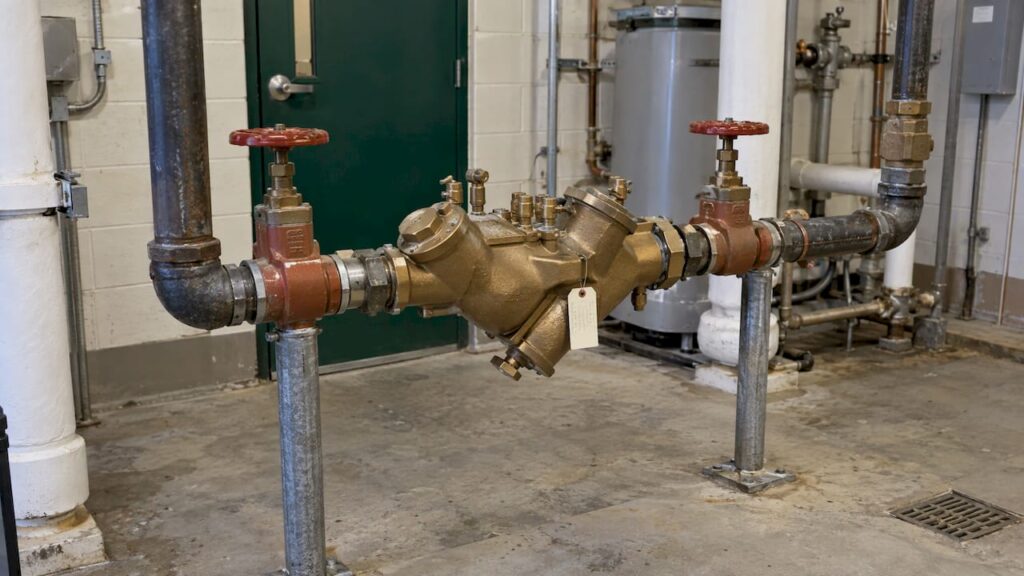
If you are searching for the backflow tag requirements in NJ, here is the short version. New Jersey’s rules do not hinge on a tag hanging from the valve. They hinge on a test performed by a certified tester, a completed report filed with your water supplier and the local health authority, and, for many properties, a certificate of compliance from the municipal plumbing subcode official. A tag on the device is a useful field record. The filed paperwork is what counts.
This guide walks through who can sign off on a test, how often it is due, where the report goes, what happens after a failure, and how requirements shift depending on your property and your water purveyor.
TL;DR
- A backflow assembly on a New Jersey public water connection must be tested by a certified tester, and the result is documented on a report, not just a tag.
- Under the state’s physical connection rules, a certified tester’s report must be mailed to the administrative authority and the water supplier within five days.
- Failed assemblies must be repaired and retested within 30 days.
- Annual testing and a one-year certificate of compliance apply to most high-hazard sites such as irrigation, fire protection and commercial buildings. One- and two-family dwellings are treated differently by the state building code guidance.
- Your water purveyor and town can add stricter requirements, so confirm local rules before you book.
Table of Contents
- Why the tag is not the requirement
- What the state rules require
- Quick reference: who must do what
- Who is allowed to test and sign
- Filing: the step most owners miss
- What happens when the device fails
- Requirements differ by water purveyor and town
- Irrigation, fire lines and enclosures
- What it costs to stay compliant
- Book testing and filing in one visit
- A practical checklist before your next test
- FAQ
- Sources
Why the tag is not the requirement
People usually ask about tags because an inspector, a water authority letter or a previous tester left one on the device. It looks like the proof. In practice, the proof lives in three places: the certified tester’s signed test results, the report filed with the supplier of water and the local health authority, and the municipal certificate of compliance where your town issues one.
New Jersey’s DEP form for backflow testing says the certification of inspection and testing results must be completed by the certified backflow prevention device tester, and that it goes to the supplier of water and the administrative authority, within five days of each test. That form, not a tag, is the document an authority will ask you for.
We attach a record to the device so the next person who opens the enclosure can see when it was last serviced. If your water authority wants a specific tag or sticker, it will say so in its notice, and you should follow that notice to the letter. But if the report is not filed, a tag will not protect your account.
What the state rules require
Two layers of New Jersey regulation apply. The Department of Environmental Protection (NJDEP) governs connections to public community water systems under N.J.A.C. 7:10-10. The Department of Community Affairs (DCA) and your local plumbing subcode official enforce the plumbing code on the building side.
Which devices are approved
An approved physical connection installation must be either a double check valve assembly or a reduced pressure zone backflow preventer, as set out in N.J.A.C. 7:10-10.3. NJDEP describes the program as requiring installation and testing of these devices on public supply lines where they enter facilities, generally near the water meter on domestic lines and ahead of the alarm check and siamese connection on fire lines.
Who can require a device
The owner of a public community water system may require customers with cross-connection hazards to install backflow prevention devices, including when the facility uses water in a way that may contaminate the public system. That is why two neighboring properties can get different letters from the same utility. The hazard, not the street, decides.
Testing intervals
This is where the details matter. Under N.J.A.C. 7:10-10.6, an installation under an existing physical connection permit needs a tightness test at least every three months, plus an internal inspection within six months before permit renewal. Separately, the DCA’s guidance to plumbing subcode officials says field-testable backflow preventers that isolate cross connections must be tested before final inspection after installation and then retested annually.

In plain terms: if your site holds an NJDEP physical connection permit, expect the quarterly and permit-cycle schedule. If your obligation comes through the building code and your town, expect an annual test and an annual certificate. Many commercial properties will deal with both.
One- and two-family homes
DCA Bulletin B-99-2 states that testable backflow preventers for one- and two-family dwellings are not required to be tested annually. It adds that locations where cross connections are likely, such as lawn sprinklers and irrigation systems, fire-protection systems, laboratories, boilers and hospitals, require testing before final inspection and annually.
So a typical home without irrigation is treated more lightly by that bulletin, but a home with an in-ground sprinkler system falls into the likely-hazard group. Your water purveyor may also have its own rule, so a letter from the utility always takes priority in practice.
Quick reference: who must do what
| Requirement | What the rule says | Where it comes from |
|---|---|---|
| Tester credential | Certificate from a Department-approved certifying agency | N.J.A.C. 7:10-10.6(b) |
| Report filing | Mail to administrative authority and water supplier within 5 days | N.J.A.C. 7:10-10.6 and the NJDEP test form |
| Tightness test | At least every 3 months under an existing permit | N.J.A.C. 7:10-10.6(a)1 |
| Internal inspection | Within 6 months before permit renewal | N.J.A.C. 7:10-10.6(a)2 |
| Failed assembly | Repair and retest within 30 days | N.J.A.C. 7:10-10.6(g) |
| Building-code testing | Before final inspection, then annually | DCA model letter |
| Certificate of compliance | Valid one year, issued after passing results are received | DCA Bulletin B-99-2 |
Who is allowed to test and sign
The tester is the heart of the requirement. A test only counts if the right person performs it.
N.J.A.C. 7:10-10.6(b) allows two routes. Either an authorized representative of the facility owner performs the test while an authorized representative of the administrative authority or water supplier is present, or a certified tester performs it, holding a valid certificate from a certifying agency approved by NJDEP. For most owners, the certified tester route is the practical one.
A common question is whether you need a plumber. State scope-of-practice rules say testing of backflow devices may be done by licensed master plumbers and by individuals who are not master plumbers, if certified by an approved entity. Installing, repairing or removing the device itself is different: that work may be performed only by a master plumber, an authorized plumbing contractor, or W-2 employees under a master plumber’s supervision.
Certification itself is not casual. ASSE International’s program requires five years of documented experience, a 40-hour course, a written exam and a practical exam, and the certification runs for three years. When you hire a tester, ask for the current certificate number and confirm your water purveyor accepts it.
Building inspectors do not do the test either. The DCA bulletin says inspectors are not permitted to perform the test. Their job is to make sure the owner has it done by a qualified individual, and a certificate of compliance valid for one year is issued after passing results are received.

Filing: the step most owners miss
A passed test sitting in a truck or a glovebox does nothing for your compliance record. The sequence that protects you looks like this:
- The certified tester performs the test and records the device type, location, serial number, date and results.
- The report is completed on the required form. The NJDEP form requires the certified tester’s certification of the inspection and testing results.
- The report reaches the water supplier and the administrative authority within five days of the test. Under the code, when a certified tester does the work, the owner must mail the report in that window.
- The plumbing subcode official receives the test certification where your town issues an annual certificate. The DCA model letter says that regardless of whether a test is witnessed, the owner must provide the test certification from the person who performed it and pay the annual fee before the certificate is issued.
- You keep copies for your own file, along with the device’s service history.
This is the part we handle directly for clients: we file test reports with the water authority so the owner does not have to chase addresses and deadlines. Property managers with several buildings can see how we approach it on our property manager compliance page.
What happens when the device fails
A failed test is routine. Check valves wear, springs fatigue and debris holds seats open. What matters is the clock.
Under N.J.A.C. 7:10-10.6(g), a facility owner must repair and retest within 30 days any approved installation that fails a pressure test or internal inspection. If repair is not possible and a new physical connection is needed, the owner must get Department approval for the new device. The DCA letter adds that devices not passing must be repaired or replaced, and replacement requires a construction permit. Our page on the backflow replacement permit in NJ explains what to file.
We stock OEM parts so most rebuilds can be done during the same visit as the failed test. That keeps you well inside the 30-day window, and the retest and filing happen right away.
If a test is missed altogether, the consequences depend on your utility. Read our overview of water shutoff for a missed backflow test so you know the sequence before a notice arrives.
Requirements differ by water purveyor and town
State rules set the floor. Utilities and towns apply them to specific properties. The Jersey City Municipal Utilities Authority is a good example: its rules require an approved reduced pressure principle device on domestic service when the authority determines a potential cross-connection hazard exists or the code requires one. Facilities it lists include hospitals, schools, fire sprinkler systems, chemical plants, factories and facilities with sewage ejectors. The same rules make the owner responsible for maintaining a required device under the authority’s cross-connection control program.
So your first step is always to read the notice from your own utility. If you own property in one of these cities, we have written the local picture out:
- Jersey City backflow requirements
- Newark backflow testing requirements
- Trenton backflow testing requirements
- Camden backflow testing requirements
Special property types carry their own concerns. Operators of cooling towers and nursing homes should read the dedicated guides, and anyone reopening a vacant building should see testing after a building shutdown.
Irrigation, fire lines and enclosures
Irrigation is the most common reason a homeowner ends up under a testing requirement. A sprinkler system tied to the potable supply is exactly the kind of cross-connection location the DCA bulletin names. Fertilizer injection raises the stakes further, and a stronger assembly is typically needed in those setups, so have the design reviewed by a certified professional before you add it.
Fire lines are treated separately: the NJDEP program places devices on fire lines before the alarm check and siamese connection. Commercial buildings often have a domestic device and a fire-line device, each with its own report.
Outdoor devices also need protection. Freezing and tampering damage assemblies, which leads to failed tests. Our enclosure requirements guide covers what local rules say, and we install custom backflow preventer enclosures across the state.
Our perspective
After years of testing assemblies, we see the same pattern. Owners who get into trouble rarely ignored the rules on purpose. They had a passed test and no filing, a tag on the valve and a letter they never opened, or a tester whose certification the utility did not accept.
That is why we treat the report as the product. Our job is not finished when the gauge reads good. It is finished when the result is on file with the water authority and the owner holds a copy. We are family-owned, licensed and insured, and we carry OEM parts so a failed device can usually be rebuilt on the same visit instead of leaving you with a 30-day deadline hanging over you.
If you manage several properties, the biggest gain is consolidation: one schedule, one filing process, one bill. That is how compliance stops being a recurring scramble.
Jordan
What it costs to stay compliant
Our published ranges, as listed on our FAQ page, are:
| Service | Published range |
|---|---|
| Annual residential certification test | $150 to $250 |
| Commercial device testing | $200 to $450 per device |
| Rebuild kit service (residential) | $125 to $250 |
| Protective enclosure installation | $200 to $500 |
| Residential installation | $300 to $800 |
Final pricing depends on the device, its size and its condition. Property managers planning a portfolio can use our testing budget guide and New Jersey checklist.
Book testing and filing in one visit
We test, certify, repair, rebuild and file the report with your water authority, for residential, commercial and multi-unit properties across New Jersey. We offer same-day service and emergency calls, and consolidated billing for managers with multiple properties.
Start with our backflow preventer testing and certification page, or contact us with your address and the notice you received, and we will tell you what applies.
A practical checklist before your next test
- Find your notice. Note the sender (utility, health department or plumbing subcode office) and any deadline.
- Locate each device. Record type, size, location and serial number. Commercial sites often have several.
- Confirm tester credentials. Ask for the current certificate and check that your purveyor accepts it.
- Clear access. Snow, shrubs or a locked enclosure cause missed appointments.
- Ask who files. Get a clear answer on who submits the report and when you will receive a copy.
- Calendar the next cycle. Annual or quarterly, put the date in writing now.
- Keep every record. Reports, repair invoices and certificates of compliance belong in one folder.
FAQ
Does New Jersey require a tag on a backflow preventer?
The state rules we work with focus on a certified tester, a completed test report and filing with the supplier of water and administrative authority. A tag is a handy service record, but it does not replace the report. If your utility specifies a tag or sticker, follow its instructions.
How often does a backflow preventer have to be tested in NJ?
It depends on the setting. Installations under an NJDEP physical connection permit need a tightness test at least every three months. Building-code testing for devices that isolate cross connections is annual, after an initial test before final inspection. One- and two-family dwellings are not required to test annually under DCA guidance, though irrigation systems fall into the annual group.
Can any licensed plumber test my backflow device?
Not automatically. The tester must hold a valid certificate from an NJDEP-approved certifying agency, whether or not they are a master plumber. A plumber who installs a device is not automatically qualified to test it unless separately certified.
What if my backflow preventer fails the test?
You must repair and retest within 30 days under N.J.A.C. 7:10-10.6(g). If the device cannot be repaired, a new device needs Department approval, and replacement requires a construction permit. We can usually rebuild with OEM parts during the same visit.
Who sends the test report to the water authority?
Under the state code, the owner must mail a certified tester’s report within five days. We take that task off your plate by filing reports directly with the water authority for our clients.
Sources
- NJDEP form BWSE-CITR-IQ, inspection and testing certification
- N.J.A.C. 7:10-10.3, approved physical connection installation
- NJDEP Physical Connection Permit Processing
- N.J.A.C. 7:10-10.9, cross-connection control by suppliers
- N.J.A.C. 7:10-10.6, inspection and testing
- NJ DCA model letter for plumbing subcode officials
- NJ DCA Bulletin B-99-2
- N.J.A.C. 13:32-1.4, scope of practice
- ASSE International backflow prevention certification
- JCMUA Water Rules and Regulations, November 2020