
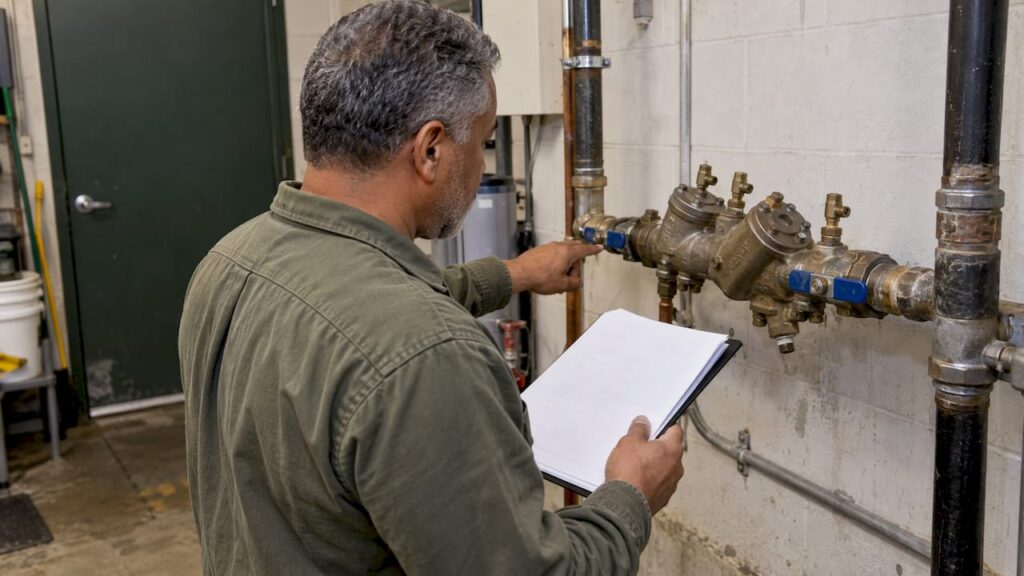
Most backflow test form errors in New Jersey come down to five things: device details that don’t match the device, a missing or incomplete tester section, a failed result that was left off, a replacement valve that was never entered, and a report that missed the five-day mailing window. All five are avoidable, and all five can be corrected. The cleanest fix is a certified tester who completes the form on site and files it with your water authority for you. That is how we handle it at South Jersey Backflow, so the paperwork is finished when the test is.
This guide is for New Jersey property owners and for property managers whose clients’ properties are in the state. It explains what the form asks for, where errors creep in, how to tell a form error from a failed test, and what to do when something is wrong.
TL;DR
- New Jersey requires the test report to be mailed to the water supplier and the administrative authority within five days of each test.
- The most common problems are mismatched device details (manufacturer, model, size, serial number), an incomplete tester section, and failed results that were not recorded.
- A failed test is not a form error. A device that fails must be repaired and retested within 30 days.
- Keep a copy of every form at the property. It must be shown on request.
- If a replacement is needed, a new plumbing permit is usually required, and the form needs a new row for the new device.
Table of Contents
- What the New Jersey test form is and who files it
- The errors that cause the most trouble
- A failed test is not a form error
- How to check a form before you submit it
- Correcting an error after submission
- Deadlines and consequences
- For property managers: errors multiply with the portfolio
- What testing and fixing typically cost
- Let the tester file it for you
- Our perspective
- FAQ
- Sources
What the New Jersey test form is and who files it
A backflow preventer is a valve assembly that keeps water in your plumbing from flowing backward into the public supply. New Jersey requires these devices to be tested by a certified tester, and the result goes on a standard report.
The state’s NJDEP form, BWSE-CITR-IQ, covers the initial inspection and testing of each approved physical connection device. That includes new service connections, newly permitted existing devices, modified devices and replacement devices. It asks for:
- the device description: manufacturer, model, size and serial number
- the installation type and any remarks
- the tester certification section, which identifies the certified tester and their credentials
The form says it must be mailed to the supplier of water and to the administrative authority (the local health or code body that oversees the program) within five days of each test. For recurring testing, N.J.A.C. 7:10-10.6 puts that duty on the facility owner when a certified tester does the work. The owner is accountable even though the tester holds the pen.
Municipalities add their own paperwork. Hillsborough Township, for example, publishes an annual backflow compliance form that is submitted with payment after the test by a tester certified under ASSE-5000. Your town or water company may want its own version in addition to the state form, so ask which one applies before the tester arrives.
Inspectors don’t do the testing either. DCA Bulletin 99-2 says an inspector’s role is to make sure a qualified person did the test, either by witnessing it or by accepting a certification from the owner. That certification must show the type and location of the device, the date tested, the results, and the tester’s name, qualifications and signature.
The errors that cause the most trouble
A form can be rejected or questioned because of what is on it, what is missing, or when it arrives. These are the patterns to look for.
| Error | Why it matters | How to catch it |
|---|---|---|
| Device details don’t match the device (model, size, serial number) | The report must tie to the specific device on record | Compare the nameplate on the device to the form line by line |
| Prepopulated details accepted without checking | NJDEP’s online quarterly service instructions tell users to verify the prepopulated device details after selecting the service ID | Confirm the ID belongs to your device before submitting |
| Tester section incomplete | The form must show who tested and their certification details | Check name, certification information and signature are all present |
| Failed result left off | A failed test must be recorded if the retest falls on a different day | Ask whether any initial test failed, even if it passed later |
| Replacement valve not entered | A replaced device needs its own details and replacement date | Look for a second entry with the new manufacturer, model, serial number and date |
| RPZ pressure readings missing | The RPZ test procedure calls for recording the differential gauge pressure in step 1, with a minimum of five psi | Make sure the readings are filled in, not blank |
| Late or one-sided mailing | Copies go to both the water supplier and the administrative authority within five days | Confirm both recipients and the mailing date |
An RPZ is a reduced pressure zone assembly, the type common on commercial lines and irrigation or fire systems. If you aren’t sure which type you have, the model on the nameplate tells you.
Device details: the quiet problem
Serial numbers are the usual culprit. A digit is transposed, the tester copies from an old report, or a device was swapped and the file still shows the old unit. The form then describes a device that is no longer there. If your device was replaced at any point, make sure the current report shows the current unit.

The tester section
The tester certification block is the part that makes the form a certification rather than a note. A missing certification detail or signature gives the water authority a reason to treat the report as incomplete. Check it before the tester leaves, because correcting it later means tracking down the person who did the work.
A failed test is not a form error
Owners often confuse these two, and they have different fixes.
- A form error means the paperwork is wrong or incomplete. You correct the document.
- A failed test means the device did not meet the required criteria when tested. You correct the device.
Under N.J.A.C. 7:10-10.6, an installation that fails a pressure test or internal inspection must be repaired and retested within 30 days. If repair isn’t possible and a new physical connection is needed, the owner must get NJDEP approval for the new device, and results go on the Quarterly Physical Connection Test and Maintenance Report.
How the failure is recorded depends on timing. NJDEP’s quarterly service instructions say a failed test does not need to be recorded when the valve is cleaned, repaired and retested the same day. If the retest happens on a different day, the failed test must be recorded. That is why same-day repair matters for paperwork as well as for water service. Because we stock OEM parts, many repairs and rebuilds can be done in the same visit, which can keep the record to a single passing result.
A failed test is common and usually fixable. Worn seals, debris on a check valve and pressure fluctuations are the everyday causes, and a rebuild with the right parts often resolves it.
When the device has to be replaced
Replacement changes the paperwork in two places. The state instructions say that for a replaced valve you record the failed result, add a second row for the same valve, check the replaced valve box, and enter the new manufacturer, model, serial number and replacement date.
A permit also comes into play. DCA Bulletin 99-2 states that all backflow preventer replacements require a permit, and Hillsborough’s form says the same for units that fail and must be replaced. A step the law gives to your municipality is part of the process, and the permit is filed with them. If you are in that position, our page on the backflow replacement permit in NJ walks through what to file.
How to check a form before you submit it
A five-minute review catches nearly everything in the table above. Use this order:
- Read the nameplate. Photograph it at the test. Match manufacturer, model, size and serial number to the form.
- Check the service ID. If your water authority or NJDEP system prepopulates device data, confirm it is your device.
- Review the results. Every test field should have a reading. For an RPZ, confirm the differential pressure reading is recorded.
- Ask about failures. If the first test failed and the device was repaired, find out whether it was retested the same day. That decides whether the failure goes on the report.
- Verify the tester block. Name, certification details and signature must be there.
- Confirm recipients and date. Both the supplier of water and the administrative authority need copies, inside five days.
- File your own copy. Under the NJDEP form, records must be kept at the facility and shown upon request.
Correcting an error after submission
The process is practical rather than dramatic.
- Identify what is wrong. Is it a typo in the device data, a missing tester detail, or a missing failed result?
- Get a corrected form from the certified tester. Only the tester can fix the tester section or the test data. Don’t edit results yourself.
- Resubmit to both recipients. Send the corrected report to the supplier of water and the administrative authority, and note that it replaces the earlier one.
- Contact the water authority if you got a notice. Ask what it needs and by when, then respond in writing.
- Replace the facility copy. Keep the corrected form with the original, so the file shows what changed.
If a device was swapped and the old record is still on file, the fix is the replacement entry described above, plus the permit.
Deadlines and consequences
The clock is short. Reports go out within five days of testing, and failed installations are repaired and retested within 30 days. The rules sit in N.J.A.C. 7:10-10.6.
What happens when a report is missing or wrong depends on your water supplier and municipality. A missed or unresolved report can escalate into a notice and, in some cases, service interruption. We cover how that plays out on our page about water shutoff for a missed backflow test in NJ. Local rules also differ. If you own in a larger city, see our requirements pages for Newark, Jersey City, Camden and Trenton.
Because forms and portals get updated, check the NJDEP and your water supplier’s pages for the version in use when you file. The form linked here carries a 2022 date, and the online quarterly instructions a 2015 date.
For property managers: errors multiply with the portfolio
One wrong serial number is a nuisance. Across 30 buildings, it is a pattern. Managers run into the same few problems:
- Inconsistent device records. Devices replaced by previous vendors never made it into the file.
- Different recipients per municipality. Each town may want its own form or deadline.
- No proof of filing. The test happened, but nobody can show that both recipients got the report.
- Failed results tracked in email. The 30-day retest window passes unnoticed.
A simple tracker helps: one row per device with address, model, serial number, test date, result, filing date, and next due date. Our property manager backflow checklist and filing confirmation page go deeper, and the testing budget guide helps with planning costs. If a building sat vacant, see testing after a building shutdown.
We offer consolidated billing for multi-property clients, and we file test reports directly with water authorities, so the proof of filing is part of the job rather than a separate chase.
What testing and fixing typically cost
The published ranges on our site are:
| Service | Published price |
|---|---|
| Annual residential certification test | $150-$250 |
| Commercial device testing | $200-$450 per device |
| Rebuild kit service (residential) | $125-$250 |
| Residential installation | $300-$800 |
| Protective enclosure installation | $200-$500 |
Repairs and rebuilds beyond the residential rebuild kit service don’t have a published price. Our pricing FAQ has the details.
Let the tester file it for you
We test, certify, repair, rebuild and install enclosures for residential, commercial and multi-unit properties across New Jersey, and we file the report with your water authority directly. We are a family-owned, licensed and insured company, we offer same-day service and we stock OEM parts so a failed device can often be rebuilt in the same visit. You can see the full scope on our testing and certification page.
If you already have a report with a problem on it, contact us with the device address and the notice you received.
Our perspective
Most of the form problems we hear about are not really paperwork problems. They are handoff problems. The person who tests the device is not the person who files the report, and the person who owns the building is not the person who reads it.
We built our service around closing that gap. The tester reads the nameplate, fills in every field, and we file the report with the water authority directly. When a device fails, we aim to rebuild it with OEM parts on the same visit, which keeps the record simple and the water on.
For owners and managers, the result is one point of contact for the test, the repair and the filing. That is what we think compliance should feel like.
Jordan
FAQ
How long do I have to send in a backflow test report in New Jersey?
The report must be mailed to the supplier of water and the administrative authority within five days of each test and inspection. That is in N.J.A.C. 7:10-10.6. Ask your tester to file it right after the test so the deadline never becomes your problem.
Do I have to report a failed test if I fix it right away?
NJDEP’s instructions say a failed test need not be recorded when the valve is cleaned, repaired and retested the same day. If the retest is on a different day, the failure must be recorded. See the quarterly service instructions.
Can I correct a wrong serial number myself?
The test data and tester section belong to the certified tester, so corrections should come from them as a revised report. Send the corrected version to both the supplier of water and the administrative authority. Keep both versions in your file.
Do I need a permit if my backflow preventer is replaced?
Yes. DCA Bulletin 99-2 states that a permit is required for all backflow preventer replacements. The form also needs a replacement entry with the new device’s details and date.
Where should I keep the completed form?
At the facility. The NJDEP form states that records are kept on site and shown on request, so a copy in your property file or on site is the safe place.
Sources
- NJDEP BWSE-CITR-IQ form
- N.J.A.C. 7:10-10.6, Inspection and testing
- NJDEP Physical Connection Online Quarterly Service Instructions
- NJ DCA Bulletin 99-2
- Hillsborough Township Annual Backflow Preventer Compliance form