
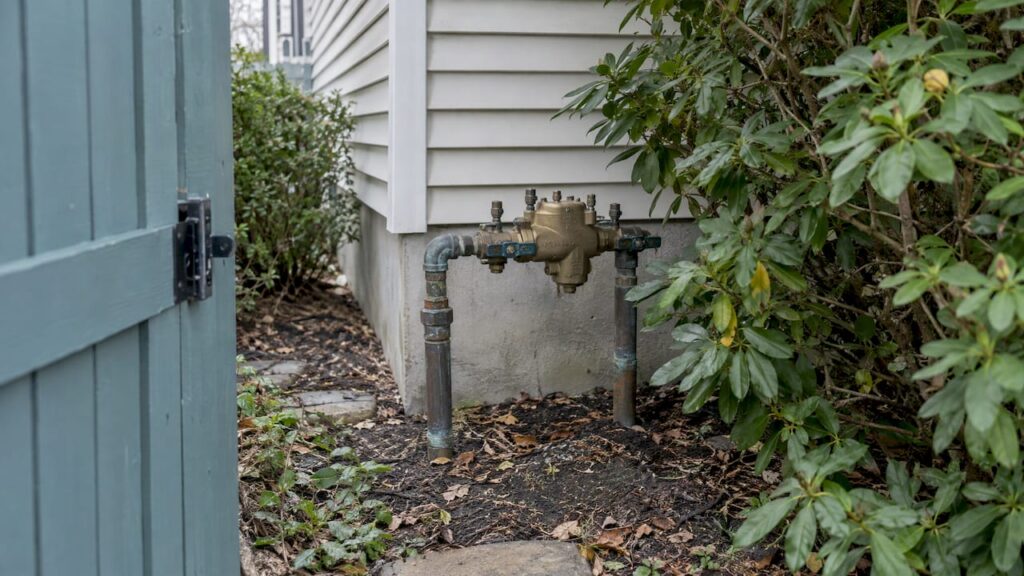
If a certified tester cannot reach your backflow preventer, the device cannot be tested, and an untested device cannot earn its annual Certificate of Compliance. The fix is almost always the same: clear the space, make the device reachable at the right height, and book the test once access is restored. We test, rebuild and enclose backflow preventers across New Jersey, and we can file the report with your water authority once the device passes.
TL;DR
- Plumbing code requires every testable backflow preventer to be accessible for testing, maintenance, repair and replacement, with the manufacturer’s clearances.
- New Jersey requires testable devices to be tested annually by a tester certified through an agency recognized by the NJDEP, and the Certificate of Compliance lasts one year.
- Water utilities can charge access fees or shut off service when a device or meter cannot be reached.
- Common blockers are shrubs, fences, finished basements, low or high mounting, flooded vaults and locked enclosures.
- Photograph the device and nameplate, clear a work zone, and book a test before the annual deadline.
Table of Contents
- What “accessible” means for a backflow preventer
- What blocks access most often
- Is it a backflow preventer or a sewer backwater valve?
- What New Jersey requires
- What happens when the device cannot be reached
- How to restore safe access, step by step
- For property managers: what to gather and who to call
- What the test and the fix cost
- Getting the device tested
- Our perspective
- FAQ
- Sources
What “accessible” means for a backflow preventer
Code language is more specific than most owners expect. The National Standard Plumbing Code, as published on UpCodes, says all backflow preventers must be accessible for testing (if testable), maintenance, repair and replacement, with clearances as recommended by the manufacturer. Double check valves and reduced pressure principle assemblies must sit at least 12 inches above the floor or a permanent platform, and no more than 60 inches above it.
Two more details from the same section matter in practice:
- Devices with atmospheric vents may not be installed in pits, vaults or similar locations that could flood.
- Where an outdoor enclosure is used, it must comply with ASSE 1060.
Local utilities add their own limits. The Dover Water Department’s procedures manual, for example, calls for isolating valves on each side of the unit, adequate support, a location no more than three feet above the floor, and drainage for the unit’s maximum discharge. That manual dates from 2010, so confirm what your own utility currently requires.
In plain terms, a tester needs to get hands, gauges and hoses onto the test cocks and shutoff valves without moving anything heavy, crouching in water, or climbing a ladder.
What blocks access most often
Most access problems fall into a few patterns. The table pairs each with the usual fix.
| Obstruction | Why it stops the test | Typical fix |
|---|---|---|
| Overgrown shrubs, fencing, stored materials | No room to attach test equipment | Clear a work zone around the device |
| Device in a finished basement behind drywall or cabinets | Tester cannot see or reach the test cocks | Open a panel or relocate the assembly |
| Mounted too low or too high | Falls outside the 12 to 60 inch window | Re-pipe or reinstall at a compliant height |
| Pit or vault that floods | Vented devices should not sit where they can be submerged | Relocate above grade |
| Locked enclosure, no key on site | Tester cannot open it | Provide a key or lock code to the tester |
| Tenant or occupant unavailable | Interior device cannot be entered | Schedule with notice to the occupant |
Philadelphia’s water department notes the same pattern in its basement protection program: finished-basement drywall or improvements can block plumbing, while most fixes happen outside at the sidewalk or downspout. Interior finishing is the classic access killer, because walls get built around a device that was once exposed.
Is it a backflow preventer or a sewer backwater valve?
Before you start clearing anything, make sure you are looking at the right device. People often use “backflow” for two different things.
The definitions in Illinois’ administrative code show the split clearly. A backwater valve sits in a sanitary sewer, storm drain or storm sewer to stop sewage or drainage from backing up. A backflow preventer protects the potable water supply from contamination through a cross-connection. One guards your drains; the other guards your drinking water.
To identify a water-side device, read the nameplate for manufacturer, model, size and any RP, RPZ, PVB, DC or AVB marking. According to an identification guide, a relief opening under the body usually points to a reduced pressure assembly, a raised bonnet or air inlet above the piping often indicates a pressure vacuum breaker, and two check modules without an open relief vent may indicate a double check assembly. The location of the vent or relief opening tells you more than the brass shape.
This matters for access, because the annual test and certification rules in New Jersey apply to the testable potable-water devices. If your device is on a sewer line, you have a different maintenance task, covered in our guide to backflow flooding protection.

What New Jersey requires
The state rules are short and firm.
- Annual testing. DCA Bulletin 99-2 requires testable backflow preventers to be tested before final inspection and then annually. The tester must be certified by an agency recognized by the NJDEP Bureau of Safe Drinking Water. A Certificate of Compliance, valid for one year, is issued once passing results are received.
- Certification paperwork. The test certification should identify the device type and location, the test date and results, and the tester’s name, qualifications and signature, according to the same bulletin.
- Who may do what. Under N.J.A.C. 13:32-1.4, installing, altering, repairing, maintaining or removing approved backflow devices is work for a master plumber, an authorized plumbing contractor or supervised employees, while certified individuals may test them.
- No separate permit for the test. N.J.A.C. 5:74-2.1 says a permit is not required for the backflow portion of the annual test, as long as the tester holds a valid certification from a recognized agency.
- Replacement needs a permit. The DCA’s model letter for Plumbing Subcode Officials states that the Certificate of Compliance expires, that failed devices must be repaired or replaced, and that replacement requires a Construction Permit. We cover the filing steps in our NJ backflow replacement permit guide.
Commercial properties may face a tighter schedule. New Jersey American Water’s guidance says non-residential customers with permitted physical connections protected by a DCVA or RPZ must be enrolled in the NJDEP physical connection permit program, which requires quarterly testing. If you manage a commercial building, an access problem therefore bites four times a year, not once.
The NJDEP’s own regulatory guidance explains that N.J.A.C. 7:10-10.1 requires the permit, design and testing of a backflow prevention device where a public community water system connects to a facility with potentially contaminated water sources, applied together with the plumbing subcode at N.J.A.C. 5:23-3.15.
What happens when the device cannot be reached
The consequences come from your water provider, and they escalate.
- Fees and shutoff. Jersey City’s utility authority rules say that if someone refuses entry or access for inspection, the authority may turn off water service until written notice is given that access will be allowed, and it issues a Failure to Allow Access Fee. The same rules require owners and occupants to keep the water meter and its valves easily accessible.
- Disconnection for noncompliance. New Jersey American Water states that failure to comply with cross-connection requirements may result in water service disconnection.
- Obstruction of utility equipment. Dover’s manual says no one may obstruct free access to hydrants, meters, curb stops or other water department equipment, and that authorized employees must be admitted to inspect the plumbing system.
For a landlord, a shutoff means tenants without water. For a business, it means closing. An access problem that costs an afternoon to fix is far cheaper than any of those outcomes. If you manage Jersey City or Newark property, see our pages on Jersey City backflow requirements and Newark testing requirements for local specifics.
How to restore safe access, step by step
Here is the sequence we recommend, with where each step tends to go wrong.
1. Identify and document the device
Photograph the whole assembly and the nameplate. Note exactly where water appears, if it does, without removing covers. Keep the last test report or utility notice next to the device. Where it goes wrong: people photograph only the brass body and miss the nameplate, which is what a tester needs to bring the right parts.
2. Measure the clearances
Check the height of the device against the 12 to 60 inch window, and read the manufacturer’s clearance recommendations from the nameplate or manual. Allow room on all sides to open test cocks and reach both shutoff valves. Where it goes wrong: owners measure to the pipe instead of to the device body, or forget that a heavy cover or a shelf above the unit also counts as an obstruction.
3. Clear the work zone
Trim vegetation, move stored items, and unlock gates or enclosures. Keep floor drains and the discharge area free, because a reduced pressure assembly can discharge a lot of water when it operates, and the Dover manual calls for drainage sized to the maximum discharge. Where it goes wrong: stacking items against the device after clearing it, and landscaping that grows back by next year.
4. Deal with interior and concealed devices
If the device sits behind drywall, cabinetry or a ceiling, it needs a proper opening or a move. Where the opening cuts through a rated wall or floor, fire protection matters as much as plumbing access. Guidance on service riser openings explains why the fire strategy should be checked before anyone cuts. Where it goes wrong: a patched hole that hides the device again within a month.

5. Fix mounting height and flood exposure
A device that is too low, too high, or in a pit that can flood is not a clearing job. It is a reinstallation, which is work for a licensed plumbing contractor and needs a Construction Permit for replacement. We are licensed and insured, and we handle residential installation, which we publish at $300 to $800.
6. Protect the device
Outdoor devices exposed to freezing, vandalism or lawn equipment benefit from an enclosure that meets ASSE 1060. A properly sized enclosure with a lockable door keeps the device protected and still reachable. Our protective enclosure installation is published at $200 to $500, and our page on NJ enclosure requirements explains what the rules say.
7. Book the test and file the report
Once the device is reachable, schedule the certified test. The result goes to your utility and, where applicable, the Plumbing Subcode Official, along with the annual fee. The DCA model letter says the owner must supply the performance test certification from the tester before the annual Certificate of Compliance is issued.
For property managers: what to gather and who to call
An access problem across a portfolio is a paperwork problem as much as a plumbing one. Gather these before you make any call:
- Device type, size, location and nameplate photos for each property
- The date and result of the last test, and the certificate expiry
- Who holds keys or codes to rooms, vaults and enclosures
- Tenant or occupant contacts for interior devices
- The utility’s cross-connection contact and any open notice
The DCA says owners should arrange retesting with a qualified individual and contact the local Plumbing Subcode Official about a test appointment. For multi-property portfolios, we offer consolidated billing, and our property manager compliance page shows how to confirm that filings reached the water authority. If you are budgeting a portfolio, see our backflow testing budget guide.
If a building has been shut down or vacant, the device may need attention before it goes back into service. Our guide to backflow testing after a building shutdown covers that case.
What the test and the fix cost
These are the prices published on our site:
| Service | Published price |
|---|---|
| Annual residential certification test | $150 to $250 |
| Commercial device testing | $200 to $450 per device |
| Rebuild kit service (residential) | $125 to $250 |
| Protective enclosure installation | $200 to $500 |
| Residential installation | $300 to $800 |
Repairs and rebuilds beyond the residential kit service have no published price; the details are on our installation, testing and rebuilding cost page.
Getting the device tested
If your device is reachable but overdue, or you have cleared a space and want the certificate, our backflow testing and certification service covers residential, commercial and multi-unit properties across New Jersey. We stock OEM parts so that many repairs and rebuilds can happen in the same visit, we offer same-day service, and we file the test report directly with the water authority.
If the device needs a protective enclosure or a rebuild to be testable, we can quote that along with the test. Contact us with the address, a photo of the device and its nameplate.
Our perspective
Access problems are the most avoidable reason a backflow test fails to happen. The device is usually fine. What changes is the space around it: a fence goes up, a basement gets finished, a landscaper plants hedges, a lock gets replaced.
We design our visits around removing that friction. We bring OEM parts so a worn device can be rebuilt on the same visit, we handle the filing with the water authority, and we offer enclosures that keep a device protected while leaving room to test it.
Our advice to owners and managers is simple: treat the clearance zone like part of the device. Photograph it, keep it clear, and put the annual test on the calendar before the certificate expires. A reachable device is a certifiable device.
Jordan
FAQ
How much clearance does a backflow preventer need?
The code requires clearances recommended by the manufacturer, so the nameplate and manual are the starting point. Double check and reduced pressure assemblies must also sit between 12 and 60 inches above the floor or permanent platform. Your local utility may add its own limits.
Can I enclose or hide my backflow preventer?
Yes, with the right enclosure. Outdoor enclosures should comply with ASSE 1060, and the enclosure must still allow a tester to open it and reach the device. Hiding a device behind drywall or in a flood-prone pit creates access and code problems.
What happens if my tenant will not let the tester in?
Your water provider can treat refused access seriously. Jersey City’s utility rules allow a Failure to Allow Access Fee and a service shutoff until access is confirmed in writing. Give the occupant written notice and schedule a firm appointment.
Do I need a permit to test a backflow preventer in New Jersey?
Not for the backflow portion of the annual test, provided the tester holds a valid certification from an agency recognized by the NJDEP. Replacing a device does require a Construction Permit.
How often must the device be tested?
Testable devices in New Jersey must be tested annually. Some non-residential connections under the NJDEP physical connection permit program must be tested quarterly, according to New Jersey American Water’s guidance.
Sources
- Installation of Backflow Preventers, UpCodes
- Dover, NJ Water Department Procedures Manual
- Philadelphia Water Department, Basement Protection Program
- Ill. Admin. Code tit. 77, § 890.120
- Backflow preventer identification guide
- NJ DCA Bulletin 99-2
- N.J.A.C. 13:32-1.4
- N.J.A.C. 5:74-2.1
- NJ DCA model letter for Plumbing Subcode Officials
- New Jersey American Water, Cross Connection and Backflow
- NJDEP regulatory guidance, physical connection permit
- JCMUA Water Rules and Regulations