
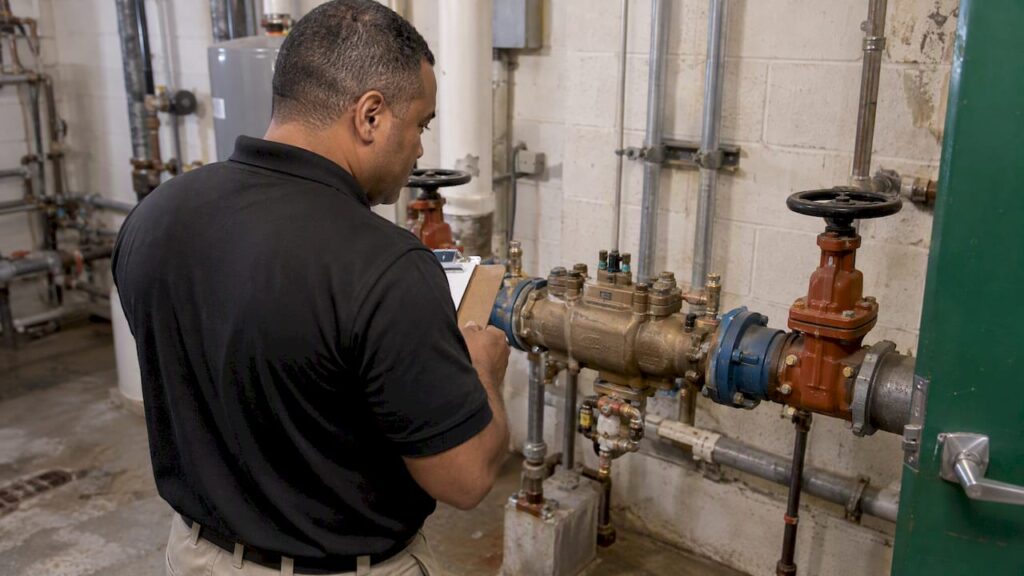
A good backflow checklist for a New Jersey property manager covers six things: which devices each property has, who is allowed to test them, how often, where the paperwork goes, what to do when a device fails, and what happens if a deadline slips. The checklist below follows the state’s own forms and rules, so you can run it property by property and keep a defensible file.
TL;DR
- Inventory every public-water service line at every property, and confirm each one has the right device (RPZ or DCVA on domestic lines, RPDRP or DCDC on fire lines).
- The owner is responsible for hiring a certified tester. Plumbing inspectors verify compliance but do not run the test.
- Testing frequency depends on the device: facilities under a physical connection permit follow a three-month tightness test rule, and most other devices run on an annual Certificate of Compliance cycle.
- Keep the signed test report on file, make sure it is filed on time, and calendar the certificate expiration.
- A failed device must be repaired or replaced, and a replacement needs a construction permit. Failed physical-connection installations must be retested within 30 days.
Table of Contents
- Step 1: Build a device inventory
- Step 2: Confirm the right assembly for each line
- Step 3: Know how often each device must be tested
- Step 4: Hire a qualified tester and prepare the site
- Step 5: Collect the right paperwork
- Step 6: Have a plan for a failed device
- Step 7: Understand what a missed test can cost
- Budgeting the checklist
- Perspective: how we run this for managers
- Book testing and filing for your properties
- The one-page checklist
- FAQ
- Sources
Step 1: Build a device inventory
You cannot manage what you have not listed. New Jersey’s Physical Connection Permit checklist starts with the same idea: identify every public-water service line entering the facility and verify that each is protected by a backflow-prevention device. The device belongs on the customer side of the meter, as close to the meter as reasonably practicable, and ahead of any other connection.
For each device, record:
- Property address and the building or unit it serves
- Service type: domestic, irrigation, or fire line
- Device type (RPZ, DCVA, RPDRP, DCDC), manufacturer, model, size and serial number
- Location, including whether it is indoors, in a vault, or in an outdoor enclosure
- Date of last test, tester name, and result
- Which water authority or municipality receives the report
Multi-building portfolios often turn up surprises here: a separate irrigation line nobody mentioned, a fire line with its own assembly, or a device that was bypassed or removed during a renovation. Walk the property rather than relying on the file.
Step 2: Confirm the right assembly for each line
The same state checklist asks you to note whether the assembly fits the service: RPZ or DCVA for domestic lines, and RPDRP or DCDC for fire lines. An RPZ is required where the unapproved supply is non-potable or the facility has a cross-connection hazard.
If you manage a property with a bypass meter on a fire line, the difference between a DCDA and a plain DC matters for testing. We explain it in DCDA vs. DC for property managers. For industrial sites with process water, see our manufacturing backflow requirements guide.
Step 3: Know how often each device must be tested
There is no single interval for every New Jersey property, so tag each device with the rule that governs it.
| Situation | Typical requirement | Source |
|---|---|---|
| Facility with a physical connection permit | Inspect and test for tightness at least every three months; internal inspection within six months before renewal, except RPZ assemblies | N.J.A.C. 7:10-10.6 |
| Device tracked through the municipal plumbing subcode office | Annual performance test and a Certificate of Compliance valid for one year | NJ DCA bulletin |
| Dedicated fire service line | Fire official may accept a current Certificate of Compliance as meeting the NFPA 25 annual backflow test | NJ DCA bulletin |
Your local water purveyor can add its own schedule on top of these. Cities differ in who collects reports and fees, so check the local rules for your properties. We have written up Jersey City, Camden and Atlantic City specifically.
Step 4: Hire a qualified tester and prepare the site
New Jersey places the duty on the owner. The Department of Community Affairs guidance says the facility owner must arrange qualified testing and provide certification, and that municipal plumbing subcode officials may not perform backflow tests themselves. Their job is to make sure a certified tester is engaged.
For permit-covered physical connections, tests are done by an authorized owner representative or by a certified tester holding a valid certificate from a Department-approved certifying agency. Ask for the tester’s certificate number before the visit and save a copy.
Before the tester arrives
- Give permission for the test and for a temporary water interruption. The state’s testing form lists owner permission for the test and the service interruption as a first step. Warn tenants in writing, especially in multi-unit buildings and commercial spaces with water-dependent operations.
- Clear access. Tester needs room to attach gauges, so remove stored items, overgrown landscaping, snow or debris. If a storage area needs clearing first, property cleanout planning can help you get it ready before test day.
- Confirm that downstream shut-off valves operate. On a DCVA the tester has to confirm that backpressure does not exist, and a leaking No. 2 shut-off valve can cause it. A valve that does not close fully can turn a routine visit into a repair.
- Have the device record ready so the tester can verify identifying information, flow direction and the presence of test cock adapters.
What the tester does, and what you leave alone
The tester checks identification and flow direction, confirms test cock adapters, runs the performance test and records results. You should not open, adjust or rebuild a device yourself ahead of the test. Beyond the legal issue, an undocumented repair makes the report harder to explain.
Step 5: Collect the right paperwork
Proof of annual testing is not a receipt. The state’s guidance says it must include the device type and location, test date, results, and the tester’s name, qualifications and signature. Reject any report missing one of those items.
Then handle filing:
- For physical connection installations, keep the test form at the facility and mail it to the Supplier of Water and the Administrative Authority within five days of each test and inspection.
- For devices on the municipal cycle, a passing result leads to a Certificate of Compliance from the municipal inspector, valid for only one year.
- Put the expiration on your own calendar. Many municipal offices send an annual reminder that the certificate is expiring and that a performance certification and an annual fee are due, as described in the state’s municipal procedures manual, but a reminder that goes to an old owner address is not an excuse.
- Store the report, the certificate and any repair invoices together per device, digitally and in the property file.
If you want a second pair of eyes confirming that the filing actually reached the authority, our page on confirming backflow filing for property managers walks through it.
Step 6: Have a plan for a failed device
A failure is common enough that your checklist should already say what happens next.
- Repair or replace. A device that fails testing must be repaired or replaced, and replacement requires a construction permit. Our guide to the backflow replacement permit in NJ shows what to file.
- Retest on the clock. An approved physical-connection installation that fails a pressure test or internal inspection must be repaired and retested within 30 days. If repair is not possible and a new connection is needed, the owner must get Department approval.
- Get approval for spend. Many failures are a worn seat, spring or check that a rebuild fixes on the same visit. Have a pre-approved dollar limit per device so the tester can proceed without waiting days for an owner signature.
- Protect the device afterward. Freeze damage and tampering are frequent reasons for repeat failures on outdoor assemblies. Read our rundown of backflow enclosure requirements in NJ before you decide.
Step 7: Understand what a missed test can cost
A lapse is not just an administrative annoyance. Under the state’s safe drinking water rules, the Department of Environmental Protection can issue a compliance order, bring a civil action, or levy a civil administrative penalty against a person found in violation. Local enforcement varies by municipality and water purveyor, and an expired certificate can also hold up a sale or occupancy approval. See our pages on Certificate of Occupancy and backflow testing and backflow inspection before closing.
The practical cost is bigger than any one fee: a contamination event in a tenant building is a liability question, and your file of dated, signed reports is what you will want to hand over.

Budgeting the checklist
Plan a number per device rather than per building. Our published ranges are $150 to $250 for an annual residential certification test, $200 to $450 per device for commercial device testing, $125 to $250 for a residential rebuild kit service, and $200 to $500 for protective enclosure installation. Residential installation runs $300 to $800. Prices depend on device size, access and condition, and the full detail is on our FAQ pricing page. For portfolio planning, our backflow testing budget guide shows how to roll devices into a yearly line item.

Perspective: how we run this for managers
Most of the failures we see in a manager’s portfolio are not hardware failures. They are record failures: a report that was never filed, a device nobody knew about, a certificate that expired the week the owner changed. We are a family-owned, licensed and insured New Jersey company, and we stock OEM parts so a rebuild can usually happen on the same visit instead of dragging into a second appointment. We also handle filing the test report with the water authority, because a passed test that was never filed is the same as no test in the authority’s eyes.
Our advice: pick one person to own the device register, test every device in a building during one visit window, and ask for the report in a form you can drop straight into the file.
— Jordan
Book testing and filing for your properties
We test, certify, repair, rebuild and enclose backflow preventers across New Jersey, for residential, commercial and multi-unit properties, with consolidated billing for managers with several sites and emergency service when a device fails. Start with our backflow preventer testing and certification service, or contact us with your property list.
The one-page checklist
- [ ] Every service line at every property identified and listed
- [ ] Correct device type confirmed for each line (domestic, irrigation, fire)
- [ ] Governing rule and test interval tagged per device
- [ ] Certified tester hired, certificate on file
- [ ] Tenants notified of water interruption; owner permission given
- [ ] Device accessible and downstream valves working
- [ ] Signed report with all required fields received
- [ ] Report filed or mailed within five days where a permit applies
- [ ] Certificate of Compliance saved, expiration calendared
- [ ] Failed devices repaired or replaced, permit pulled, retest scheduled within 30 days where required
FAQ
Can my own maintenance staff test a backflow preventer?
Not as a rule. The owner must arrange qualified testing, and municipal officials only verify that a certified tester was used. Under the permit rule, tests are done by a certified tester or an authorized owner representative, so confirm the requirements with your water supplier before relying on staff.
How long is a Certificate of Compliance good for?
One year, per the state’s guidance for municipal certificates. Put the expiration date on your calendar rather than waiting for a reminder from the municipality.
Who gets the test report?
For physical connection installations, the form goes to the Supplier of Water and the Administrative Authority within five days of each test, and a copy stays at the facility. For municipal-cycle devices, the certified result goes to the local plumbing subcode office. Ask your tester or water purveyor which applies.
What if a device fails the test?
It has to be repaired or replaced, and a replacement needs a construction permit. If it is a permit-covered physical connection, repair and retest must happen within 30 days.
Sources
- Application Form for Initial Physical Connection Permit, NJDEP
- PERMIT* backflow test form instructions, NJDEP
- N.J.A.C. 7:10-10.6 Inspection and testing
- NJ Department of Community Affairs backflow bulletin
- NJ DCA guidance, State Library copy
- NJ DCA Municipal Procedures Manual
- N.J.A.C. 7:10 Safe Drinking Water rules, NJDEP
- Property cleanout planning