
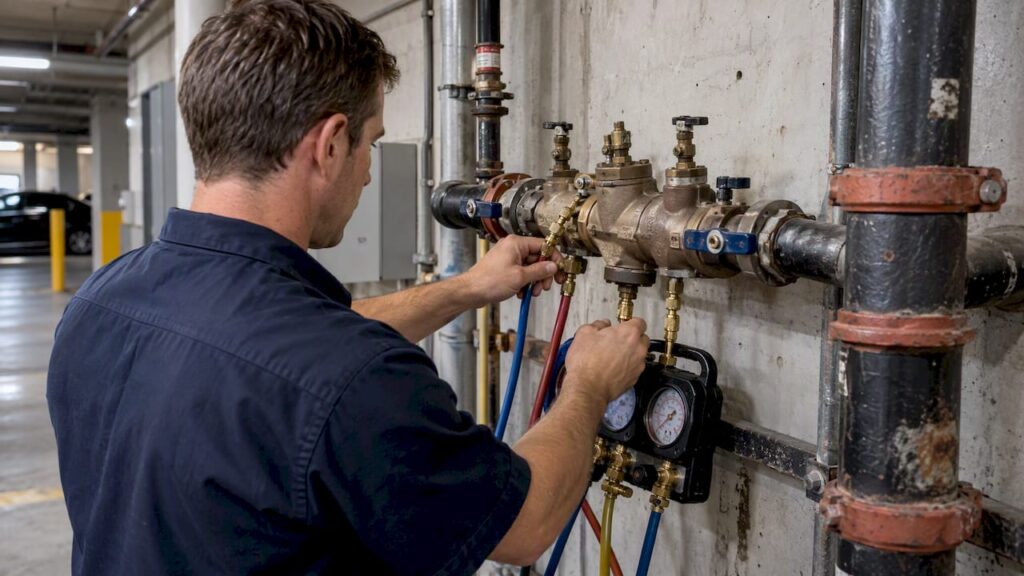
Budget $150 to $450 per device for annual backflow testing, plus a contingency for repairs if a unit fails, since most purveyors require annual testing and recordkeeping. Start by inventorying every device on the property, then set aside a repair and retest reserve before you request quotes. That one step prevents the most common budgeting surprise owners run into each year.
TL;DR:
- RPZ assemblies usually cost more to test than double check valves or pressure vacuum breakers, while vaults and confined spaces add labor or equipment charges.
- Reserve 15% to 20% of the testing total for repairs and retests, because a failed device may require parts, labor, and another mobilization.
- For portfolios, request one contract with a fixed per device rate and group nearby properties into one visit to reduce mobilization costs.
- Check local rules because some authorities require reports within days of testing, and certified testers must submit them using calibrated gauges.
- If a device has failed repeatedly in the past two or three cycles, compare replacement cost with another rebuild, especially when OEM parts are scarce.
Table of Contents
- What influences backflow testing costs
- Typical prices and sample budgets for backflow testing
- Fail → repair → retest: what a failed test actually costs
- How to plan a backflow testing budget for a property portfolio
- Testing frequency, compliance, and who files the report
- Authoritative budgeting checklist and where we fit in
- Why budgeting prevents surprises and keeps properties compliant
- Getting a predictable annual number with South Jersey Backflow
- FAQ
- Sources
What influences backflow testing costs
The price of a single test depends on what kind of device sits on the line, how hard it is to reach, and who has to do the work. A reduced pressure zone (RPZ) assembly has more moving parts than a double check (DC) valve or a pressure vacuum breaker (PVB), and each additional component adds time on site. The EPA Cross-Connection Control Manual describes these device categories and the testing procedures tied to each one, and that complexity is the main reason two properties with the same number of devices can end up with different bills.
Access matters just as much as device type. A backflow preventer sitting in an underground vault, a confined mechanical room, or a line that runs through an area prone to freezing takes longer to test and sometimes requires extra equipment or a second technician.
Several other line items shape the final invoice:
- Pipe diameter and special fittings that require less common parts or adapters
- OEM part availability, since a rebuild using original manufacturer components usually costs more than a generic substitute
- Tester certification level and travel distance, which show up as mobilization fees
- Administrative costs for filing the test report with the water authority
Pro Tip: Ask for a flat per-device rate that already bundles the report filing fee, so you are not surprised by a separate administrative charge later.
Typical prices and sample budgets for backflow testing

A straightforward residential test commonly falls in the $150 to $250 range, while commercial devices, which tend to be larger and more complex, run $200 to $450 per device. Regional labor rates and the mix of device types on a property both push that range in either direction, so a portfolio with several RPZ assemblies will sit higher than one built mostly on PVBs.
Three quick examples show how the math scales:
- A single-family home with one PVB: budget around $200 for the annual test, with no additional line items if the device passes.
- A small commercial property with three devices, two DC valves and one RPZ: budget roughly $900 to $1,100, factoring the higher RPZ rate into the average.
- A 10-device multi-unit portfolio: budget $2,000 to $4,000 for testing alone, before adding a repair contingency.
When you build the annual line item, include the test fee itself, the report filing fee if it is billed separately, a small parts allowance, a repair contingency proportionate to testing costs, and any mobilization charge for sites outside a technician’s normal route.
Fail → repair → retest: what a failed test actually costs
A failed test rarely ends with the test fee alone. Most programs require the device to be repaired and retested before the report can be filed, which usually means a second site visit and a second mobilization charge on top of the parts and labor for the repair itself.
The repair itself typically involves one of two paths:
- A rebuild kit with new seals, springs, and seats, installed in place for a device still in good physical condition
- A full bench rebuild or an outright assembly replacement when the body or major components are too worn to repair economically
Pro Tip: If a device has failed more than once in the past two or three cycles, price out a replacement alongside the repair quote. Repeated rebuilds on an aging assembly often cost more over time than swapping it once.
Older assemblies, or ones where OEM parts are getting harder to source, are usually the ones where replacement wins out financially once you compare it against another round of repairs.
How to plan a backflow testing budget for a property portfolio
Start with a device inventory that lists type, size, access conditions, and hazard level for every assembly you manage. Pull the previous one to two years of test history so you can see which devices fail repeatedly, since those are the ones that need a larger repair reserve.
From there, a few practical steps keep the annual number predictable:
- Request a consolidated contract that locks a per-device rate across the portfolio instead of pricing each site separately.
- Set an approval threshold so technicians can proceed with minor repairs on the spot, while anything above a set dollar amount requires sign-off.
- Pre-authorize common rebuild kit replacements so a failed test does not stall on a second approval cycle.
- Batch nearby properties into the same scheduling window to cut mobilization costs, and avoid peak season when testers are booked solid.
Negotiating consolidated contracts across several properties can meaningfully lower the per-device rate compared to booking each site as a one-off call, since the provider is scheduling one route instead of several separate trips.
Track renewal dates in a shared calendar or reminder system so devices never lapse into noncompliance between cycles; our guide to managing annual backflow deadlines walks through a simple setup for that.
Testing frequency, compliance, and who files the report
Most water purveyors require backflow testing once a year, though some device classes or local programs set different intervals, so confirm the exact schedule with your water authority rather than assuming a single rule applies everywhere. The City of Boulder’s backflow prevention program is a representative example: it requires annual testing for most commercial and multi-unit assemblies, online submission of reports by a certified tester, and can issue fines or shut off water for noncompliance.
Reporting windows matter for budgeting too. Some programs require submission within days of the test, and a failed test often triggers a notification requirement within 24 hours, so build time into your schedule rather than waiting until a deadline is close.
Certified testers using calibrated gauges are the standard requirement almost everywhere:
- Test reports must come from a certified tester, not a general plumber without that credential
- Calibration records for the test gauge are usually required alongside the report itself
- Late filing commonly triggers a warning first, then fines, and in persistent cases a water shutoff
Authoritative budgeting checklist and where we fit in
Before requesting quotes, run through a short checklist:
- Count every device on the property and note its type (RPZ, DC, PVB)
- Flag access issues: vaults, confined spaces, or seasonal shutoffs
- Pull the last two years of test results to spot repeat failures
- Set a repair and retest contingency of 15% to 20% of the testing total
Payment models vary by water purveyor, and TCEQ’s cross-connection program guidance outlines three common routes: the utility tests in-house and bills the customer, the customer arranges private testing, or the utility supplies a list of approved testers. Our team at South Jersey Backflow files reports directly with New Jersey water authorities, which removes that administrative step from an owner’s plate; our New Jersey compliance guide covers the submission process in more detail.
Why budgeting prevents surprises and keeps properties compliant
Owners who skip the contingency line almost always end up paying more later, once a repair or a missed deadline forces a rushed second visit. The pattern repeats across property types: a modest reserve set aside up front is cheaper than an emergency call after a failed test.
Use the checklist above before your next round of quotes, and reach out for a consolidated estimate if you manage more than a handful of devices.
— Jordan
Getting a predictable annual number with South Jersey Backflow
We handle annual testing, rebuilds, and enclosure installation, and we offer consolidated billing for owners managing multiple properties, which keeps one predictable number instead of a pile of separate invoices. Request an inventory-based quote through our testing and certification page to start locking in next year’s number.
FAQ
How often should backflow prevention devices be tested?
Most water purveyors require testing once a year, though some device classes or local programs set a different interval, so confirm the exact requirement with your water authority. The City of Boulder program is a typical example of an annual requirement tied to online report submission.
Why are backflow valves so expensive?
Cost comes from the device’s complexity, with RPZ assemblies costing more to test and repair than simpler double check or PVB valves because they have more internal components. Access conditions, like underground vaults or confined spaces, and the need for a certified tester with calibrated equipment add further cost, as described in the EPA’s cross-connection control manual.
What is the average cost of a backflow preventer device test?
A residential test typically runs $150 to $250, while commercial devices run $200 to $450 per device depending on type and access. Repairs and retests after a failed test are billed separately from the initial test fee.
Who pays for backflow testing?
Payment arrangements vary: some water utilities test in-house and bill the property owner, others require the owner to arrange private testing, as outlined in TCEQ’s program guidance. In rental situations, the arrangement between owner and tenant can also shift who covers the cost; our guide to who pays for backflow testing breaks down the common splits.
How should I budget for maintenance costs beyond backflow testing?
A broader property maintenance budget, not just backflow testing, typically sets aside a percentage of a property’s value each year for upkeep; Auben Realty’s property maintenance budgeting framework walks through a 1% to 4% approach and a five-step planning process that backflow testing costs fit into.
Sources
- Cross-Connection Control Best Practices Guide (EPA NEPIS)
- Backflow Prevention | City of Boulder
- Establishing and Managing an Effective Cross-Connection Control Program (TCEQ)
- Cross-Connection Control Manual (EPA)