
TL;DR:
- Managing annual backflow testing deadlines in New Jersey is essential to prevent water service disruptions and legal penalties. Property owners must keep accurate inventories, verify certified testers, and submit reports timely to water purveyors, who enforce compliance through various channels. Establishing a proactive system and maintaining ongoing communication with your water utility ensures continuous compliance and peace of mind.
If you own or manage property connected to a public water system in New Jersey, managing annual backflow deadlines is not optional. Miss the window, and you risk more than a fine. Water service can be cut off until you restore compliance, and your tenants or occupants bear the consequences. This guide walks you through everything you need to stay ahead: New Jersey’s specific rules, how to build a tracking system that actually works, what the testing process looks like from start to finish, and how to avoid the mistakes that catch property owners off guard every year.
Table of Contents
- Key takeaways
- Managing annual backflow deadlines in New Jersey
- Building your backflow testing schedule
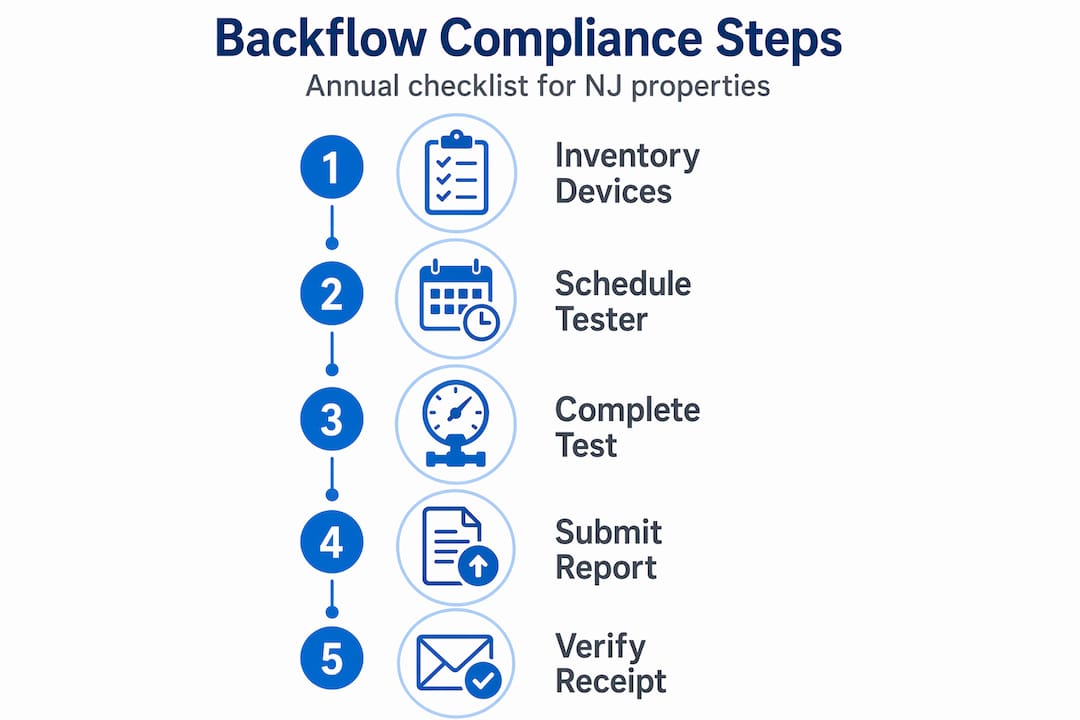
- The testing process from scheduling to submission
- Common pitfalls in backflow compliance
- Verifying compliance and staying current year to year
- My honest take on backflow compliance in NJ
- Let Southjerseybackflow handle your annual deadlines
- FAQ
Key takeaways
| Point | Details |
|---|---|
| NJ requires annual testing | All assemblies on public water connections must be retested yearly and reports submitted within 30 days. |
| Tester certification matters | Only testers with ASSE Series 5000 or equivalent certification qualify. A plumbing license is not enough. |
| Start reminders 60 days early | Set calendar alerts at 60 and 30 days before your deadline to avoid scrambling at the last minute. |
| Not all devices test the same way | Mechanical assemblies with test cocks require annual testing; vacuum breakers typically need visual inspection only. |
| Documentation protects you | Keeping copies of all test reports simplifies future audits, property sales, and any compliance disputes. |
Managing annual backflow deadlines in New Jersey
New Jersey’s backflow prevention rules come from N.J.A.C. 7:10-10, administered by the NJDEP. The core requirement is straightforward: annual retesting and reporting within 30 days applies to every assembly installed on a public water system connection. That 30-day clock starts the moment the test is completed, not when you decide to get around to paperwork.
What surprises many property owners is who enforces this. It is not just the state. Local water purveyors, municipal code officials, and utilities all play a role. Your water purveyor maintains records of every registered backflow device on your property. If a report does not arrive within the required window, they notice. The enforcement can range from written notices to service interruption.
Here is what you need to understand about NJ-specific rules:
- Testing frequency. Testing is required at installation, after any repair, and at least once per year thereafter.
- Tester credentials. New Jersey water purveyors require testers to hold ASSE Series 5000 certification or an equivalent credential. Hiring a licensed plumber who lacks that specific certification is a common and costly error.
- Report destination. Results go to the water purveyor, not to the state directly.
- Timing patterns. Many NJ municipalities assign deadlines tied to your installation date or to a fixed calendar window. Check with your purveyor because the deadline can vary by town.
- Initial vs. annual inspections. The test at installation is a one-time baseline. Annual operational testing is a separate, recurring obligation.
Pro Tip: Contact your local water purveyor directly at the start of each year and confirm the exact deadline for your property. Do not assume the date is the same as the previous year. Some utilities adjust their compliance windows.
Building your backflow testing schedule
Before you can manage a schedule, you need to know what you are managing. Start with a full property inventory. Walk every utility room, mechanical space, and irrigation connection. Write down the location, device type, and serial number of every backflow assembly on your property.
Why does device type matter? Because not all backflow assemblies require the same testing protocol. Mechanical assemblies equipped with test cocks, such as reduced pressure zone assemblies and double check valves, need formal annual testing by a certified tester. Atmospheric vacuum breakers, by contrast, typically only require visual inspection. Conflating these two categories leads to either wasted money or missed compliance obligations.
Once your inventory is complete, follow these steps to build a working schedule:
- Record each device’s last test date. Pull prior reports if you have them. If not, contact your water purveyor. They may have records in their database.
- Identify the annual deadline for each device. For most NJ properties, this aligns with the anniversary of the last test or a purveyor-assigned calendar date.
- Set reminders at 60 and 30 days before each deadline. Sending reminders 60 and 30 days before due dates measurably improves compliance rates. Apply that same logic to your own calendar.
- Verify your tester’s certification before booking. Confirm their ASSE Series 5000 status is current before scheduling. An expired credential means the test result will not be accepted.
- Log everything in one place. Use a spreadsheet, property management software, or a dedicated compliance tracking tool. Paper systems fail when staff changes.
If you receive a letter from your utility about backflow testing, treat it as a deadline notice, not a suggestion. These backflow notification letters carry real consequences if ignored.
Pro Tip: If you manage multiple properties, create a single master compliance calendar that consolidates deadlines across all sites. Reviewing it monthly takes five minutes and prevents the kind of last-minute chaos that results in missed submissions.

The testing process from scheduling to submission
Knowing the steps in order removes most of the stress from annual backflow compliance. Here is how to move through the process cleanly.
- Schedule your certified tester early. Do not wait until the final two weeks before your deadline. Certified testers get booked out, especially in the spring when irrigation systems come back online across NJ.
- Prepare for the appointment. Make sure the tester has clear access to every assembly on your list. Locked mechanical rooms, overgrown irrigation connections, and missing shut-off access all slow the process down and can require a second visit.
- Understand what happens during the test. The tester uses a calibrated gauge kit to measure pressure differentials across the assembly. They check that the device opens and closes at the correct thresholds. The entire process for a single assembly typically takes 15 to 30 minutes depending on the device type and conditions.
- Handle failures immediately. If a device fails the test, it needs repair or replacement before it can pass. Skipping annual tests increases the risk of device failure and potential water contamination, which is exactly the outcome compliance rules exist to prevent. Once repairs are complete, schedule a retest as soon as possible. The 30-day submission clock does not pause while you wait.
- Submit the report to your water purveyor within 30 days. Confirm the submission method your purveyor accepts: some use online portals, others require fax or mail. Do not assume email is acceptable.
- Keep your own copy. File the test report by property address and device. These records matter during property inspections and real estate transactions.
Failure to submit test results on time can lead directly to water service interruption. Water service can be shut off until compliance is fully restored, with no grace period for active users on the property.
Pro Tip: Ask your tester to confirm submission directly to the water purveyor as part of their service. Many certified testers handle this routinely. Having them submit on your behalf eliminates one more opportunity for error.
Common pitfalls in backflow compliance
Even well-organized property managers miss things. These are the mistakes that show up repeatedly and how to avoid each one.
- Assuming a plumbing license equals backflow certification. It does not. NJ rules require ASSE Series 5000 credentials, and a standard plumbing license does not satisfy that requirement. Always ask for the specific certification number and verify it is current.
- Incomplete device inventories. If you do not know a device exists, it will not get tested. Irrigation backflow preventers are the most commonly overlooked, especially on commercial properties with multiple zones.
- Late report submissions. Testing on time is only half the job. The report must land with the water purveyor within 30 days of the test date. Many non-compliance flags come from testing that happened but was never properly reported.
- Ignoring notification letters. Utilities track devices and require documentation through active databases. A letter arriving at your property address is a formal compliance trigger. Treating it as junk mail is a reliable way to end up with a service shutoff notice.
- Applying the same deadline to all devices. Different device types may carry different schedules, and different municipalities within NJ may enforce different windows. Confirm each deadline individually rather than assuming uniformity.
| Mistake | Consequence | Fix |
|---|---|---|
| Unlicensed tester used | Report rejected; deadline missed | Verify ASSE 5000 credentials before booking |
| Device not inventoried | Assembly untested; compliance gap | Full property walkthrough each year |
| Report submitted late | Non-compliance notice; potential shutoff | Submit within 30 days of test date |
| Notification letter ignored | Escalated enforcement action | Respond to all purveyor letters immediately |
| Wrong deadline assumed | Missed annual window | Confirm deadline with purveyor each year |
Verifying compliance and staying current year to year
Completing the test and submitting the report is not the end of your responsibility. You need to confirm that your submission was received and recorded correctly.
| Verification step | When to do it | How |
|---|---|---|
| Confirm report receipt | Within 5 days of submission | Call or email your water purveyor |
| Check compliance database | 2 weeks after submission | Request status from purveyor or check their portal |
| Update device inventory | Once per year, before test season | Physical walkthrough of all mechanical spaces |
| Audit tester credentials | Before each scheduling cycle | Request current ASSE certification documentation |
| Archive test reports | Immediately after receipt | File by address, device, and year |
Because NJ rules tie valid testing to specific tester qualifications, confirming that your tester’s credential was current at the time of testing is something you want on record. If a dispute arises later, that documentation is your defense.
For property owners preparing to sell or refinance, backflow compliance records often come up during due diligence. A clean, organized history of annual test reports signals a well-managed property. A gap in records raises questions that slow transactions down.
Pro Tip: Set a recurring annual calendar event titled “Backflow Audit” for 90 days before your expected test deadline. Use it to review your device inventory, confirm your tester’s credentials, and pull the prior year’s report. Ninety days gives you enough lead time to fix anything before the deadline pressure kicks in.
Working with a professional service that tracks your backflow testing schedule year over year removes the burden of maintaining all of this yourself and significantly reduces the chance of a compliance gap.
My honest take on backflow compliance in NJ
I have worked with enough NJ property owners to notice a consistent pattern. The ones who struggle most are not the ones who forget entirely. They are the ones who rely on a single reminder and assume everything downstream will fall into place. A calendar alert is a useful tool. It is not a compliance system.
What actually works is treating backflow management the same way you treat property insurance renewal: as a fixed annual process with defined steps, assigned responsibility, and verification at the end. I have seen multi-property managers lose track of one building’s device because it was added mid-year and never entered into the main tracking system. That oversight turned into a service interruption for tenants who had nothing to do with the paperwork failure.
The other misconception I encounter constantly is around tester qualifications. Property managers often trust that whoever their plumber sends is qualified. NJ does not work that way. The certification is specific, and the water purveyor will reject a report from an uncertified tester regardless of how well the test was executed.
My strongest advice: build a relationship with your water purveyor’s compliance team. Call them once a year, confirm your device list matches their records, and ask if they see any open items on your account. That five-minute conversation has saved more than a few property owners from surprises. Maintaining consistent processes from inventory through submission is what separates proactive compliance from reactive scrambling.
— Jordan
Let Southjerseybackflow handle your annual deadlines
Staying current with annual backflow compliance in New Jersey takes more than good intentions. It takes certified testers, proper report submission, and a system that does not drop the ball when life gets busy.
Southjerseybackflow works with property owners and managers across New Jersey to schedule testing, handle reporting, and confirm that your assemblies are properly documented with your water purveyor. From the initial appointment to the submitted report, every step is handled by certified professionals who understand the specific requirements that NJ purveyors enforce. If you want to understand exactly how to pass and stay compliant, that resource covers the full picture. For properties with current backflow letters, the notification response service walks you through your next steps without the guesswork.
FAQ
What is the reporting deadline after backflow testing in New Jersey?
Test results must be submitted to your water purveyor within 30 days of the test date per N.J.A.C. 7:10-10. Missing this window can trigger non-compliance notices.
Does a licensed plumber qualify to perform backflow testing in NJ?
No. New Jersey water purveyors require testers to hold ASSE Series 5000 certification or an equivalent credential. A standard plumbing license does not satisfy this requirement.
What happens if I miss my annual backflow testing deadline?
Continued non-compliance can result in water service shutoff until compliance is restored. Service is not restored until testing is completed and the report is submitted.
Do all backflow devices require annual testing?
No. Mechanical assemblies with test cocks require annual certified testing, while some devices like vacuum breakers require visual inspection only. Confirm requirements for each device type with your water purveyor.
How do I confirm my backflow report was received by my water purveyor?
Contact your purveyor directly within five days of submitting your report. Many utilities maintain compliance databases where your submission status can be verified. Confirming receipt is the final step in a complete annual compliance cycle.
Pingback: 2026 Regulatory Deadlines for Backflow: NJ Guide
Pingback: Backflow Mandates in 2026: What NJ Owners Must Know
Pingback: Backflow Hazard Assessment Explained for NJ Owners