
TL;DR:
- New Jersey property owners with testable backflow prevention assemblies must conduct annual certified testing and submit reports to avoid penalties and service disconnection in 2026.
- Municipal enforcement varies, requiring owners to stay informed about local deadlines, reporting methods, and permit requirements to ensure compliance.
Backflow mandates in 2026 legally require New Jersey property owners with testable backflow prevention assemblies to conduct annual inspections, submit certified test reports, and maintain documented compliance records. A backflow prevention assembly is a device installed on your plumbing to stop contaminated water from flowing backward into the public drinking supply, a process called cross-connection control. These are not optional upgrades. They are enforceable obligations tied to your water service, and the consequences of ignoring them range from fines to water shutoff. If you own or manage a property in New Jersey with any qualifying device, this guide covers exactly what you need to know before your next deadline.
What backflow mandates in 2026 actually require from NJ property owners
New Jersey’s 2026 backflow regulations build on existing state plumbing codes and cross-connection control requirements enforced through local water providers. The core obligation is straightforward: if your property has a testable backflow prevention assembly, you must have it tested at installation, after repair, and annually at minimum. That annual requirement is not a suggestion. Water providers treat it as a condition of service.
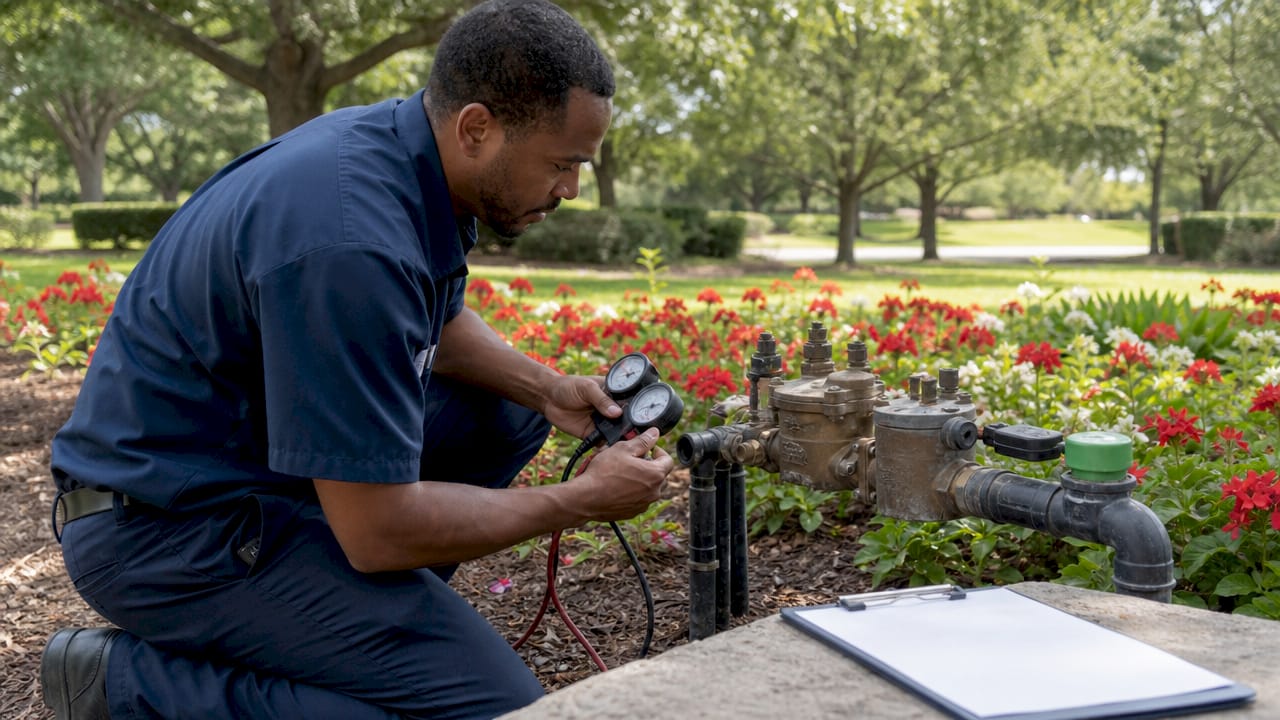
The public health stakes are real. Backflow assemblies prevent contaminated water from reversing into the public supply, protecting not just your building but every property connected to the same water main. A failed or untested device is a direct risk to your neighbors and your community. Regulators treat it accordingly.
Understanding the NJ backflow compliance roadmap for 2026 means knowing three things upfront: which properties are covered, what the testing process requires, and how your specific municipality enforces the rules. Each of those areas has nuances that catch property owners off guard.
Which properties and devices are subject to NJ backflow requirements
Not every property in New Jersey triggers a backflow testing mandate, but the list is broader than most owners expect. Properties with irrigation systems, fire suppression lines, boilers, or other cross-connections typically require backflow devices and mandatory annual testing. That covers a significant share of both commercial and residential properties across the state.
The following property and device categories commonly fall under New Jersey’s backflow testing requirements:
- Commercial properties of nearly any type, including retail, office, industrial, and multi-family buildings with shared plumbing systems
- Residential properties with in-ground irrigation systems, which create a direct cross-connection between the potable water supply and soil or fertilizer
- Properties with fire suppression systems, including sprinkler lines that connect to the public water main
- Buildings with boilers or HVAC systems that use water and connect back to the plumbing supply
- Car washes, restaurants, medical facilities, and laboratories where chemical or biological contamination risk is elevated
- Any property where a new backflow prevention device was recently installed or repaired, which triggers an immediate post-service test requirement
For residential owners, the most common trigger is an irrigation system. If your home has an in-ground sprinkler setup connected to municipal water, you almost certainly have a testable backflow preventer on that line. The NJ residential backflow guide for homeowners explains exactly where to locate your device and what testing involves. Ownership changes and major plumbing renovations also reset the compliance clock, requiring fresh testing regardless of when the previous test occurred.
What are the annual testing and certification requirements for NJ backflow devices
Annual testing in New Jersey follows a structured process with specific credentialing, reporting, and deadline requirements. Getting any one of these wrong can trigger penalties even if your device passes the physical test.
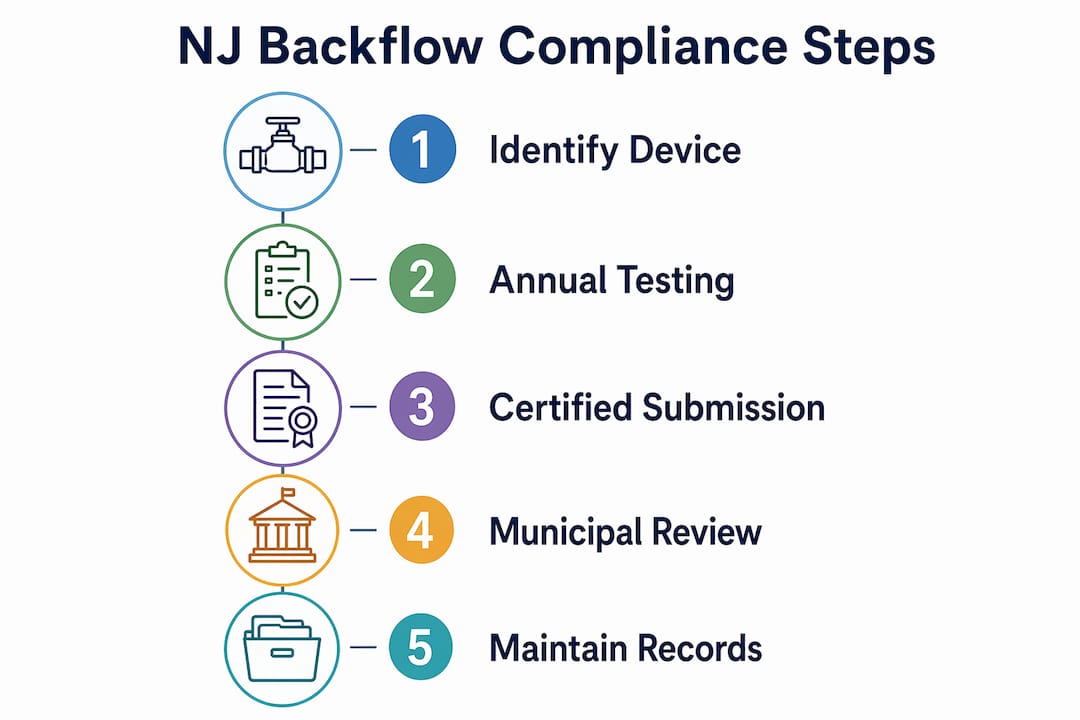
Here is the sequence every property owner should follow:
- Confirm your device type and location. Identify whether you have a reduced pressure zone assembly (RPZ), double check valve, or pressure vacuum breaker. Each type has specific test procedures, and your tester needs to know in advance.
- Hire a certified tester. Testing must be performed by certified professionals, and test reports must be submitted to local water authorities within 10 to 30 days of the test date. Hiring an uncertified technician voids the test entirely.
- Schedule before your deadline, not after. Water providers mail reminders 60 to 90 days before annual testing is due, and failure to comply can lead to water shutoff. That window sounds generous until you factor in tester availability during peak season.
- Review the test results on-site. If your device fails, you need a repair or replacement completed before the report submission deadline. A failed test with no follow-up repair is treated the same as no test at all.
- Confirm report submission. Your tester submits the results to your water authority, but you should request a copy for your own records. Submission confirmation protects you if paperwork gets lost.
- Attach the compliance tag. Compliance tags listing technician name, certification number, and service details must be attached to the device after service. This is becoming standard practice across New Jersey and several other states as of 2026.
Pro Tip: Schedule your annual backflow test in January or February. Spring is the busiest season for certified testers in New Jersey because irrigation systems come back online, and appointment slots fill up fast. Early scheduling also gives you time to address any repair needs before your deadline.
How do NJ backflow mandates vary by municipality
Statewide backflow regulations set the floor, but New Jersey municipalities have significant latitude in how they interpret and enforce those rules. Even when statewide codes remain stable, municipalities frequently vary in enforcement and documentation requirements. That variation creates real compliance risk for property owners who assume one set of rules applies everywhere.
The table below illustrates the key differences property owners encounter across New Jersey municipalities:
| Area of variation | Statewide baseline | Municipal interpretation |
|---|---|---|
| Testing deadline | Annual, tied to device installation date | Some municipalities set fixed calendar deadlines (e.g., March 31 or June 30) |
| Report submission window | 10 to 30 days post-test | Some localities require submission within 10 days; others allow 30 |
| Notification method | Water provider mailing | Some municipalities also post notices online or require owner acknowledgment |
| Penalty structure | Fines starting around $100 | Some municipalities add daily penalties for ongoing violations |
| Permit requirements | Varies by device type | Some towns require a separate permit for device installation or replacement |
The practical takeaway is that you cannot rely solely on state-level guidance. Municipalities often vary in how strictly they enforce backflow testing, making it necessary for property owners to stay informed via local notices and utility updates. Contact your local building department and water provider directly at the start of each year to confirm your specific deadlines and documentation requirements. Property managers overseeing multiple sites across different towns should maintain a municipality-by-municipality compliance calendar.
Practical steps to stay compliant with 2026 backflow requirements
Compliance is not complicated, but it does require organization. The property owners who get hit with fines are rarely the ones who ignored the rules entirely. They are usually the ones who meant to handle it and ran out of time.
The following steps keep you ahead of the process:
- Audit your current records. Pull your last test report and check the submission date, the tester’s certification number, and whether a compliance tag was attached to the device. Keeping detailed backflow testing records and permits helps in audits and prevents disputes with your water authority.
- Identify all testable devices on your property. Many property owners discover they have more than one backflow preventer once they do a full walkthrough. Irrigation lines, fire suppression systems, and boiler connections may each have their own device.
- Select a certified tester with New Jersey-specific experience. Not all certified testers know the reporting quirks of every NJ municipality. A tester who regularly works in your county will know the local submission portal, the preferred report format, and the deadline your water authority actually enforces.
- Build repair time into your schedule. Fines start at around $100 with potential daily penalties for ongoing violations. If your device fails the test, you need time to repair or replace it and retest before the submission deadline. Scheduling your test with six weeks to spare gives you that buffer.
- Store documentation in one place. Keep digital and physical copies of every test report, repair invoice, compliance tag photo, and water authority confirmation. Organize them by property address and test year.
Pro Tip: Ask your certified tester to send you the submitted report directly, not just a copy. Confirm the submission reference number with your water authority within a week of testing. This two-step check catches submission errors before they become compliance violations.
Managing annual backflow deadlines across multiple NJ properties gets complex fast. A consistent tracking system, combined with a reliable certified tester, eliminates most of the risk.
Key takeaways
New Jersey property owners with testable backflow prevention assemblies must complete annual certified testing, submit reports within the required window, and track local municipal deadlines to avoid fines and water service interruption in 2026.
| Point | Details |
|---|---|
| Annual testing is mandatory | Any testable backflow prevention assembly requires certified testing at least once per year. |
| Certified testers only | Tests performed by uncertified technicians are invalid and will not satisfy compliance requirements. |
| Municipal rules vary | Deadlines, submission windows, and penalty structures differ across New Jersey towns and water providers. |
| Documentation protects you | Retain test reports, compliance tags, and submission confirmations to defend against disputes or audits. |
| Early scheduling prevents penalties | Booking tests in winter avoids the spring rush and leaves time for repairs before deadlines. |
Why backflow compliance deserves more than a checkbox
I have worked with enough New Jersey property owners to know that backflow testing gets treated like a parking ticket. You pay it when you have to, and you forget about it until the next notice arrives. That mindset is expensive.
The properties that consistently fail tests or miss deadlines share a common pattern. Nobody owns the process. The property manager assumes the building owner scheduled it. The building owner assumes the property manager handled it. The water authority sends a shutoff notice, and suddenly everyone is scrambling to find a certified tester on a two-day deadline in April.
What I have found actually works is treating backflow compliance the same way you treat property insurance renewal. Put it on the calendar in January. Assign one person to own the process. Keep a single folder, physical or digital, with every document from every test. That folder has saved clients from fines more than once when a water authority claimed a report was never received.
The hidden costs of backflow failure go beyond fines. Emergency repairs on a failed device cost significantly more than a scheduled annual test. Water service interruption on a commercial property can mean lost revenue, tenant complaints, and lease disputes. None of that is worth the cost of skipping a $75 to $150 annual test.
The 2026 regulatory environment in New Jersey is not dramatically different from 2025, but enforcement is tightening. Water providers are following through on shutoff threats more consistently, and municipalities are cross-referencing test submission records more carefully. Proactive compliance is no longer just good practice. It is the only strategy that reliably avoids disruption.
— Jordan
Stay compliant with Southjerseybackflow
Southjerseybackflow serves New Jersey property owners and managers who need certified backflow testing, accurate report submission, and documentation they can rely on. Every technician on the team holds current New Jersey certification and knows the specific requirements of local water authorities across the state.
Whether you manage a single residential property with an irrigation system or a portfolio of commercial buildings across multiple counties, Southjerseybackflow handles the scheduling, testing, and paperwork so nothing falls through the cracks. Read the full NJ backflow testing guide to understand exactly what passing, submitting, and staying compliant looks like in practice. Property owners in Ocean County can also explore local service options tailored to their area. Contact Southjerseybackflow today to schedule your 2026 inspection before the spring deadline rush begins.
FAQ
Is backflow testing legally required in New Jersey?
Yes. New Jersey property owners with testable backflow prevention assemblies are legally required to have them tested annually by a certified professional and submit results to their local water authority. Non-compliance can result in fines and water service disconnection.
What happens if I miss my backflow testing deadline?
Fines typically start at around $100 and can escalate with daily penalties for ongoing violations. Water providers may also disconnect service for properties that remain non-compliant after the deadline.
Who is qualified to test a backflow prevention device in NJ?
Only state-certified backflow testers are authorized to perform compliance testing in New Jersey. Test results submitted by uncertified technicians are not accepted by water authorities and do not satisfy the annual requirement.
How do I know if my property has a testable backflow device?
Properties with in-ground irrigation systems, fire suppression lines, boilers, or commercial equipment connected to municipal water almost always have a testable backflow preventer. Check near your water meter, at the irrigation shutoff, or at the fire suppression connection point. The backflow preventer FAQs from Southjerseybackflow cover common identification questions in detail.
Do backflow requirements differ between residential and commercial properties in NJ?
Commercial properties face broader requirements due to more cross-connection points, but residential properties with irrigation systems or fire suppression lines carry the same annual testing obligation. The residential backflow protection guide for NJ homeowners explains the specific rules that apply to single-family and small multi-family properties.