TL;DR:
- Property owners in New Jersey can lower backflow testing costs by negotiating based on clear, itemized quotes. Tiered pricing benefits properties with multiple devices and upfront retest fees help avoid surprise expenses. Ensuring the tester is certified and scheduling during off-peak times further reduces overall compliance costs.
Negotiating backflow testing price is a direct way for New Jersey property owners to reduce compliance costs without sacrificing service quality. Local water authorities require annual backflow testing for most commercial and residential properties with backflow prevention assemblies. Fees across the state range from $75 to $300 per device, depending on location, device type, and included services. That spread is wide enough to justify every property owner asking harder questions before signing any service agreement. Southjerseybackflow works with property owners across New Jersey to provide transparent, certified testing at competitive rates.
What are typical backflow testing pricing structures in New Jersey?
Backflow testing fees follow a predictable structure once you know what to look for. Most providers charge a higher rate for the first device and a lower rate for each additional device on the same property. Market pricing typically runs $125–$250 for the first device and $40–$100 for each additional device. That tiered model rewards property owners who manage multiple assemblies, making bundling one of the most reliable ways to reduce per-device cost.
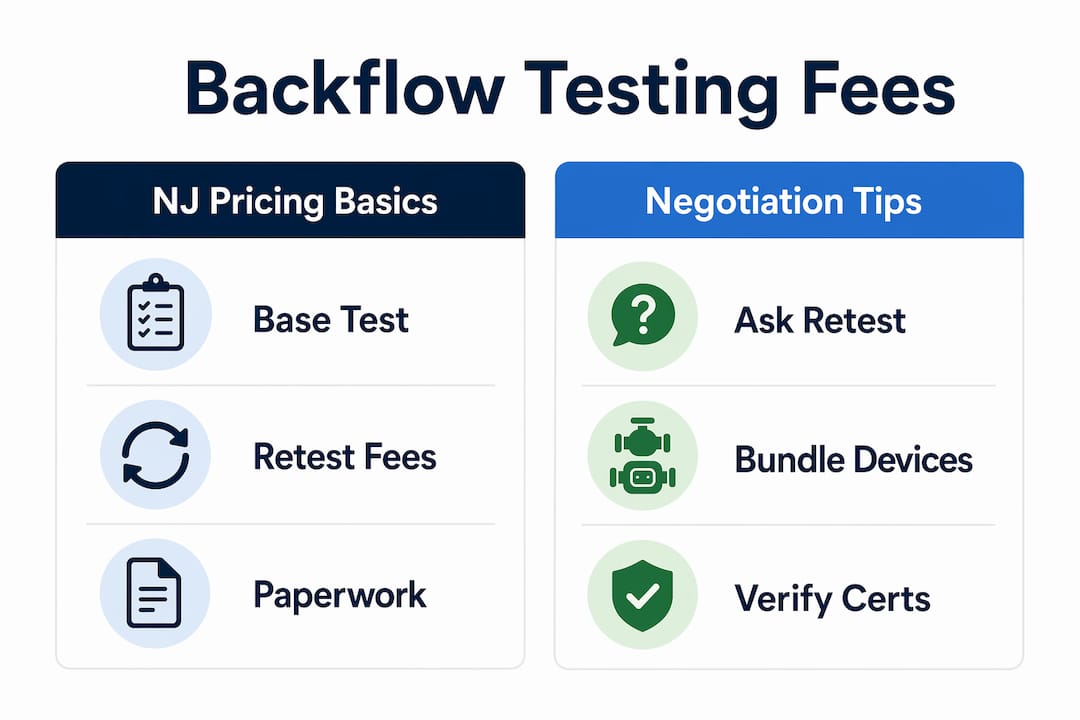
Beyond the base test fee, several other charges appear regularly in quotes. Retesting after a failed inspection is priced separately, commonly $40–$150 depending on the device and timing. Administrative fees for submitting paperwork to the local water authority add another layer of cost that many owners overlook until the invoice arrives.
The table below breaks down the typical fee categories you will encounter when comparing backflow services pricing in New Jersey.
| Fee Category | Typical Range | Notes |
|---|---|---|
| First device test | $125–$250 | Higher rate; includes initial inspection |
| Additional devices | $40–$100 each | Per-device discount for multiple assemblies |
| Retest after failure | $40–$150 | Separate charge; request upfront pricing |
| Paperwork submission | Varies | Some providers include it; others bill separately |
| After-hours or rush service | Varies | Confirm before scheduling |
Understanding each line item gives you a clear baseline before any negotiation begins. A quote that bundles everything into one number is harder to challenge and easier to inflate.
How to prepare effectively to negotiate backflow testing prices

Preparation is the single biggest factor in a successful negotiation. Property owners who walk into a pricing conversation with documented quotes and a clear scope consistently secure better terms than those who call one provider and accept the first number offered.
Follow these steps before contacting any provider:
- Gather 2–3 written estimates. Request quotes from multiple certified testers with identical scope descriptions. Written estimates with explicit scope comparison prevent providers from quoting different services at similar prices, which makes comparison meaningless.
- Request itemized pricing. Ask each provider to separate the base test fee, retest fee, repair costs, and paperwork submission charges. Bundled quotes obscure the real cost.
- Identify potential hidden costs. Ask directly about access fees for hard-to-reach assemblies, permit fees, and after-hours charges. These costs appear after the fact when not addressed upfront.
- Verify tester certification. Certified backflow testers must hold credentials recognized by your local water authority. An uncertified tester cannot submit valid test results, which means your property remains out of compliance regardless of what was tested.
- Count your assemblies. Know the exact number of backflow prevention devices on your property before requesting quotes. Multi-device properties qualify for tiered pricing, and knowing your count lets you negotiate from a position of fact.
Pro Tip: Ask each provider what their retest fee is before the test happens. A provider who hesitates or refuses to quote that number upfront is signaling that the fee will be high or undefined.
What negotiation strategies work best for backflow testing costs?
The most effective negotiation strategy is structured comparison. Property owners who frame the conversation around specific line items, rather than total price, consistently get more movement from providers.
- Lead with your device count. Multi-assembly properties often receive 10–15% discounts on bundled annual testing. State your count clearly and ask what tier pricing applies.
- Ask for the retest schedule upfront. Providers who price retesting transparently are easier to work with if a device fails. Knowing the retest cost before the test removes a significant source of surprise charges.
- Request separation of administrative fees. Paperwork submission to the New Jersey water authority is a real cost. Some providers include it; others charge separately. Separating base test and retest scopes in quotes leads to more transparent negotiations and fewer surprise costs.
- Use competing quotes as reference points. You do not need to name other providers. Simply stating that you have received quotes ranging from a specific low to a specific high gives the provider context and signals that you have done your homework.
- Negotiate annual contracts. If your property requires testing every year, ask about a multi-year rate or a preferred-client discount for scheduling in advance. Providers value predictable revenue and often reduce per-visit fees for guaranteed annual bookings.
- Clarify rush and scheduling fees. Ask whether standard scheduling is included or whether peak-season appointments carry a surcharge. Scheduling during slower periods, typically late fall or winter, can reduce costs without any formal negotiation.
Pro Tip: Frame your negotiation around total annual cost, not just the base test fee. A provider with a lower base rate but high retest and paperwork fees may cost more overall than one with a slightly higher base rate and no add-ons.
What pitfalls should you avoid when negotiating backflow testing prices?
The most common mistake property owners make is choosing the lowest bid without examining what it includes. Low bids may result in compromised service quality or missing compliance steps. A test performed by an uncertified tester produces results that your water authority will not accept, leaving you liable for non-compliance penalties.
Watch for these specific traps:
- Vague scope descriptions. A quote that says “backflow testing” without specifying device count, retest policy, or paperwork handling is not a real quote. Reject it and ask for detail.
- No retest pricing disclosed. Providers who refuse to quote retest fees upfront often charge premium rates after a failure, when you have no leverage.
- Bundled quotes with no line items. Clear separation in quotes helps negotiation. A single-number quote prevents you from identifying which component is overpriced.
- Unverified certification. Confirm that the tester appears on your local water authority’s approved list before scheduling. Certification is not optional in New Jersey.
- No policy on repairs or replacements. Ask what happens if a device fails and needs repair. Some providers mark up parts significantly or charge a separate trip fee for repair visits.
“The cheapest quote is rarely the best deal. A provider who cannot explain their retest fee, does not carry jurisdictional certification, or bundles everything into one opaque number is a liability, not a bargain. Compliance failures in New Jersey carry real financial consequences, and the cost of a non-compliant test always exceeds the cost of a proper one.”
Understanding the hidden costs of backflow failure reinforces why cutting corners on provider selection is a false economy.
How to evaluate total compliance cost when negotiating backflow contracts
The base test fee is only one part of your actual annual cost. Property owners who negotiate only on that number often pay more in total than those who evaluate the full picture.
Use this framework to estimate your real annual cost before finalizing any agreement:
| Cost Component | Questions to Ask | Why It Matters |
|---|---|---|
| Base test fee | Per device or flat rate? | Sets the floor for comparison |
| Retest fee | What triggers it? What does it cost? | Devices fail; this cost is likely, not hypothetical |
| Paperwork submission | Included or billed separately? | Required for compliance; not optional |
| Repair or replacement | Who handles it? At what markup? | Unplanned repairs are the largest variable cost |
| Scheduling flexibility | Same-day available? Rush fees? | Compliance deadlines are fixed; delays cost money |
Structuring bids into per-device base price, additional device tiers, retest schedule, and paperwork responsibilities enables clear cost comparisons across providers. That structure also gives you a documented baseline for future negotiations when your annual testing cycle comes around again.
Compliance reporting deadlines in New Jersey are set by local water authorities and are not negotiable. A provider who cannot meet your deadline reliably is not a cost-effective choice regardless of their base rate. Factor scheduling reliability into your evaluation alongside price. Southjerseybackflow handles compliance reporting and submission as part of its standard service, which removes one variable from your total cost calculation.
Key Takeaways
Negotiating backflow testing price in New Jersey requires understanding the full cost structure, verifying tester certification, and comparing itemized quotes across multiple providers.
| Point | Details |
|---|---|
| Know the pricing tiers | First-device rates run $125–$250; additional devices drop to $40–$100 each. |
| Request itemized quotes | Separate base test, retest, paperwork, and repair fees before comparing providers. |
| Verify certification first | Only testers on your water authority’s approved list can submit valid results. |
| Bundle for discounts | Multi-assembly properties can negotiate 10–15% off bundled annual testing. |
| Evaluate total annual cost | Add retest probability and paperwork fees to the base rate for a true cost comparison. |
What I’ve learned from watching NJ property owners negotiate backflow pricing
The property owners who get the best deals are not the ones who push hardest on price. They are the ones who ask the most specific questions. A provider who can answer “What is your retest fee if the device fails on the first visit?” without hesitation is a provider who has thought through their pricing honestly. That transparency is worth more than a $20 discount on the base test.
The New Jersey market has real variation in how providers structure their fees. I have seen quotes for identical properties differ by more than $100 per device, not because one provider is gouging but because one quote included paperwork submission and the other did not. That detail only surfaces when you ask for line items.
Certification is the one area where I would not negotiate at all. An uncertified tester is not a cheaper option. It is a compliance failure waiting to happen. Check the approved list from your local water authority before you schedule anything. The questions to ask before booking service are straightforward, and any reputable provider will answer them without hesitation.
Timing matters more than most owners realize. Providers are busier in spring and summer when compliance deadlines cluster. Scheduling in the fall or early winter often opens up more room for negotiation, simply because demand is lower and providers want to fill their calendars.
— Jordan
Certified backflow testing with transparent pricing in New Jersey
Property owners who want clear pricing without the guesswork have a direct option with Southjerseybackflow.
Southjerseybackflow serves property owners across New Jersey with certified testers who appear on local water authority approved lists. Every quote includes itemized pricing for the base test, retest fees, and paperwork submission, so you know your total cost before the technician arrives. Multi-device properties receive tiered pricing automatically, and the team handles compliance reporting directly with your water authority. Whether you manage a single residential property or a portfolio of commercial buildings, Southjerseybackflow provides the documentation and follow-through that keeps you compliant. Request a quote and get a line-item breakdown for your property today.
FAQ
What is a fair price for backflow testing in New Jersey?
Backflow testing fees in New Jersey typically range from $75 to $300 per device, depending on location, device type, and included services. Properties with multiple assemblies generally pay less per device through tiered pricing.
How do I get a discount on backflow testing?
Multi-assembly bundling is the most reliable way to reduce per-device cost, with discounts of 10–15% common for annual contracts covering multiple devices. Scheduling during off-peak periods and requesting itemized quotes from multiple providers also improves your negotiating position.
What should an itemized backflow testing quote include?
A complete quote should separate the base test fee, retest fee, paperwork submission cost, and any repair or trip charges. Quotes that clearly delineate labor, materials, and retesting fees give you the clearest basis for comparison.
Does my backflow tester need to be certified in New Jersey?
Yes. Certified backflow testers must hold credentials recognized by your local water authority and appear on its approved tester list. Results submitted by an uncertified tester are not accepted, leaving your property out of compliance.
What happens if my backflow device fails the test?
A failed test triggers a retest, which is billed separately and commonly costs $40–$150 depending on the device and provider. Ask for the retest fee schedule before the initial test so there are no surprises if a device does not pass.