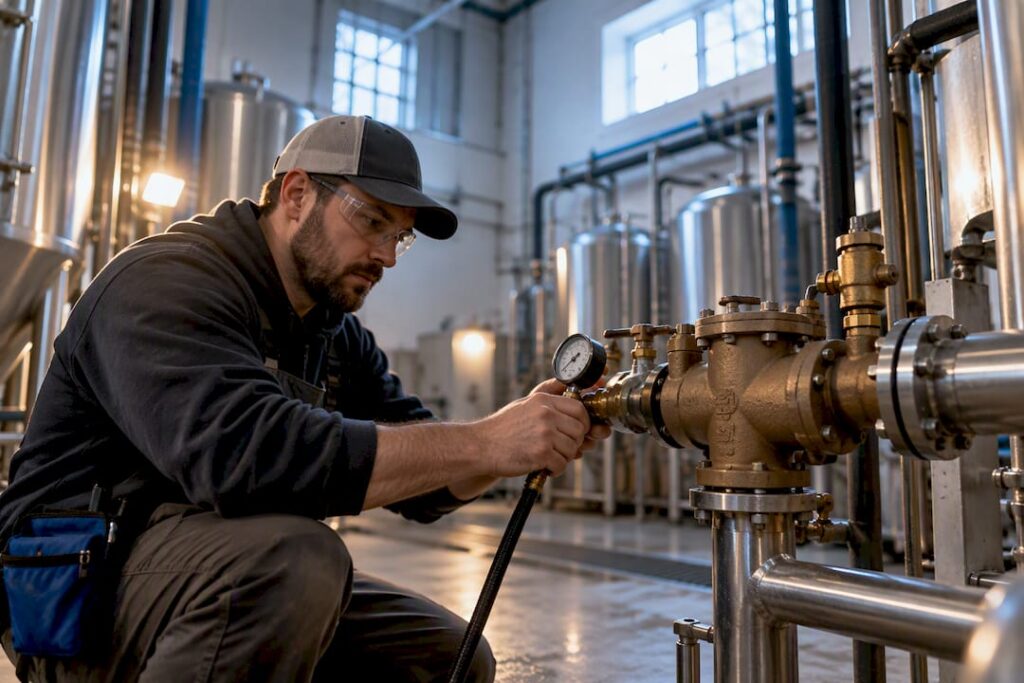
Yes: New Jersey classifies breweries as facilities with cross-connection hazards, which usually means a Physical Connection Permit, a reduced pressure zone (RPZ) assembly at the water entrance, and testing on whatever cadence that permit sets, often quarterly. A certified tester recognized by NJDEP must run the test and issue a Certificate of Compliance. Skip the permit or the test window, and you risk a fine or an interrupted water service.
TL;DR:
- Breweries with process or chemical hazards must obtain and annually renew a Physical Connection Permit to remain compliant with NJ backflow regulations.
- Most brewery-specific devices, especially those handling chemicals or chemicals, require a reduced pressure zone assembly installed on the customer’s side, close to the water entrance.
- Quarterly testing is mandatory for permitted devices, requiring certified testers and detailed reports, while non-permitted equipment tests annually under the UCC.
- Failing a test requires immediate repairs, re-testing, and timely report submission to avoid permit lapses or water service disruptions.
- Using a certified, full-service backflow provider ensures proper testing, documentation, and prompt handling of repairs or permit renewals.
Table of Contents
- Which Facilities Trigger NJ Backflow Rules, and Why Breweries Qualify
- Physical Connection Permit: When You Need One, and How to Renew It
- Which Backflow Devices Breweries Need, and Where They Go
- Testing Cadence, Who Can Test, and How Results Get Filed
- Brewery-Ready Installation and Permit Checklist
- What Happens When a Device Fails, and What Comes Next
- How Southjerseybackflow Supports Brewery Compliance
- An Editorial Take on Brewery Backflow Compliance in NJ
- Schedule Testing, Repairs, or Permit Help With Southjerseybackflow
- Sources
- FAQ
Which Facilities Trigger NJ Backflow Rules, and Why Breweries Qualify
Under N.J.A.C. 7:10-1.3, a “facility with cross-connection hazards” is any property where a public water connection comes into contact with a process, chemical, or non-potable water use that could siphon contaminants back into the drinking water main. Breweries land squarely on that list, and it’s not a technicality. Brewhouse cleaning chemicals, glycol chilling loops, CO2 and nitrogen delivery lines, and reclaimed rinse water for bottling all create the kind of pressure differential that can pull contaminated water backward into the public system.
DEP guidance on physical connections spells out the underlying logic: any tie between a public water main and an “unapproved water supply” (a private well, a reused process line, or a non-potable tank) is a public health hazard until it’s protected, and the department’s own examples specifically name breweries among the facility types it expects to see applying for permits.
Common brewery-specific triggers include:
- Glycol chiller makeup water lines tied into the domestic supply
- Bottling and canning line rinse-water recovery systems
- Keg washers and cleaning-in-place (CIP) systems using caustic or acid solutions
- Fire suppression lines combined with domestic service in the same building
- Wastewater pretreatment systems that draw from or discharge near potable lines
If your water supplier or the DEP flags any of these during a facility review, they can require a permit and device even before you’ve had an incident; you can also explore local support for maintaining your compliance via Credit Card Processing & POS Systems Newark, NJ | Merchant Solutions Corp.
Physical Connection Permit: When You Need One, and How to Renew It
Any brewery with a connection between the public water system and an unapproved supply needs a Physical Connection Permit, and the owner, not the water utility, is responsible for obtaining it. NJDEP’s Physical Connection Permit guidance confirms the permit must be renewed every year, and renewal depends on submitting current test results for every device it covers.
Getting the paperwork right the first time saves months of back and forth. Here’s the sequence:
- Pull Form BWSE-PCI-145 and complete the facility and device inventory sections in full.
- Attach a site drawing showing the water entrance, meter location, and every backflow assembly.
- Get a signature or acknowledgment from your public water system confirming the connection details.
- Submit the application fee along with the completed form and drawings.
- Once approved, mark your calendar for annual renewal and quarterly testing on any device the permit designates.
Miss the annual renewal and the permit lapses, which can trigger a compliance letter or a service restriction until you refile.
Which Backflow Devices Breweries Need, and Where They Go
Most brewery hazards call for a reduced pressure zone (RPZ) assembly, not a double check valve assembly (DCVA). The difference matters: a DCVA protects against backpressure and backsiphonage for non-health hazards, while an RPZ adds a relief valve that dumps water to atmosphere if either check fails, which is why it’s the standard for chemical, process, or CIP connections. N.J.A.C. 7:10-10.3 sets the installation parameters for both device types.
Installation rules that inspectors actually check include:
- Device installed on the customer side of the meter, as close to the water entrance as practical
- Test cocks accessible for a certified tester without disassembly
- Elevation between roughly 12 and 60 inches off the finished floor
- No pits or below-grade vaults for RPZ assemblies, since the relief valve needs somewhere to discharge
- Freeze and flood protection, whether that’s an insulated enclosure or a heated mechanical room
- Detector-check assemblies where fire suppression shares a line with domestic or process water
A brewery that can’t shut down production for testing, think a taproom with a packed tasting schedule, may need a redundant, parallel device setup so one assembly can be isolated for testing while the other keeps water flowing. Document that configuration in your permit application, not as an afterthought after the DEP asks why you have two devices where one is expected. If you’re speccing new equipment, the RPZ installation guide walks through code-compliant placement in more detail.
Testing Cadence, Who Can Test, and How Results Get Filed
Two separate clocks run on brewery backflow devices, and mixing them up is one of the most common compliance mistakes. Devices covered under a Physical Connection Permit test quarterly, as DEP’s permit guidance requires. Devices that fall only under the baseline Uniform Construction Code plumbing subcode, without a DEP permit attached, test annually per DCA Bulletin 99-2. A brewery with a permitted process connection is almost always on the quarterly schedule for that device, even if other assemblies on the same property sit on the annual cycle.
Testing frequency at a glance:
| Trigger | Testing cadence | Governing authority |
|---|---|---|
| DEP Physical Connection Permit device | Quarterly | NJDEP permit guidance |
| UCC plumbing subcode baseline (no DEP permit) | Annual | DCA Bulletin 99-2 |
Only testers certified by an agency NJDEP recognizes can perform the test, and a municipal plumbing inspector cannot substitute for that certification, even during a routine walkthrough. A passing test produces a Certificate of Compliance valid for one year, though a quarterly-permit device still needs the next quarter’s test regardless of that certificate’s validity window.
A compliant report needs to show the device type and serial number, its exact location, the test date, pass or fail results by check valve, the tester’s certification number, and a signature. Depending on your setup, that report goes to the municipal plumbing subcode official, your public water system, or DEP directly when the permit requires it. The RPZ testing guide breaks down what testers check step by step.
Brewery-Ready Installation and Permit Checklist
Getting ahead of an inspection beats scrambling to answer questions on the spot. Work through this before you submit a permit application or schedule a first test:
- Inventory every device and service line, including anything added during a recent expansion or renovation.
- Map process connections and flag what’s flowing through them (glycol, caustic, rinse water, CO2 condensate).
- Confirm an RPZ is specified for any process or chemical hazard, not a DCVA.
- Verify test cocks are reachable, full-port ball shutoffs are installed on smaller devices, and an upstream strainer protects the assembly from debris.
- Check elevation and clearance meet the 12 to 60 inch range with no below-grade pit.
- Line up a certified tester and confirm their NJDEP recognition before the test date, not after.
- Draft your redundancy plan now if production can’t tolerate a shutdown for testing.
Pro Tip: Keep a single binder, physical or digital, with your permit, device inventory, drawings, and every test report going back three years. When a water authority or DEP reviewer asks for history, that binder turns a two-week records hunt into a five-minute email.
What Happens When a Device Fails, and What Comes Next
A failed test means repair or replacement, not a warning to note and revisit later. Municipal officials or DEP set the retest window, and running past it risks losing your Certificate of Compliance entirely.
Replacing a backflow preventer, not just repairing it, typically requires its own permit, and combined fire and domestic lines may need a joint review from both the fire subcode official and the water authority. A leaking first check that causes RPZ discharge during testing is one of the more common failure points, and it needs repair before the device can pass. Miss a report deadline on top of a failed device, and you’re looking at permit expiration, fines, or a water service restriction until you’re back in compliance. If a device just failed, the retest after repair guide covers realistic turnaround windows.
How Southjerseybackflow Supports Brewery Compliance
Handling a failed test, a permit renewal, and a certified retest all in the same week is exactly where breweries lose time they don’t have. Commercial backflow service providers work with commercial properties across New Jersey on the pieces that matter most for a facility like yours:
- Commercial backflow device testing and certification for permitted and UCC-baseline devices alike
- Rebuilds and repairs when a device fails and needs a fast turnaround before a retest deadline
- Custom enclosure installation for devices that need freeze or flood protection
- Direct filing of test reports with water authorities, so paperwork doesn’t sit on someone’s desk
A certified local tester who also handles the filing side removes one of the biggest compliance risks: a passed test that never actually reaches the water authority or DEP on time. That gap, more than any single testing mistake, is what turns a routine renewal into a permit lapse.
An Editorial Take on Brewery Backflow Compliance in NJ
Most brewery compliance advice treats backflow prevention as a one-time installation problem, get the RPZ in, pass one test, move on. That’s backwards. The real risk in New Jersey isn’t the device itself; it’s the paperwork rhythm around it. A permit that lapses because nobody renewed it on the anniversary date causes more disruption than a device that occasionally needs a rebuild kit.

The quarterly versus annual testing split trips up more brewery operators than any technical detail about RPZ versus DCVA. Owners assume one annual test covers everything, then get a compliance letter because their DEP-permitted process line was due quarterly three months earlier. If you take one thing from this article, make it this: figure out which testing clock applies to which device before you build your maintenance calendar, not after a missed deadline forces the question.
Redundancy planning gets underrated too. Breweries running continuous fermentation or packaging schedules treat isolation valves as a nice-to-have until a tester shows up and the whole line has to stop. Build that into your permit application from day one.
— Jordan
Schedule Testing, Repairs, or Permit Help With Southjerseybackflow
Some backflow service providers offer combined testing, repairs, enclosure installation, and filing with water authorities to streamline compliance without the delays that come from juggling multiple vendors.
If your brewery has a Physical Connection Permit renewal coming up, a device that just failed a test, or you’re still working out which assembly your process lines need, request a quote for commercial backflow testing and certification and get a certified tester on the calendar before your next deadline hits.
Sources
- N.J.A.C. 7:10-1.3 (facility definitions) — Cornell LII
- Physical Connection Permit Processing – NJDEP
- Application form for Initial Physical Connection Permit (BWSE-PCI-145)
FAQ
Is Backflow Testing Required in NJ?
Yes. Any testable backflow preventer must be tested before final inspection and then on an ongoing basis, annually under the UCC baseline set by DCA Bulletin 99-2, or quarterly if the device is covered under a DEP Physical Connection Permit. One- and two-family homes are exempt from this requirement.
What Is the NJ Plumbing Code Requirement for Backflow Preventers?
The Uniform Construction Code plumbing subcode requires testable backflow preventers at facilities with cross-connection hazards, tested annually by a certified agency recognized by NJDEP. Breweries with a DEP-permitted process connection face the stricter quarterly cadence on top of that baseline.
Where Are Backflow Devices Required?
Devices are required anywhere a public water connection meets a hazard, chemical use, process water, non-potable reuse, or an unapproved supply, as defined under N.J.A.C. 7:10-1.3. For breweries, that typically means the water entrance serving glycol systems, CIP lines, and bottling or canning equipment.
Does a Backflow Preventer Require a Permit?
Installing or replacing a backflow preventer tied to an unapproved water supply generally requires a Physical Connection Permit from NJDEP, renewed annually. Southjerseybackflow can help breweries prepare the application, drawings, and device inventory Form BWSE-PCI-145 requires.