
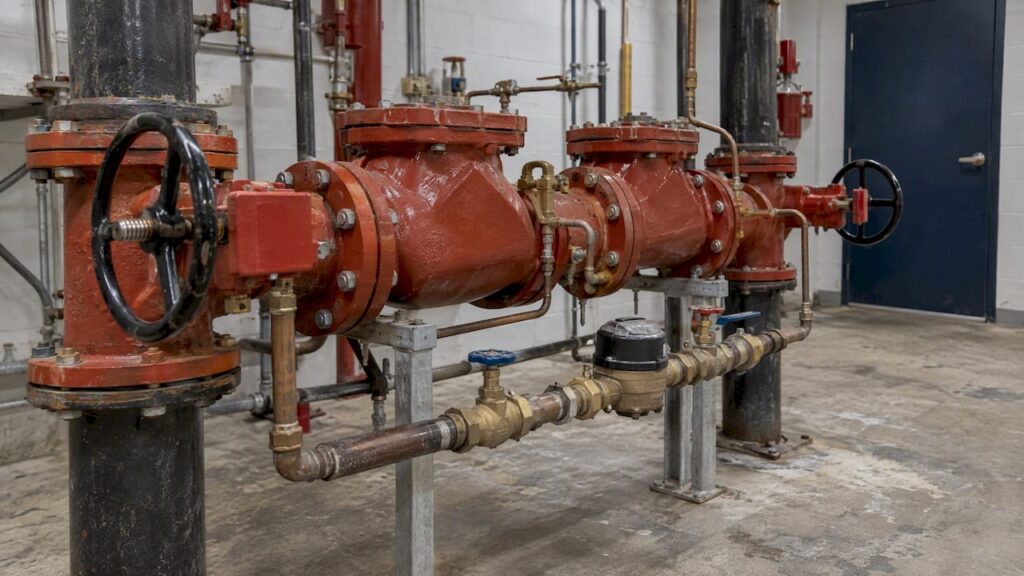
BLUF: a DCDA is a detector-equipped double check assembly with a bypass meter built for fire lines, while a DC (double check) is the simpler two-check assembly typically used on low-hazard domestic and irrigation lines. Choose DC for ordinary water service, DCDA for fire protection systems without chemical additives, and an RPDA whenever the fire system includes antifreeze or other chemical hazards.
TL;DR:
- A fire system containing antifreeze, foam concentrate, or another chemical requires an RPDA; a DCDA is limited to plain water.
- Before installation, confirm the hazard classification with your local water authority, check its approved device list, and require a complete unit assembled by its manufacturer.
- DCDA testing must cover the mainline and bypass separately each year, with both results documented and submitted to the water authority.
- Check the bypass meter between annual tests for slow leaks, and keep shutoffs and test cocks accessible for inspection and repairs.
Table of Contents
- What a double check valve assembly does and where it belongs
- How a DCDA works and why the bypass meter matters
- DC vs DCDA: components, flow, and what gets tested
- Matching the assembly to the hazard: DC, DCDA, or RPDA
- Testing, maintenance, and the mistakes that fail inspections
- What a licensed tester checks and what to ask for
- What busy property managers should prioritize first
- Get your assembly tested, certified, or rebuilt
- FAQ
- Sources
What a double check valve assembly does and where it belongs
A double check valve assembly, often written as DC or DCVA, uses two independently acting, spring-loaded check valves installed in series between two shutoff valves, with test cocks placed before, between and after the checks so a tester can verify each one separately. This design stops backsiphonage and backpressure from pulling or pushing contaminated water into the potable supply, but it is rated only for non-health, low-hazard conditions, not for cross-connections involving chemicals or sewage.
Because of that hazard limit, DC assemblies show up most often on:
- Residential and commercial irrigation systems with fertilizer or pesticide injection excluded.
- Domestic water services at homes, apartments and small commercial buildings.
- Boiler feed lines and other low-hazard process connections.
Sizing and placement matter as much as the device itself. A DC assembly needs to sit somewhere a tester can reach the shutoffs and test cocks without draining a vault or climbing scaffolding, since annual testing is mandatory wherever these devices protect a water supply. Property owners who skip accessibility planning during installation often pay for it later in longer test visits and harder repairs.
How a DCDA works and why the bypass meter matters
A double check detector assembly pairs a standard double check mainline assembly with a smaller bypass assembly that includes its own meter, its own shutoffs and its own pair of check valves. The mainline carries normal fire sprinkler system flow, while the bypass is plumbed to intercept small, continuous flows before they reach the mainline checks.
That bypass design is the entire point of a DCDA. Detector assemblies are built so flow up to several gallons per minute routes through the bypass meter, which means a slow leak, an unauthorized tap or routine system testing registers on that small meter rather than going unnoticed through the larger mainline. A Double Check Detector Assembly is designed for fire suppression systems specifically to detect leakage or unauthorized use through this bypass arrangement.

A DCDA’s bypass is engineered to accept flows up to a certain low-flow rate before mainline flow activates, letting the meter catch water loss that would otherwise go undetected.
Unlike a reduced pressure assembly, a DCDA has no relief valve. That absence keeps the assembly simpler and lowers pressure loss, which fire systems need to maintain adequate flow for suppression, but it also means a DCDA will not discharge water to signal an internal failure. Monitoring depends on the bypass meter and on periodic testing, not on a visible relief drip.
In the field, DCDAs typically show up:
- On fire service entries to commercial buildings, warehouses and multi-family properties.
- In vaults or mechanical rooms large enough to house both the mainline and bypass piping.
- Wherever the water purveyor’s cross-connection control program classifies the fire line as low-hazard.
DC vs DCDA: components, flow, and what gets tested
Side by side, the component list tells most of the story. A DC assembly has two check valves, two shutoffs and four test cocks, full stop. A DCDA has all of that on its mainline, plus a parallel bypass line with its own smaller double check assembly, its own shutoffs and a meter register. Neither assembly includes a relief valve, which is the detail that separates both of them from an RPZ.
Flow behavior is where the practical difference shows up. Under normal fire system conditions, the line sits static or sees only occasional test flow, so a DCDA’s bypass is engineered to pick up that low-rate activity first. Mainline and bypass assemblies each have allowable pressure-loss limits, with double check assemblies capped at roughly 10 psi, and that pressure differential is what pushes small flows into the bypass instead of the mainline.
Testing follows the same split:
- The mainline assembly gets a full functional test of both check valves.
- The bypass assembly, being a complete backflow preventer in its own right, requires its own separate functional test.
- Testers record two sets of results, since a bypass failure does not automatically mean the mainline failed.
Pro Tip: Ask your tester for a written copy of both the mainline and bypass test results, not just a one-line pass or fail; compliance reports filed with your water authority typically expect both.
Type I and Type II detector assemblies differ in how that bypass line is arranged and whether a single mainline check also protects the bypass side. Knowing which type is installed changes how a tester isolates each section and which test cocks apply, so it is worth confirming with whoever services your system.
Matching the assembly to the hazard: DC, DCDA, or RPDA
Assembly selection comes down to hazard level, not preference. A domestic or irrigation line with no chemical introduction calls for a DC. A fire protection line with plain water and no additives calls for a DCDA. The moment a fire system includes antifreeze, foam concentrate or any other chemical additive, the hazard classification jumps and an RPDA, a reduced pressure detector assembly, becomes the required device instead of a DCDA.
Code language backs this up directly. Section 603.5.14 of the Uniform Plumbing Code lists DC, DCDA, RP and RPDA as acceptable devices for protecting potable water supplies to fire protection systems, with selection driven by the hazard the fire system presents rather than by building type alone.
Before finalizing a choice:
- Confirm classification with your local water purveyor or authority having jurisdiction, since requirements vary by municipality.
- Check that the assembly you plan to install appears on your purveyor’s approved list.
- Verify the unit ships as a complete, manufacturer-assembled device rather than a field-piped substitute, which USC Foundation guidance specifically flags as unacceptable for true DCDA or RPDA compliance.
Our guidance on fire sprinkler backflow compliance walks through how these AHJ conversations typically go for property managers handling fire line upgrades.
Testing, maintenance, and the mistakes that fail inspections
Annual testing applies to DC and DCDA assemblies alike, and for a DCDA that means testing the mainline and the bypass separately, then submitting both results. Here is what keeps a system compliant between those visits:
- Schedule the annual test early enough to leave time for repairs before a certification deadline.
- Read the bypass meter periodically between tests so a slow leak gets caught before the annual visit.
- Keep vaults and enclosures protected from freezing, since a cracked housing often takes the check valves with it.
- Flag field-modified bypass piping for replacement, since a true DCDA must ship as a complete, USC-approved unit rather than a piped-together substitute.
- Confirm shutoffs and test cocks stay accessible, not buried behind stored equipment or landscaping.
Pro Tip: If a previous test report shows inconsistent check spring readings year over year, ask for a rebuild quote before the next cycle rather than waiting for a failed test.
Our maintenance and preventive care checklist covers the same points in more detail for managers overseeing several properties at once.
What a licensed tester checks and what to ask for
On a typical visit, a licensed tester isolates and functionally tests the mainline assembly, then repeats the process on the bypass, documenting meter readings and check valve performance separately before filing reports with the water authority on your behalf. Reviewers also confirm the installed unit matches an approved, manufacturer-shipped configuration, since a modified bypass can fail inspection even if it passes a flow test.
When hiring a service provider, ask for:
- A complete written test report covering both mainline and bypass results.
- A clear rebuild-versus-replace recommendation when a check valve underperforms.
- Enclosure options if the assembly sits exposed to weather or vehicle traffic.
Our backflow preventer FAQ page answers the questions we hear most often from managers coordinating testing across multiple buildings.
What busy property managers should prioritize first
The safest default is hazard-based: DCDA for fire lines carrying plain water, RPDA the moment chemicals or antifreeze enter the system, and DC for everything low-hazard and domestic. Confirm your classification with the AHJ before scheduling work, then book a licensed tester who can test both mainline and bypass in one visit. Have your most recent test report and any installation drawings ready before that visit starts.
— Jordan
Get your assembly tested, certified, or rebuilt
We handle backflow compliance tasks including testing, certification filing, rebuilds, and enclosure installation, all billed per visit with consolidated invoicing available across multiple properties.

- Backflow Preventer Testing & Certification for mainline and bypass testing with direct filing to your water authority.
- Rebuild and repair services when a check valve or bypass component needs attention.
- Custom enclosures to protect exposed assemblies from weather and vehicle contact.
If a vault or enclosure also has roofing or drainage issues worth a second look, our partners at Hytz Roofing cover curb and drainage checks that can affect equipment housed nearby. Request a quote or schedule an inspection through our FAQ and service page to get started.
FAQ
What is the difference between a DCDA and a DCVA?
A DCVA, or double check valve assembly, is the standard two-check device used on low-hazard domestic and irrigation lines with no detection feature. A DCDA adds a bypass assembly with its own meter and shutoffs so it can detect leaks or unauthorized use on fire protection lines, which a plain DCVA cannot do.
What does DCDA mean?
DCDA stands for double check detector assembly, a backflow preventer built for fire suppression systems. It combines a standard double check mainline with a metered bypass line that catches low flows before they reach the mainline checks.
What is the main difference between a double check valve and an RPZ backflow preventer?
A double check assembly uses two check valves and no relief valve, making it suitable only for low-hazard, non-health conditions. An RPZ, or reduced pressure zone assembly, adds a relief valve between the checks and is required whenever the cross-connection involves a health hazard, such as chemicals or antifreeze in a fire system.
What are the three types of backflow preventers?
Common categories include double check assemblies (DC/DCVA), detector assemblies (DCDA/RPDA) for fire lines, and reduced pressure assemblies (RP/RPZ) for high-hazard conditions. Selection among them depends on the hazard level of the connection being protected, not on building type alone.
When is an RPDA required instead of a DCDA?
An RPDA is required whenever a fire protection system contains chemicals, antifreeze, or another additive that raises the hazard level beyond what a DCDA is rated to handle. Confirming this classification with your local water authority before installation avoids a failed inspection later.
Sources
- Cross Talk — Detector Assemblies and Pressure Loss (USC Foundation)
- DCDAs & RPDAs — Working Pressure Magazine