TL;DR:
- Many property owners assuming last year’s sprinkler inspection suffices face compliance issues when backflow preventers are outdated or missing.
- Strict New Jersey regulations require appropriate, approved backflow devices, permits, and annual testing for fire sprinkler systems to protect public water supplies and public health.
Your fire sprinkler system passed inspection last year, so you’re covered — right? Not necessarily. A surprisingly large number of New Jersey property owners and managers carry this exact assumption, only to discover during an audit or incident that their backflow prevention device is wrong for their hazard level, expired, or missing entirely. Backflow in fire sprinkler systems is not just a plumbing technicality; it is a public health risk and a regulatory obligation enforced under New Jersey state law. This guide walks you through every requirement so you can protect your tenants, your water supply, and your investment.
Table of Contents
- Understanding fire sprinkler backflow and why it matters
- Key New Jersey backflow regulations for fire sprinkler systems
- Types of approved backflow preventers for fire sprinklers
- Installation, permits, and testing: What owners must do
- Why most fire sprinkler systems fail backflow compliance (and what truly works)
- Get expert help with New Jersey fire sprinkler backflow compliance
- Frequently asked questions
Key Takeaways
| Point | Details |
|---|---|
| Backflow compliance is mandatory | Every fire sprinkler system on public water in NJ must have a rated backflow preventer to protect drinking water. |
| Select the right device | DCVA or RPZ may be required depending on your property’s hazard classification. |
| Permits and licensing required | Installing or upgrading devices must be done by a licensed plumber with appropriate permits. |
| Annual testing keeps you safe | Testing by certified professionals is necessary every year to remain compliant and avoid penalties. |
Understanding fire sprinkler backflow and why it matters
Backflow sounds simple enough: water flowing the wrong way. But the consequences for a fire sprinkler system are more serious than most building owners realize. Fire sprinkler piping sits filled with stagnant water, sometimes mixed with antifreeze, corrosion inhibitors, or microbial growth. Under normal conditions, the municipal water supply pressurizes the system and keeps everything moving in one direction. When that pressure drops — during a main break, a heavy fire department draw, or routine maintenance — the pressure balance reverses. That reversal can pull sprinkler water back into the public supply, contaminating it.
Here’s what makes this especially concerning for New Jersey properties:
- Stagnant water in sprinkler pipes can contain bacteria, heavy metals from corroded steel, and chemical additives used in wet or dry systems.
- Backflow events are often invisible. Contamination can enter the supply with no alarm, no warning, and no immediate symptom.
- Multi-tenant buildings amplify the risk because one compromised connection can affect every unit on the same supply line.
- Municipal water systems have pressure fluctuations daily, especially during peak demand and seasonal changes in New Jersey’s densely connected water districts.
New Jersey regulates fire sprinkler backflow prevention under the Uniform Construction Code plumbing subcode, adopting the International Plumbing Code (IPC), and NJDEP’s N.J.A.C. 7:10 Safe Drinking Water Act regulations.
Understanding the NJ water backflow basics helps you see why the state takes this so seriously. New Jersey’s water infrastructure is among the most interconnected in the country, and a single unprotected cross-connection can affect thousands of downstream users. The backflow prevention regulations that apply to your building exist specifically to close those gaps before they become public health events.
Key New Jersey backflow regulations for fire sprinkler systems
Now that you know the risks, let’s break down the exact laws and codes that determine your building’s requirements.
Three regulatory layers govern fire sprinkler backflow prevention in New Jersey. The first is the Uniform Construction Code (UCC), which controls permitting, inspections, and installation standards for all plumbing work in the state. The second is the International Plumbing Code (IPC), adopted by New Jersey under the UCC, which provides technical standards for cross-connection control. The third is N.J.A.C. 7:10, the NJDEP’s Safe Drinking Water Act regulations, which focus specifically on protecting the public water supply from contamination at the point of connection.
Here is the key compliance framework broken down step by step:
- Identify your hazard level. The type of backflow preventer required depends on whether your fire sprinkler system contains additives like antifreeze or chemical corrosion inhibitors (high hazard) or is a clean water-only wet system (low to moderate hazard).
- Match your device to that hazard level. Fire sprinkler systems connected to public water require backflow prevention devices such as a Double Check Valve Assembly (DCVA) for low-to-moderate hazard situations or a Reduced Pressure Zone (RPZ) assembly for high hazard conditions.
- Verify NJDEP device approval. New Jersey does not allow you to install just any brand. The NJDEP maintains a published list of approved devices. Using an unlisted device fails inspection, period.
- Pull the required permits. You need a UCC plumbing permit and, for public water connections, a physical connection permit from your local water purveyor.
- Use a licensed master plumber. Only a NJ-licensed master plumber may perform the installation. This is not optional.
- Schedule testing after installation. Initial testing confirms the device is functioning before the system goes live.
Review the full NJ backflow codes to see how these layers interact for your specific property type.
Pro Tip: Download the current NJDEP approved devices list directly from the NJDEP website before purchasing any backflow preventer. Device model lines get delisted when manufacturers change internal components, and an outdated model can fail your inspection even if it was approved when you originally bought it.
One often-overlooked statistic: New Jersey has over 650 public water systems, all subject to NJDEP cross-connection control program requirements. Each one of those systems can and does audit the commercial and multi-family properties connected to it. If your building is flagged during a system-wide survey, you will be required to demonstrate compliance quickly or face service interruption.
Types of approved backflow preventers for fire sprinklers
Once you know the legal baseline, choosing and installing the right device is the next critical step.
The two main device types used on fire sprinkler systems in New Jersey are the Double Check Valve Assembly (DCVA) and the Reduced Pressure Zone (RPZ) assembly. Each serves a different hazard scenario, and using the wrong one for your situation is a compliance failure even if the device itself is NJDEP-approved.
| Feature | DCVA | RPZ |
|---|---|---|
| Hazard level | Low to moderate | High |
| Protection method | Two independent check valves | Two check valves plus a relief valve |
| Drainage required | No | Yes |
| Typical use case | Clean water-only wet systems | Antifreeze or chemical additive systems |
| Installation space | Compact | Larger footprint |
| Testing frequency | Annual | Annual |
| Cost (general range) | Lower | Higher |
The mechanics of each device matter for both installation and maintenance. A DCVA relies on two check valves to physically block reverse flow from backpressure or back-siphonage. It works well when the only concern is stagnant potable water returning to the supply. An RPZ goes further: it adds a pressure differential relief valve between the two check valves. If either check valve fails, the relief valve opens and discharges to a drain rather than allowing contaminated water to reach the public supply. That is why the RPZ is required when hazardous additives are present.
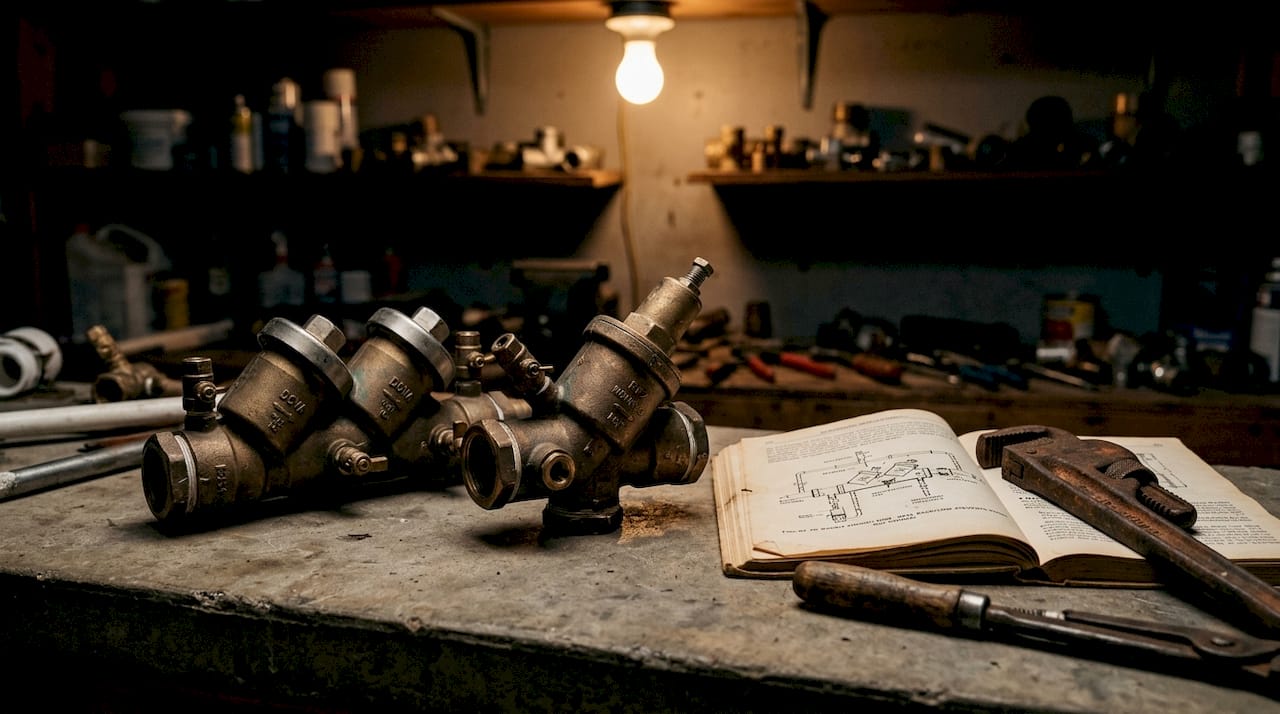
The approved devices list requirement also means that installation requires a licensed master plumber working under a valid UCC permit. Many property owners ask whether a fire sprinkler contractor can handle this work. The answer is no unless that contractor also holds a NJ master plumber license. Fire protection and plumbing are separate licensed trades in New Jersey, and the cross-connection work falls firmly in the plumbing category.
Use the device installation guide to understand what a compliant installation looks like from start to finish. You can also review backflow preventers explained for a deeper technical breakdown of how each assembly functions.
Pro Tip: If your sprinkler system was installed more than ten years ago and you have never been asked about backflow prevention, do not assume the original permit included one. Many older New Jersey systems were connected before current cross-connection rules were enforced, and those gaps often only surface during property sales or fire marshal re-inspections.
Installation, permits, and testing: What owners must do
After the right device is chosen, here is an actionable roadmap to compliance and ongoing safety.
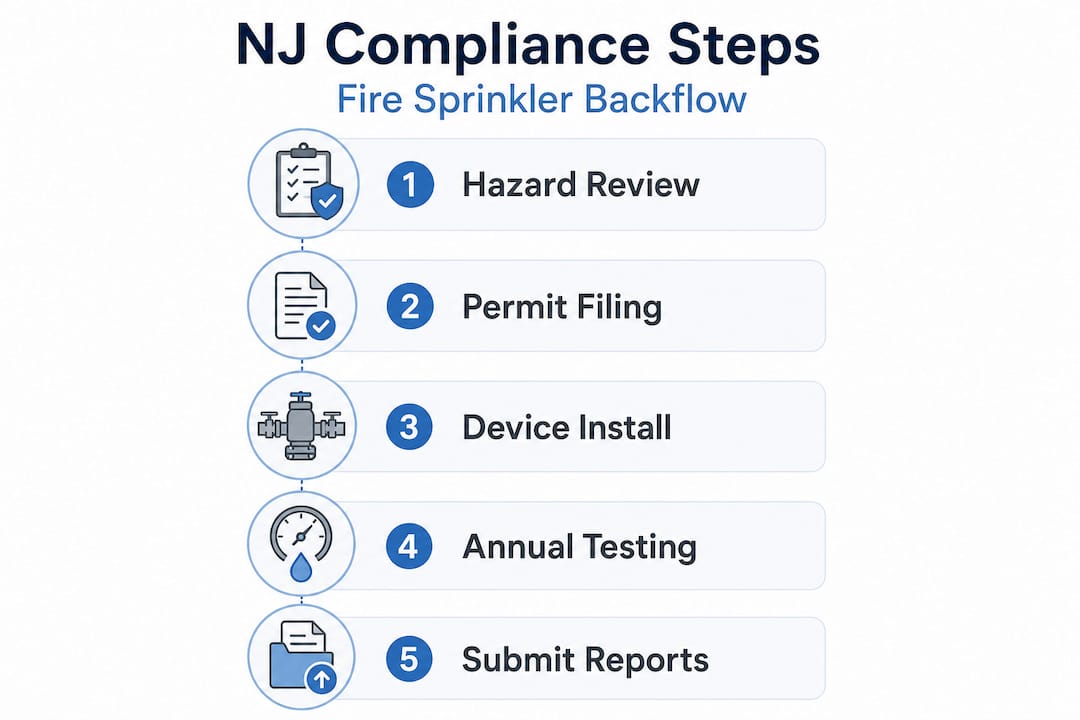
Getting from “we need a backflow preventer” to “we are fully compliant” involves more steps than most owners expect. Here is the complete process:
- Conduct a hazard assessment. Determine whether your fire sprinkler system uses any antifreeze, chemical corrosion inhibitors, or non-potable additives. This single determination drives every decision that follows.
- Select an NJDEP-approved device. Match the device to your hazard level (DCVA or RPZ) and confirm it appears on the current NJDEP approved list.
- Hire a licensed NJ master plumber. Confirm their license is current and that they have experience with fire sprinkler cross-connections specifically. Not every plumber has worked with sprinkler systems.
- Pull a UCC plumbing permit. Your plumber will submit this to the local construction office. A physical connection permit is also required when connecting to a public water supply.
- Complete the installation. The plumber installs the device, confirms proper drainage if an RPZ is used, and prepares for inspection.
- Pass the UCC inspection. A local construction official inspects the installation before the system is put back into service.
- Initial testing by a certified tester. A certified backflow prevention tester verifies the device is operating within acceptable parameters.
- Submit test results. Results go to your water purveyor and, in many cases, directly to the NJDEP.
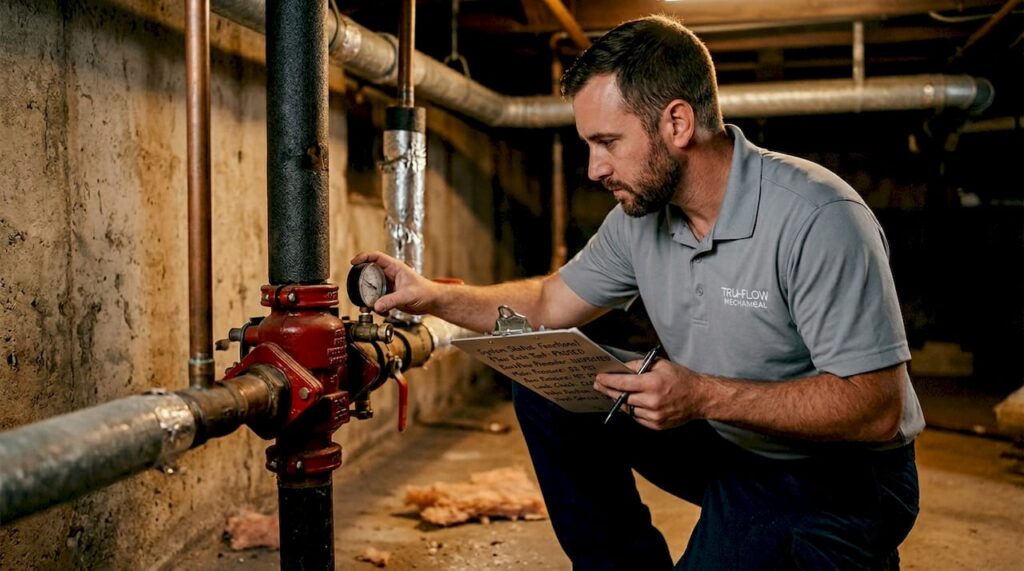
- Schedule annual retesting. Mark your calendar. Annual testing is not optional and is the most common compliance gap we see in the field.
| Step | Who is responsible | Permit or documentation needed |
|---|---|---|
| Hazard assessment | Property owner or licensed plumber | None, but document findings |
| Device selection | Licensed master plumber | NJDEP approved list verification |
| Installation | Licensed master plumber | UCC plumbing permit, physical connection permit |
| Inspection | Local construction official | Permit inspection record |
| Initial and annual testing | Certified backflow tester | Test report submitted to water purveyor |
Review the full backflow inspection process to understand what inspectors look for. Owners of residential multi-family buildings should also check the residential protection guide for property-specific guidance.
Pro Tip: Schedule your annual backflow test in the same month every year and tie it to a calendar reminder 30 days in advance. Water purveyors track test submission deadlines, and a single missed year can trigger a compliance notice that requires you to re-submit documentation under a formal correction order, adding cost and administrative work you don’t need.
Connect with preventer services for full-service support, and use the testing and certification guide to understand exactly what the annual test process involves.
Why most fire sprinkler systems fail backflow compliance (and what truly works)
Here is the uncomfortable reality we see repeatedly in the field: almost every compliance failure we encounter was not caused by an owner who ignored the rules. It was caused by an owner who thought someone else had handled it.
The most common scenario looks like this. A property changes hands. The new owner receives paperwork showing the fire sprinkler system was inspected and certified. What that paperwork does not show is that the backflow preventer was never tested after 2022, the device is a model that was removed from the NJDEP approved list, and there is no physical connection permit on file because the original plumber pulled the permit in the wrong category. That property is now non-compliant in three separate ways, and the new owner inherited all of it.
The second most common failure is the “set it and forget it” mindset. A property manager installs a proper RPZ assembly, passes the initial inspection, and files the paperwork. Then annual testing gets pushed back a month, then two, then falls off the schedule entirely. Two years later, the water purveyor conducts an audit and the property has no testing record on file. The fine and re-inspection process costs far more than four years of annual testing would have.
What actually works is treating backflow testing strategies as a fixed operating expense, the same way you treat fire extinguisher inspections or elevator certifications. Certified annual testing from a company that tracks your compliance history, submits results directly to the water purveyor, and flags device concerns before they become violations is not a luxury. It is the most efficient way to manage this obligation.
We have also seen owners try to cut costs by using a general plumber with no backflow certification experience. The installation may look correct, but small errors in valve orientation, relief valve drainage direction, or test port placement can cause a device to fail its first certification test. At that point you pay for a second mobilization, potentially a permit revision, and lost time. Hiring right the first time is always cheaper than fixing it.
The truth about New Jersey fire sprinkler backflow compliance is that the technical requirements are actually quite manageable. The failures happen in the gaps: wrong device for the hazard, missing paperwork, lapsed testing, or untrained installers. Close those gaps with qualified professionals and a consistent annual schedule, and compliance becomes routine rather than stressful.
Get expert help with New Jersey fire sprinkler backflow compliance
If reading this article made you realize there might be a gap in your current compliance setup, you are not alone. Whether you need a new device installed, an annual test completed, or a full compliance audit of your fire sprinkler cross-connection, working with a certified New Jersey backflow professional is the fastest path to resolution.

At South Jersey Backflow, we handle professional backflow testing for fire sprinkler systems across New Jersey, submit results directly to your water purveyor, and keep your documentation organized so nothing falls through the cracks. We also help owners understand how to stay compliant year over year without the administrative headache. Our certified testing services cover both DCVA and RPZ assemblies on residential, commercial, and industrial properties. Contact us today to schedule your test or talk through your compliance situation with a certified professional.
Frequently asked questions
Do all fire sprinkler systems in New Jersey require backflow preventers?
Yes, all fire sprinkler systems connected to public water must have approved backflow prevention devices under NJ code. New Jersey regulates this requirement under both the UCC plumbing subcode and NJDEP’s N.J.A.C. 7:10 Safe Drinking Water Act regulations.
What is the difference between a DCVA and an RPZ device?
A DCVA uses two check valves for moderate hazard situations, while an RPZ includes a pressure relief valve for high-hazard cases. The RPZ is specifically required where chemicals, antifreeze, or other non-potable additives are present in the sprinkler system.
Who is qualified to install or test a backflow preventer on a fire sprinkler system?
Only a licensed master plumber can install these devices in New Jersey, and testing must be performed by a certified backflow prevention tester. Installation also requires a valid UCC plumbing permit and, for public connections, a physical connection permit.
What permits are needed to add or upgrade a fire sprinkler backflow preventer in NJ?
A plumbing permit under the UCC and a physical connection permit for public water systems are both required. These permits must be in place before installation begins and are tied to the formal inspection process through the local construction official.
How often must fire sprinkler backflow preventers be tested in New Jersey?
Annual testing is required to maintain compliance and confirm the device is functioning correctly. NJDEP N.J.A.C. 7:10 regulations govern this requirement for systems connected to public water supplies, and test results must be submitted to your water purveyor each year.