
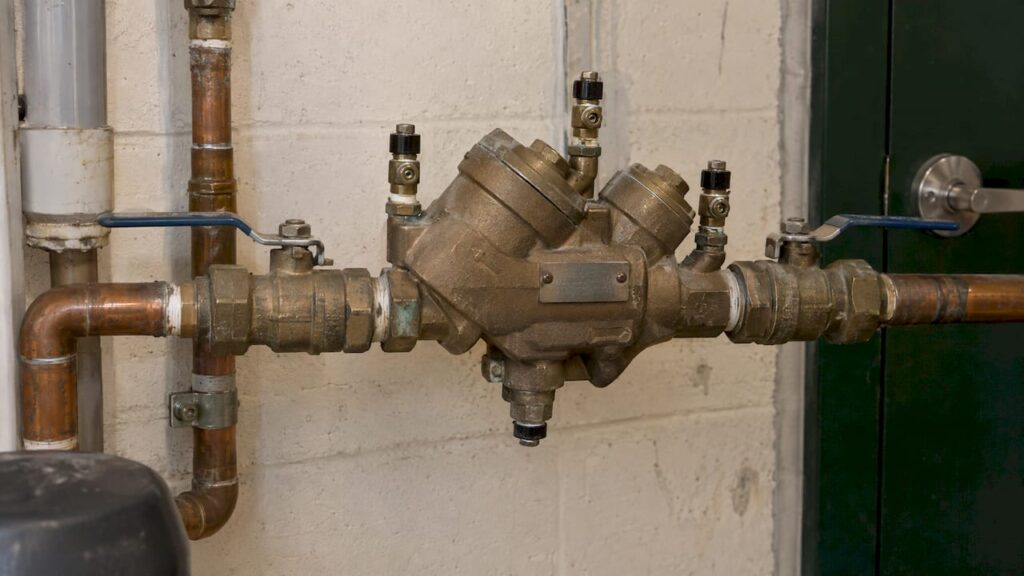
The serial number is usually cast or stamped into the body of the backflow assembly, or printed on a metal nameplate attached to it. To read it, first locate the device, which is typically near your water meter or in a mechanical room. Then look over the valve body and any tag for a string of digits next to the words “S/N” or “Serial.” Clean off dirt and rust gently, and photograph what you find. This guide shows where to look, how to avoid mixing the serial number up with the model or size, and what to do when it is missing.
TL;DR
- Do backflow devices have serial numbers? Yes. Municipal and state agencies describe the make, model, serial number and size as cast or stamped on the body or shown on a nameplate.
- Start by finding the device. Irrigation assemblies are often near the water meter. Fire-system assemblies are often in a mechanical room, closet or garage.
- Do not confuse the serial number with the model number, the size in inches, or the water meter number. Test reports ask for each one separately.
- Do not paint over the identifiers, and do not scrape them off. Some jurisdictions require a device with no legible serial number to be replaced.
- If you cannot find or read it, a certified tester can identify the assembly and file the report for you.
Table of Contents
- First, make sure you are looking at the right device
- Where the serial number is marked
- Serial number, model, make and size: how to tell them apart
- Step by step: reading a stamped or faded serial number
- What to do if you cannot find or read the serial number
- Why testers record the serial number
- Enclosures: finding the number without removing the box
- What identification and testing cost with us
- Let us find it, test it and file it
- FAQ
- Sources
First, make sure you are looking at the right device
Not every property has a backflow preventer. A city program FAQ from Richmond, Virginia states that most single-family residences there are not required to have a backflow prevention device. Requirements depend on your water authority and on what is connected to your plumbing. Lawn irrigation, fire sprinklers and commercial uses are common triggers. If you have received a testing notice, you almost certainly have a device somewhere.
The same Richmond FAQ says there is no grandfathering clause. Owners who are legally required to protect their service lines are responsible for doing so, however long the property went without protection. In New Jersey, your local water purveyor sets the specifics. Our pages on Newark, Trenton, Camden and Jersey City explain what owners in those cities need to do.
Common places to look
Portland’s water bureau describes the typical layouts well. Residential irrigation assemblies are usually near the water meter box. They sit in a small in-ground box with a green lid, sometimes marked “sprinkler system.” Fire-system assemblies are usually in a mechanical room, closet or garage.
A practical search order for a typical New Jersey property:
- Near the water meter. Check the front yard or curb area, and the basement wall where the service line enters the house.
- At the irrigation connection. Follow the main irrigation line back from the nearest zone valve, or look where the sprinkler line branches off the house supply.
- Inside the building. Check the mechanical room, utility closet, boiler room or garage, especially for fire sprinkler and commercial systems.
- In or under a protective enclosure. Many outdoor devices sit inside an insulated box to protect them from freezing and theft. You may need to lift or unlock the cover to see the body.
- Along the line to outdoor spigots. Small hose bib vacuum breakers screw onto the faucet itself and look very different from the larger assemblies.
What the device looks like
The City of Novi, Michigan lists the typical residential device types: hose bib vacuum breakers, anti-siphon hose bibs, atmospheric vacuum breakers, pressure vacuum breakers, dual check valve devices and reduced pressure zone assemblies. Novi also notes that residential devices must be stamped with an ASSE approval number in the casing. That approval number is not the serial number, and it is a common source of confusion.
Larger assemblies usually show two shutoff valves with test cocks (small brass fittings) between them. Small hose-connection devices are often too small for a unique serial number you would report, so the serial number question mostly applies to assemblies that get tested and certified.
Where the serial number is marked
The South Jordan, Utah city page states that all backflow assemblies are marked with a unique serial number, which can help identify your device. The Washington State Department of Health explains where to look in its field test report instructions. The make, model, serial number and size are either cast or stamped on the assembly body or appear on the nameplate.
That gives you two places to check:
- The valve body. Look on the main casting between the two shutoff valves. Stamped numbers can be small and shallow, so use a flashlight held at a low angle. Shadows make the characters easier to read.
- The nameplate or tag. This is a small metal or plastic plate attached with a wire, screws or a band. It often carries the manufacturer’s name, model and serial number together.
San Francisco’s utility requires that assemblies be installed so the make and serial number are visible in a readily accessible location. It also says these identifiers must not be painted over or made illegible. If your device was painted during a landscaping or maintenance project, say so when you call a tester.
Serial number, model, make and size: how to tell them apart
Test report forms ask for several identifiers. The Washington DOH instructions define the make as the manufacturer’s name, the model as the assembly’s name or number, and the size as a measurement in inches. Phoenix’s backflow assembly test report asks testers for manufacturer, size, model number and serial number. It separately notes that the water meter number is stamped on the meter body.
| Identifier | What it is | Where you will see it | Common mix-up |
|---|---|---|---|
| Make | The manufacturer’s name | Body casting or nameplate | Mistaken for the model |
| Model | The product name or number | Body casting or nameplate | Mistaken for the serial number |
| Serial number | The unique number for your specific unit | Stamped or cast on the body, or on the nameplate | Confused with the ASSE approval number or model |
| Size | Pipe size in inches | Nameplate, or marks on the shutoff valves | Confused with a part number |
| Water meter number | Identifies the meter, not the device | Stamped on the meter body | Written in the serial number field |
A few habits help keep them straight. The serial number is the one that is different on every unit, even two identical devices side by side. If you see a label that says “Model” or “Series” followed by letters and digits, that is not it. Look for “S/N,” “SN,” “Ser.” or “Serial.” If the characters are only stamped into metal with no label, the longest unique string is often the serial number, but confirm it against the manufacturer’s name and model before you write it down.
Step by step: reading a stamped or faded serial number
- Shut off nothing. You only need to look. Do not open valves or remove parts. If the device is in a locked enclosure, ask the person who has the key or call us.
- Clear the surface. Wipe dirt with a dry rag. For corrosion, use a soft brush. Avoid wire brushes and sharp tools that can damage stamped characters.
- Use light from the side. A phone flashlight held nearly parallel to the metal makes shallow stamps stand out.
- Photograph everything. Take a wide shot showing the location, then close-ups of every tag, stamp and label. A clear photo is easier to read than squinting at a cold, wet pipe.
- Try a pencil rubbing. Press a sheet of thin paper over a stamped number and rub gently with the side of a pencil lead. The characters often appear in the rubbing.
- Write down each identifier separately. Record make, model, serial number and size on separate lines, and note any characters you are unsure of.
- Check the date on your last test report. A previous certification report from your water authority or tester usually lists the serial number of the device that was tested.
If the tag is missing
Tags fall off, rot or get painted over. A product guide from a retailer notes that pipe size can often be determined from marks stamped or cast on both shutoff valves when the tag is gone. The size is only one piece, though. A tester can usually identify the make and model from the body shape and casting marks. A missing serial number is a different matter.
What to do if you cannot find or read the serial number
First, do not guess or invent a number. A test report is a compliance record that goes to your water authority, and it should match the device in the ground.
Rules differ by municipality, and the consequences can be real. Garland, Texas, for example, requires devices without an attached manufacturer’s identification plate and without a legible serial number to be replaced. New Jersey utilities set their own policies, so find out what yours requires before assuming either way.
A sensible sequence:
- Check any prior test reports, permits or closing paperwork for the serial number.
- Look at the whole assembly again, including the underside of the body and the area behind the shutoff valves.
- Have a certified tester inspect it. They can record what is legible, identify the model, and tell you whether your water authority will accept the report as it is or whether replacement is the cleaner path.
- If replacement is needed, ask about the permit. Our guide to the backflow replacement permit in NJ explains what to file.
Our perspective on serial numbers
We see the same situation on service calls again and again. An owner receives a testing notice, and the form asks for a serial number they have never seen. The device is in a box, behind shrubs, or in a basement corner, and nobody remembers who installed it.
Our view is that you should not have to solve this alone. The serial number is the thread that ties your device to its test history, and getting it right is part of staying compliant. That is why we handle the identification work as part of the visit. We record the make, model, serial number and size, and we file the test report directly with the water authority.
We stock OEM parts so that when a device needs a repair or a rebuild, we can often complete it on the same visit. Having the exact model and serial number in front of us is what makes that possible. Our approach is simple: identify the device correctly, test it, fix what needs fixing, and send the paperwork in so you do not have to chase it.
Jordan
Why testers record the serial number
A written description of the testing process from a service provider notes the tester starts by identifying the assembly’s make, model, serial number and size, before a visual inspection. That order reflects how the report works. The test results only mean something when they are attached to a specific, identifiable device.
For owners, that has practical value:
- Filing accuracy. The water authority links the report to your account and device. A wrong or missing serial number can lead to a rejected or unmatched report.
- Replacement tracking. If a device is replaced, the new serial number should replace the old one in the record.
- Warranty and parts. Rebuild kits are specific to the manufacturer and model. The right identification means the right parts.
- Theft recovery. The South Jordan page notes that theft can be deterred with lockable cages, full enclosures and fake rocks. A recorded serial number gives you something concrete to report if a device goes missing.
Enclosures: finding the number without removing the box
Most enclosures are designed with a lift-off cover. The serial number is on the assembly, not the cover, so you will need to remove or open the enclosure to read it. If the box is locked, contact whoever installed it or your property manager before cutting any lock.
For property managers handling several buildings, a simple log saves time. Walk each site once, photograph every device and enclosure, and record make, model, serial number, size and location in a spreadsheet. That record speeds up test scheduling and helps when a water authority asks which devices you have. Our page on confirming backflow filing for property managers explains how we handle the filing side, and our budgeting guide for property managers covers cost planning across a portfolio.
If you are considering a new or replacement box, see what we cover in backflow enclosure requirements in NJ. A well-designed enclosure protects the device from freezing and tampering while still allowing access for testing.

What identification and testing cost with us
We do not charge separately for reading a serial number on a test visit. It is part of the work. Our published ranges, listed on our FAQ page, are:
| Service | Published range |
|---|---|
| Annual residential certification test | $150 to $250 |
| Commercial device testing | $200 to $450 per device |
| Rebuild kit service (residential) | $125 to $250 |
| Protective enclosure installation | $200 to $500 |
| Residential installation | $300 to $800 |
Final pricing depends on the device, its condition and its location. Our cost breakdown for installing, testing and rebuilding goes into more detail.
Let us find it, test it and file it
If you have searched and still cannot find the device, or you found it but cannot read the numbers, we can take it from here. We are a family-owned, licensed and insured company serving New Jersey, and our technicians identify the assembly, perform the certification test and file the report with your water authority.

See our backflow preventer testing and certification service, or contact us to schedule a visit. We offer same-day service, and we cover the state, including Hudson, Essex, Passaic, Monmouth and Sussex counties.
FAQ
Do backflow preventers have serial numbers?
Yes. Agencies such as the Washington State Department of Health and South Jordan, Utah describe assemblies as marked with a unique serial number. It is cast or stamped on the body, or printed on the nameplate. Smaller hose-connection devices are less likely to carry one you would report.
Where is the serial number on a backflow preventer?
Look at the main valve body between the two shutoff valves and at any attached tag or nameplate. Clean the surface and use a flashlight at a low angle. If you still cannot read it, photograph the device and send the images to a certified tester.
How do I know if I have a backflow preventer?
Check near your water meter, at your irrigation connection, and in mechanical rooms or garages. Portland’s water bureau notes irrigation assemblies are often in a small in-ground box with a green lid. A testing notice from your water authority is also a strong sign you have one.
What if the serial number is missing or painted over?
Do not make one up. Some cities, such as Garland, Texas, require replacement of devices with no legible serial number. Ask a certified tester to inspect the assembly, and ask your water authority what it accepts.
Sources
- Backflow and Cross-Connection Program FAQ, City of Richmond
- Backflow prevention and cross-connection control, Portland Water Bureau
- Cross Connection Residential Backflow Preventer Picture Identification, City of Novi
- Numbered Test Report with Instructions, Washington State Department of Health
- General Requirements for Installation of Backflow Prevention Assemblies, SFPUC
- Backflow Assembly Test Report, City of Phoenix