
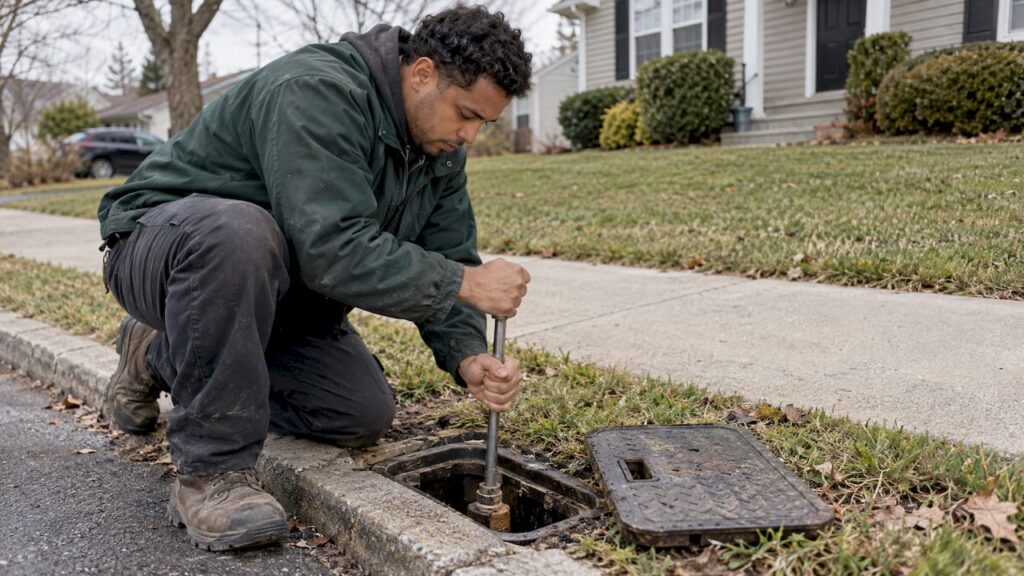
Yes, a New Jersey water supplier can shut off service when a required backflow test is missed. It usually happens only after repeated notices go unanswered. New Jersey American Water states that failing to meet cross-connection requirements can lead to disconnection after repeated requests from its Cross Connection Department. The fix is simple and quick if you act at the first letter: book a certified tester, repair anything that fails, and make sure the report reaches the right office.
This guide explains who can shut you off, how the notice process tends to run, what penalties exist on paper, and exactly what to document to get water back on.
TL;DR
- A missed backflow test can end in water disconnection, but suppliers typically send several notices first. Answering the first one avoids almost all of the trouble.
- Who enforces depends on where you are: your water utility, your town’s code office, and the state each have a role.
- State rules allow civil penalties of up to $25,000 per violation, and continuing violations can count day by day after an order.
- To restore service you need a passing test by a certified tester, repairs and retest if the device failed, and the report filed with the right office.
- Our residential annual test runs $150–$250, and commercial testing runs $200–$450 per device. We file reports for you.
Table of Contents
- Can a missed backflow test really get your water shut off?
- Who enforces backflow testing in New Jersey
- How often a device must be tested
- What happens after a missed test: notices, fees and penalties
- Step by step: what to do the day you get a notice
- Restoring water after a shutoff
- What it costs to get compliant
- For landlords and property managers
- Get your testing handled before the next notice
- FAQ
- Sources
Can a missed backflow test really get your water shut off?
It can. Backflow preventers protect the public water supply from contaminated water flowing backward into it. Because a failed or untested device is a risk to everyone on the line, utilities treat compliance as a condition of service.
The public pattern is documented by the utilities themselves. New Jersey American Water describes a process in which its Cross Connection Department sends requests, and continued non-compliance can lead to service disconnection. Homeowners on public forums describe the same sequence: a series of letters, then a notice on the door, then no water. We would not treat the forum stories as the rule, but they match what the utility publishes.
A few points shape how real the risk is for you:
- It is rarely sudden. Disconnection is the end of a notice chain, not the first step.
- It is not about your bill. Moratoria and grace periods that pause shutoffs for unpaid bills are a different matter. A compliance shutoff is tied to the device, so ask your utility directly whether any pause applies.
- The device is your responsibility. New Jersey American Water notes that water customers carry the ultimate responsibility for properly maintaining their plumbing systems.
Who enforces backflow testing in New Jersey
Three layers can come after you, and a notice can arrive from any of them.
The water utility
Your water supplier protects its distribution system at each service connection. It writes to customers whose devices are due for testing, collects the test reports and, if letters go unanswered, can move to disconnection.
Your town’s code office
Municipal plumbing subcode officials handle the annual Certificate of Compliance in many towns. The NJ Department of Community Affairs Bulletin 99-2 explains that inspectors do not perform the test themselves. They make sure the owner has a qualified person test the device, either by witnessing it or by receiving a certification.
Local practice varies. In Ocean Township, for example, the township says it enforces the state plumbing code and that failing to provide the permit and test results to the building department may bring a violation notice. Cherry Hill Township requires testable devices to be field-tested at installation and annually, with the original certification filed with Code Enforcement, which issues a one-year Certificate of Compliance at $25.00 per device.
The state
The NJDEP and the Division of Consumer Affairs regulate cross-connections through the Plumbing Subcode and state water rules. NJDEP guidance notes the Plumbing Subcode (N.J.A.C. 5:23-3.15) governs installation of backflow prevention devices, and that a physical connection between an approved public water supply and an unapproved one requires a permit from the Department.
How often a device must be tested
The schedule depends on the property and the device, which is why one neighbor gets a letter and another does not.
| Situation | What the sources say |
|---|---|
| Commercial and most non-residential testable devices | Tested before final inspection and annually, per DCA Bulletin 99-2 |
| One- and two-family dwellings | The same bulletin says annual testing is not required under that code provision. Your water utility or town may still ask for it |
| Permitted physical connections under state water rules | A test for tightness at least once every three months under an existing permit, per N.J.A.C. 7:10-10.6 |
| Township enforcement, for example Ocean Township | All testable devices tested at installation and annually for commercial properties, per the township |
The takeaway: a residential owner can be exempt under one rule and still get a letter under a utility or town program. If a letter arrives, treat it as binding until the issuer tells you otherwise in writing.
What happens after a missed test: notices, fees and penalties
The notice sequence
Expect a first reminder, then follow-ups, then a final warning. Your utility sets the exact wording and timing, so read the dates on your own letter. Keep every notice, including the ones you think are duplicates.

We cover the paperwork side in more detail in our guide to what to do after a backflow violation notice in NJ.
Penalties on paper
State drinking water rules give NJDEP real teeth. Under N.J.A.C. 7:10-3.6, the Department can assess a civil administrative penalty of up to $25,000 for each violation of the State Act or any related regulation, rule, permit or order. If a violation continues after an order to cease, each day counts as an additional, separate violation.
Most homeowners and small landlords never see penalties at that level, because the practical consequence is a local violation notice or a utility disconnection. But for a commercial owner with an ignored order, the exposure is real, and it is a good reason not to let a notice sit.

Local fees
Towns that issue annual certificates charge for them. Cherry Hill’s published fee is $25.00 per device. Late filing can also mean a second inspection visit or a new permit if a device must be replaced.
Step by step: what to do the day you get a notice
- Read the notice for three things: the device address, the deadline, and the office that wants the report (utility, town code office, or both).
- Find the device. Ocean Township acknowledges that some owners do not know whether they have a backflow device at all, and recommends hiring a local certified inspector to check the water supply and report what is found.
- Book a certified tester. Ask whether the tester files the report directly with your water authority. Our team handles that filing so the paperwork does not stall.
- If the device passes, the report goes to the office named in your notice, and you receive the annual certificate where your town issues one.
- If it fails, repair or rebuild it, then retest. State water rules require the owner to repair and retest a failed physical connection installation within 30 days.
- Confirm receipt. Call the office a few days after filing and ask them to confirm they have the passing report on record. Our property manager compliance page walks through how to confirm filing.
Restoring water after a shutoff
If service has already been cut, the goal is a documented passing result that the right office accepts. Based on the state’s own materials, plan on these pieces:
- A passing test from a qualified tester. The DCA’s model reminder letter says the owner must supply a performance test certification from the person who ran the test before the annual certificate is issued.
- Repair or replacement if it failed. DCA Bulletin 99-2 says devices that fail must be repaired or replaced, and every replacement needs a permit. Our guide to the backflow replacement permit in NJ covers what to file.
- The Certificate of Compliance. Per the same bulletin, the plumbing subcode official issues it after passing results are received, and it is valid for one year. The model reminder letter confirms it expires and that an annual fee is due.
- Reconnection from your utility. The utility decides when to turn service back on. Ask what they require, how fast they act once they receive the report, and whether there is a reconnection charge.
If the shutoff followed a vacancy or a building closure, also read our guide to backflow testing after a building shutdown.
Our perspective
Nearly every backflow shutoff we hear about could have been a routine annual visit. The device was never the real problem. The letter sat in a pile, or the report was never filed, or nobody knew which office wanted it.
That is why we built our service around the whole job, not just the test. We are a family-owned, licensed and insured company. We stock OEM parts so that when a device fails, we can repair or rebuild it on the same visit instead of sending you away to wait. We also manage the filing with your water authority, because a passing test that never reaches the right desk does not protect your water service.
If you have a notice in hand, call us before the deadline, not after. Same-day service is something we aim for, and a short call is often enough to work out which paperwork you need.
Jordan
What it costs to get compliant
Budgeting for a test is far cheaper than a shutoff, a penalty or an emergency repair. These are the prices published on our FAQ page:
| Service | Price |
|---|---|
| Annual residential certification test | $150–$250 |
| Commercial device testing | $200–$450 per device |
| Rebuild kit service (residential) | $125–$250 |
| Protective enclosure installation | $200–$500 |
| Residential installation | $300–$800 |
Final pricing depends on the device, its size and its condition. Our cost guide for installing, testing and rebuilding goes into the details, and property managers can plan multi-device portfolios with our backflow testing budget guide.
For landlords and property managers
A missed test on one building can mean tenants without water, which becomes an emergency fast. The most reliable defense is a calendar. Put each device’s annual test date alongside your other recurring inspections, such as NJ landlord smoke detector checks, and assign one person to confirm that every passing report was filed.
A few habits that help across a portfolio:
- Keep a device list with address, location, size and last test date.
- Route every utility and township letter to one inbox.
- Ask your tester to file reports directly and send you the confirmation.
- Replace exposed or damaged devices before they fail. A protective enclosure can help shield equipment, and our enclosure service is built around New Jersey requirements.
We offer consolidated billing for clients with several properties, which keeps the paperwork in one place.
Get your testing handled before the next notice
We test, certify, repair, rebuild and install enclosures for residential, commercial and multi-unit properties across New Jersey, including emergency calls, and we file the test report with your water authority. Start with our backflow testing and certification service or contact us with your notice in hand.
We serve counties across the state, including Hudson, Essex, Passaic, Somerset, Sussex and Warren. Our full list of services is on our home page.
FAQ
Can New Jersey American Water shut off my water for backflow non-compliance?
Yes. The utility states that failure to comply with its cross-connection requirements can result in disconnection after repeated requests. Respond to the first notice and the process normally stops there.
How long do I have to fix a failed backflow device?
For a physical connection installation under state water rules, the owner must repair and retest within 30 days of a failed pressure test or internal inspection. Your utility or town may set a shorter deadline in its own letter, so follow the date printed on your notice.
Does a homeowner need annual backflow testing in NJ?
It depends. DCA Bulletin 99-2 says testable devices at one- and two-family dwellings are not required to be tested annually under that guidance. Some utilities and towns still require testing, so check the letter you received or call your water supplier.
What do I need to get my water turned back on?
You need a passing test from a qualified tester, repair or replacement and a retest if the device failed, and the report filed with the office that issued the notice. Then ask your utility what it requires to reconnect service.
Sources
- NJ American Water: Cross Connection & Backflow Prevention
- NJDEP regulatory guidance: Physical connection permit
- N.J.A.C. 7:10-10.6, Inspection and testing
- NJDEP Safe Drinking Water Act rules, N.J.A.C. 7:10
- NJ DCA Bulletin 99-2
- NJ DCA Bulletin 99-2 (certificate of compliance text)
- NJ DCA model backflow reminder letter
- Township of Ocean: Maintenance & Testing of Backflow Prevention Devices
- Smoke detector checks for NJ landlords