
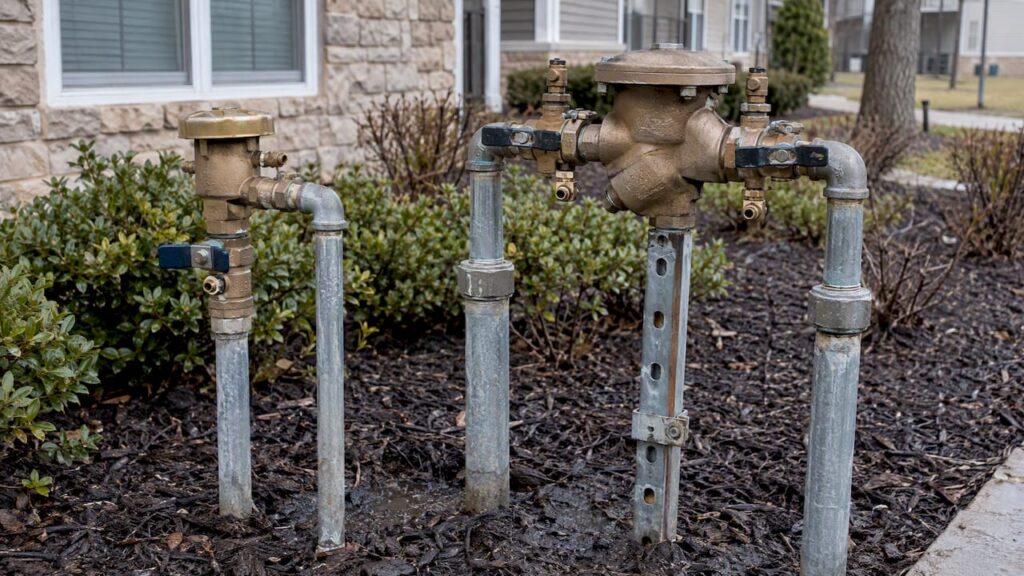
An atmospheric vacuum breaker (AVB) is a gravity-operated device that cannot be tested and shouldn’t stay under continuous pressure, while a pressure vacuum breaker (PVB) is spring-loaded, testable, and built for continuous-pressure systems. Both guard only against backsiphonage, never backpressure. As a rule of thumb, choose an AVB for intermittent, low-hazard fixtures and a PVB wherever continuous pressure or annual compliance testing is required.
TL;DR:
- AVBs generally cannot remain pressurized beyond 12 hours per day, while PVBs serve irrigation systems with multiple zones and other continuously pressurized lines.
- An AVB needs at least 6 inches of clearance above the highest outlet and cannot have a downstream shutoff; a PVB needs roughly 12 inches.
- PVBs support annual certification through built in test cocks, while authorities may reject untestable AVBs for commercial or high hazard applications.
- Some jurisdictions require testable assemblies for every property on a compliance schedule, regardless of hazard level, so confirm local rules before installation.
- Neither device protects against backpressure, where downstream pressure forces contaminated water toward the supply; codes typically call for an RPZ or double check valve assembly.
Table of Contents
- AVB vs PVB: comparing protection, pressure, and testing
- Installation standards and code requirements that decide field acceptability
- Testing, maintenance, and the failures worth watching for
- Matching the right device to your property setup
- What we see most often in the field
- How we help you choose, install, and certify the right device
- FAQ
- Sources
AVB vs PVB: comparing protection, pressure, and testing
The two devices solve the same basic problem, keeping contaminated water from siphoning backward into the potable supply, but they do it with different mechanics and different rules attached. An AVB uses a simple poppet or float that opens by gravity when pressure drops downstream. A PVB uses a spring-loaded check valve paired with an air inlet valve positioned after the check, which is why it can hold a seal under constant pressure and still be opened for testing.

Neither assembly protects against backpressure, the condition where downstream pressure pushes contaminated water back toward the supply. Where that risk exists, codes typically call for a reduced pressure zone (RPZ) assembly or a double check valve assembly (DCVA) instead, and it’s worth comparing PVB vs RPZ requirements before settling on either option for a higher-hazard setup.
The practical differences show up in installation and upkeep:
- Continuous pressure: AVBs are not rated for it, with manufacturer limits typically capping exposure at 12 hours in a 24-hour period, while PVBs are built to handle pressure around the clock.
- Installation clearance: an AVB needs at least 6 inches above the highest downstream outlet, while a PVB needs roughly 12 inches.
- Downstream shutoffs: AVBs cannot have a shutoff valve anywhere downstream of the device, while PVBs are built with shutoff valves and test cocks as standard components.
- Testability: AVBs cannot be field-tested at all, while PVBs are designed for annual certification by a trained tester.
| Factor | AVB | PVB |
|---|---|---|
| Protection scope | Backsiphonage only | Backsiphonage only |
| Continuous pressure | Not rated, limited to about 12 hours in 24 | Rated for continuous use |
| Installation clearance | About 6 inches above highest outlet | About 12 inches above highest outlet |
| Downstream shutoff valves | Not permitted | Permitted, built-in test cocks |
| Testable | No | Yes, typically annually |
| Typical use | Single hose bib or per-zone irrigation | Whole-system irrigation, compliance-driven properties |
These distinctions matter most when a property has mixed fixtures: a single outdoor spigot might get by on an AVB, while a multi-zone irrigation controller feeding several heads at once usually calls for a PVB precisely because of the continuous-pressure exposure and the need for a verifiable annual record.
Installation standards and code requirements that decide field acceptability
Both devices are built to specific ASSE standards, and inspectors check against those standards rather than general assumptions about what “looks right.” AVBs fall under ASSE 1001, which defines a non-testable assembly limited to intermittent, low-hazard backsiphonage protection. PVBs fall under ASSE 1020, which specifies an independently acting check valve, an air inlet valve, shutoff valves, and test cocks, and explicitly allows the assembly to sit under continuous pressure beyond the 12-hour AVB limit.
Many local water authorities decline to accept non-testable devices for commercial or high-hazard applications because there’s no way to verify they’re still functioning, a pattern documented by the Southern Nevada Health District.
A few field rules decide whether an installation passes inspection:
- Clearance above the highest downstream outlet is measured and enforced strictly: 6 inches for AVB, 12 inches for PVB.
- Any downstream shutoff valve installed on an AVB line is a common and often cited code violation.
- Orientation and placement relative to shutoffs, drains, and freeze exposure affect whether the inspector signs off the first time.
Before installing either device, check with your local water authority or building department, since some jurisdictions require testable assemblies for any property on a compliance schedule regardless of hazard level.
Testing, maintenance, and the failures worth watching for
Testing obligations are where AVB and PVB diverge most for property owners. A PVB is designed to be tested, and most local programs require annual certification by a certified tester who checks the test cocks, confirms the check valve is seating properly, and verifies the air inlet valve opens correctly. An AVB has no test cocks and isn’t subject to annual testing at all, since the standard it’s built to doesn’t include a field-test procedure.
- Know which device you have before assuming an annual test is required, since AVBs are exempt by design, not by neglect.
- Watch for a stuck poppet or float on an AVB, the most common failure mode when the device is accidentally left under continuous pressure.
- Watch for water discharging from the air inlet or test cocks on a PVB, which usually signals a worn seal or a clogged check valve; our guide to PVB spraying water walks through the checks a homeowner can safely perform.
- Call a certified tester for anything beyond a visual check, since opening test cocks or adjusting a check valve on a pressurized line requires training.
Pro Tip: If you can hear water running from an outdoor valve when nothing is in use, check the vacuum breaker before assuming it’s a hose bib problem.
Matching the right device to your property setup
Picking between AVB and PVB comes down to how the fixture is used, not personal preference. A single hose bib or a one-zone drip system that runs only occasionally is a reasonable fit for an AVB. A multi-zone sprinkler system, any fixture under constant pressure, or any property with a compliance letter from a water authority points toward a PVB or something higher-tier.
Run through these criteria before deciding:
- Will the line stay pressurized continuously, or only during short watering cycles?
- Does your local code or water authority require annual testing and a certified tester’s report?
- Does the setup need a downstream shutoff valve, which rules out an AVB outright?
- Is there any realistic contamination or high-hazard risk that would call for an RPZ instead?
- Is the device exposed to freezing temperatures, which affects enclosure needs regardless of device type?
When any of those answers is uncertain, default to a testable assembly. Our page on the atmospheric vacuum breaker covers typical NJ installation scenarios in more detail if you want to confirm which category your fixture falls into before requesting a quote.
What we see most often in the field
The most common mistake we encounter is an AVB installed on a line that’s accidentally left under continuous pressure, which lets the poppet stick closed without any visible warning. Property managers juggling multiple addresses tend to prefer PVBs simply because the annual test produces a record they can file and forget, and they may also consider additional water-protection measures detailed in how to automate water shutoff for leak prevention. Before hiring anyone, ask what standard the device meets, whether they’ll provide a signed test report, and how they handle a failed test.
— Jordan
How we help you choose, install, and certify the right device
Whether your property needs a straightforward AVB swap or a full PVB installation with annual certification, we handle testing and certification from the first visit through filing the report with your water authority. Our visits include checking clearance and shutoff placement against code, testing the assembly if it’s a testable type, and flagging anything that needs a rebuild or replacement on the spot since our trucks carry replacement parts for same-visit repairs.

If your current device is exposed to weather or vehicle traffic, we also build custom enclosures sized to the clearance your assembly requires. Property managers juggling several addresses can arrange consolidated billing across locations rather than tracking separate invoices. Request an inspection through our testing and certification page and we’ll get a certified tester out to confirm what your property actually needs.
FAQ
Is a vacuum breaker the same as a backflow preventer?
A vacuum breaker is one category of backflow preventer, specifically one that protects against backsiphonage only. Other backflow preventer types, like RPZ and DCVA assemblies, also guard against backpressure, which vacuum breakers cannot do.
How do I replace a PVB valve?
Replacing a PVB involves shutting off the supply, draining the assembly, disconnecting it at the unions or threaded fittings, and installing a new unit at the same or correct clearance, generally 12 inches above the highest downstream outlet. Because the replacement needs to pass inspection and often requires an initial certification test, most property owners have a licensed technician handle the swap and file the paperwork.
How do you test a vacuum breaker?
Only a PVB can be tested in the field, using its built-in test cocks to check that the check valve seats properly and the air inlet valve opens as designed. An AVB has no test cocks and isn’t built for field testing, so a certified tester instead confirms correct installation and clearance rather than running a functional test.
What is an AVB in plumbing?
An AVB, or atmospheric vacuum breaker, is a gravity-operated assembly that opens to let air in whenever downstream pressure drops, preventing contaminated water from siphoning back into the supply. It’s governed by ASSE 1001 and is meant for intermittent use only, not continuous pressure.
Sources
- Home sprinkler systems: backflow prevention devices | Colorado State University Extension
- Types of backflow devices – Southern Nevada Health District
- ASSE 1020 Pressure Vacuum Breaker Assembly (preview) | ANSI webstore