
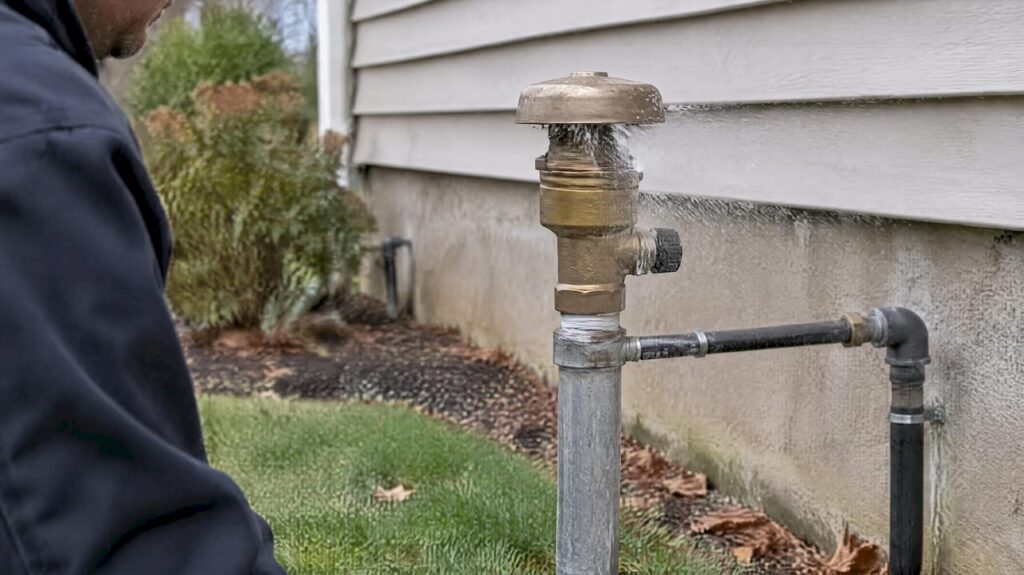
A pressure vacuum breaker that spits or sprays briefly when you turn your irrigation system on is often normal mechanical behavior, but continuous spraying, a leak at the test cocks, or a device that won’t hold pressure means something has failed. If you see ongoing discharge, isolate the irrigation supply and call a certified backflow tester rather than attempting a repair yourself.
TL;DR:
- Continuous spraying from a pressure vacuum breaker indicates internal wear, downstream blockages, or backpressure issues, not normal startup behavior.
- Proper installation, including vertical orientation and adequate clearance above outlets, is crucial to prevent frequent or chronic device discharges.
- Upstream pressure surges from closed valves or pumps can cause spray even if the device itself is functioning correctly, often misdiagnosed as device failure.
- Most repairs involve replacing worn internal parts like seats, springs, or seals, but cracked housings or severe damage require total replacement.
- Annual testing by certified technicians, combined with proper installation and winterization practices, helps ensure compliance and prevents water contamination risks.
Table of Contents
- How a PVB works and why it can spray or discharge water
- Common causes: a checklist for diagnosing PVB spraying
- Step-by-step safe checks before calling a technician
- Repair vs. replace: what determines the right fix
- Installation, orientation, and freeze protection rules
- Field troubleshooting examples from South Jersey Backflow
- Why timely compliance protects more than your yard
- How South Jersey Backflow can help with testing and repairs
- FAQ
- Sources
How a PVB works and why it can spray or discharge water
A pressure vacuum breaker, or PVB, exists for one job: stopping contaminated water from siphoning backward into the drinking water supply when pressure drops upstream. It does not guard against backpressure, which is a different hazard entirely, and that distinction explains a lot of the confusing behavior homeowners see.
Inside the device sit two main working parts: a spring-loaded check valve and a poppet connected to an air inlet valve at the top. When water flows normally through the assembly, pressure holds the check valve open and keeps the air inlet sealed shut. The moment pressure drops, whether because a sprinkler zone shuts off, the main line gets shut down for winter, or someone closes a valve upstream, the check valve snaps shut and the air inlet pops open to let atmospheric air into the pipe. That open-air inlet is what prevents a siphon from forming.
This is also why a PVB can spit or spray for a second or two during startup. When you turn the water back on after it has been off, whether for the night, for winterization, or for a repair elsewhere in the system, the poppet and air inlet need a moment to reseat as pressure builds back up. Water escaping from the air inlet canopy during that brief window is the device doing exactly what it’s designed to do. According to the Chesterfield County irrigation backflow guide, PVB assemblies are built specifically to stop back-siphonage, and their internal parts are meant to move and reseat as pressure cycles, which naturally produces the occasional short spray.
What’s not normal is when that discharge doesn’t stop. A PVB that sprays continuously, drips steadily from the air inlet, or leaks from the test cocks is telling you that a seal, spring, or seat inside the device has worn out or that something downstream is keeping it from reseating properly. The device is a back-siphonage preventer only. It offers no protection against backpressure, which happens when downstream pressure (from a pump, an elevated pipe run, or a closed valve trapping pressurized water) pushes back toward the device instead of away from it. When backpressure is present, a PVB can appear to malfunction even when its internal parts are fine, because it was never designed to handle that condition in the first place.
Installation also shapes how the device behaves day to day. A PVB has to sit upright, with the air inlet canopy facing up and exposed to open air, and it needs clearance above the highest downstream sprinkler head or outlet it protects. Get that orientation or clearance wrong, and the device can discharge more often, or fail to vent properly, even when nothing inside it is actually broken.
Common causes: a checklist for diagnosing PVB spraying
Before assuming the PVB itself has failed, it helps to rule out the issues that live downstream or upstream of the device. Many “PVB problems” are actually symptoms of something else in the irrigation system.
- Backpressure from pumps or closed valves: a booster pump, an elevated pipe run, or a zone valve that closes while water is still pressurized can push water back toward the PVB and cause it to discharge even though the device itself is healthy.
- Worn internal parts: a failing check valve, a worn poppet seat, or a cracked spring will keep the device from sealing fully, producing a steady trickle or spray instead of a brief one.
- Leaking test cocks: these small ports are used for testing and are a common point of failure, especially after years of exposure to weather and seasonal freeze-thaw cycles.
- Clogged or stuck downstream components: debris in a zone valve, a stuck sprinkler head, or sediment in the line can create pressure spikes that show up at the PVB first, even though the PVB isn’t the root cause.
- Winterizing and seasonal damage: water left in the assembly over winter can freeze and crack internal components, and blow-off ports placed upstream of the assembly (instead of downstream, where they belong) can force air and water through the PVB the wrong way during de-winterizing.
Pro Tip: If the spraying only happens right when a specific zone kicks on, start by checking that zone’s valve and heads before assuming the PVB itself is at fault.
Downstream faults are easy to misdiagnose because the PVB is usually the first visible sign of trouble. A stuck zone valve or a clogged head several hundred feet away can send a pressure spike straight back to the assembly, and the water you see at the PVB canopy may have nothing to do with the device’s own condition.
Step-by-step safe checks before calling a technician
If your PVB is spraying and you want to narrow down the cause before a service call, a few safe checks can save time and money. Stop as soon as you reach a step that requires opening or disassembling the device itself.
- Shut off the irrigation supply at the zone valve or the main shutoff feeding the backflow assembly, and avoid using any potable outlets tied to the same line until you know what’s happening as explained in How to Automate Water Shutoff for Leak Prevention.
- Relieve pressure carefully if it’s safe to do so, since a fully pressurized line can make leaks look worse than the underlying fault actually is.
- Inspect the test cocks for drips or spray, since a leak there often points to a worn seal rather than a problem with the main check valve.
- Watch where the water is coming from: the air inlet canopy, a test cock, or a cracked housing each suggest a different kind of fault.
- Cycle the zone valves one at a time to see if the spraying is tied to a specific zone, which usually points downstream rather than at the PVB itself.
- Check for freeze damage, including cracks in the housing or bonnet, especially after a cold snap or if the system wasn’t winterized properly.
- Call a certified tester if the spraying is continuous, if you can’t isolate the source, or if you’re unable to shut off the supply safely. Many jurisdictions also require a certified technician for any repair followed by re-testing before the device is considered compliant again.
Before the technician arrives, photograph the discharge, note what time it happens and which zones are running, and write down anything unusual you noticed, like reduced water pressure elsewhere in the house. That information often shortens the diagnostic visit considerably.
Repair vs. replace: what determines the right fix
Not every spraying PVB needs a full replacement, but some symptoms point clearly in that direction. A worn seat, a tired spring, or a leaking test cock seal is typically a rebuildable fault: a technician replaces the internal kit, retests the device, and you’re back in compliance within the same visit in many cases. A cracked housing, freeze-split components, or a bonnet that no longer seals, on the other hand, usually means the device has to be replaced outright, since those failures affect the structural body rather than a replaceable part.
Testing requirements shape this decision as much as the physical damage does. Los Angeles County Public Health notes that backflow devices must be tested when first installed, again after any repair, and at least annually after that, and these tests have to be performed by a certified tester for the results to count toward compliance. Beyond annual testing, many assemblies benefit from a fuller overhaul roughly every five years, replacing springs, seals, and seats before they fail on their own schedule instead of yours.
A typical technician visit follows a predictable sequence: isolate the assembly, run a diagnostic pressure test to see whether the check valve and air inlet are holding properly, then either rebuild the internals on-site or, for more extensive damage, pull the unit for a bench rebuild. After the repair, the technician retests the device and files the certification paperwork with the local water authority where that’s required.
One number technicians watch closely is the check valve’s closing pressure. A check valve that won’t hold at the required threshold pressure differential fails the test even if the device looks fine on the outside, which is exactly why a visual check at home can’t replace an actual certified test.
Installation, orientation, and freeze protection rules
A surprising number of PVB problems trace back to how the device was installed rather than anything wearing out inside it. Getting orientation, clearance, and freeze protection right from the start prevents most of the nuisance spraying homeowners deal with later.
The device has to sit vertically with the air inlet canopy facing straight up, fully exposed to open air. It also needs to sit at least 12 inches above the highest downstream sprinkler head or outlet it protects, a clearance rule set out in the Chesterfield County guide that exists so the air inlet can vent properly and so gravity doesn’t work against the device’s siphon protection. A PVB installed below grade, buried in a pit, or tucked into a vault with a sealed lid cannot vent to atmosphere correctly, and that alone can cause chronic spraying or outright failure to protect against back-siphonage.

Freeze protection creates a common conflict: homeowners want to keep the device from freezing, but the fix has to allow the canopy to keep breathing. Wrapping the air inlet in foam insulation, covering it with a tarp, or sealing it inside an airtight box blocks the vent the device depends on, which can prevent the poppet from opening and closing correctly and lead to exactly the kind of malfunction you’re trying to avoid. The better approach is an insulated enclosure built for backflow assemblies, one that protects against freezing temperatures without sealing off the air inlet, or relocating to a freeze-tolerant model where the climate calls for it.

Where the system includes a winterizing blow-off port, placement matters just as much as insulation. That port needs to sit downstream of the backflow assembly, not upstream, so that compressed air used to clear the lines in fall doesn’t force water and debris backward through the PVB. A misplaced blow-off is a common, easily overlooked cause of post-winterizing leaks and spraying each spring.
Where backpressure is a known risk, such as a property with an irrigation pump or an elevated storage tank, a PVB may not be the right device at all. The San Francisco Public Utilities Commission’s cross-connection requirements note that systems with backpressure potential typically need a reduced pressure assembly instead, and that a PVB that can’t be repaired in that kind of system may need to be replaced with an RP assembly rather than another PVB.
Field troubleshooting examples from South Jersey Backflow
Seeing how a real diagnostic visit unfolds helps explain why technicians ask the questions they do and why documentation from the homeowner matters so much.
- In a Zurn 720-A PBA troubleshooting case in Deptford, New Jersey, our technicians traced reported spraying back to the assembly’s internal check mechanism rather than the irrigation zones themselves, isolating the fault through a sequence of pressure checks before performing the repair.
- Work orders completed in Bordentown and Hamilton Township followed a similar pattern: isolate the assembly, confirm whether the issue originates upstream or downstream, then test the check valve and air inlet separately before deciding between a rebuild and a full unit swap.
During these visits, technicians record static line pressure, the differential reading across the check valve, which parts were replaced (seat, spring, or seals), and the final pass or fail result, since those numbers are what get filed with the local water authority for compliance. Homeowner evidence shortens this process considerably. A short video of the discharge, a note of what time it happens, and which irrigation zone was running when it started let a technician narrow down likely causes before they even arrive on-site.
Why timely compliance protects more than your yard
A spraying PVB is rarely just a nuisance. It’s a signal that a device meant to protect drinking water from contamination may not be doing its job, and in most jurisdictions that’s a regulatory issue as much as a plumbing one. Annual testing catches small faults, a worn seat or a tired spring, before they turn into a failed device during a dry spell or a compliance notice you weren’t expecting. Staying ahead of the schedule costs less than catching up after the fact.
— Jordan
How South Jersey Backflow can help with testing and repairs
We handle the testing, rebuilds, and enclosures that keep a spraying PVB from turning into a bigger problem or a compliance headache. We stock parts for most common assemblies, which means a worn seat or a failed spring can often be rebuilt in the same visit instead of waiting on a parts order.

If you’re dealing with a PVB that won’t stop spraying, here’s what helps us move fast once we’re on-site:
- Photos or a short video of where and when the discharge happens.
- Your most recent test certificate, if you have one, so we know the device’s service history.
- Clear access to the shutoff valve and the assembly itself, especially if it’s in an enclosure or a hard-to-reach spot.
Beyond diagnosing and rebuilding a faulty PVB, we handle backflow preventer testing and certification, custom enclosures for freeze protection, and same-day rebuilds and repairs for properties across the state, with direct filing of results to your local water authority so you’re not left chasing paperwork. If your PVB is spraying and you’re not sure what’s causing it, schedule a certified test or repair and we’ll take it from there.
FAQ
Is it normal for a PVB to spray water briefly on startup?
Yes, a short spray or spit from the air inlet when the system re-pressurizes is typically normal, since the internal poppet needs a moment to reseat as pressure builds. Continuous spraying, dripping from the test cocks, or a device that won’t hold pressure is not normal and points to a worn part or a downstream issue.
Why does my PVB keep spraying even after the zones are off?
Ongoing spraying usually means the check valve or poppet seat is worn and no longer sealing fully, or that backpressure from a pump, closed valve, or elevated pipe run is pushing water back into the device. A certified tester can run a pressure test to pinpoint which one it is.
Can I repair a spraying PVB myself?
Simple checks, like inspecting test cocks or cycling zone valves, are safe for most homeowners to perform, but opening and rebuilding the internal assembly is best left to a certified technician. Many jurisdictions require certified testing and reporting after any repair before the device is considered compliant again.
How often does a PVB need to be tested?
Most jurisdictions require testing at installation, again after any repair, and at least annually after that, with a fuller overhaul recommended roughly every five years as parts wear. Requirements vary by location, so check with your local water authority or a certified tester for the exact schedule that applies to your property.
How much does it cost to repair or rebuild a PVB?
A residential rebuild kit service typically costs within a moderate range, while a full residential installation’s price varies depending on the scope of work. For a quote on your specific situation, request pricing through our rebuild and repair page.
Sources
- Certified backflow testers (Los Angeles County Public Health)
- Residential irrigation backflow guide (Chesterfield County)
- Cross-Connection Control Requirements for Dedicated Irrigation Services (San Francisco Public Utilities Commission)