
Backflow preventers with field-testable check valves must be tested annually in New Jersey, with two major exceptions: most one- and two-family homes are exempt, and any device covered by a NJDEP Physical Connection Permit needs quarterly testing instead. The immediate move is simple. Hire a certified tester before your Certificate of Compliance expires, and make sure the results get filed with your municipality or NJDEP.
TL;DR:
- Most commercial and industrial properties with backflow preventers must undergo quarterly testing if covered by a Physical Connection Permit, while other devices require annual testing.
- Certified testers recognized by the NJDEP must perform the tests; property owners should verify credentials separately from plumbing licenses to avoid report rejections.
- Failure to promptly repair a failed device can lead to delays in obtaining or renewing the Certificate of Compliance, especially if joint fire and water permits are involved.
- Scheduling testing 60 to 90 days before expiration prevents last-minute rushes and reduces the risk of lapses in compliance documentation.
- Coordinating testing across multiple devices and maintaining records of expiration dates help prevent unintentional violations and ease permit renewals.
Table of Contents
- What NJ Law Actually Requires for Backflow Testing
- Who Is Allowed to Test a Backflow Device in NJ?
- When Does Quarterly Testing Apply Instead of Annual?
- What to Do When a Backflow Device Fails Its Test
- Building a Backflow Testing Schedule That Doesn’t Slip
- How South Jersey Backflow Keeps NJ Properties Compliant
- What Property Owners Consistently Get Wrong About This Rule
- Book Your Backflow Test Before the Deadline Sneaks Up
- Sources
- FAQ
What NJ Law Actually Requires for Backflow Testing
The annual testing rule doesn’t come from a vague industry standard. It’s written into New Jersey’s Uniform Construction Code. The Department of Community Affairs spelled it out in DCA Bulletin 99-2, which clarifies N.J.A.C. 5:23-2.23(l) and Plumbing Subcode Section 10.5.6. The rule is direct: any backflow preventer designed to be field-tested, and installed to isolate a cross-connection, must be tested before final inspection and then re-tested every year after that.
Certificates of Compliance issued under this rule expire annually, which is why “set it and forget it” doesn’t work here. The devices covered tend to show up wherever plain drinking water meets a system that could contaminate it.
- Reduced pressure zone (RPZ) assemblies protecting irrigation systems
- Double check valve assemblies (DCVAs) on fire-protection lines
- Devices serving laboratories, industrial processing lines, and boiler feed systems
- Commercial and multi-unit residential connections with elevated contamination risk
One- and two-family dwellings get a break here. The bulletin generally excludes them from the annual testing mandate, though local plumbing subcode officials still enforce whatever rule applies in a given town. Officials issue the Certificate of Compliance, but they cannot legally perform the test itself. That job belongs to someone else entirely.
Who Is Allowed to Test a Backflow Device in NJ?
Testing has to be done by someone certified through an agency recognized by the NJDEP Bureau of Safe Drinking Water. Municipalities keep or reference these certified tester lists, and they lean on that certification instead of running tests themselves. A local plumbing subcode official can witness a test or require a signed report, but state rules keep the actual testing role separate from the inspection role.
- Certification must come from an NJDEP-recognized certifying agency, not just a plumbing license
- Municipalities typically maintain or point to a certified tester directory for property owners
- Certified testers are expected to submit reports to the appropriate authority within a set window after testing
Pro Tip: Don’t assume your plumber is automatically qualified to test backflow devices. Plumbing licensure and backflow tester certification are two different credentials, and pulling the wrong one for the job is a common way owners end up with a rejected report. For a rundown of what to check before you book someone, this guide to choosing a certified tester breaks down the qualifications that actually matter.
When Does Quarterly Testing Apply Instead of Annual?
Not every device runs on the standard annual clock. If your property has a Physical Connection Permit from NJDEP, the schedule changes. A physical connection typically means a direct or indirect link between a public water system and another source, and it shows up at facilities like car washes, cooling towers, and certain industrial sites with auxiliary water supplies.
- NJDEP’s Physical Connection Permit guidance requires quarterly testing for any device covered under that permit.
- The permit itself renews annually, separate from the quarterly test cycle for the device.
- Certified testers submit quarterly results through NJDEP’s e-permitting system, and timely submissions support automatic renewal.
Private residences generally don’t need a Physical Connection Permit, so this quarterly requirement mostly affects commercial and industrial properties with unusual water supply arrangements. Coordinating your tester’s schedule with the permit’s e-permitting deadlines matters more here than in a standard annual setup, since a missed quarterly filing can stall the renewal.
What to Do When a Backflow Device Fails Its Test
A failed test isn’t a paperwork problem you can push to next month. NJ rules expect repair or replacement right away, not at the property owner’s convenience.
- Repair or replace the device immediately after a failed test result
- Replacing a device generally requires a construction permit from the local building department
- If the device serves a combined fire and domestic water service, expect joint plan review from both plumbing and fire protection subcode officials, which can add real time to the permit process
- Retest the repaired or replaced device before submitting a new Certificate of Compliance
- Keep copies of the failed report, the permit, and the passing retest, since municipalities may charge a per-device fee and request documentation at renewal
That joint review step is easy to underestimate. Budget extra lead time if your building’s backflow assembly sits on a combined line, because getting two subcode officials to sign off rarely happens in a single visit.
Building a Backflow Testing Schedule That Doesn’t Slip
Most compliance gaps aren’t caused by ignorance of the rule. They’re caused by nobody tracking the expiration date until a reminder letter shows up. A simple annual workflow closes that gap.
- Set a calendar reminder 60 to 90 days before your Certificate of Compliance expires, giving yourself room to book a tester without rushing.
- Consolidate scheduling if you manage multiple devices or properties. One coordinated visit saves on service calls compared to booking each unit separately.
- Collect the essentials from your tester: device type and location, test date, pass/fail results, tester name and certification number, and a signature.
- File the completed form with your municipal building department, or through NJDEP’s e-permitting portal if the device falls under a Physical Connection Permit.
Test length varies more than most owners expect. A standard RPZ or DCVA test commonly runs 15 to 45 minutes per device under normal conditions, but tight access, extra diagnostics, or an on-the-spot repair can stretch that visit considerably. If you’re scheduling five devices across a property, don’t assume the whole job wraps in under two hours. For a closer look at what records you need on hand before filing, see this breakdown of required test documentation.
How South Jersey Backflow Keeps NJ Properties Compliant
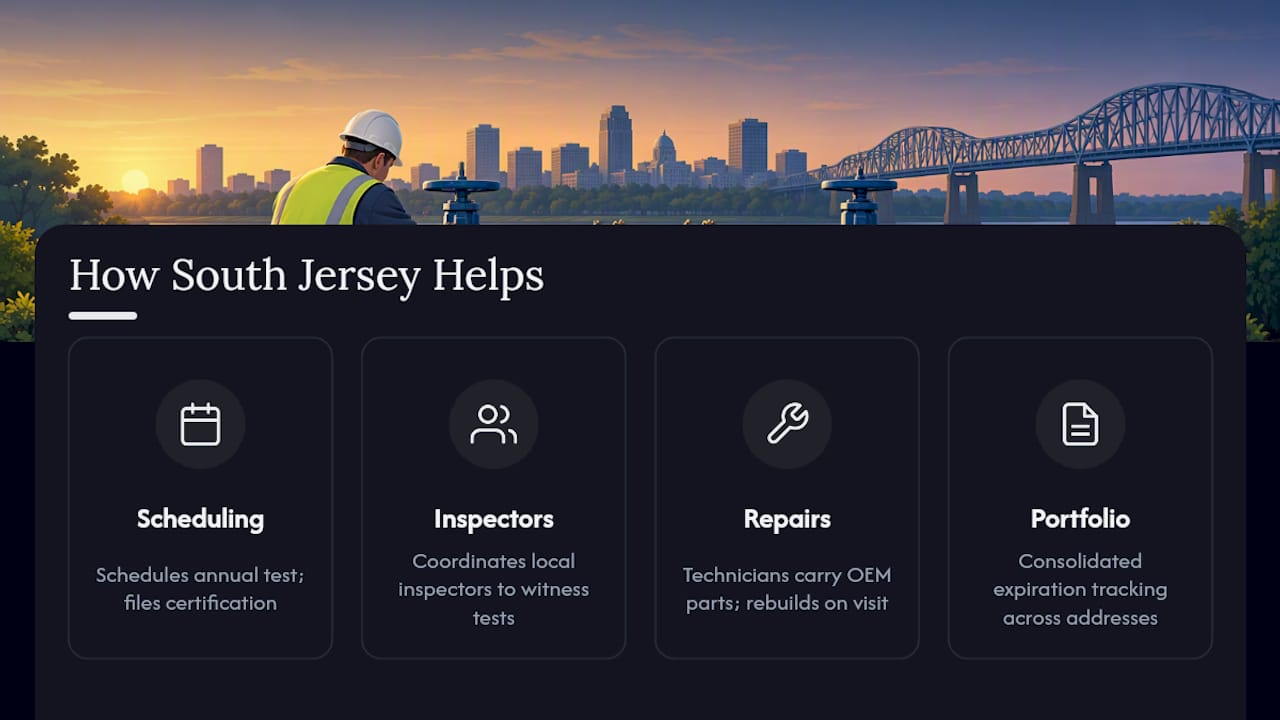
Southjerseybackflow handles the parts of this process owners find most tedious: scheduling the annual test, filing the certification with your municipality, and coordinating with local inspectors who need to witness the work. When a device fails, the same visit can often include the rebuild or repair, since technicians carry OEM parts for common assemblies. That’s a meaningful advantage when a joint plan review is already adding delay on the permit side.
Property managers juggling several addresses get one more benefit: consolidated tracking of expiration dates across a portfolio, so no single device slips through unnoticed. Full service details are outlined on the backflow testing and certification page.
What Property Owners Consistently Get Wrong About This Rule
Most compliance guides treat backflow testing like a single, uniform rule everyone follows the same way. That’s the biggest misread of the whole system. New Jersey actually runs two parallel schedules, annual for most field-testable devices and quarterly for anything under a Physical Connection Permit, and conflating the two is where owners get burned. A commercial property manager who assumes annual testing covers everything can miss a quarterly filing entirely and jeopardize a permit renewal without realizing it.
The other blind spot is timing. Owners tend to treat the Certificate of Compliance expiration like a deadline to react to, rather than a date to plan around. By the time a reminder letter arrives, there’s often not enough runway to handle a failed test, a construction permit, and a joint plan review before the certificate lapses. The fix isn’t complicated. Build your testing calendar around the permit process’s slowest possible path, not the fastest one. If a replacement might need joint fire and plumbing subcode review, schedule as if it will.
— Jordan
Book Your Backflow Test Before the Deadline Sneaks Up
A licensed and insured company offers testing services, files required reports, and stocks OEM parts for on-the-spot rebuilds when a device fails.
That last point matters more than it sounds. A failed test that turns into a second visit for parts can blow past your Certificate of Compliance window, especially if a construction permit is also in play. Getting testing and repair handled in one trip cuts that risk down considerably.
- Testing, filing, rebuilds, and enclosure installation services for residential, commercial, and multi-unit properties
- Submission of test reports to help avoid a lapsed certificate
Ready to get on the schedule? Visit the backflow testing and certification page to book your test and get compliance paperwork handled in the same visit.
Sources
- Testing of Backflow Preventers (DCA Bulletin 99-2)
- Certified Backflow Prevention Device Testers | NJDEP
FAQ
Is Backflow Testing Required in NJ?
Yes. New Jersey requires annual testing for field-testable backflow preventers under the Uniform Construction Code and DCA Bulletin 99-2. Most one- and two-family homes are exempt, but commercial, industrial, and multi-unit properties with these devices generally are not.
How Often Does Backflow Testing Need to Happen?
Standard field-testable devices need testing once a year to keep the Certificate of Compliance current. Devices covered by a Physical Connection Permit need testing quarterly instead, with the permit itself renewing annually.
What Does the NJ Plumbing Code Require for Backflow Preventers?
The plumbing subcode, under N.J.A.C. 5:23-2.23(l), requires that field-testable backflow preventers isolating a cross-connection be tested before final inspection and then annually afterward. Local plumbing subcode officials enforce this and issue the compliance certificate, but they don’t perform the test themselves.
How Long Does a Backflow Test Take?
A single RPZ or DCVA test typically takes 15 to 45 minutes under normal access conditions. Properties with multiple devices, tight mechanical rooms, or a device that needs repair should budget more time per visit, and the service provider can often handle testing and same-visit repairs together.
Pingback: Property Managers: Find Exact NJ Commercial Backflow Deadlines
Pingback: Avoid Fines: NJ Landlords' Backflow Compliance Checklist & Lease Tips
Pingback: NJ Property Owners' Boiler Backflow Playbook: Checklist & Deadlines
Pingback: 24 Hour Rule: Employers' Checklist for Testing During Business Hours
Pingback: Pass Annual Tests Property Owners & Managers: Meter Pit Backflow Rules
Pingback: Atlantic City Backflow Rules: ACMUA, NJDEP, or Both?