TL;DR:
- Contaminated drinking water from backflow poses a real risk for New Jersey property owners, with strict compliance enforced by local water authorities. Owners must identify, test, and maintain all backflow preventers at their properties to prevent contamination and avoid penalties. Proper location, regular testing by certified professionals, and proactive system management are essential for NJ backflow compliance.
Contaminated drinking water is not a hypothetical risk for New Jersey property owners. It is a documented consequence of undetected backflow, and local water purveyors across the state are actively enforcing compliance rules that carry real penalties. New Jersey requires property owners to conduct a hazard survey to identify all cross-connections and potential backflow risks. If you manage a property with irrigation, a boiler, or a commercial plumbing system, you need to know where every backflow preventer is, whether it has been tested recently, and whether your paperwork is current. This article walks you through each step.
Table of Contents
- Understanding backflow and its risks
- Identifying backflow preventers: Types and common locations
- Step-by-step: How to locate your backflow preventer
- Testing and maintaining your backflow preventer for NJ compliance
- Why property owners often miss critical backflow preventers
- Get help with backflow compliance in New Jersey
- Frequently asked questions
Key Takeaways
| Point | Details |
|---|---|
| Hazard survey required | New Jersey enforces hazard surveys to identify all backflow risks and devices. |
| Device types matter | Backflow prevention device type depends on the hazard level and plumbing context. |
| Annual testing mandatory | State law requires ASSE Series 5000 certified testing and submission every year. |
| Documentation prevents fines | Keeping clear records and device maps helps avoid compliance penalties or water shutoff. |
| Professional support available | Certified testers and services streamline compliance and ensure safe water supply. |
Understanding backflow and its risks
Backflow happens when water flows in the wrong direction through your plumbing. Instead of clean water flowing from the supply into your building, contaminated water from inside your pipes gets pulled or pushed backward into the public water supply. This typically happens during pressure drops, such as a water main break or firefighting activity nearby.
The hazards are serious. Irrigation systems can pull fertilizers, pesticides, and soil bacteria into the water supply. Boiler systems can introduce chemicals used in heating water treatment. Even a garden hose submerged in a bucket of soapy water creates a cross-connection (any physical link between a potable water system and a potential contamination source).
New Jersey regulations are strict about this. The NJDEP backflow program covers a broad range of property types, including residential homes with irrigation systems, multi-unit residential buildings, commercial properties, schools, and any facility with a boiler or cooling tower.
Who must comply? Practically everyone with a water connection that has any cross-connection potential:
- Residential properties with in-ground irrigation systems or boilers
- Commercial properties with process water, chemical injection, or fire suppression systems
- Multi-unit buildings with shared mechanical systems
- Properties with pools or water features fed by potable water lines
“Property owners bear the compliance burden. Your water purveyor can prompt a hazard survey, but the responsibility to locate, test, and maintain every device sits with you.”
Understanding NJ backflow regulations from the start means you avoid surprises when a notice arrives from your municipality. Getting ahead of the process protects both your tenants and your bottom line.
Identifying backflow preventers: Types and common locations
Before you can locate your backflow preventers, you need to recognize what they look like and understand which type protects which kind of hazard. New Jersey rules under NJAC 7:10 classify devices by the degree of hazard they address.
The three most common types are:
- Double Check Valve Assembly (DCVA): Used for low-to-moderate hazard applications, such as irrigation without chemical injection or fire sprinkler systems without additives. Looks like a horizontal pipe segment with two check valves and test ports.
- Reduced Pressure Zone Assembly (RPZ): Required for high-hazard applications like boilers, chemical feed systems, and cooling towers. Has a visible relief valve between the two check valves that will discharge water if the device fails. This is the most protective device available.
- Pressure Vacuum Breaker (PVB): Used for irrigation systems where the device can be installed at least twelve inches above the highest sprinkler head. Looks like a vertical pipe fitting with a small air vent on top.
| Device type | Hazard level | Typical application | Common location |
|---|---|---|---|
| DCVA | Low to moderate | Irrigation (no chemicals), fire lines | Basement, meter pit, valve box |
| RPZ | High | Boilers, cooling towers, chemical systems | Mechanical room, utility area |
| PVB | Low to moderate | Irrigation systems | Exterior, near irrigation shutoff |
Knowing which device belongs where helps you audit your property systematically. A certified tester can verify device types and flag any that are incorrectly sized or installed for your hazard level.
Where should you look for devices on your property?
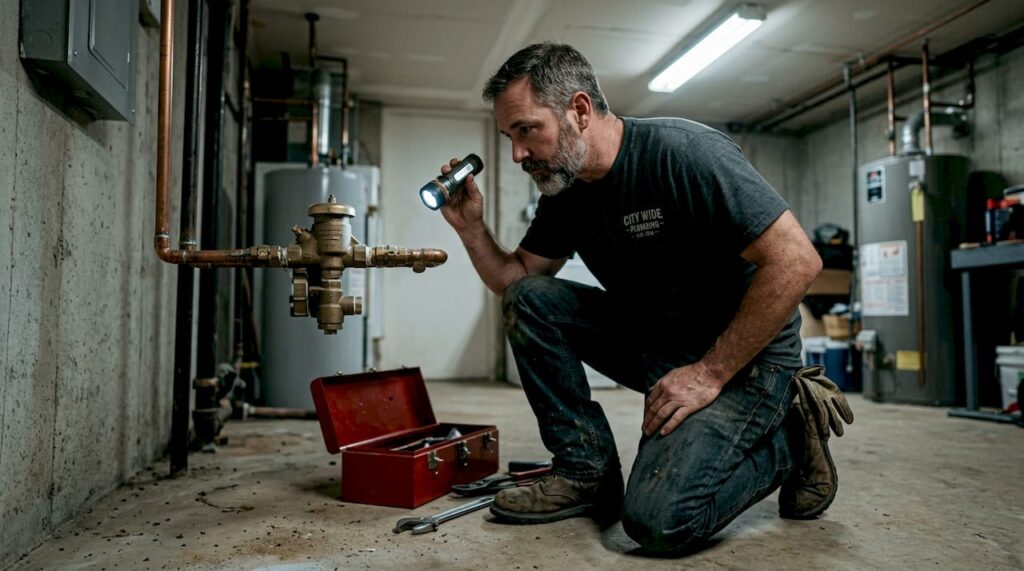
- Basements and mechanical rooms: Most boiler-related RPZs and building-entry DCVAs are installed here, often near the main water meter.
- Outdoor valve boxes: Flush-mounted metal or plastic boxes at ground level near irrigation shutoffs often contain PVBs or DCVAs.
- Near the water meter: Local water purveyors sometimes require a device at the point of entry before water even enters the building.
- Irrigation control areas: Follow the irrigation main from the controller back to its supply connection to find the preventer.
- Near cooling towers or rooftop HVAC equipment: High-hazard connections here typically require RPZs, sometimes on rooftop mechanical platforms.
Pro Tip: Document every device location with a photo and a written description including the device type, serial number, and manufacturer. Store this with your compliance records so you are never scrambling during an audit or renewal cycle.
Step-by-step: How to locate your backflow preventer
After understanding device types, let’s walk through a practical process for finding each backflow preventer on your property. This is especially important if you recently purchased a property or manage a building with aging infrastructure.
Step 1: Pull your property records. Start with any available as-built drawings, plumbing permits, or prior compliance test reports. These often list device locations explicitly. If you have past water purveyor correspondence, check for hazard survey forms or prior test submissions.
Step 2: Contact your local water purveyor. Your water utility may have records of devices they required at installation. Some utilities maintain cross-connection control logs that list every registered device on your service address. They can also guide you through the hazard survey process if one has not been completed.
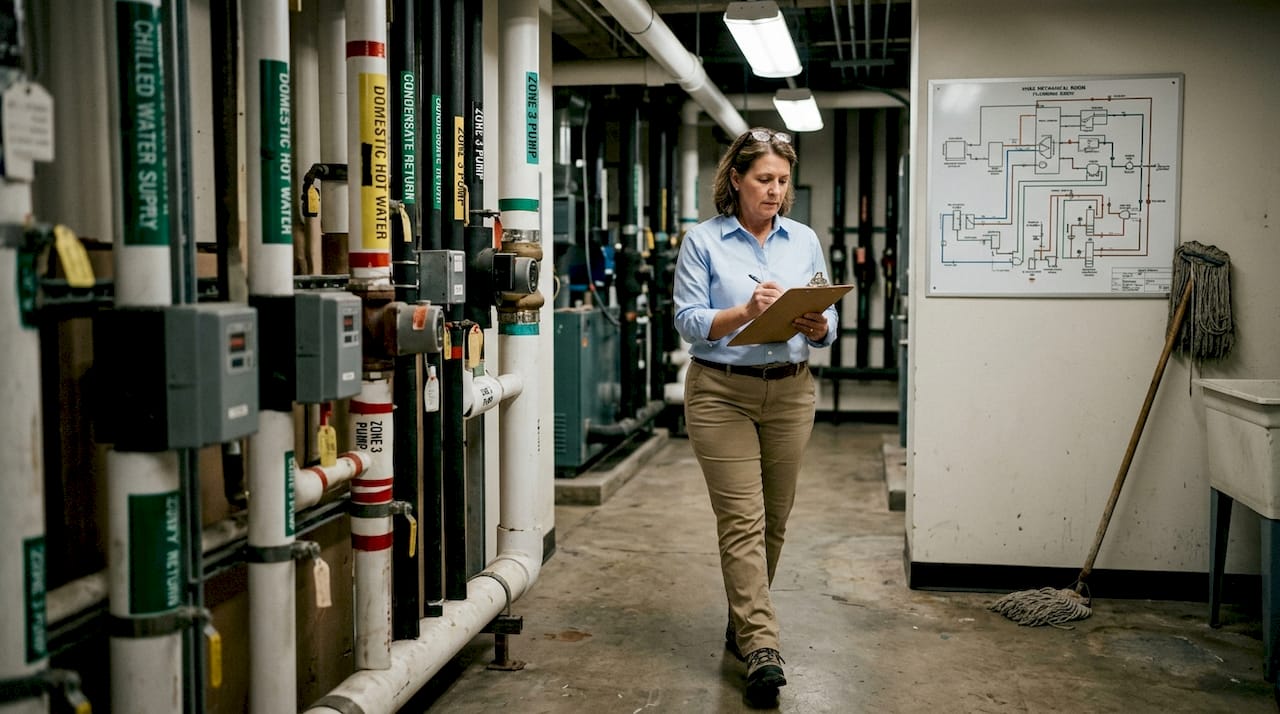
Step 3: Walk the building systematically. Start at the point where the water main enters the building. Follow every branch line. Check mechanical rooms, boiler rooms, irrigation shutoffs, and any utility areas where process water is used.
Step 4: Check all exterior valve boxes. Use a valve box key or flat pry bar to open flush-mounted boxes near sidewalks, driveways, and landscaped areas. Irrigation system devices are often buried in these locations.
Step 5: Inspect rooftop and elevated mechanical areas. Cooling towers and rooftop HVAC systems with water-cooled condensers often have RPZs installed at the equipment level. Do not skip these, as they are frequently overlooked.
Step 6: Document everything you find. Record the location, device type, model, serial number, and visible condition of each preventer. Note any that appear damaged, corroded, or inaccessible.
Step 7: Schedule testing and certification for all devices. Once located, every device needs to be on a tested and current compliance schedule.
| Property type | Primary challenge | Key locations to check |
|---|---|---|
| Single-unit residential | Limited plumbing complexity | Basement near meter, irrigation shutoff |
| Multi-unit residential | Multiple systems, multiple entries | Each unit’s boiler connection, shared irrigation, main entry |
| Commercial | Process water, chemical injection | Mechanical rooms, lab areas, cooling towers |
| Mixed-use | Overlapping residential/commercial rules | All of the above, plus tenant-specific connections |
“Do not assume a device is missing just because you cannot find it. Hidden valve boxes, finished ceilings, and buried pipe runs are common reasons devices go undetected for years.”
Pro Tip: Ask your water purveyor for the most recent hazard survey record for your address. This is public-facing documentation that can point you directly to known cross-connections on your service connection.
One critical safety note: never open, disassemble, or attempt to test a backflow preventer yourself. These devices are under water pressure, and improper handling can cause injury or damage the device. Only qualified professionals should touch them once located.
Testing and maintaining your backflow preventer for NJ compliance
Locating each device is just the first step. Here is how to ensure you meet NJ testing and maintenance requirements so your property stays in good standing with your water purveyor and NJDEP.
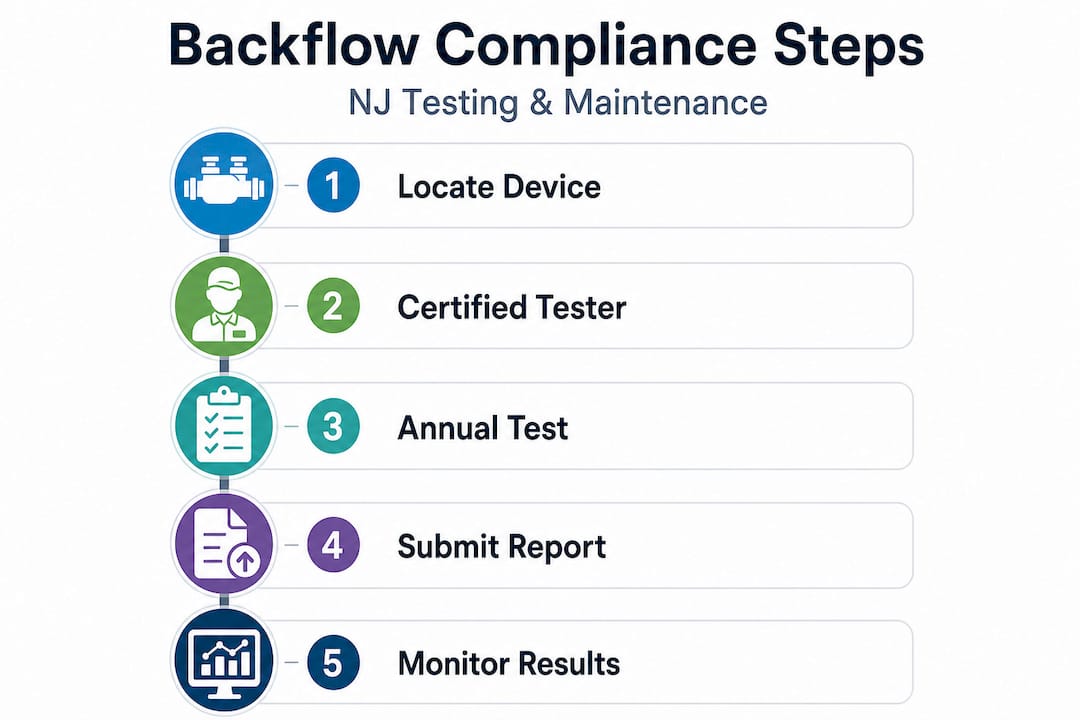
Under N.J.A.C. 7:10-10, backflow prevention devices must be tested at installation and annually by ASSE Series 5000 certified testers, with results submitted to your water purveyor within 30 days of the test date. Missing this window is one of the most common compliance failures we see.
What the annual testing process looks like:
- A certified tester arrives with calibrated differential pressure gauges to perform a field test on each device.
- The tester checks each check valve and, for RPZs, verifies the relief valve opens at the correct differential pressure.
- Results are recorded on a standardized test report form.
- The form is submitted to your water purveyor within the 30-day window.
- You retain a copy for your property compliance records.
Choosing the right tester matters more than many property owners realize. The certification requirements in New Jersey specify ASSE Series 5000 credentials. This is not a general plumber’s license. It is a specialized certification requiring passing a written and practical exam covering backflow theory, device types, and proper testing procedures. Always ask for proof of certification before scheduling a test.
Steps to stay fully compliant throughout the year:
- Keep a compliance calendar. Note the test date for every device and set reminders 60 days before each is due.
- Maintain device accessibility. Devices buried under stored equipment or behind locked doors cause scheduling delays and failed inspections.
- Verify your tester submits results on time. Some property owners assume the tester handles submission automatically. Confirm this in writing before the test.
- Replace failing devices promptly. If a device fails its annual test, it typically must be repaired or replaced before retest. Delays compound the compliance problem.
- Understand how often testing is required for your specific device types and local enforcement jurisdiction.
Common mistakes that lead to non-compliance:
- Missing the 30-day submission window after testing
- Using an uncertified tester and having results rejected by the water purveyor
- Failing to test a device because it was not on the original location list
- Letting devices become inaccessible due to renovation or landscaping
- Not updating records when a device is replaced or relocated
Pro Tip: Keep a physical binder and a digital folder with all test reports, device serial numbers, and submission confirmations organized by test year. Water purveyors can request documentation going back several years, and having it ready saves significant time and stress.
Why property owners often miss critical backflow preventers
Here is something we see repeatedly that most compliance checklists never acknowledge: property owners are not negligent. They are working from incomplete information, and the system does not always make it easy to fill in the gaps.
The most common scenario is a property that was purchased with a partial list of devices. The prior owner tested what they knew about, and the new owner inherits the assumption that the list is complete. But irrigation systems get expanded, boilers get replaced with different configurations, and new connections get made without anyone updating the compliance record. By the time we arrive to test, there are two or three devices that have never appeared on any test report.
Local enforcement is another variable that catches people off guard. NJDEP certified tester requirements set a state floor, but individual municipalities and water purveyors can and do enforce stricter timelines, require additional device types, or trigger re-surveys after any plumbing modification. A property that was compliant under one utility’s jurisdiction may face entirely different expectations after a service area change.
The commercial-versus-residential distinction also creates confusion. An irrigation system with a fertilizer injector on a residential property carries the same high-hazard designation as one on a commercial landscape. The property type does not change the hazard classification. We have seen homeowners surprised to learn their residential boiler connection requires an RPZ rather than a simple check valve.
Our recommendation is straightforward: coordinate with your certified tester before the annual test, not just during it. A brief walkthrough conversation about any changes to your plumbing or systems since the last test can surface missed devices before they become a compliance violation. Review your 2026 compliance roadmap now if you have not done so since the latest regulatory updates.
Proactive owners who treat backflow compliance as an ongoing conversation rather than an annual checkbox tend to have far fewer problems. The ones who get caught off guard are almost always the ones who assumed nothing changed since last year.
Get help with backflow compliance in New Jersey
Navigating device locations, test scheduling, and submission deadlines across multiple systems is a real operational challenge, especially for properties with complex plumbing or multiple tenants. Professional support makes the entire process faster, more reliable, and significantly less stressful.
Our team at South Jersey Backflow specializes in testing and certification across New Jersey, handling everything from device location walkthroughs to annual test report submissions. We work with residential and commercial property owners to ensure every device is identified, properly tested, and fully documented. If you want to understand how to pass testing on the first attempt and avoid the most common compliance pitfalls, our resource library covers the specifics in detail. You can also learn more about why regular testing matters for protecting your tenants, your liability exposure, and your water service. Reach out to schedule your annual test or a property walkthrough today.
Frequently asked questions
What are the signs that my property has a backflow preventer?
Common indicators include devices near irrigation systems, boilers, main water lines, or labeled valve boxes in basements and outdoors. Look for pipe assemblies with test ports, shut-off handles, and visible check valve bodies, which match the device types required under NJAC 7:10 rules.
Who can legally test my backflow preventer in New Jersey?
Only ASSE Series 5000 certified testers can perform legal testing and submit compliance results in New Jersey. Under N.J.A.C. 7:10-10, test results submitted by uncertified individuals will not be accepted by your water purveyor.
How often must backflow preventers be tested for compliance?
Backflow prevention devices must be tested annually in New Jersey, with test results submitted to your water purveyor within 30 days of the test date.
What happens if I don’t find and test all backflow preventers?
Failure to locate and test all devices can result in fines, water shutoff, and serious water contamination risks. New Jersey requires a hazard survey to identify every cross-connection, meaning undetected devices are still your legal responsibility.
Pingback: Water System Safety Tips NJ Homeowners Must Know