
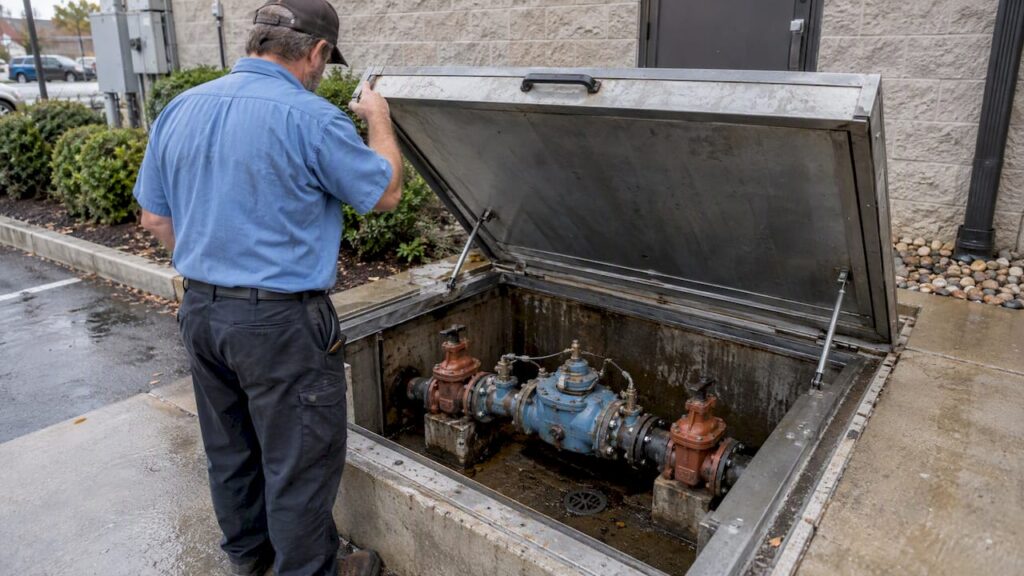
Short answer: testable backflow prevention assemblies should not be installed inside underground meter pits… Most utilities require them above grade, where test cocks and the relief port stay accessible and dry. If you find a backflow device buried in a pit or sitting in standing water, schedule a professional inspection before your next test is due.
TL;DR:
- Backflow prevention assemblies must be installed above grade with accessible test cocks and relief ports, not buried inside underground meter pits.
- Utility guidelines generally specify a minimum of 12 inches clearance above ground for proper testing and maintenance access.
- Standing water in a meter pit usually indicates groundwater or surface runoff, not backflow, unless a leak source is identified.
- Testing must be done annually, and inaccessible or submerged devices typically result in failed inspections and mandated relocations.
- Installing backflow devices on a concrete pad with proper drainage and an insulated enclosure ensures compliance and easier testing.
Table of Contents
- What a meter pit does versus what a backflow preventer does
- Code and utility rules that govern where devices go
- Common meter pit specs and what drawings show
- Installation practices that keep pits and backflow devices compliant
- Why meter pits fill with water and how to troubleshoot it
- Testing, maintenance, and what happens if access fails
- Field checklist and what we look for on a service call
- Where compliance advice tends to go wrong
- Testing, repairs, and enclosures when your device needs fixing
- Where to verify local rules and specs
- Sources
- FAQ
What a meter pit does versus what a backflow preventer does
A meter pit is a below-grade box, usually concrete or plastic, built to house the water meter register and setter. It tolerates some moisture and is sized mainly for meter reading and replacement, not for ongoing mechanical testing.
A backflow preventer is a different animal. Reduced pressure assemblies, double check assemblies, and pressure vacuum breakers require visible test cocks, a working relief port, and sufficient open space for testing access. Burying one limits access and may defeat its intended purpose.
- Meter pits favor compact, moisture-tolerant housings built around the meter itself.
- Backflow assemblies need open air, visible serial numbers, and drainage for the relief valve.
- Combining the two functions in one buried enclosure usually fails testing requirements before it fails plumbing requirements.
Code and utility rules that govern where devices go
Most water authorities publish design manuals that spell out exactly where a backflow assembly can and cannot sit. The San Francisco Public Utilities Commission’s installation guidelines state plainly that assemblies may not be installed in pits or vaults in the ground, and that they require a minimum of 12 inches of clearance above the ground along with side clearance for test cocks.
State-level manuals echo the same logic. The IDEM cross-connection control manual requires accessible installation for reduced pressure and double check assemblies, sets a 12-inch minimum clearance above floor or ground level, and caps testing intervals at one year.
- Testable assemblies generally cannot sit below grade in a pit or vault.
- Minimum clearance runs around 12 inches, with a common range of 12 to 36 inches above grade.
- Relief ports and serial numbers must stay visible without excavation or disassembly.
One figure worth remembering: the IDEM manual sets testing intervals “not exceeding one year,” which is the baseline most residential and commercial owners will be held to regardless of device type.
Common meter pit specs and what drawings show
Municipal and vendor drawings for meter pits follow a fairly consistent pattern once you know what to look for.
- Pit diameter and depth vary by service size, with irrigation meter boxes often larger in diameter than standard residential boxes to allow room for a backflow assembly mounted separately above grade.
- Base and drainage details typically call for a gravel base beneath the pit with a drainage hole, sometimes sealed with speed-crete once the meter is set, as shown in municipal irrigation meter and backflow drawings.
- Lid and cover notes usually specify a hinged or pentagon-plug lid rated to avoid trip hazards and discourage tampering.
- Sleeve and slope notes direct installers to slope the surrounding grade away from the cover and sleeve the service line to prevent settling against the pipe.
- Backflow callouts on these same drawings often point to a separate above-grade pad or enclosure rather than the pit itself, confirming that the two components are drawn, and installed, as separate systems.
Installation practices that keep pits and backflow devices compliant
When a property needs both a meter pit and a backflow assembly, the fix is usually a raised, protected installation next to the pit rather than inside it.
- Mount the assembly above grade on a concrete pad, then protect it with an insulated enclosure meeting ASSE 1060 so it survives freezing weather without losing test-cock access.
- Route the service line through a sleeve and anchor it so technicians can service the assembly without disturbing the meter pit below.
- Grade the pad to drain away from both the pit and the enclosure, since pooled water near either component invites the same infiltration problems.
- Get sign-off from the local water authority before you install anything. A device installed without pre-approval can be ordered relocated after the fact, which means paying for the work twice.
Pro Tip: Photograph test-cock clearance and serial number visibility before you call for an inspection. It saves a return trip if the tester flags something minor.
An enclosure built to protect the assembly year-round solves most of the placement problems that force relocations later.
Why meter pits fill with water and how to troubleshoot it
A flooded meter pit does not automatically mean a backflow failure. According to Collier County’s utility guidance, standing water is more often groundwater infiltration, surface runoff, or a leaking service line than evidence of backflow itself.
The quickest diagnostic tool is the meter’s own leak indicator dial. If it spins while no fixtures are running inside the property, you likely have a service leak rather than external water intrusion.
- Check the leak indicator first, with every fixture inside the property shut off.
- Bail or pump the pit temporarily, but treat this as a short-term fix, not a repair.
- Call a certified tester or plumber once the leak source is identified, and keep any photos or notes for the water authority’s records.
Testing, maintenance, and what happens if access fails
A tester arriving at your property needs clear access to the test cocks, the relief opening, and a readable serial number on the assembly. Standard test tools include a differential pressure gauge and reference tubes, which the Los Angeles County testing manual notes must be leveled carefully against the reference tube’s water line for an accurate reading.
Testing happens at initial installation, again at service turn-on, and then annually after that.
- A submerged or buried assembly usually cannot be tested at all, which counts as a failed inspection.
- Utilities commonly respond to inaccessible devices with a relocation order rather than a conditional pass.
- Repeated noncompliance can lead to a water service interruption until the device is corrected.
Field checklist and what we look for on a service call
Before any test, our technicians walk through the same short checklist on-site: clear test-cock access, the required 12 inches of clearance, a readable serial number, and a dry pit or a properly elevated above-grade device. We document the site with photos so there’s a record if a utility later questions the installation.

Most fixes are routine. We install insulated enclosures, raise pads, rebuild worn assemblies, and file test results the same day when the device is accessible and otherwise sound. The goal on every call is to leave the property in a state that passes inspection the first time, not to patch around a problem that resurfaces next year.
Where compliance advice tends to go wrong
Most guidance on this topic treats the meter pit and the backflow assembly as one problem with one fix. They are not. The pit is a housing decision. The backflow device is a testing and public health decision, and treating it as an afterthought to the plumbing layout is how properties end up with relocation orders years after the original installation passed a casual inspection.

The bigger issue is timing. Owners usually find out their setup is noncompliant at the worst possible moment, during an annual test or after a compliance letter arrives, rather than during the original installation when a five-minute call to the water authority would have settled the question. If there is one thing worth prioritizing, it is that call before anything goes in the ground, not a scramble afterward.
Standing water in a pit gets treated as a backflow emergency more often than it deserves to be. Most of the time it is a drainage or leak issue with nothing at all to do with backflow protection. Diagnose before you panic.
— Jordan
Testing, repairs, and enclosures when your device needs fixing
If your backflow assembly failed a test, sits in a flooded pit, or triggered a compliance letter, the fix usually needs a licensed professional on-site rather than another round of guesswork. A licensed professional company can handle the full range of that work across New Jersey, often on the same day, with parts available for same-visit rebuilds.

- Testing and certification with results filed directly to your water authority.
- Rebuilds and repairs for worn or failed assemblies.
If you received a compliance letter or found standing water near your device, contact us for an inspection before your deadline passes.
Where to verify local rules and specs
Placement rules vary by utility, so confirm specifics with your own water authority before installing or relocating a device. The SFPUC installation guidelines, IDEM’s cross-connection manual, and Charlotte Water’s design details are useful starting points for comparing your situation against a published standard. For related maintenance context, Tendaro’s water system checklist and Vector Claim Solutions’ guidance on leak-related claims cover adjacent concerns owners often run into.
Sources
- General Requirements for Installation of Backflow Prevention Assemblies at Point of Connection/Water Meter (SFPUC)
- Meters and Backflows | Collier County, FL
- IDEM – Cross Connection Control and Backflow Prevention Manual (via EPA public docket)
- Charlotte Water cross-connection and backflow prevention details (2025)
FAQ
Why is my meter pit full of water?
Standing water in a meter pit is usually groundwater infiltration, surface runoff, or a leaking service line rather than a backflow problem. Check the meter’s leak indicator dial with all fixtures off: if it moves, you likely have a leak rather than external water intrusion, according to Collier County’s utility guidance.
What causes backflow on a water meter?
Backflow happens when pressure changes in the system, such as a drop from a water main break or a pump surge, pull or push water in the wrong direction through unprotected connections. A properly installed and tested backflow assembly, kept accessible above grade per utility design guidelines, stops that reversal before it reaches the public supply.
What is a meter pit for water?
A meter pit is a below-grade box that houses the water meter register and setter so a utility can read and service the meter without digging. It is a separate component from any backflow prevention assembly, which typically needs to sit above grade rather than inside the pit.
What does a backflow meter look like?
There is no single “backflow meter,” but a typical reduced pressure or double check assembly looks like a short section of pipe with two shutoff valves, a center body housing the check mechanism, and several small test cocks along the side. Most are mounted above grade, often inside an insulated enclosure in colder climates.
How often does a backflow assembly need testing?
Most jurisdictions require testing at initial installation, again at service turn-on, and then annually afterward, a schedule confirmed in IDEM’s cross-connection manual. Missing a cycle or having an inaccessible device can trigger a failed inspection or a relocation order from your water authority.
Pingback: DCDA vs. DC for Property Managers: What the Bypass Meter Reveals