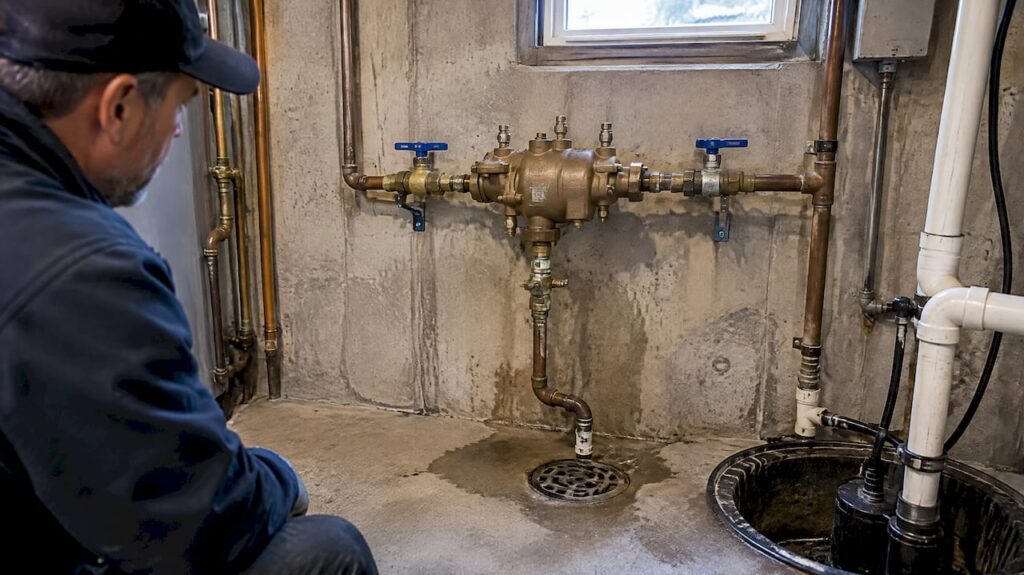
Backflow in a basement almost always refers to a testable backflow prevention assembly (an RPZ, double check, or vacuum breaker) installed on the potable water line, not sewage backing up through a drain. If your property has one of these devices, it typically needs an annual test and a file Certificate of Compliance. The immediate step is to locate the device’s tag, confirm when it was last tested, and schedule a certified field test before the required testing interval ends.
TL;DR:
- Most basement backflow prevention devices are tested annually, with certification reports filed directly with the local water authority, not the state.
- Proper device placement, regular visual checks, and maintaining drainage and heat protection reduce the risk of failure and flooding.
- Device failures often result from worn seats or relief valves; repairs should include on-site rebuilding and retesting to ensure compliance.
- Property owners are typically responsible for confirming that test records are submitted, and missing deadlines can lead to service disconnection.
- Preventative steps include clearing access, installing protective enclosures, and scheduling tests ahead of expiration to avoid costly emergency repairs.
Table of Contents
- Why basement backflow devices are regulated and who enforces testing
- Which devices are typically installed in basements and what field tests check
- If a device fails: repairs, rebuilds, retesting, timeline and cost drivers
- How to prepare for a test and prevent future compliance lapses
- Causes and risks of backflow occurring specifically in basements
- Signs and symptoms of backflow problems in a basement environment
- Preventative measures to avoid backflow incidents in basements
- How to respond to basement flooding from backflow before help arrives
- Field perspective: common compliance mistakes and how to avoid them
- How South Jersey Backflow solves basement backflow testing, repairs, and compliance
- Sources
- FAQ
Why basement backflow devices are regulated and who enforces testing
Backflow prevention exists because a cross-connection, a point where potable water could mix with a contaminated source, can pull dirty water back into the public supply under the wrong pressure conditions. The EPA’s cross-connection guidance treats this as a real public health risk and recommends that public water systems run cross-connection control programs staffed by trained personnel who keep records of testing and repairs.
Enforcement sits with the local water purveyor, not a state agency reaching directly into your basement. That distinction matters because requirements, forms, and deadlines vary by supplier, and a property owner who assumes a national standard applies can miss a local rule.
- Water purveyors can require installation, testing, and maintenance of backflow assemblies at their discretion.
- Noncompliance can lead to service disconnection in cases where required testing or repairs are ignored.
- Owners, not testers, generally carry the legal duty to confirm records and reports were actually submitted.
Since submission forms and timelines differ by water authority, confirming the exact process locally is worth more than relying on a general compliance guide.
Which devices are typically installed in basements and what field tests check
Three assembly types show up most often in basement mechanical rooms. Reduced pressure zone assemblies (RPZs) handle high-hazard connections where contamination could be severe, such as boiler feeds or irrigation tie-ins. Double check assemblies cover lower-hazard, non-health-threatening connections. Pressure and atmospheric vacuum breakers protect specific fixtures and outlets where backpressure isn’t a concern. Picking the wrong device for the hazard level is a common reason a system fails inspection even when the hardware itself is fine.
Field testing follows a defined sequence, not a visual check. County public health testing manuals describe the core equipment and steps testers use:
- A differential pressure gauge measures the pressure drop across each check valve.
- A bleed valve and water column confirm the relief valve opens at the correct differential.
- Individual test cocks isolate each check so testers can verify it holds independently.
A properly tested RPZ is required to maintain an adequate pressure differential across its check valves, and a failure at any single test cock is enough to fail the whole assembly.
Placement affects all of this. Devices installed below grade, without clearance above the floor, or with a relief port aimed at a wall are hard to test and prone to flood or freeze damage, which is why clearance and drainage rules exist in most local codes.
If a device fails: repairs, rebuilds, retesting, timeline and cost drivers
Most failures trace back to a handful of causes: worn rubber seats in the check valves, a relief valve that won’t seat properly, or a shutoff valve that no longer closes fully. Minor leaks are often fixable with a rebuild kit; a cracked body or a severely corroded assembly usually means replacement.
- The tester documents the failure and specifies what needs repair or replacement.
- A technician rebuilds or replaces the failed components, ideally during the same visit if parts are on hand.
- The device is retested on the spot or on a follow-up visit to confirm it now passes.
- A passing report is filed with the water authority to restore or maintain the Certificate of Compliance.
That sequence can close out in a single appointment when a technician carries OEM parts, or stretch to a second visit when specialty parts must be ordered. Cost depends on several factors: RPZs generally cost more to service than double checks because they have more moving parts, OEM parts typically cost more than aftermarket but reduce repeat failures, and enclosure work or relocation adds labor beyond the valve itself. Emergency or same-day service carries a premium over scheduled work, a pattern also seen in general plumbing repair pricing.
Pro Tip: Ask for a written scope of work and price before repairs start, not after the tester has already opened up the assembly.
How to prepare for a test and prevent future compliance lapses
A little preparation cuts down on failed tests and repeat visits. Start with the physical side of the space:
- Locate the device and clear a path so the tester has full access to all test cocks.
- Make sure the area has enough light and that shutoff valves on either side turn freely.
- Confirm the relief port has somewhere to drain without spraying equipment or flooding the floor.
Administrative prep matters just as much, and it’s where most lapses actually happen:
- Find the previous test tag or report and note the device’s serial number and model.
- Set a reminder well in advance of the next required test date.
- Confirm how your local water authority wants reports submitted, since methods vary by supplier.
Tagging the device after every test, doing a quick visual check between annual tests, and installing a protective enclosure to guard against freezing or flood exposure all reduce the odds of an unplanned failure showing up on inspection day.
Causes and risks of backflow occurring specifically in basements
Basements create conditions that make backflow more likely than in an above-grade installation. Devices sit at the lowest point of the building’s plumbing, which means any pressure drop in the municipal supply, whether from a water main break, firefighting draw, or scheduled shutoff, has an outsized effect there first. Basements also tend to be colder and damper than the rest of a building, which accelerates corrosion on check valve seats and relief valve springs.
Flooding is the other basement-specific risk. A relief valve that discharges correctly is doing its job, but if the surrounding floor has no drain or the sump pump isn’t working, that discharge water has nowhere to go. Improper installation, such as mounting a device too close to the floor or in a spot that traps runoff, turns a normal relief event into standing water around electrical panels and stored equipment.
Basement backflow assemblies are also more likely to be forgotten. A device tucked behind storage or boxed in by later renovations doesn’t get the casual visual attention a rooftop or exterior unit might, so early signs of wear go unnoticed until a scheduled test catches them or, worse, until the device fails outright.

Signs and symptoms of backflow problems in a basement environment
A backflow assembly rarely fails silently. Watch for these signs between scheduled tests:
- Water pooling near the device with no obvious source, often from a relief valve discharging when it shouldn’t.
- A steady drip or spray from the relief port even when no fixture upstream is running.
- Visible corrosion, rust streaks, or mineral buildup on the valve body or fittings.
- A hissing or knocking sound from the assembly when water is drawn elsewhere in the building.
- A noticeable drop in water pressure at fixtures on the line the device protects.
None of these guarantee a failed test, but any of them is reason to have a certified tester look at the device before its next scheduled date. Catching a worn seat or a sticking relief valve early is almost always cheaper and faster than dealing with a full failure during a compliance inspection.
Preventative measures to avoid backflow incidents in basements
Most basement backflow problems are preventable with routine attention rather than major work. Keep the area around the device dry and drained: a functioning sump pump and a floor drain positioned to catch relief valve discharge stop small leaks from becoming standing water. Grading and gutter maintenance outside the building also reduce the amount of groundwater pressure against basement walls, which indirectly protects any plumbing installed there.
Temperature control matters too. A basement that dips near freezing in winter puts stress on valve seals and can crack a device body outright, so insulating exposed pipes and keeping the space above freezing protects the assembly year-round. A custom enclosure around the device does double duty, guarding against both freeze damage and accidental impact from stored items or foot traffic.
On the administrative side, sticking to the annual test schedule is itself a preventative measure. Testing catches worn components before they fail outright, and a technician doing a routine test will often flag a valve that’s close to the end of its service life, giving you time to plan a rebuild instead of reacting to an emergency.
How to respond to basement flooding from backflow before help arrives
If you notice water pooling near a backflow assembly, shut off the isolation valves on either side of the device if they’re accessible and safe to reach. This stops water from continuing to feed the leak while you wait for a technician.
Move anything valuable or electrical away from the water immediately, and if the sump pump isn’t keeping up, use a wet vacuum or portable pump to control standing water and reduce the risk of mold or floor damage. Avoid using electrical outlets or equipment in standing water.
Document what you’re seeing with photos before cleanup starts. This helps the tester diagnose the failure faster and gives you a record if you need to file an insurance claim. Once the immediate water is under control, call a certified tester rather than attempting to open the assembly yourself. These devices are tested and adjusted with specific gauges and procedures, and an untrained attempt to fix a leaking valve can turn a repairable problem into a full replacement.

Field perspective: common compliance mistakes and how to avoid them
The most common mistake property owners make is assuming the tester automatically files the report with the water authority. Some do, but the owner is usually the one legally responsible if it never arrives. Losing the physical tag is the second most frequent issue, since it’s often the only quick reference for the last test date.
Keep a copy of the submission receipt, not just the test tag, and ask upfront which certifying body the tester is accredited under. Waiting until a violation notice shows up before scheduling repairs almost always costs more than fixing a known issue proactively. A well-placed enclosure that protects the device from flooding and freezing cuts down on repeat failures and the emergency calls that follow them.
— Jordan
How South Jersey Backflow solves basement backflow testing, repairs, and compliance
If your basement device is coming up for its annual test or already failed one, South Jersey Backflow handles the testing, the repair, and the paperwork so you’re not chasing three separate steps. The company offers annual residential certification testing, commercial device testing, rebuild kit service, and custom enclosure installation, and files test reports directly with the water authority on the owner’s behalf.

- Operates with licensing and insurance, providing service statewide in New Jersey, including counties such as Middlesex, Hunterdon, Gloucester, and Cumberland.
- Same-day service with parts stocked on the truck, aiming to complete repairs in a single visit.
- Manages compliance by submitting necessary paperwork on behalf of the property owner.
Before booking, have a few things ready: a photo of the device and its tag, the date of the last passing test, and any access notes for the basement space. From there, you can schedule testing and certification directly and get a device brought current without managing multiple vendors.
Sources
These sources cover the technical and administrative backbone of backflow compliance:
- Distribution System Water Quality Protecting Water Quality – Through Cross-Connection Control and Backflow Prevention
- Backflow prevention assembly testing manual — County of Los Angeles Department of Public Health
FAQ
What does backflow in a basement actually mean?
It refers to a testable backflow prevention assembly, such as an RPZ, double check, or vacuum breaker, installed on the potable water line in a basement mechanical room. These devices stop contaminated water from being pulled back into the clean water supply and typically require annual testing under local water authority rules.
Who is allowed to test a backflow preventer?
Testing must be done by a certified backflow tester using calibrated equipment such as a differential pressure gauge and bleed valve, following the procedures set out in public health testing manuals. Certification requirements vary by water authority, so confirm the tester’s credentials match what your local supplier accepts.
How much does it cost to fix a failed backflow device?
Cost depends on the device and the parts needed. South Jersey Backflow lists rebuild kit service for residential devices at 125 to 250 USD, and separate installation and rebuild pricing is available on the cost page.
What happens if I miss my annual backflow test?
Missing the deadline can put your Certificate of Compliance in lapsed status, and some water authorities have the authority to disconnect service for extended noncompliance. Scheduling a test as soon as you notice the lapse, rather than waiting for a violation notice, is the fastest way to get back into compliance.
Can I temporarily stop a leaking backflow device myself?
You can shut off the isolation valves on either side of the device if they’re safely accessible, which stops the leak while you wait for a technician. Avoid opening the assembly itself, since adjusting the internal checks or relief valve without the right gauges can turn a minor repair into a full replacement.