In New Jersey, the property owner is generally responsible for backflow testing, repairs, and filing the test certification, not the tenant. If your Certificate of Compliance is missing, expired, or you’re not sure when the device was last checked, the move is simple: pull the paperwork promptly and schedule a certified tester to avoid a compliance violation.
TL;DR:
- Most residential landlords are legally responsible for backflow testing, repairs, and filing certifications, while tenants are only required to cooperate with access.
- Commercial properties under a Physical Connection Permit may face quarterly testing, but typically, backflow devices like DCVA and RPZ must be tested annually, unless exempted.
- Certified testers must perform tests using NJDEP-approved credentials, and landlords should obtain digital copies of reports immediately to avoid compliance issues.
- If a backflow device fails, repairs and re-testing are required within approximately 30 days to prevent violations and potential enforcement actions.
- Proper access clearance and adherence to permit requirements are often overlooked causes of inspection failures, making pre-appointment walkthroughs highly recommended.
Table of Contents
- Who Handles Landlord Backflow Responsibilities in NJ?
- Backflow Testing Requirements NJ Landlords Need to Track
- Who Can Test Your Device and How to File the Results
- What Happens After a Failed Test
- Access Rules and When You Need a Physical Connection Permit
- Lease Language and Who Actually Pays
- The Landlord Compliance Checklist Worth Keeping
- Why Most Landlords Get This Wrong Until Something Breaks
- Get Your NJ Backflow Testing Handled Without the Paperwork Headache
- Where to Verify These Rules Yourself
- Sources
- FAQ
Who Handles Landlord Backflow Responsibilities in NJ?
The default rule in New Jersey is straightforward: responsibility follows ownership. Municipal plumbing subcode officials treat the property owner as the party accountable for making sure a backflow preventer gets tested, that failed devices get repaired, and that results reach the right office. A property owner must ensure required testing reports are submitted to the local administrative authority, plumbing subcode official, or water supplier, and that submission has to include the device type and location, the test date, the results, and the tester’s name and signature.
Local inspectors enforce this, but they don’t do the testing themselves. A plumbing subcode official can witness a test or accept a certified report, but the actual work has to come from a qualified tester the owner hires.
Where this gets murkier is commercial leasing. A well-drafted commercial lease can shift the cost or logistics of testing onto a tenant, especially in multi-tenant buildings with their own dedicated systems. Residential landlord duties don’t really work that way. You can ask a tenant to grant access or report a leaking device, but you can’t hand off the legal obligation itself.
- Property owner: legally responsible for scheduling tests, arranging repairs, and filing certifications
- Municipal official: enforces the requirement and issues the Certificate of Compliance
- Tenant: can be required to cooperate with access, but generally cannot assume the legal duty
- Commercial lease language: can reassign cost, rarely reassigns liability
Backflow Testing Requirements NJ Landlords Need to Track
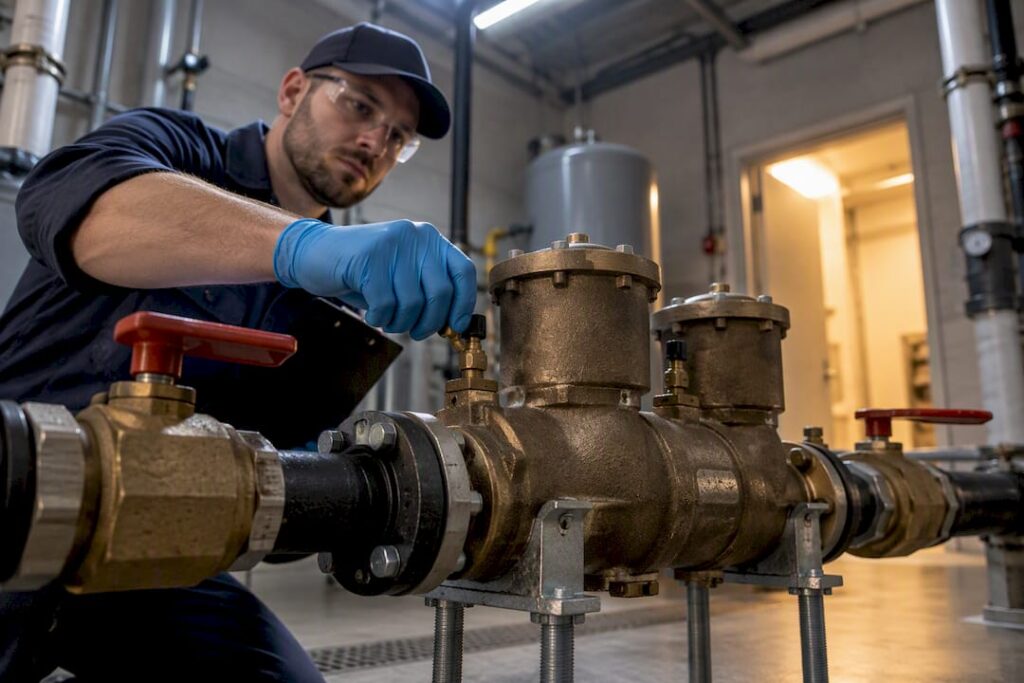
Not every device on a property needs testing every year, and knowing which ones do is half the battle. Backflow prevention devices like double check valve assemblies (DCVA) and reduced pressure zone assemblies (RPZ) are the two most common types landlords deal with, and NJ ties the testing schedule to the hazard level and the type of permit attached to the property.

Testable backflow preventers must be tested before final inspection and annually thereafter under DCA guidance. One- and two-family dwellings are generally exempt from that annual requirement unless a specific device or hazard condition triggers it. That exemption trips up a lot of small landlords who assume a duplex is automatically off the hook.
Quick fact: Facilities operating under a Physical Connection Permit can face quarterly testing instead of annual, with electronic submission of results required by the tester.
- DCVA and RPZ devices: tested at least annually in most commercial and multi-family settings
- One- and two-family homes: usually exempt from annual testing absent a specific hazard trigger
- Physical Connection Permit holders: quarterly testing, often submitted electronically
- Certificate of Compliance: typically valid for one year from the passing test date
Municipalities also set their own flat filing fees and local reporting windows, so two towns ten minutes apart can run slightly different administrative processes even under the same state rules.
Who Can Test Your Device and How to File the Results
You cannot hire just anyone with a wrench. New Jersey requires backflow testing be performed by testers certified through an agency recognized under NJDEP guidance, and that directory is the fastest way to confirm a tester’s credentials before you book them.
Once the test happens, the paperwork has to hold up. The required test form has to spell out:
- Device type and exact location on the property
- Date the test was performed
- Pass or fail results, with any pressure readings the procedure calls for
- The tester’s name, certification number, and signature
Filing goes to the municipal plumbing subcode office or, for permitted facilities, directly through electronic reporting tied to the NJDEP testing procedure. Keep your own copy regardless of who submits it. Municipal offices lose paperwork more often than landlords expect, and a missing filing looks identical to a missed test from the inspector’s side of the desk.
Pro Tip: Ask your tester for a digital PDF copy of the signed certification the same day, not “sometime this week.” A verbal promise doesn’t help you when a compliance letter shows up in six months.
What Happens After a Failed Test
A failed test isn’t the end of the world, but the clock starts ticking the moment it happens. NJDEP procedural guidance and the state’s repair and re-test rule generally require a device that fails to be repaired or replaced and then re-tested within a set window, often 30 days. Miss that window and you’re no longer dealing with a maintenance issue, you’re dealing with a compliance violation.
Replacing certain devices, particularly on combined domestic and fire lines, isn’t a swap-and-go job. It can trigger a permit requirement and joint review between the plumbing and fire subcode offices before installation is approved.
- Failed test: repair or replace, then re-test (commonly within 30 days)
- Replacement on fire/domestic combined lines: may require permits and subcode review
- Missed repair window: risk of fines, enforcement letters, or utility-ordered shutoff action
- Documentation: keep the failed report alongside the eventual passing one, not just the final result
Access Rules and When You Need a Physical Connection Permit
A shocking number of failed inspections have nothing to do with the device itself. NJDEP guidance on accessibility requires adequate clearance around the device for maintenance and testing, and a backflow preventer buried behind storage shelves or crammed into a two-foot mechanical closet routinely fails an inspection before the tester even opens a test cock.
A Physical Connection Permit is a different animal from routine testing. It applies to facilities with a connection between a public water system and an unapproved supply, like a well, an irrigation system, or a secondary source, not to a typical private residence pulling water from one approved main. Whether a device needs to be a DCVA or an RPZ comes down to the hazard level NJDEP assigns to that connection under N.J.A.C. 7:10.
- Clearance around test cocks: required, and the single most common reason for a failed inspection
- Physical Connection Permit: triggered by connections to unapproved or secondary water supplies
- Device type (DCVA vs. RPZ): determined by hazard evaluation, not landlord preference
Pro Tip: Walk the mechanical room with your tester’s access requirements in mind before the appointment, not during it. A five-minute check saves you a rescheduled visit and a second service call.
Lease Language and Who Actually Pays
For a standard residential rental, the owner covers the cost of testing, repair, and filing as a normal operating expense. That’s the practical norm even though nothing in state code says a landlord must eat the cost personally, it’s simply where the legal responsibility sits.
Commercial leases have more room to move. If the lease clearly assigns testing costs or logistics to the tenant, and both parties sign off on it, that arrangement can hold up. What doesn’t hold up is a landlord assuming a vague lease clause protects them if the device never gets tested at all.
- Residential leases: owner typically pays; cost is rarely shifted successfully
- Commercial leases: cost can be assigned to tenant with clear, specific language
- Access clauses: require tenant cooperation for scheduling and entry, without transferring legal duty
- Written notices: document every scheduling request and access denial in case a dispute arises later
The Landlord Compliance Checklist Worth Keeping
Staying ahead of backflow compliance is less about memorizing statutes and more about running the same short checklist on a schedule.
- Pull your current Certificate of Compliance and confirm the expiration date
- Check the last test date against your municipality’s required cadence (annual or quarterly)
- Confirm your tester’s certification through the NJDEP tester directory
- Set a reminder 60 to 90 days before the certificate expires, not the week it lapses
- Keep both digital and physical copies of every passing and failing test report
- Contact the municipal plumbing office directly if you’re replacing a device or need a permit
| Checklist item | Why it matters |
|---|---|
| Certificate expiration date | Determines your compliance window before enforcement risk begins |
| Last test date vs. required cadence | Confirms whether you’re on an annual or quarterly cycle |
| Tester certification | Protects the validity of your filed report |
| 60 to 90 day reminder | Prevents last-minute scrambling and missed deadlines |
| Test report copies | Creates your own paper trail independent of municipal records |
Why Most Landlords Get This Wrong Until Something Breaks
The biggest misconception I keep running into is landlords assuming backflow compliance is a “set it and forget it” item, something you handle once at installation and never think about again. It isn’t. It’s an annual or quarterly obligation with a paper trail that has to be renewed every single cycle, and the Certificate of Compliance is not the same as a Certificate of Occupancy that just sits on file forever.
The second misconception is scarier: landlords who assume a tenant complaint or a quiet water bill means the system is fine. Accessibility problems and missed re-tests are the two issues that come up over and over in the field, and both are entirely preventable with a calendar reminder and a five-minute walkthrough. Nobody gets caught off guard by a hurricane. They get caught off guard by a certificate that quietly expired eleven months ago.
— Jordan
Get Your NJ Backflow Testing Handled Without the Paperwork Headache
There are companies that handle testing, certification, and submission to local water authorities as a single service to simplify compliance.
The company’s core services cover backflow preventer testing and certification, rebuilds and repairs for devices that fail inspection, and custom enclosure installation for units that need better weather or physical protection. Every completed job comes with documentation you can hand straight to your municipality or keep in your own compliance file. If a device fails and needs a rebuild before the re-test clock runs out, the repair and rebuild page walks through typical scope and cost.
For clients managing multiple properties, some companies offer consolidated billing to streamline invoicing and renewal scheduling. Reach out through the FAQ and quote page to get your certification scheduled before your current one lapses.
Where to Verify These Rules Yourself
For primary sources beyond this guide, NJDEP’s Physical Connection program page covers permit triggers and quarterly testing rules, while DCA Bulletin 99-2 lays out annual testing requirements and exemptions. The full regulatory text sits in N.J.A.C. 7:10, and your municipal plumbing subcode office remains the actual issuing authority for your Certificate of Compliance and any local fees.
Sources
- Physical Connection Permit Processing | Water Supply and Geoscience | NJDEP
- BULLETIN 99-2: Testing of Backflow Preventers (NJ DCA)
FAQ
Who pays for backflow testing, the tenant or the landlord?
The landlord pays in the vast majority of residential situations, since the legal obligation to test and file results sits with the property owner. Commercial leases can shift the cost to a tenant if the lease says so explicitly, but the owner still bears the underlying compliance duty.
Is backflow testing required in NJ?
Yes, testable backflow preventers must be tested before final inspection and annually thereafter under DCA guidance, with one and two-family homes generally exempt from the annual cycle. Facilities under a Physical Connection Permit face a quarterly testing schedule instead.
Who is responsible for backflow repair?
The property owner is responsible for arranging repair or replacement after a failed test, and for scheduling the required re-test, often within 30 days. Southjerseybackflow handles rebuilds and repairs directly, with re-test scheduling built into the same service call.
Are backflow preventers required by code?
Yes, N.J.A.C. 7:10 requires approved backflow preventers, either a double check valve assembly or a reduced pressure zone assembly, wherever a hazard evaluation determines one is necessary to protect the public water system. Whether your property needs one depends on your connection type and any secondary water sources on site.
How much does backflow testing cost with Southjerseybackflow?
Annual residential certification testing runs $150 to $250 per device, while commercial device testing runs $200 to $450 per device. Exact pricing depends on device type and site conditions, so a direct quote is the fastest way to confirm your number.