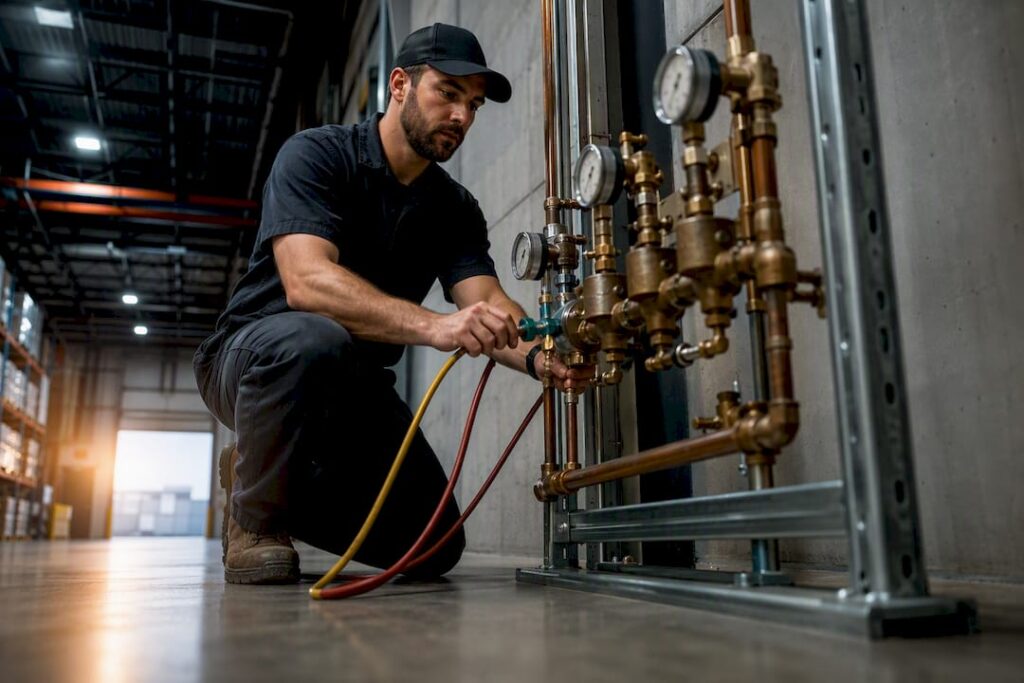
Any New Jersey warehouse with a cross-connection hazard, an unapproved water supply, or a fire line tied to the public system generally needs an NJDEP Physical Connection Permit, and any device covered by that permit must be tested quarterly by a certified tester. Renewal happens every year, and current test results are what keep the renewal automatic. Start now by mapping every service line entering your building and calling your water supplier before an inspector calls you.
TL;DR:
- Warehouses with cross-connections, unapproved water supplies, or fire lines linked to the public system must obtain an NJDEP Physical Connection Permit and test devices quarterly by certified testers.
- Device placement must be close to the water meter with proper mounting height, no pits, and easy access to test cocks and shutoff valves, to meet inspection standards.
- Test results must be filed with water suppliers every quarter, and renewal depends on current testing, requiring planning to avoid permit lapses or service disconnections.
- Permits are triggered by connection risks rather than building type, and failing to obtain or renew them can lead to account flagging, service denial, or local inspection issues.
- Use a certified backflow tester or engineer for device selection and installation, and consider professional services to manage testing, filings, and permit renewal to ensure ongoing compliance.
Table of Contents
- What NJ Law Requires for Warehouse Backflow Prevention
- Which Backflow Devices Warehouses Need and Where to Put Them
- How Often Backflow Devices Must Be Tested in NJ
- How to Apply for an NJDEP Physical Connection Permit
- A Warehouse Compliance Checklist You Can Actually Follow
- How Southjerseybackflow Helps NJ Warehouses Stay Compliant
- The Compliance Failures I See Most Often
- Get Your Warehouse Tested and Filed With NJDEP
- Where to Verify These Rules Directly
- Sources
- FAQ
What NJ Law Requires for Warehouse Backflow Prevention
New Jersey’s backflow rules come from two directions at once. The state side runs through N.J.A.C. 7:10-10, which governs physical connections between a public water system and anything the state considers an unapproved source. The local side runs through the Plumbing Subcode at N.J.A.C. 5:23-3.15, enforced by your town’s construction official. Passing one does not exempt you from the other.
The trigger for the state permit isn’t building type. It’s connection risk. A single-family home rarely qualifies because it lacks the industrial hazards that worry NJDEP. Warehouses trip the requirement far more often because of:
- Unapproved or auxiliary water supplies, including wells or reclaimed water used for irrigation or process equipment
- Chemical storage, wash bays, or process lines that could siphon contaminants backward into the main
- Dual service arrangements, such as a domestic line and a separate fire line feeding off the same main
- Fire suppression systems with siamese connections that create a second path into the public supply
Skip the permit and the consequences aren’t hypothetical. Utilities can flag the account, deny renewal, or in serious cases move toward service disconnection. Local AHJs also get involved when plumbing inspections surface a connection nobody permitted at the state level.
Which Backflow Devices Warehouses Need and Where to Put Them
Device selection in New Jersey isn’t a matter of preference. N.J.A.C. 7:10-10.3 sets specific conditions for when a double check valve assembly (DCVA) will pass inspection and when a reduced pressure zone assembly (RPZ) becomes mandatory, typically when a non-potable source is involved or contaminant levels exceed a set threshold. Fire lines carry their own rule: detector check assemblies or reduced pressure detector assemblies are usually required wherever a siamese connection or hydrant arrangement could push contaminated water back into the distribution system.
Placement follows a containment logic. The goal isn’t protecting a single fixture, it’s protecting the public main at the point where your property connects to it. That means installation as close to the meter as practically possible, always on the customer side.
NJDEP’s checklist for physical connections spells out the physical details inspectors actually check:
- Mounting height between 12 and 60 inches off the floor
- No pits or vaults, ever, for testable assemblies
- Protection from freezing and flooding
- Accessible test cocks, strainers, and shutoff valves on both sides of the device
Pro Tip: Don’t guess on device type before a certified tester or engineer walks the site. Choosing a DCVA when your hazard profile calls for an RPZ is one of the most common reasons warehouses fail their first inspection.
How Often Backflow Devices Must Be Tested in NJ
Testing frequency depends on which rule covers your device. Devices tied to an NJDEP Physical Connection Permit require testing four times a year by a certified tester. Devices governed only by local plumbing subcode enforcement typically require an annual re-test, so it pays to know which regime applies to which device on your property.
Only a New Jersey certified backflow tester can perform the test. Municipal guidance confirms the process: the tester files the original certification with local authorities, and the town issues a Certificate of Compliance once the paperwork clears.
Three things happen in sequence each testing cycle:
- The certified tester runs the test and documents pass/fail results for each device.
- Results get filed with the water supplier and, where applicable, the municipality.
- Current results on file support automatic permit renewal; missing or expired results can stall it.
If your operation can’t tolerate a water interruption during testing, plan for redundant devices so one can be tested while the other stays in service. NJDEP’s own guidance builds this expectation into facilities where a shutdown isn’t acceptable.
How to Apply for an NJDEP Physical Connection Permit
The application process is straightforward once you know what NJDEP wants to see. Start by contacting your public water supplier, since utilities like New Jersey American Water often run their own cross-connection survey and will flag whether you need the state permit before you even file.
From there, the steps generally look like this:
- Complete the initial NJDEP Physical Connection Permit application
- Submit facility drawings showing meter locations, service lines, and where each device sits
- List every device by type and size
- Pay the application fee, commonly $150
- Include signed and sealed engineering plans if any service line is 2 inches or larger, a threshold utilities frequently enforce beyond the baseline state requirement
Renewal is annual, and it moves fastest when your quarterly test results are already on file before the renewal date arrives. Facilities that let testing lapse right before renewal season create their own bottleneck. Facilities that stay current on testing barely notice the renewal happening.
A Warehouse Compliance Checklist You Can Actually Follow
Compliance gets manageable when you break it into a sequence instead of treating it as one big legal obligation.
- Survey your service lines. Map every connection, domestic, fire, irrigation, or process, and flag anything that looks like an unapproved supply.
- Confirm device type and placement. Bring in a certified tester or engineer before you buy hardware, not after.
- File the permit application. Submit drawings, device lists, and fees to NJDEP, and loop in your water supplier early.
- Lock in a quarterly testing schedule. Put it on a calendar tied to your permit renewal date, not a vague “sometime this quarter.”
- Centralize your records. Keep test reports, certificates, and permit correspondence in one place so renewal never turns into a scramble.
- Plan for redundancy if your operation genuinely cannot absorb a water interruption during testing.
Pro Tip: Set your quarterly test dates to the same week every quarter. Warehouses that test on a fixed schedule almost never miss a cycle; warehouses that test “when someone remembers” almost always do.
How Southjerseybackflow Helps NJ Warehouses Stay Compliant
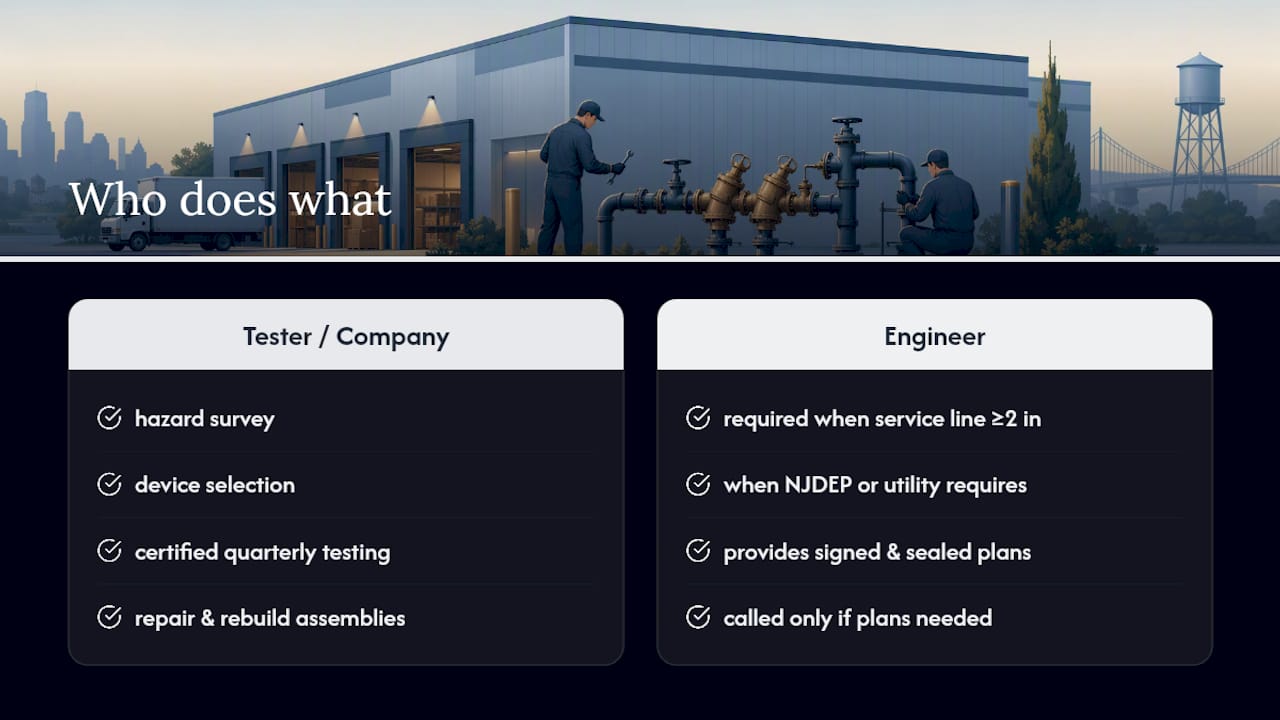
Most of the work above, the hazard survey, device selection, quarterly testing, and filing results with your water supplier, is handled by backflow testing and service companies for commercial and warehouse properties in New Jersey. This includes certified testing, repair and rebuilding of existing assemblies, enclosure installation, and submission of test reports to be on file before renewal dates.
A certified tester can confirm device type and run your quarterly tests. An engineer becomes necessary when your service line is 2 inches or larger and NJDEP or your utility requires signed and sealed plans. Knowing which one you need before you call saves a step.
The Compliance Failures I See Most Often
The mistakes that get warehouses in trouble aren’t complicated. They’re the missed permit renewal, the skipped quarterly test because production got busy, and the device installed in a pit because nobody checked the mounting rules first. If you take one action after reading this, make it a certified survey of your service lines this month, before an inspector or a water supplier flags it for you.
— Jordan
Get Your Warehouse Tested and Filed With NJDEP
Some companies provide a direct route to compliance for warehouse operators who prefer not to manage certified testers, permit drawings, and water supplier paperwork on their own. Such services may offer one point of contact for hazard assessment, quarterly testing, repair, rebuilding, and enclosure installation, plus filing of test reports with the water authority to support timely renewals.
If you already know your device schedule, read the step-by-step guide to passing and submitting backflow tests in New Jersey for the exact submission workflow. If your warehouse sits in Ocean, Mercer, Salem, Gloucester, or Cumberland County, Southjerseybackflow’s Ocean County and Gloucester County service pages cover local scheduling and permit support. Warehouses with on-site fuel storage that adds another cross-connection variable can also review site factors for fuel tank containment standards before finalizing device placement. Request a site survey or schedule your next quarterly test now, before your permit renewal date arrives with expired results attached.
Where to Verify These Rules Directly
- NJDEP Physical Connection Permit Processing
- N.J.A.C. 7:10-10.3, physical connection installation rules
- NJDEP physical connection triggers and checklist
- New Jersey American Water cross-connection guidance
This article is general information, not a substitute for advice from a qualified lawyer. Consult a qualified legal professional about your own circumstances before acting on anything here.
Sources
- Physical Connection Permit Processing – NJDEP
- N.J.A.C. 7:10-10.3 – Approved physical connection installation requirements
- Physical connection triggers and checklist – NJDEP
- Backflow Preventers — Municipal guidance (Example)
FAQ
Is Backflow Testing Required in NJ?
Yes. Any device covered by an NJDEP Physical Connection Permit requires quarterly testing by a certified tester, while devices under local plumbing subcode enforcement often follow an annual schedule instead.
Do All Commercial Buildings Need a Backflow Preventer?
Not automatically. NJDEP requires one when a building has a cross-connection hazard, such as an unapproved water supply, chemical process line, or fire service arrangement, which is common in warehouses but not universal.
Where Are Backflow Preventers Required?
They’re required on the customer side of the water meter, positioned as close to the connection point as practically possible, and on fire lines wherever a siamese or hydrant connection creates a path back into the public main.
Does a Backflow Preventer Require a Permit?
If the device is part of a physical connection to an unapproved supply or a qualifying hazard, yes, it needs an NJDEP Physical Connection Permit that renews annually, separate from any local plumbing permit your municipality issues.