
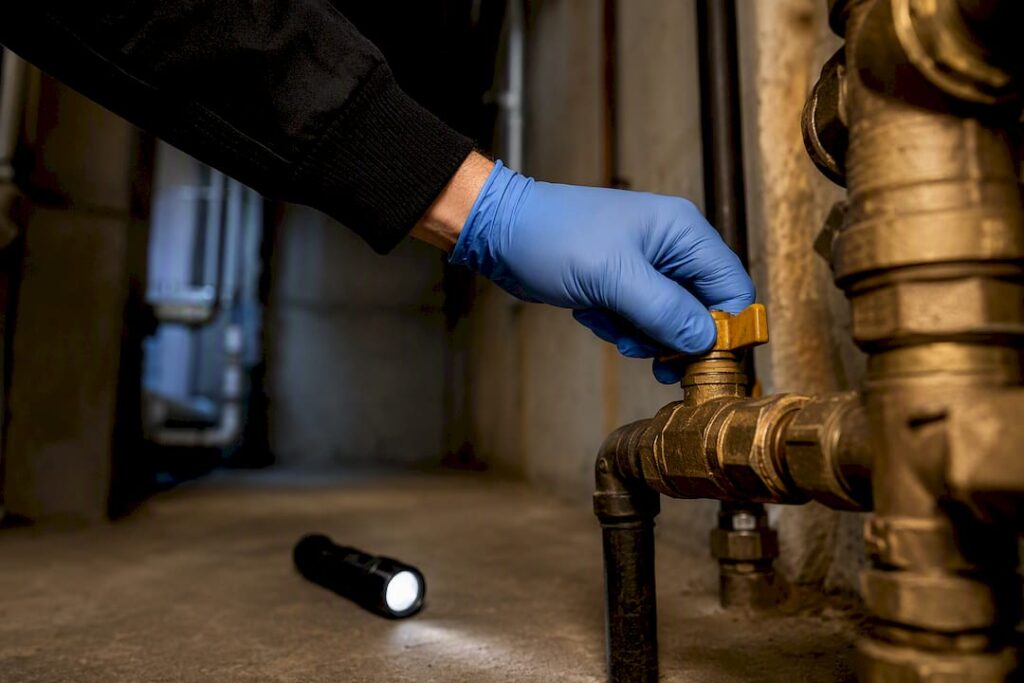
Close the backflow assembly’s upstream isolation valve first. If it won’t hold or you can’t reach it, shut the building’s main service valve or curb stop instead. If water is actively flooding the space or you suspect contamination has reached the potable supply, stop using water immediately and call both your water utility and an emergency backflow technician.
TL;DR:
- The upstream isolation valve must be closed first, but if it fails, the main service valve or curb stop should be used as a backup for shutting off water.
- Rapidly turning the shutoff valves can cause water hammer damage; slow, controlled closures are essential, especially on multi-turn or quarter-turn valves.
- If the isolation valves are seized or broken, the curb stop or main service valve should be used, but forcing frozen or corroded valves risks extensive damage.
- Suspected contamination requires immediate cessation of water use, switching to bottled water, and notification of health and water authorities before restoring service.
- After emergency shutdown, only certified technicians should reopen and retest the system to ensure safety and compliance, and proper documentation is critical for future reference.
Table of Contents
- Emergency Backflow Shutdown: The First 10 Minutes
- How Do You Shut Off a Backflow Valve Safely?
- What If the Isolation Valves Fail?
- When Should You Worry About Contaminated Water?
- Stopping Water Damage Without Making It Worse
- What Happens After You Shut Everything Down?
- A Field Perspective on Backflow Emergencies
- Get Emergency Backflow Help From Southjerseybackflow
- Where to Learn More About Backflow Safety
- Sources
- FAQ
Emergency Backflow Shutdown: The First 10 Minutes
Every minute matters once a backflow preventer starts failing. The sequence below follows the order a field technician would actually use, not a theoretical checklist.
- Assess the hazard fast. Look for active flooding, a sulfur or chemical smell, discolored water, sudden pressure loss, or a fire alarm triggered by water intrusion. This tells you whether you’re dealing with a nuisance leak or a real emergency plumbing shutoff situation.
- Find the upstream isolation valve on the assembly itself. It sits directly before the backflow preventer, usually a ball valve with a lever handle. Close it.
- If that valve won’t hold water back, move to secondary isolation. Shut the building’s main service valve or the curb stop at the property line.
- Shut down non-essential systems only if it’s safe to reach them. Irrigation controllers and sprinkler zone valves are common culprits worth cutting off to reduce discharge volume.
- Call your water utility and an emergency backflow technician. Give them the address, the device type if you know it, and what you’re seeing: flooding, smell, color, pressure.
A backflow failure counts as a true emergency when it produces active flooding, triggers a utility shutoff notice, ruptures the assembly itself, or raises any suspicion that contaminated water has reached drinking taps.
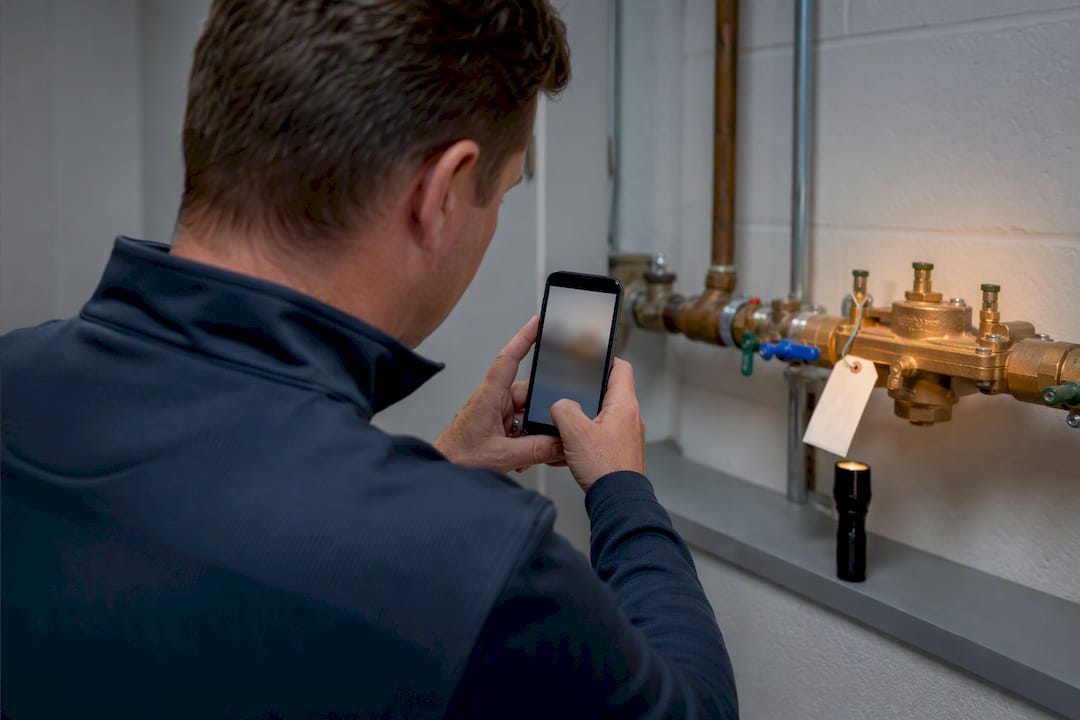
Pro Tip: Keep a photo of your backflow assembly’s tag and valve layout on your phone. When you’re calling a technician at 11 p.m., being able to describe “RPZ, 2-inch, Watts brand” instead of “the metal thing in the basement” cuts response time significantly.
How Do You Shut Off a Backflow Valve Safely?
Shutting off the wrong valve, or shutting off the right one too fast, turns a leak into a burst pipe. Here’s the actual technique.
- Identify the valve type before touching anything. Reduced-pressure zone assemblies (RPZ), double-check valve assemblies (DCVA), and pressure vacuum breakers each have shutoff valves on both the inlet and outlet side of the device.
- Turn quarter-turn ball valves slowly, even though they close in 90 degrees. A fast quarter-turn on a pressurized line is one of the more common causes of water hammer.
- On multi-turn wheel valves, close them gradually, stopping every few turns. This gives trapped pressure a chance to equalize instead of slamming shut against a full head of water.
- Bleed the test cocks on the assembly before final shutdown. Cracking a test cock open briefly relieves built-up pressure and reduces the shock when the main valve seats.
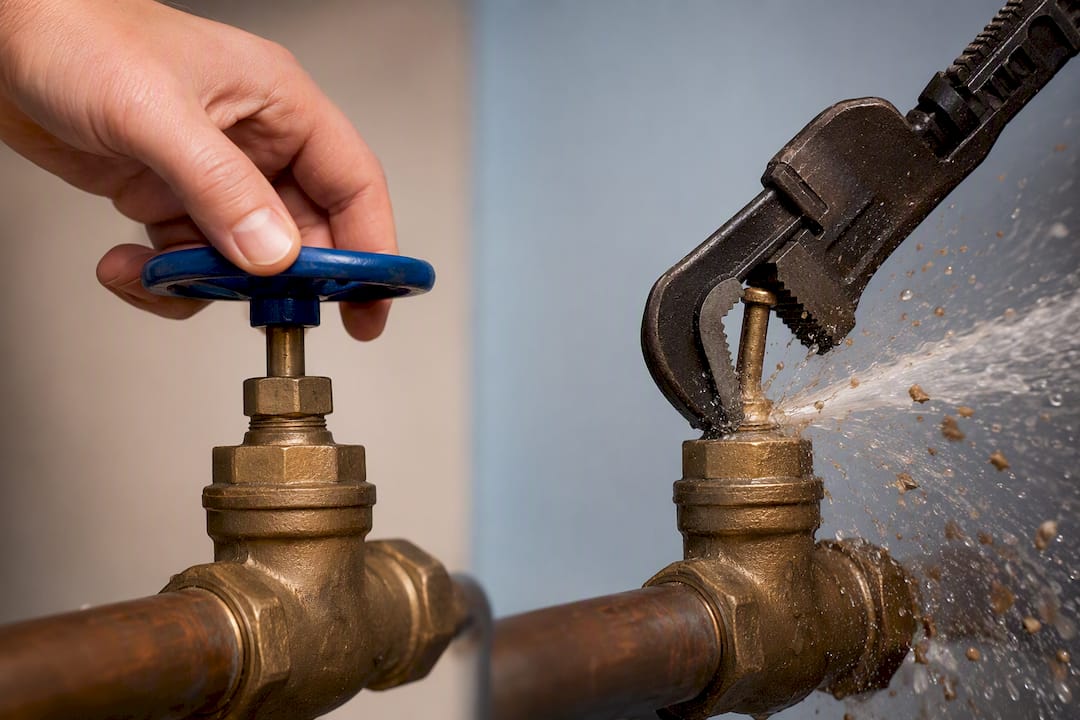
- If the isolation valve won’t hold, or you can’t turn it at all, stop and go to the main service valve or curb stop. Forcing a corroded or seized valve often snaps the stem, which turns a manageable repair into a full valve replacement.
Basic tools help here: an adjustable wrench for stubborn valve handles and a curb stop key if your main shutoff is below grade. Beyond that, if you’re staring at a valve that won’t budge or water pressure that isn’t dropping after you’ve closed everything you can reach, stop trying. Wait for a certified technician rather than risk a broken valve stem or a flooded mechanical room.
Pro Tip: Never force a valve with a pipe wrench for extra leverage. A snapped valve stem under pressure can spray water and debris with real force, and now you have two problems instead of one.
What If the Isolation Valves Fail?
Sometimes the assembly’s own valves are seized, corroded, or simply won’t seat, and you need a fallback plan that doesn’t involve waiting helplessly for water to keep flowing.
- Locate the curb stop, typically buried near the property line under a small metal or concrete lid, and use a curb stop key to close it if you have one and know how to operate it safely.
- If you don’t have a curb stop key or can’t locate the valve, call the utility and ask for an emergency plumbing shutoff at the street. Many utilities will send a crew to shut off service at the main when a property owner can’t isolate the leak.
- Forcing a buried or frozen curb stop with excessive torque risks snapping the valve stem underground, which turns a same-day fix into an excavation job. In cold weather, a frozen curb stop box is common and shouldn’t be forced.
The building’s main service valve or curb stop should always be your backup plan when the backflow valve shutdown procedure at the device itself doesn’t hold.
When Should You Worry About Contaminated Water?
If there’s any chance backflow pulled contaminants into the potable line, treat every tap in the building as suspect until you hear otherwise.
- Stop drinking, cooking with, or brushing teeth with tap water immediately if you suspect contamination, and switch to bottled water for the household or tenants.
- Call your water utility first, then your local health department if the utility doesn’t automatically involve them. Give them the address, what you observed (color, smell, pressure drop), and when it started.
- Public water system protocol calls for isolating the cross-connection, notifying affected customers, and coordinating flushing and sampling before water is considered safe again, according to Texas Commission on Environmental Quality guidance.
- Follow any boil-water advisory or do-not-drink notice the utility issues, and don’t lift it yourself just because the water looks clear again.
Stopping Water Damage Without Making It Worse
Containing the mess matters almost as much as stopping the source, and a few wrong moves here create a second repair bill on top of the first.
- Route relief-valve discharge toward a floor drain using a flex hose or temporary piping if the valve is dumping water indoors; a bucket works as a stopgap if no drain is reachable.
- Open and close every valve slowly, and bleed the test cocks before full shutdown. Rushing this step is the single biggest cause of preventable water hammer damage during emergency operations.
- Mop up standing water and move electronics, stored goods, or equipment away from the wet area as soon as it’s safe to do so.
- Automatic flood-protection shutdown valves, like the Watts LFF113FP, close upstream of an RPZ automatically when they detect continuous relief-valve discharge, but these require professional installation and aren’t a same-day fix during an active emergency.
Pro Tip: If you’ve had one flooding event, ask a technician about installing a flood sensor on the assembly. It won’t stop the next failure, but it can alert you or a building management system before a slow leak becomes standing water overnight.
What Happens After You Shut Everything Down?
Getting the water stopped is only half the job. Reopening the system before it’s actually fixed is how a one-day emergency turns into a repeat visit.
- Do not reopen or reuse the line until a certified tester has repaired and retested the assembly. A device that failed once under pressure can fail again the moment you restore flow.
- Schedule the certified retest promptly, and confirm your technician files the required report directly with the water authority. Skipping this step leaves your compliance status unresolved even after the physical repair is done.
- Document everything: photos of the failure, timestamps of when you shut off water, and the technician’s written report. Insurance claims and municipal compliance records both depend on this paper trail.
A Field Perspective on Backflow Emergencies
Most emergency calls Southjerseybackflow’s technicians get aren’t complicated devices failing in complicated ways. They’re an isolation valve nobody has touched in three years, seized in place, at the exact moment someone needed it to move. On-truck emergency capability typically means carrying rebuild kits for common assembly brands, the tools to isolate a failed device on-site, and the ability to complete a certified retest and file it with the local authority the same visit, rather than making the property wait on parts.
There are real limits to what any technician, ours included, should try to handle alone. Once contamination is suspected, the water utility and local health department have to lead the response. That’s not a jurisdictional formality. It’s how public water systems protect everyone downstream of your property, not just the people inside it.
— Jordan
Get Emergency Backflow Help From Southjerseybackflow
Southjerseybackflow handles the moment your isolation valve won’t turn and your basement is filling with water. That’s the gap a general plumber or a DIY fix can’t close: an emergency response built specifically around backflow assemblies, not general pipes.

Emergency service includes on-site isolation, temporary shutoff at the assembly or main, on-truck rebuilds using common parts stock, and same-visit certified retesting with the report filed directly to your water authority. When you call, have the property address ready along with the device type if you know it (RPZ, DCVA, or PVB) and what you’re seeing: flooding, discoloration, smell, or a pressure drop. Emergency call-out visits may cost more than scheduled testing appointments due to the nature of after-hours response and on-site repairs. If your property is due for standard testing once the emergency is resolved, check compliance requirements for New Jersey or reach out through Southjerseybackflow to schedule a technician.
Where to Learn More About Backflow Safety
For deeper technical detail beyond the immediate emergency, manufacturer documentation on automatic flood-protection valves covers permanent prevention options. State environmental guidance like TCEQ’s incident-response document explains the utility side of contamination events. For routine system checks that reduce emergency risk in the first place, Tendaro’s water system inspection guide covers practical habits for smaller properties.
Sources
- Series LFF113FP – Flood Protection Shutdown Control Valve (Watts)
- TCEQ — Public water system guidance for responding to a backflow incident (RG-476)
- LF009FS — Watts flood sensor and integration documentation
FAQ
Does Water Need to Be Shut Off for Backflow Testing?
Yes, briefly. A certified tester closes isolation valves and uses test cocks to check each check valve, which interrupts water flow to that line for the duration of the test, typically for a short period.
Where Is the Emergency Shutoff Valve for Water?
The primary emergency shutoff is the upstream isolation valve on the backflow assembly itself; if that fails, use the building’s main service valve or the curb stop near the property line.
What Happens if a Backflow Preventer Fails?
A failed backflow preventer can flood the area around it, allow contaminated water to enter the potable supply, or trigger continuous relief-valve discharge, and it requires immediate isolation followed by certified repair and retesting before reuse.
Does Turning Off the Backflow Turn Off the Water?
Closing the isolation valve on the assembly stops flow through that specific line, but it won’t necessarily shut off water to the entire property; for a full shutdown, use the main service valve or curb stop instead.