
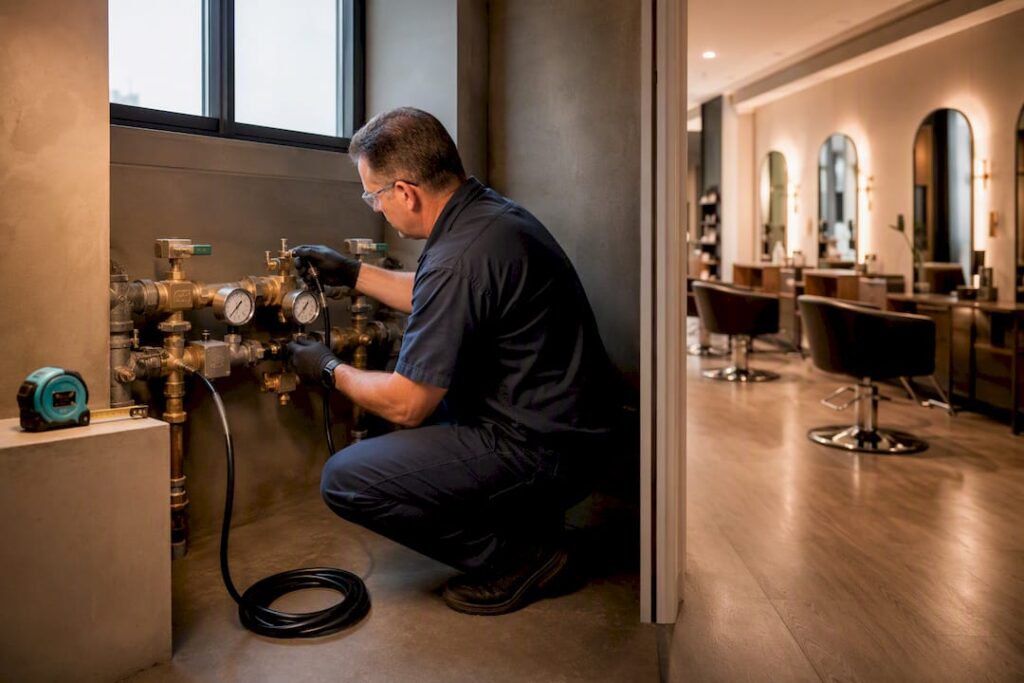
Most New Jersey salons need some level of backflow protection, but full containment devices and permits only kick in when your water supplier flags the property as a cross-connection hazard under N.J.A.C. 7:10-10. If you’re unsure where you stand, call your local water supplier this week and ask whether your salon is on a containment list. If it is, you’ll need a certified tester on the schedule before your next permit renewal.
TL;DR:
- Most salons only need containment devices if their water supplier flags them as a cross-connection hazard; calling your supplier clarifies your installation requirements.
- When required, a double check valve assembly suffices for standard chemical use, while an RPZ is necessary for higher-risk situations involving non-potable sources.
- Quarterly pressure testing and internal inspections are mandated, with reports due within five days; owners should confirm which testing schedule applies to their property.
- Common inspection failures stem from inaccessible devices, missing test ports, or unsealed connections, all of which are easy to fix if identified early.
- Prompt scheduling and careful preparation before testing can prevent delays, with most repairs on salon-grade devices completed in a single visit.
Table of Contents
- When Salon Backflow Requirements NJ Rules Actually Apply
- What Backflow Devices and Installation Rules Apply
- How Often Must Salons Test Backflow Devices in NJ?
- Preparing Your Salon Before the Tester Arrives
- What Happens After a Failed Backflow Test?
- South Jersey Backflow’s Approach to Salon Compliance
- Why Most Salon Owners Handle This Backward
- Get Your Salon Tested and Filed With South Jersey Backflow
- Where to Verify These Backflow Rules Yourself
- Sources
- FAQ
When Salon Backflow Requirements NJ Rules Actually Apply
Not every salon needs a containment device. The trigger is a “cross-connection,” meaning any point where your plumbing could let contaminated water flow backward into the public drinking water system. New Jersey draws a hard line between two levels of protection: fixture-level devices that guard a single sink or hose bib, and full facility containment, which protects the entire water service entering your building.
Salons tend to raise their hazard profile through specific, identifiable activities. Your water supplier or the administrative authority overseeing your area, not you, makes the final call on which category you fall into, based on guidance tied to N.J.A.C. 5:23-3.15. Conditions that commonly push a salon toward containment include:
- Mixing chemical treatments (color, relaxers, peroxide solutions) at sinks connected to the main supply
- Using non-potable or auxiliary water sources anywhere on the property
- Running dual water lines for equipment like pedicure stations or steam units
- Operating commercial-grade equipment that draws from the same line as drinking fountains or ice machines
Before you assume you need anything, call your water supplier and describe your equipment, chemical use, and any secondary water sources. That single conversation determines whether you need a permit at all.
What Backflow Devices and Installation Rules Apply
Once your supplier confirms you need containment, the device choice isn’t optional. New Jersey code recognizes two approved assemblies, and which one you install depends on how much risk your salon actually presents.
- Double check valve assembly. This works for standard hazard salons, most that use typical retail chemical products without a non-potable source connected anywhere on site.
- Reduced pressure zone assembly (RPZ). Required when the hazard is higher, meaning a non-potable source is present, chemical concentrations are severe, or the supplier’s assessment flags elevated risk.
- Test cocks and shutoff valves. Every approved installation needs test cocks for pressure testing and full-port ball shutoff valves for devices up to two inches in diameter, per N.J.A.C. 7:10-10.3.
- Upstream protection. A strainer ahead of the device catches debris that would otherwise wear down internal seals faster than normal.
- Relief port clearance. RPZ assemblies need proper air gap sizing at the relief discharge so the device can vent safely without flooding the mechanical room.
Materials matter too. Devices need to be built for repeated servicing, not sealed units you’d replace outright. If a device needs swapping rather than repair, don’t assume you can install a new one and move on. Replacement units may need approval before installation, which is worth knowing before you order parts. Southjerseybackflow’s installation guide for NJ property owners walks through placement and accessibility requirements in more detail.
How Often Must Salons Test Backflow Devices in NJ?
Here’s where a lot of salon owners get confused, and understandably so: two different testing rhythms show up in the rules, and they apply to different things.
Under a state physical connection permit, N.J.A.C. 7:10-10.6 requires quarterly pressure testing at minimum, plus an internal inspection (the device gets dismantled and its inner parts checked visually) within six months before permit renewal. Separately, plenty of commercial water suppliers reference annual testing as their baseline expectation for containment devices outside the state permit framework. If your supplier’s language doesn’t match what the state code says, don’t guess. Ask them directly which schedule governs your account, since the permit condition typically controls.
Only a certified backflow prevention device tester, approved through a DEP-certifying agency, or an authorized representative testing in the presence of the administrative authority, can legally perform this work. Certified testing isn’t a bureaucratic formality. It’s what keeps your reports credible if a supplier or inspector ever questions your compliance history.
A notable share of commercial backflow test failures trace back to devices that were never internally inspected, only pressure tested from the outside. That gap between the two inspection types catches owners off guard more than any other part of the process.
Results get logged on the Quarterly Physical Connection Test and Maintenance Report. When a certified tester performs the work, that report has to reach the administrative authority and your water supplier within five days. Keep copies of every report showing:
- Differential pressure readings across the device
- Relief valve behavior during the test (for RPZ assemblies)
- Pass or fail status and the tester’s certification number
Store these for at least the life of your current permit cycle. If your supplier ever disputes a compliance date, the paper trail is your only defense.
Preparing Your Salon Before the Tester Arrives
A failed test almost always traces back to something fixable before the tester ever shows up. Run through this before your appointment:
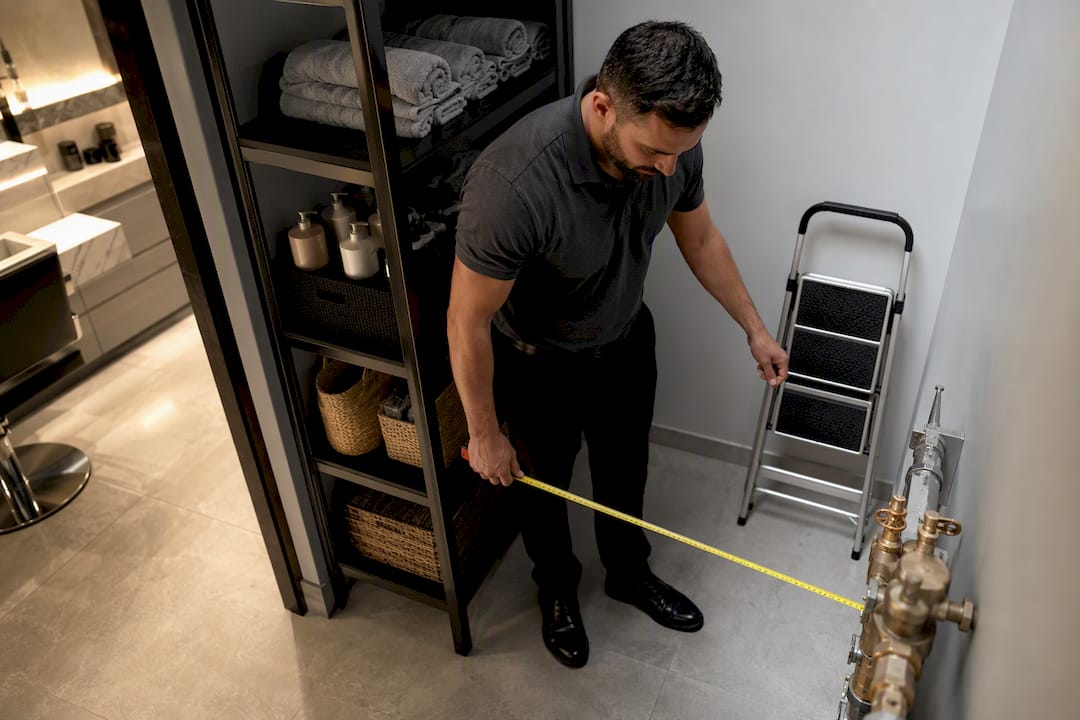
- Confirm the device is physically accessible, not boxed in behind shelving or storage.
- Check that it’s labeled clearly so anyone servicing it knows what it protects.
- Clear the relief valve discharge area of any obstruction.
- Verify test cocks and full-port shutoff valves are present and operable.
- Protect the device from freezing if it sits in an unheated space.
- Make sure the upstream strainer is clean, not clogged with sediment.
The violations that show up most often at salon sites aren’t exotic. Inaccessible devices, missing test ports, non-serviceable mounts, and unpermitted physical connections make up the bulk of failed inspections. Most of these are cheap to fix if you catch them early.
Pro Tip: Walk your mechanical room with fresh eyes a week before your scheduled test, not the day of. Half the “failures” South Jersey Backflow sees on salon sites are access issues an owner could have cleared in ten minutes with a tape measure and a stepladder.
What Happens After a Failed Backflow Test?
A failed test starts a clock, not a crisis. New Jersey gives owners 30 days to repair and retest a device that fails pressure testing or internal inspection. Miss that window and you’re looking at potential enforcement action from your supplier or the administrative authority.
Document everything: the failure report, the repair invoice, and the retest results, all filed together. If the device can’t be repaired and needs replacing, DEP approval of the new unit may add lead time you didn’t budget for, so start that process the day you learn repair isn’t an option.
- Coordinate with your water supplier on temporary service arrangements if repairs will take the connection offline
- Schedule replacement installs during off-hours when possible to limit disruption to salon operations
- Keep every document tied to the repair timeline in one file, not scattered across email threads
South Jersey Backflow’s Approach to Salon Compliance
Salon owners rarely have time to decode administrative code between clients. Southjerseybackflow handles the full cycle: assessment of your existing setup, certified testing, direct filing of the Quarterly Physical Connection Test and Maintenance Report with your supplier, and repairs or rebuilds when a device fails.
The most common finding on salon visits is a device installed correctly years ago that’s now inaccessible behind renovated shelving or storage buildout. Most repairs on salon-grade double check assemblies wrap up within a single visit; RPZ rebuilds or replacements needing DEP approval typically take longer due to the approval step itself, not the mechanical work.
Author: Jordan
Why Most Salon Owners Handle This Backward
The typical advice online treats backflow compliance like a one-time box to check: install a device, get it tested once, move on. That’s not how New Jersey’s framework works, and treating it that way is exactly what gets salons flagged during renewal cycles.
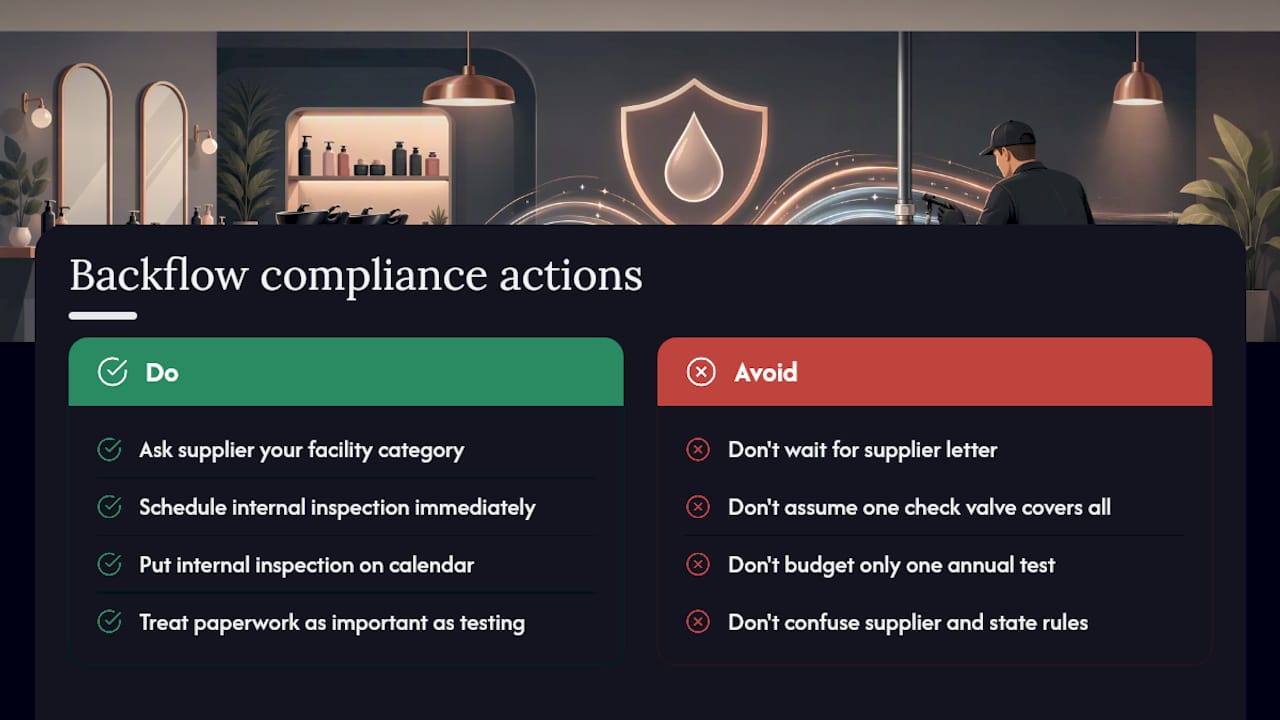
The bigger miss is confusing supplier-level annual expectations with the state’s quarterly and internal inspection requirements. Owners who only budget for one test a year get blindsided when a permit renewal demands an internal inspection they never scheduled. Fixture-level protection also gets oversold. Plenty of salon owners assume a single check valve under a shampoo sink satisfies everything, when their supplier has already classified the whole facility for containment.
If there’s one thing worth doing differently, it’s this: don’t wait for a letter from your supplier to find out which category you’re in. Ask now, put the internal inspection date on your calendar the same day you schedule quarterly testing, and treat the paperwork trail as seriously as the mechanical work. The owners who avoid enforcement aren’t the ones with the newest devices. They’re the ones who never let a deadline surprise them.
— Jordan
Get Your Salon Tested and Filed With South Jersey Backflow
Certified backflow testing services are available to help salon owners manage testing and paperwork deadlines. Some service providers offer certified testing, direct filing with suppliers, emergency repairs, rebuilds, and enclosure installations, sometimes handling multiple tasks in a single visit.
A booked visit covers the onsite pressure test, internal inspection when your renewal cycle calls for it, and submission of the Quarterly Physical Connection Test and Maintenance Report to your administrative authority and supplier, usually within the same week. If a device fails, repairs typically move fast enough to keep you inside the 30-day retest window without a second scheduling headache.
Start with the backflow testing and compliance guide for a full walkthrough of what to expect, or check service coverage in your county and book your salon’s next test directly.
Where to Verify These Backflow Rules Yourself
- N.J.A.C. 7:10-10.3 and 7:10-10.6: device and testing rules
- NJDEP physical connection guidance: permit triggers
- Check your municipal code, as some towns, like Clifton, add salon-specific plumbing rules
Sources
- N.J. Admin. Code § 7:10-10.6 – Inspection and testing requirements and procedures for physical connection installations
- N.J. Admin. Code § 7:10-10.3 – Approved physical connection installation requirements
- Regulatory guidance: physical connection permit for approved physical connection installation (NJDEP)
FAQ
Is Backflow Testing Required in NJ?
Yes, for any property with an approved physical connection permit, testing is required at least quarterly under N.J.A.C. 7:10-10.6, plus an internal inspection before permit renewal.
Is a Backflow Preventer Required by Code?
Fixture-level backflow protection is required under the state Plumbing Subcode for most commercial properties, while full containment devices apply specifically when your water supplier determines the facility poses a cross-connection hazard.
Where Are Backflow Devices Required?
They’re required wherever a public water supplier or administrative authority identifies a cross-connection risk, which for salons often means chemical mixing stations, dual water lines, or non-potable sources on site.
Does a Backflow Preventer Require a Permit?
Yes, installing an approved physical connection installation for containment purposes requires a permit from the state, separate from any local plumbing permit for the fixture installation itself.
How Do I Know if My Salon Needs Containment or Just Fixture Protection?
Contact your local water supplier directly and describe your chemical use, equipment, and any non-potable water sources. Southjerseybackflow’s inspection compliance checklist can help you prepare for that conversation.