New Jersey laboratories with any cross-connection hazard must install testable backflow preventers, and most face two overlapping testing clocks at once. Devices covered by an NJDEP physical connection permit need regular testing and renewal according to NJDEP rules, while municipal plumbing subcode enforcement under the Uniform Construction Code requires annual testing tied to a Certificate of Compliance. When both tracks apply, follow whichever schedule is stricter, and use only an NJDEP-recognized certified tester to file the results.
TL;DR:
- NJDEP requires quarterly testing and renewal of devices under physical connection permits, while municipal codes mandate annual testing for backflow devices.
- Labs with any connection between potable water and non-potable substances are considered hazards and must comply with both NJDEP and municipal regulations.
- Only certified testers from NJDEP-approved agencies can legally perform backflow tests, and licenses differ from plumbing permits.
- Failures in testing must be repaired within 30 days, with replacements for fire protection devices requiring specific approval and permits.
- Managing both compliance schedules simultaneously is complex, and consolidating testing and filing with a qualified provider reduces risk of missed deadlines.
Table of Contents
- What NJ laboratory backflow requirements actually say
- Does your lab count as a cross-connection hazard?
- Permit types and how often you need to test
- Who’s allowed to test your devices
- How the test itself works, and what gets filed
- When a device fails its test
- A working compliance checklist for lab facility managers
- How Southjerseybackflow helps labs pass inspection the first time
- What actually keeps NJ labs out of trouble
- Get your NJ lab’s compliance handled by certified testers
- Sources
What NJ laboratory backflow requirements actually say
Two separate rulebooks govern backflow prevention in New Jersey, and labs often fall under both at once. N.J.A.C. 7:10-10 covers physical connections, meaning any link between a public water system and a source NJDEP hasn’t approved, like a lab’s process water loop, cooling system, or chemical mixing station. Separately, N.J.A.C. 5:23, the Plumbing Subcode, governs backflow devices installed as part of standard building plumbing under the Uniform Construction Code.
These tracks run in parallel, not in sequence. A laboratory permitted under NJDEP’s physical connection rules still has to satisfy its municipal construction official for occupancy and annual certification. The DCA’s Bulletin 99-2 spells out how the local track works: field-testable devices get tested before final inspection, then annually, with results submitted for a Certificate of Compliance. Facility managers should keep both the NJDEP physical connection paperwork and the municipal Certificate of Compliance on file. Losing track of either one is the single most common way labs end up out of compliance without realizing it.
Does your lab count as a cross-connection hazard?
New Jersey’s regulations don’t leave this to guesswork. Medical and testing laboratories appear explicitly in the state’s hazard classification examples, alongside facilities like car washes, mortuaries, and photo processing labs, because their equipment routinely connects potable water to substances that can’t be allowed to backflow into the public supply.
Private residences are generally exempt, but a lab operating inside a mixed-use building doesn’t inherit that exemption. If your facility runs autoclaves, glassware washers with chemical additives, vacuum aspiration systems, cooling towers, or any process that mixes water with reagents, biological material, or non-potable fluids, you almost certainly meet the threshold. When in doubt, the safer assumption is coverage, not exemption, since misclassifying a hazard is what triggers enforcement later.
Permit types and how often you need to test
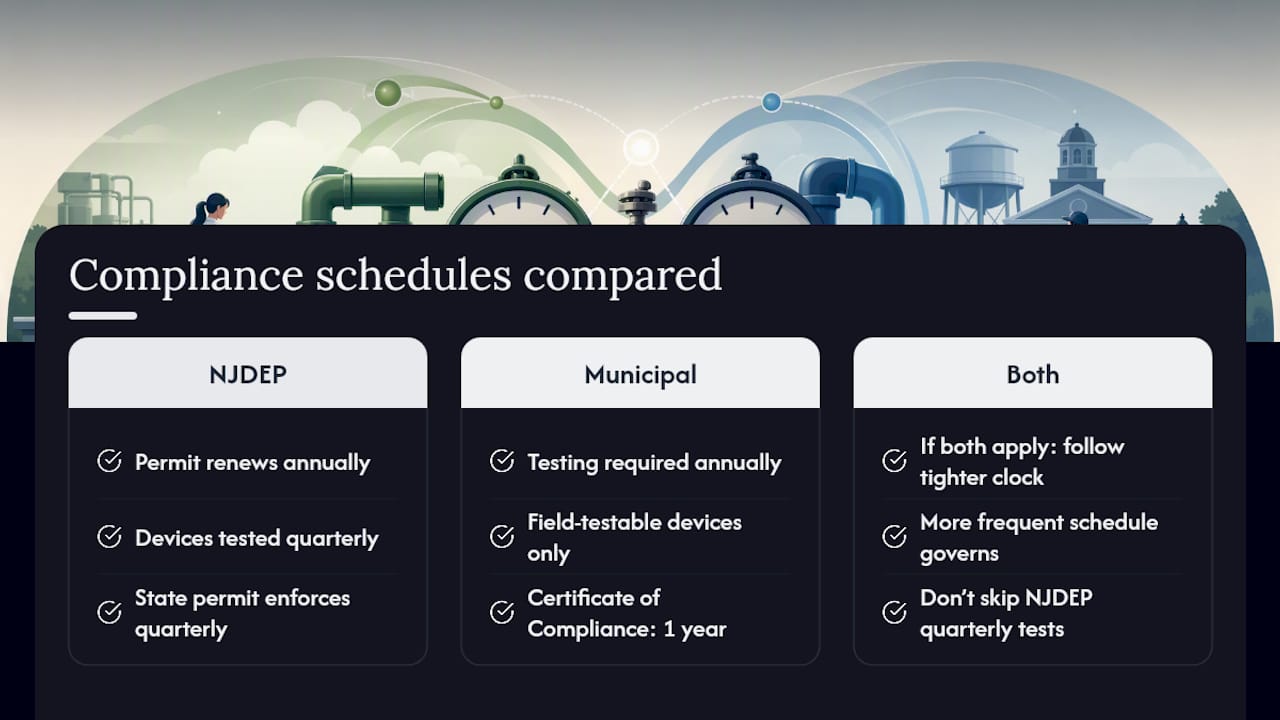
Two distinct compliance instruments apply, and they run on different clocks. Under NJDEP’s physical connection permit program, the permit itself renews annually, but devices installed under it require testing on a quarterly basis.
The municipal side works differently. Bulletin 99-2 requires annual testing for field-testable backflow preventers under the Plumbing Subcode, with results submitted to obtain or renew a Certificate of Compliance valid for one year. A lab that only has containment devices tied to municipal plumbing may only need the annual cycle. A lab with an NJDEP-permitted physical connection needs the quarterly cycle regardless of what the municipal calendar says. When a facility carries both, the practical rule is simple: comply with whichever schedule is more frequent, and don’t let the annual deadline lull you into skipping quarterly tests the state permit actually requires.
Who’s allowed to test your devices
Only testers certified through an NJDEP-approved certifying agency can legally perform the tests that satisfy either track. NJDEP publishes the current list of certifying agencies, and each agency maintains its own roster of certified individual testers, which NJDEP compiles for public reference.
Plumbing licensure and backflow tester certification are not the same credential, and this trips up more facility managers than almost anything else in the process. A licensed plumber isn’t automatically authorized to test backflow devices unless they also hold the separate certification. Before hiring anyone, confirm three things: the certifying agency appears on NJDEP’s approved list, the individual tester’s name appears on that agency’s current roster, and the certification hasn’t expired. You can verify certifying credentials directly before scheduling any work.
How the test itself works, and what gets filed
A valid test checks specific pressure differentials and relief-valve behavior defined in N.J.A.C. 7:10-10.6, which lays out the exact steps for double check valve assemblies and reduced pressure zone assemblies. Beyond the field test, internal inspection, meaning physical dismantling of the assembly, is required within a specified period before permit renewal for physical connection permits. Skipping that step is one of the fastest routes to automatic non-compliance, even if your quarterly field tests all passed.
For NJDEP-permitted connections, results go on the Quarterly Physical Connection Test and Maintenance Report. For municipal compliance, results support the annual Certificate of Compliance filing. Municipal officials may witness a test, but they do not perform the test themselves; the owner remains responsible for submitting certification paperwork on time, typically within days of the test date under local ordinance.
When a device fails its test
A failed test starts a clock, not a crisis, if you move fast. New Jersey regulation generally allows 30 days to repair and retest a failed device before it becomes a formal violation. Replacement, rather than repair, usually requires a Construction Permit from the municipality, and combination domestic and fire-protection lines need joint plumbing and fire subcode plan review before a new device is installed.
Fire-line replacements carry an extra requirement: the replacement device must be approved for fire protection use. Swapping in a standard assembly without that approval and the proper permits violates regulations. Ignore the retest window entirely and you risk escalating notices, added fees, or in persistent cases, water service disconnection.
A working compliance checklist for lab facility managers
Most compliance failures trace back to a missed step, not a misunderstood rule. Build your process around this sequence:
- Inventory every device: type, location, and which permit track (NJDEP physical connection or municipal Certificate of Compliance) covers it.
- Confirm your tester’s certification against NJDEP’s current approved list before scheduling anything.
- Schedule quarterly tests for NJDEP-permitted connections and annual tests for municipal-track devices, using the stricter cadence where they overlap.
- File the Quarterly Physical Connection Test and Maintenance Report or Certificate of Compliance paperwork immediately after each passing test.
- Track expiration dates and set reminders well ahead of renewal, not on the deadline itself.
A few habits make the difference between smooth renewals and scrambling:
- Keep every test report, permit, and Certificate of Compliance in one centralized file, not scattered across departments.
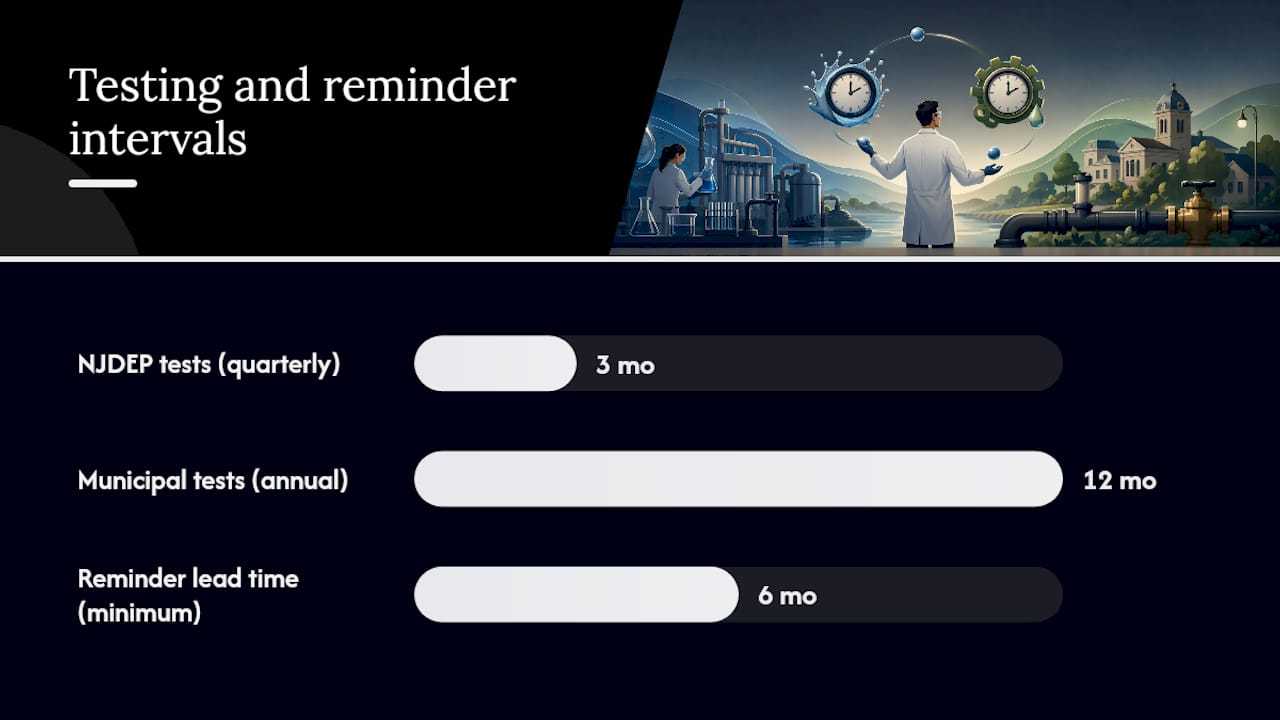
- Set internal inspection reminders at least six months ahead of permit renewal, since dismantling assemblies takes planning.
- Cross-check your testing calendar against the annual deadline tracker rather than relying on memory.
Property managers overseeing multiple buildings can borrow good habits from broader facility safety practice, including the kind of structured inspection checklist used across property management generally.
Pro Tip: Consolidate testing, repairs, and filing with a single qualified provider. Split responsibilities across separate vendors is where deadlines quietly slip through the cracks.
How Southjerseybackflow helps labs pass inspection the first time
Handling both compliance tracks in-house means someone on your staff has to know NJDEP permit renewal dates, municipal Certificate of Compliance deadlines, and the six-month internal inspection window, all at once, for every device on the property. A qualified provider can perform NJDEP-compliant testing and certification for commercial and laboratory properties, using certified testers, and file results directly with the appropriate water authority rather than leaving that step to the facility.
The most common failure point we see isn’t a bad device, it’s a missed internal inspection before renewal, or a repair that gets done without pulling the required Construction Permit. Some providers offer consolidated billing for facilities managing multiple properties, which helps keep records in one place instead of scattered across separate vendor invoices. A full walkthrough of the testing and submission process covers exactly what inspectors check first.
What actually keeps NJ labs out of trouble
The regulatory complexity here isn’t an accident of bad drafting. It reflects two agencies protecting two different things: NJDEP protects the public water supply from contamination through unapproved connections, while municipal construction officials enforce building-level plumbing safety. Most facility managers I’ve seen struggle with backflow compliance aren’t struggling with the testing itself, they’re struggling with tracking two separate clocks that don’t reset on the same day.
My honest recommendation: stop treating quarterly and annual testing as one combined task. Build separate reminders for each track, verify tester certification every time you hire someone new, and centralize every report in one place a compliance officer can access without hunting through email threads. When a situation doesn’t fit cleanly into either bucket, like a lab expanding into a new hazard category, go back to the primary NJ rule text rather than trusting a summary. The rules are detailed enough that shortcuts eventually cost more than the paperwork would have.
— Jordan
Get your NJ lab’s compliance handled by certified testers
Southjerseybackflow is the alternative to juggling two separate compliance calendars yourself: one team handles NJDEP quarterly testing, municipal annual certification, internal inspections, and permit filings, so nothing falls between the cracks of two overlapping deadlines.
Services cover certified testing for double check valve assemblies and reduced pressure zone assemblies, repairs and rebuilds when a device fails, Construction Permit coordination for replacements, and direct filing of results with your local water authority. Laboratories running multiple buildings get consolidated billing instead of separate invoices from separate vendors for every device. If your facility is due for testing or you’ve received a compliance notice, schedule certified backflow testing and certification before your next deadline hits, and get every report filed the same week it’s completed.
Sources
- N.J.A.C. 7:10-10.6 – Inspection and testing requirements and procedures for physical connection installations | LII
- Testing of Backflow Preventers, Bulletin 99-2 (NJ DCA)
- Certified Backflow Prevention Device Testers | NJDEP