
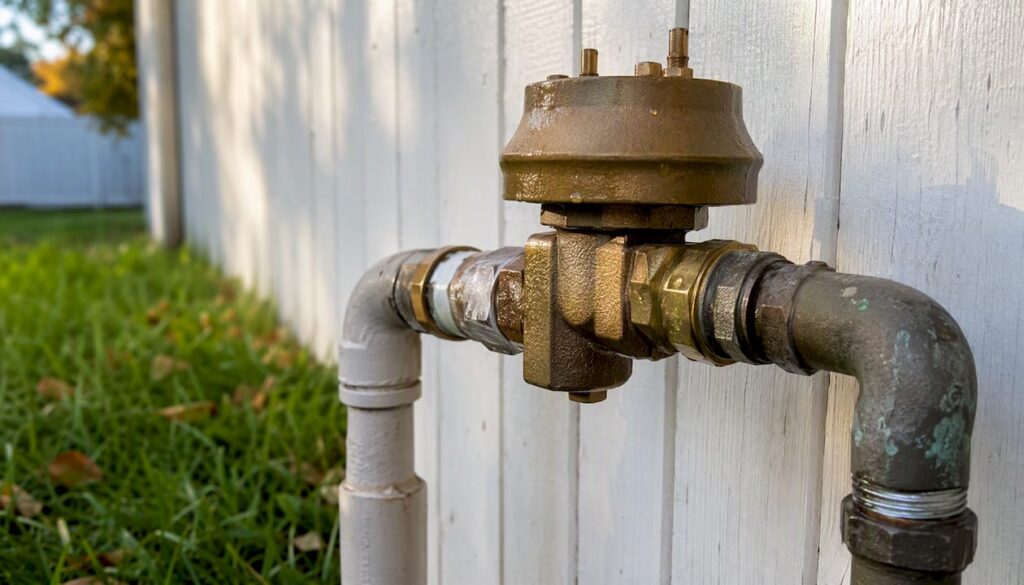
A vacuum breaker is a backflow prevention device that stops backsiphonage by admitting atmospheric air into a water line the moment the supply pressure drops, breaking any siphon before contaminated water can be drawn backward into the potable supply. Per Up, the standard code definition describes it as “a device that prevents backsiphonage of water by admitting atmospheric pressure through ports to the discharge side of the device.” You’ll find them on outdoor hose bibbs, irrigation systems, toilet flush valves, and lab sinks. The four main types are the Atmospheric Vacuum Breaker (AVB), Pressure Vacuum Breaker (PVB), hose-connection vacuum breaker, and vacuum relief valve.
Key Takeaways
A vacuum breaker prevents backsiphonage by admitting air to break a siphon, but it only works when installed correctly, tested annually (for PVBs), and matched to the right hazard type.
| Point | Details |
|---|---|
| Core function | Admits air to break a siphon and stop contaminated water from flowing backward into the potable supply. |
| AVB vs. PVB | AVBs cannot stay under continuous pressure and are not testable; PVBs handle continuous pressure and require annual certified testing. |
| Installation height | PVBs must sit at least 12 inches above the highest outlet; AVBs require at least 6 inches. |
| Backsiphonage only | Vacuum breakers do not protect against backpressure; systems with pumps or boilers need an RP assembly or DCVA. |
| Annual testing | AWWA recommends annual PVB testing because poppets and check valves can stick or accumulate mineral deposits without visible signs. |
Table of Contents
- What is the vacuum breaker definition in plain terms?
- How does a vacuum breaker actually stop backsiphonage?
- What are the main types of vacuum breakers?
- Where are vacuum breakers commonly installed?
- U.S. code and standards: what the rules actually require
- Inspection, testing, and winterization
- How vacuum breakers differ from other backflow preventers
- When should you hire a certified backflow tester?
- What most technicians see in the field
- Sources
What is the vacuum breaker definition in plain terms?
The ASSE frames vacuum breaker function around one job: prevent backsiphonage. That’s the condition where a sudden pressure drop, say a water main break or a heavy draw elsewhere on the line, creates enough negative pressure to pull water backward from a hose sitting in a bucket of fertilizer, a submerged sprinkler head, or a toilet bowl back into the pipes your family drinks from.
The device sits between the potable supply and the potentially contaminated downstream side. When pressure is normal, it stays closed and water flows through. The moment pressure drops, it opens to air. That air breaks the vacuum. No vacuum, no siphon, no contamination.
How does a vacuum breaker actually stop backsiphonage?
The physics are straightforward. A siphon needs a continuous column of liquid under negative pressure to pull fluid backward. Admitting air anywhere in that column causes the siphon to collapse.
Here’s the operational sequence:
- Normal operation. Supply pressure holds a poppet or check valve closed against its seat. Water flows downstream normally.
- Pressure drop. Supply pressure falls below a threshold, or drops to zero entirely.
- Poppet drops or vent opens. The internal poppet (held up by water pressure) falls by gravity, or a spring-loaded version releases. An air vent port opens.
- Atmospheric air enters. Air rushes in through the vent, equalizing pressure on the downstream side.
- Siphon broken. The continuous liquid column is interrupted. Contaminated water cannot travel upstream.
One distinction worth knowing: vacuum breakers protect only against backsiphonage, which is driven by negative pressure. They do not protect against backpressure, which happens when downstream pressure exceeds supply pressure due to a pump, boiler, or elevated tank. That’s a different hazard requiring a different device.
Pro Tip: AVBs rely on gravity to drop the poppet, so installation orientation matters. Mount one upside-down or sideways and it may not open when it should. Always install per the manufacturer’s arrow markings.
What are the main types of vacuum breakers?
Each type suits a different application, and using the wrong one is a compliance and safety problem.
Atmospheric vacuum breaker (AVB)
An AVB uses a check valve member and an air vent to admit air when upstream pressure drops. Simple, inexpensive, and widely used on hose bibbs and irrigation zone valves. The hard limits: it cannot remain under continuous pressure (no more than 12 hours per day in most codes), no downstream shutoff valve is permitted, and it must be installed a minimum of 6 inches above the highest downstream outlet. AVBs cannot be field-tested.
Pressure vacuum breaker (PVB)
A PVB adds a spring-loaded poppet and test cocks to the basic AVB design. That spring load means it can stay under continuous pressure, making it the standard choice for irrigation systems that run on a timer. The test cocks allow a certified tester to verify the device is functioning without removing it. PVBs still protect only against backsiphonage, not backpressure.
Hose-connection vacuum breaker
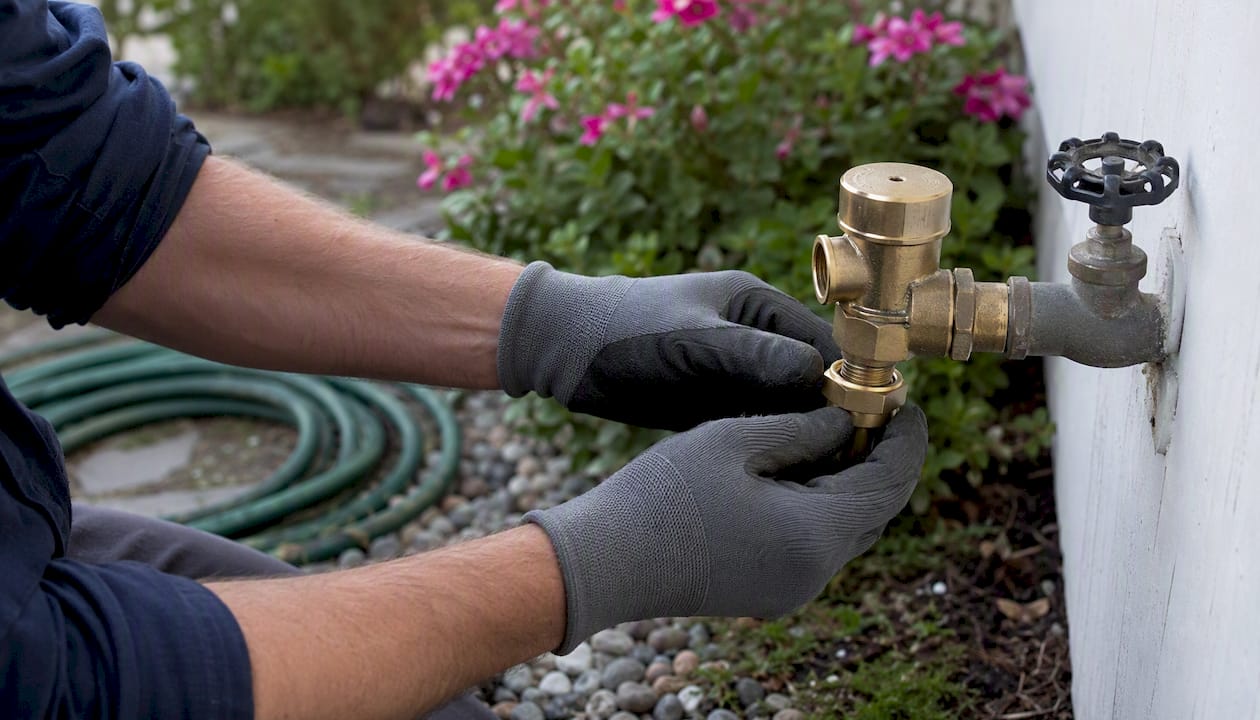
This is the small brass fitting that threads directly onto an outdoor hose bibb or utility faucet. It’s the most common vacuum breaker most homeowners already own without knowing it. Many jurisdictions require them on every hose connection by code.
Vacuum relief valve (steam systems)
Functionally similar in concept but applied to steam distribution. A vacuum relief valve admits air when pipe pressure goes sub-atmospheric, preventing steam coil collapse. It’s not a potable water device, but the underlying principle, breaking a vacuum by admitting air, is identical.
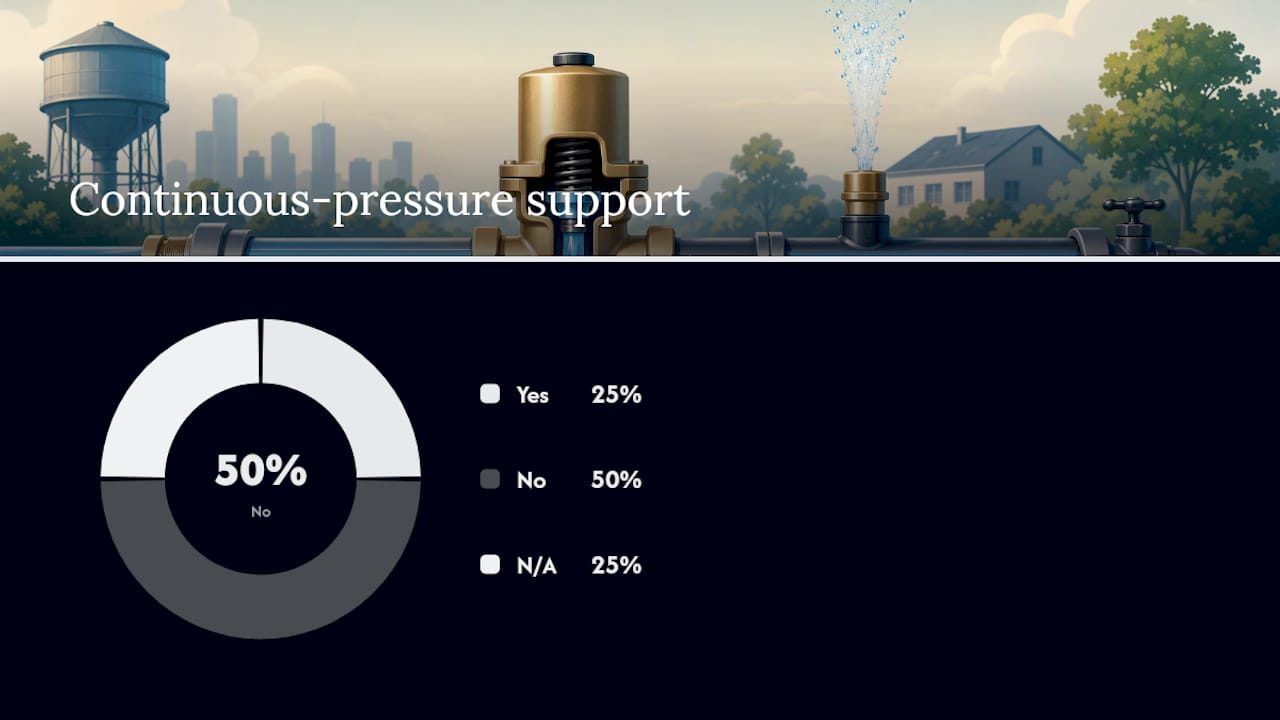
| Type | Continuous pressure? | Field testable? | Typical location |
|---|---|---|---|
| Atmospheric Vacuum Breaker (AVB) | No | No | Hose bibbs, irrigation zone valves |
| Pressure Vacuum Breaker (PVB) | Yes | Yes | Irrigation mains, commercial systems |
| Hose-connection vacuum breaker | No | No | Outdoor faucets, utility sinks |
| Vacuum relief valve | N/A (steam) | No | Steam coils, HVAC heating systems |
Where are vacuum breakers commonly installed?
Knowing where to look helps you identify what you have and whether it’s appropriate for the application.
- Outdoor hose bibbs. The most visible location. A small brass or plastic cap on the end of the spigot is almost always a hose-connection vacuum breaker. If yours is missing, that’s a code violation in most U.S. jurisdictions.
- Irrigation and sprinkler systems. PVBs are among the assemblies most frequently required by utilities on irrigation connections because submerged sprinkler heads create a direct backsiphonage path to the potable supply.
- Toilet and urinal flush valves. Commercial flush valves include a built-in vacuum breaker as part of the valve body. You won’t see it, but it’s there.
- Lab and utility sinks. Anywhere a hose or fill pipe might be submerged in a chemical solution, a vacuum breaker is required.
- Steam coils and HVAC heating. Vacuum relief valves protect against coil collapse when steam condenses faster than it can be replaced.
Visually, a PVB on an irrigation system looks like a vertical brass assembly with a bonnet on top and two small test cocks (quarter-turn ports) on the side. An AVB on a zone valve looks like a small hooded cap. Both should be above the highest sprinkler head on the system.
U.S. code and standards: what the rules actually require
Two ASSE standards govern most vacuum breaker installations in the U.S.:
- ASSE 1020 covers PVB assemblies. Working Pressure Magazine notes that ASSE 1020 defines design and testing criteria and requires PVB assemblies to include shutoff valves and test cocks for field inspection and certification.
- ASSE 1056 covers spill-resistant vacuum breakers, a variant designed to reduce the water discharge that can occur when a standard AVB vents.
- CSA B64.1.2 is the Canadian equivalent standard referenced in cross-border projects.
The International Residential Code (IRC) and IAPMO’s Uniform Plumbing Code both incorporate these standards by reference. IAPMO guidance specifies that an AVB must be installed at least 6 inches above the highest downstream outlet and must never be subject to continuous pressure.
Key installation rules to know:
AVB rule: No downstream shutoff valve. No continuous pressure. Minimum 6-inch elevation above the highest outlet. Failure on any of these three points voids the protection entirely.
PVB rule: Must be installed at least 12 inches above the highest downstream outlet. Requires annual testing in most jurisdictions. Must be protected from freezing.
Most local building codes require backflow prevention on irrigation systems, and many water utilities independently mandate it as a condition of service.
Inspection, testing, and winterization
Testing frequency
AVBs are not field-testable. You inspect them visually and replace them when they fail. PVBs, by contrast, have test cocks specifically so a certified tester can attach calibrated gauges and verify that the poppet and check valve are holding to spec. AWWA recommends annual testing of PVBs because the internal mechanical parts, particularly the poppet and check valve, can stick or accumulate mineral deposits that compromise the device without any visible external sign.
What to inspect yourself
- Check for continuous dripping from the bonnet vent. A small amount of discharge during a pressure fluctuation is normal. Constant dripping is not. It usually means the poppet is stuck open or the seat is worn.
- Look for cracks in the body. Hairline cracks in the brass or plastic housing are a freeze-damage signature.
- Confirm elevation. Measure from the device to the highest downstream outlet. If it’s below the minimum, the device isn’t protecting anything.
- Check test cocks on PVBs. They should turn freely. Seized test cocks mean a tester can’t do their job.
Winterization
Outdoor PVBs and AVBs must be drained before the first hard freeze. Watts notes that freezing is a primary cause of internal component failure, and spring-loaded internals can fracture if left pressurized and exposed to freezing temperatures. Drain the device by closing the upstream shutoff, opening the test cocks to relieve pressure, and leaving the bonnet vent exposed to air.
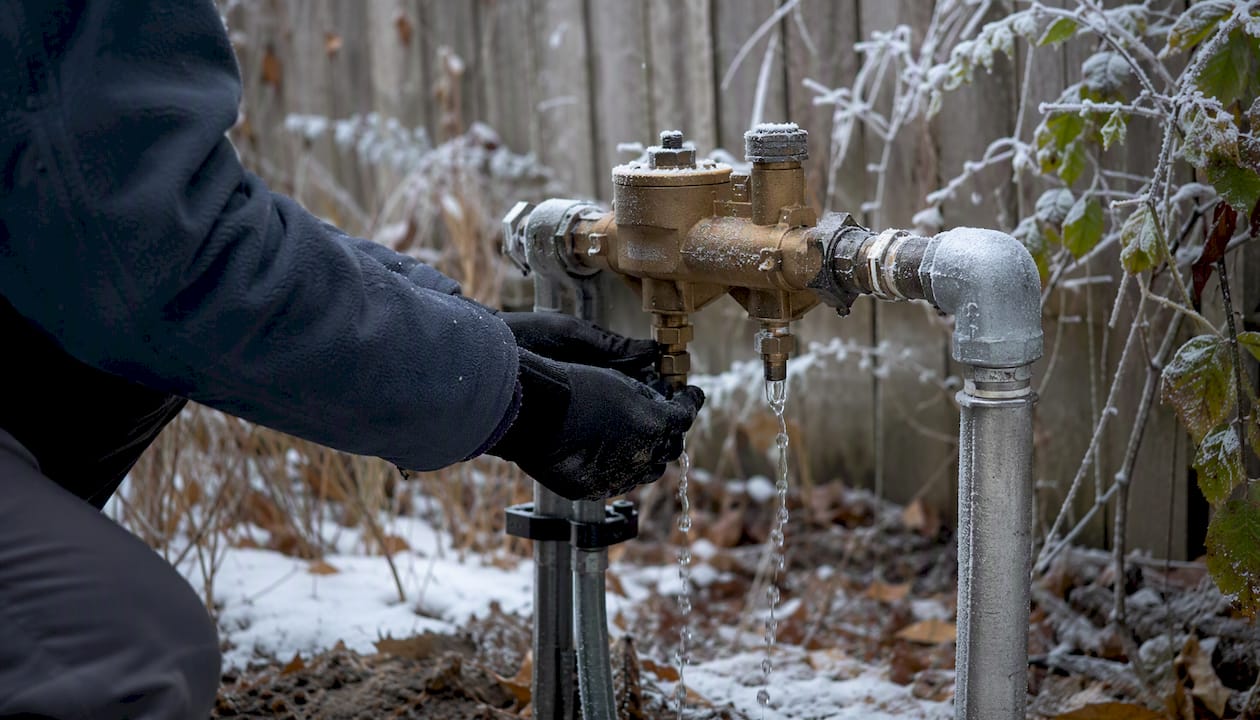
Pro Tip: Mark your calendar for mid-October in New Jersey. Drain outdoor vacuum breakers before the first freeze warning, not after. A cracked PVB body discovered in April means a full replacement before the irrigation season starts.
How vacuum breakers differ from other backflow preventers
This is where misapplication becomes a public-health issue. AWWA is direct: vacuum breakers protect only against backsiphonage. They will not stop backpressure contamination from downstream pumps, boilers, or elevated storage tanks.
| Hazard type | Cause | Correct device |
|---|---|---|
| Backsiphonage | Negative supply pressure (main break, heavy draw) | AVB, PVB, hose-connection vacuum breaker |
| Backpressure | Downstream pressure exceeds supply (pump, boiler, elevated tank) | Reduced Pressure (RP) assembly or DCVA |
| Both hazards present | Combined risk (chemical injection, medical facilities) | RP assembly |
A vacuum breaker on a system with a booster pump is not a compliant installation. The pump can push water back into the supply even when supply pressure is normal, and a vacuum breaker has no mechanism to stop that. For a broader look at how these assemblies compare, this overview of backflow prevention devices covers RP assemblies, DCVAs, and PVBs side by side.
When the hazard classification is uncertain, consult a licensed backflow professional. Guessing wrong isn’t a paperwork problem. It’s a contamination risk.
When should you hire a certified backflow tester?
Some situations call for a professional, not a visual check.
- You received a testing notice from your water utility. In New Jersey, utilities send annual testing orders for devices on irrigation, commercial, and multi-unit systems. Ignoring them leads to service interruption. If you’ve received one, this guide to backflow testing in New Jersey walks through the process.
- Your PVB is leaking from the bonnet or test cocks. A tester can diagnose whether it needs a rebuild or full replacement.
- You’re opening an irrigation system after winter. Before pressurizing, a certified tester should verify the PVB survived the off-season.
- You suspect a contamination event. Any time a backflow may have occurred, the device needs immediate inspection and the water authority notification.
A typical service visit runs like this: the technician inspects the device visually, attaches calibrated differential pressure gauges to the test cocks, runs the test sequence per the applicable standard, records results, and either clears the device or identifies the failed component. If a rebuild is possible, it happens on-site. The test report is then filed directly with the water authority, which is a requirement in most New Jersey jurisdictions.
Southjerseybackflow handles certified backflow testing and certification in New Jersey, including direct report filing with local water authorities across residential, commercial, and multi-unit properties.
What most technicians see in the field
The three most common problems on service calls aren’t exotic. They’re predictable.
First, elevation violations. A homeowner or landscaper installs a PVB at ground level because it’s easier, then wonders why the utility rejects the test report. The device has to be above the highest outlet. No exceptions.
Second, freeze damage. A cracked PVB body found in spring almost always traces back to a pressurized device left outdoors through a hard freeze. The fix is replacement, not repair.
Third, downstream shutoff valves on AVBs. Someone adds a shutoff valve downstream of an AVB for convenience. That valve traps pressure against the AVB, which was never designed for it. The device fails to vent, and the protection is gone.
Before calling a technician, do a quick visual pass: check the elevation, look for cracks or constant dripping, and confirm there’s no downstream shutoff on an AVB. Log what you see. That information cuts diagnostic time significantly.
Sources
The standards and code documents behind this article are publicly accessible. ASSE publishes the full text of ASSE 1020 (PVBs) and ASSE 1056 (spill-resistant vacuum breakers), which are the primary design and testing standards referenced by most U.S. plumbing codes. AWWA provides guidance on cross-connection control and backflow prevention programs, including testing frequency recommendations. The IRC and IAPMO Uniform Plumbing Code incorporate these standards by reference; up.codes reproduces the relevant code language in a searchable format useful for homeowners and contractors. Working Pressure Magazine covers PVB assembly requirements in practical detail.
Installation and testing rules vary by jurisdiction. What’s required in one New Jersey municipality may differ from the next. Always confirm current requirements with your local water authority or a licensed backflow tester before installing or certifying any device.
- Asse-plumbing
- Awwa
- Atmospheric vacuum breaker – Wikipedia
- Pressure Vacuum Breaker Assemblies (PVBs) » Working Pressure Magazine
- Up