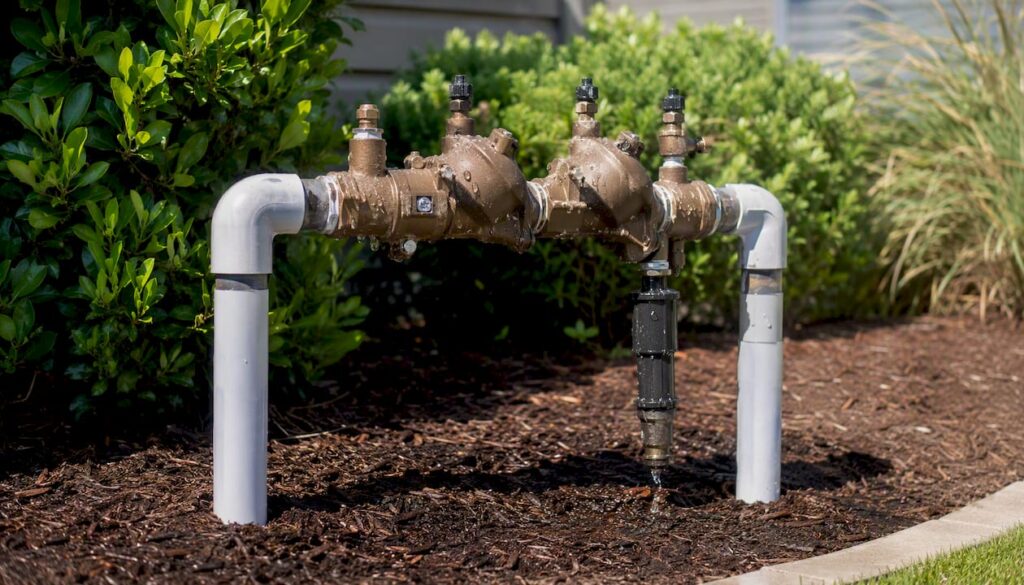
If you have an in-ground sprinkler system, you almost certainly need a Reduced Pressure Zone backflow preventer — commonly called a sprinkler RPZ. It is a mechanical assembly that sits between your potable water supply and your irrigation system, using two independent check valves plus a pressure-differential relief valve to stop contaminated irrigation water from flowing backward into your drinking water. Most water authorities classify irrigation as a high-hazard cross-connection, which means a double-check valve or vacuum breaker alone usually will not satisfy code.
The three core components of every RPZ assembly:
- Two independent check valves that open under normal flow and snap shut if pressure reverses
- An intermediate relief valve that vents the zone between the checks to atmosphere if either check fails, keeping contaminated water from reaching the supply
- Test cocks and shutoff valves that give a certified tester access to verify each component annually.
Key Takeaways
A sprinkler RPZ is the highest-level backflow protection available for irrigation systems, and most New Jersey water authorities require annual certified testing with direct filing of results to maintain compliance.
| Point | Details |
|---|---|
| RPZ is required for most irrigation | Irrigation is classified as high-hazard; most water authorities require an RPZ, not a simpler device. |
| Annual certified test is mandatory | A licensed backflow tester must test and file results with your water authority every year. |
| Above-ground enclosures save money | Insulated above-ground enclosures reduce testing time, flood risk, and long-term repair costs vs. underground vaults. |
| Budget — for annual testing | Device installation runs $150–$1,200+ depending on size; annual testing typically costs —. |
| Southjerseybackflow files for you | Southjerseybackflow handles testing, repairs, rebuilds, enclosures, and direct municipal filing across New Jersey. |
Table of Contents
- How a sprinkler RPZ works — and how it fails
- When is an RPZ required for your sprinkler system?
- Where to install an RPZ — above-ground enclosures vs. underground vaults
- How to size and select the right RPZ for your system
- What does a sprinkler RPZ cost to install and test?
- Annual testing — what happens, who does it, and what paperwork you get
- Warning signs and what to do before the technician arrives
- What a certified service visit actually looks like
- A practitioner’s note on installation pitfalls
- Southjerseybackflow handles your RPZ testing, repairs, and enclosures in New Jersey
- What’s the practitioner’s take on RPZ requirements?
- Sources
How a sprinkler RPZ works — and how it fails
The device creates a “reduced pressure zone” between the two check valves. Under normal operation, water pressure holds both checks open and the relief valve stays closed. If a pressure drop on the supply side causes back-siphonage — say, a water main break drops city pressure while your irrigation pump is running — the first check closes. If that check leaks even slightly, the intermediate zone pressure drops below supply pressure, and the relief valve opens and drains to the outside rather than letting contaminated water push through.
Backpressure is the other scenario. A fertilizer injector or booster pump can push irrigation water at higher pressure than the supply line. Without an RPZ, that pressure differential drives irrigation water, fertilizers, and pesticides directly into your home’s plumbing. The EPA’s cross-connection technical guidance identifies exactly these scenarios as significant public health risks and provides the technical foundation for every municipal cross-connection control program in the country.
Common failure modes you might actually see at your property:
- Continuous relief valve discharge — water dripping or streaming from the relief port. Often means a worn first check valve seat, not a catastrophic failure.
- Loss of downstream pressure — sprinklers running weak or not at all, sometimes caused by a fouled second check valve.
- Visible body leaks — cracked housing, usually from a freeze event.
- Failed annual test — a tester’s gauge readings show the relief valve is not opening at the correct differential, or a check valve is not holding.
Pro Tip: A dripping relief valve is the RPZ doing its job, not breaking down. It is venting to protect your water supply. Do not plug it. Do call a certified tester to diagnose the underlying check valve issue before the next irrigation season.
When is an RPZ required for your sprinkler system?
The short answer: if you have an in-ground irrigation system connected to a municipal water supply, your water authority almost certainly requires a backflow prevention device, and the hazard level of irrigation typically mandates an RPZ rather than a simpler device.
Triggers that push a system into high-hazard territory include:
- Fertilizer or pesticide injection equipment connected to the irrigation line
- Booster pumps that can create backpressure
- Chemical feeders or proportioners
- Irrigation of commercial properties, livestock areas, or reclaimed-water zones
- Any system where the sprinkler heads can be submerged (low-head drainage into standing water)
The municipal process follows a predictable sequence. You pull a permit before installation, a licensed plumber or irrigation contractor installs the device, an inspector verifies the installation, and then you file annual test results with the water authority every year after that. San Diego’s cross-connection program is a useful public example of how these programs work — permit, inspection, annual test filing, and enforcement for non-compliance. New Jersey municipalities follow the same general framework under state plumbing code.
Questions worth asking your local water authority or building department before installation:
- Which device type does your cross-connection control program require for residential irrigation?
- Do you maintain an approved tester list, and must testers be on it to file results?
- Can test results be filed electronically, or must the owner submit a paper form?
- What is the penalty for a missed annual test or a lapsed certification?
Where to install an RPZ — above-ground enclosures vs. underground vaults
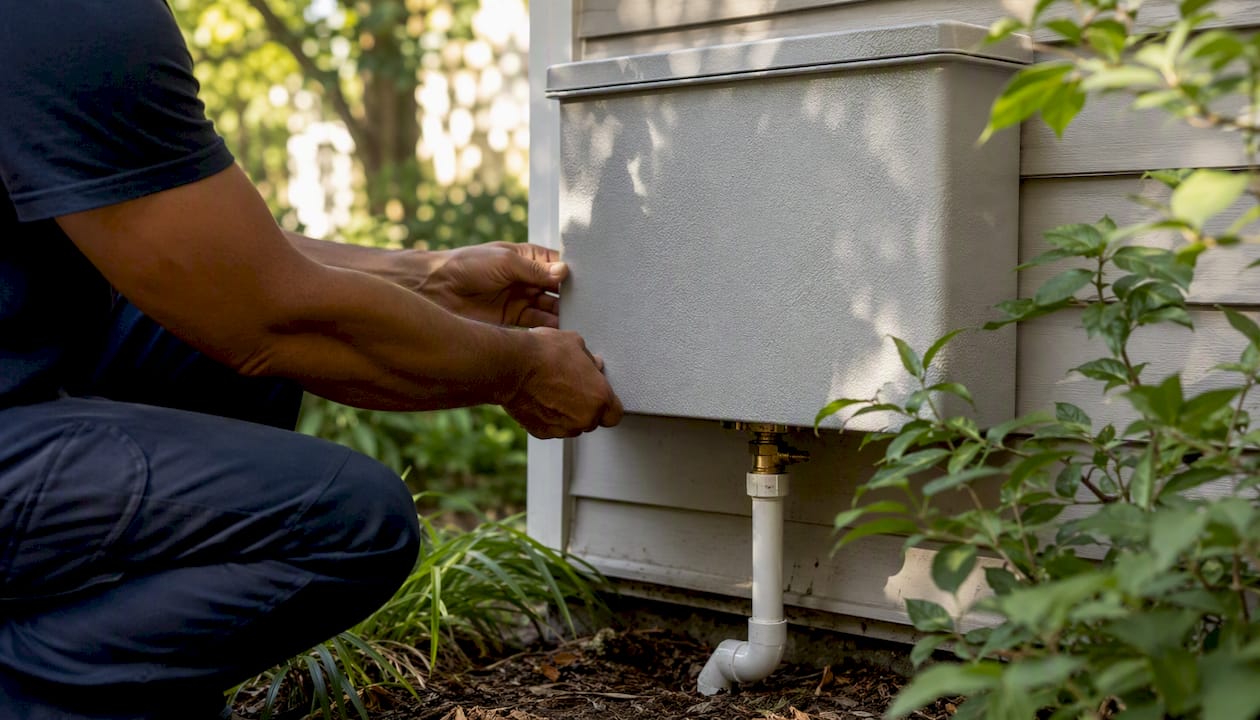
Above-ground installation inside a heated, insulated enclosure is the right call for most New Jersey properties. Manufacturers and facility managers increasingly favor this approach because it eliminates vault flooding, keeps the relief valve drain accessible, and makes annual testing faster and cheaper.
| Factor | Above-ground insulated enclosure | Underground vault |
|---|---|---|
| Testing access | Easy — tester walks up, attaches gauges | Confined space entry, often requires excavation or ladder |
| Freeze protection | Insulated enclosure + optional heat tape | Depth provides some protection, but drain lines can still freeze |
| Flood risk | Minimal | High — vaults fill with groundwater, corroding the device |
| Relief valve drain routing | Drain to grade, simple | Must slope to above-grade discharge; elevation rules apply |
| Long-term cost | Lower — faster service visits, easier repairs | Higher — vault repairs, pump-out costs, access labor |
Underground installations carry a specific code requirement worth knowing: the drain line from the relief valve must slope continuously to an above-grade discharge point, and the relief outlet cannot sit more than 12 inches below the vault rim. Get that wrong and you fail inspection. Above-ground installations sidestep the problem entirely.
Pro Tip: When selecting an enclosure, choose one rated for your climate zone and sized to allow a tester to attach differential pressure gauges without removing the device. A tight enclosure that forces partial disassembly adds time and cost to every annual test.
How to size and select the right RPZ for your system
Size to your peak flow rate and available residual pressure, then verify the device carries the right certifications for potable water contact. That is the short version. Here is what actually matters when you are talking to a contractor or reviewing quotes.
Key selection factors:
- Flow rate (gpm): The RPZ must handle your system’s peak demand without excessive pressure loss. Undersizing causes weak sprinkler coverage; oversizing wastes money and can cause velocity problems.
- Inlet/outlet size and lay length: Lay length is the face-to-face dimension between the inlet and outlet flanges. A shorter lay length reduces re-piping labor, especially on replacements. Discuss this with your contractor before ordering.
- Pressure rating: Verify the device’s maximum working pressure exceeds your supply pressure with a safety margin.
- Material: Lead-free brass or epoxy-coated cast iron for potable water contact. Verify compliance with NSF/ANSI/CAN 61 for drinking water system components.
- Certifications: Look for ASSE 1013 listing (the standard for RPZ assemblies) and NSF/ANSI/CAN 61 certification. These appear on the product data sheet and are what inspectors check.
For product examples: the Caleffi FlowShield RP (model 5751) is an RPZ assembly engineered for high-hazard applications, with an epoxy-coated cast iron body, top-entry service access, and NSF/ANSI/CAN 61 certification. The Caleffi FlowShield DC is the double-check family — appropriate for lower-hazard applications but generally not sufficient for irrigation. Common manufacturer families installed across U.S. residential and commercial properties include Wilkins (Zurn), Watts, and Febco. All produce ASSE 1013-listed assemblies in a range of sizes.
A short checklist to bring to your contractor conversation:
- Confirm lay length compatibility with existing pipe spacing
- Verify access clearance for test gauge attachment on all four test cocks
- Confirm drain routing path and discharge point location
- Ask about freeze protection options (enclosure type, heat tape compatibility)
- Request the product data sheet and certification listings before ordering
What does a sprinkler RPZ cost to install and test?
Costs vary by device size, site conditions, and local labor rates. The ranges below are broad estimates for planning purposes — get written quotes before committing.
These figures reflect typical U.S. market pricing. New Jersey labor rates, permit fees, and enclosure costs can push totals higher, particularly for commercial properties or sites requiring significant re-piping.
Timeline expectations:
- Device ordering: 1–5 business days for standard sizes; longer for large-diameter commercial units
- Installation: typically one day for a straightforward residential installation
- Annual test appointment: 30–60 minutes onsite for a standard residential RPZ
- Permit and inspection scheduling: varies by municipality, often 1–3 weeks
One factor that consistently pushes costs up: difficult access. A device installed in a cramped mechanical room, a deep vault, or behind finished walls costs more to test and repair every year. Factor that into your installation decision now.
Annual testing — what happens, who does it, and what paperwork you get
Most U.S. jurisdictions require annual testing by a licensed or certified backflow tester, with results filed directly with the water authority. Skipping a test is not a minor oversight — failure to provide proof of annual certification can result in penalties or water service disconnection.
Here is what a certified tester does during a standard visit:
- Isolate the device by closing the upstream shutoff valve and confirming downstream pressure drops.
- Attach differential pressure gauges to the test cocks — the specific gauges and kit matter; see professional test kit standards for what certified testers use.
- Test the first check valve by measuring the pressure differential it holds under static conditions.
- Test the relief valve by slowly bleeding downstream pressure and confirming the relief opens at the correct differential (typically 2 psi above the zone pressure).
- Test the second check valve for tight shutoff.
- Record all gauge readings on the official test form — pass or fail for each component.
- Perform repairs or rebuild if any component fails, then retest.
- File the completed test report with the water authority, either electronically or by mail.
What to keep for your records: a signed copy of the test form showing the device make, model, serial number, all gauge readings, the tester’s name and license number, the test date, and the water authority filing reference. Municipal programs like San Diego’s publish the exact fields their forms require — your local program will have similar requirements.
Credentials to require from any tester you hire:
- A state-issued backflow tester license or BPAT (Backflow Prevention Assembly Tester) certification from an accredited program
- Proof of general liability insurance
- Confirmation that they file test results directly with your water authority — not just hand you a form to submit yourself
Annual testing also catches worn seals and failing check valves before they cause a contamination event or require full device replacement, which makes it a cost-avoidance measure as much as a compliance requirement.
Warning signs and what to do before the technician arrives
The most common signals that something is wrong with your RPZ:
- Water dripping or flowing continuously from the relief port
- Sprinkler zones running at noticeably lower pressure than normal
- Visible water staining or corrosion on the device body or enclosure floor
- A cracked or split body after a hard freeze
- A failed annual test notice from your water authority
Short-term actions that are safe to take yourself:
- Close the upstream shutoff valve on the RPZ to stop irrigation supply if you see a major leak or cracked body
- Do not attempt to plug or cap the relief valve discharge — that defeats the device’s safety function
- Do not disassemble check valves or attempt DIY seat replacements; improper reassembly can create a cross-connection rather than prevent one
- Keep the area around the device clear so the technician can work without moving equipment
Pro Tip: If your relief valve has been discharging intermittently, note the dates, duration, and approximate flow volume before the technician arrives. That information helps diagnose whether the issue is a worn check seat, a pressure surge problem, or a device that has reached end of life.
What a certified service visit actually looks like
A professional backflow test and service visit follows a documented sequence, and you should expect a paper trail at the end of it.
- Pre-visit inspection: The technician checks device accessibility, confirms the make/model and serial number match your records, and photographs the installation.
- Isolation and gauge attachment: Upstream shutoff closes; differential pressure gauges attach to all four test cocks.
- Component testing: Each check valve and the relief valve are tested individually against pass/fail thresholds. For an RPZ, the relief valve must open at a differential no less than 2 psi; each check valve must hold a specified minimum differential.
- Repair or rebuild if needed: Failed components are replaced onsite when parts are available. The device is retested after any repair before the tester records a pass.
- Test form completion: The tester records device information, all gauge readings, pass/fail results, repair notes, their license number, and the date.
- Filing with the municipality: A compliant tester files results directly with your water authority — either through an electronic portal or by mailing the completed form. You receive a copy.
The test form fields you should see on your copy: device manufacturer and model, serial number, installation address, test gauge serial number and calibration date, individual readings for each check valve and the relief valve, overall pass/fail, tester name and license number, test date, and the water authority’s filing reference or confirmation number.
Before hiring any tester, ask two questions: What is your state backflow tester license number? And do you file results directly with my water authority, or do I need to submit the form? A tester who cannot answer both clearly is not the right choice.
A practitioner’s note on installation pitfalls
The installation decision that causes the most long-term grief is choosing an underground vault to keep the device out of sight. Vaults flood, corrode devices faster, and turn a 45-minute annual test into a two-hour job involving a ladder, a pump, and a confined-space checklist. The hidden cost of that choice compounds every year.
The second most common mistake is ignoring lay length when ordering a replacement device. A few inches of difference between the old and new device means re-piping the inlet and outlet connections, which adds labor and sometimes requires a permit amendment. Choosing a replacement with a matching or shorter lay length — a spec clearly listed on manufacturer data sheets — can save a property owner several hundred dollars per replacement cycle. Top-entry RPZ designs, like those found in several current manufacturer families, also reduce service time because the technician can access internal components without removing the device from the line.
Southjerseybackflow handles your RPZ testing, repairs, and enclosures in New Jersey
Staying compliant with your water authority’s backflow requirements does not have to be a recurring headache. Southjerseybackflow provides annual RPZ testing and certification, emergency repairs, full device rebuilds, enclosure installation, and direct filing of test results with New Jersey water authorities — so you never have to track down a form or wonder whether your paperwork was received.
Services cover residential, commercial, and multi-unit properties across New Jersey, including Ocean County, Mercer County, Gloucester County, and many other counties statewide. When you reach out, have your device make and model, your water meter location, and a photo of the current installation ready — it speeds up the estimate and the scheduling process considerably.
To book a test, request a repair quote, or ask about enclosure installation, visit Southjerseybackflow or review the full New Jersey backflow compliance guide to understand exactly what your municipality requires before your next test deadline.
What’s the practitioner’s take on RPZ requirements?
Most property owners treat their RPZ as a nuisance — something the water company makes them install and test every year for reasons that feel abstract. That framing is understandable, but it misses what the device is actually doing.
An irrigation system is a direct pathway from your soil to your drinking water supply. Fertilizers, pesticides, pet waste, and stagnant water sitting in underground pipes can all travel that path if pressure conditions are right. The RPZ is not bureaucratic box-checking; it is the one mechanical barrier standing between your sprinkler heads and your kitchen faucet. The EPA’s backflow technical guidance documents real contamination events that resulted from failed or absent backflow protection — these are not theoretical scenarios.
Where I think the conventional wisdom goes wrong is in treating annual testing as a compliance chore rather than a diagnostic tool. A test that catches a worn check valve seat costs a fraction of what a full device replacement costs. More importantly, it catches the failure before it becomes a contamination event. The property owners who get the most value from their RPZ are the ones who schedule their annual test before irrigation season starts, not after the water authority sends a notice.
Sources
- What Is A Reduced Pressure Zone Valve? And Everything Else You Need To Know. | Sprinkler School
- Zurn 975XL2 product page
- EPA cross-connection/backflow technical paper
- San Diego Public Utilities: Backflow prevention
Pingback: Supermarket Backflow in NJ: Quarterly Tests, Refrigeration and RPZs