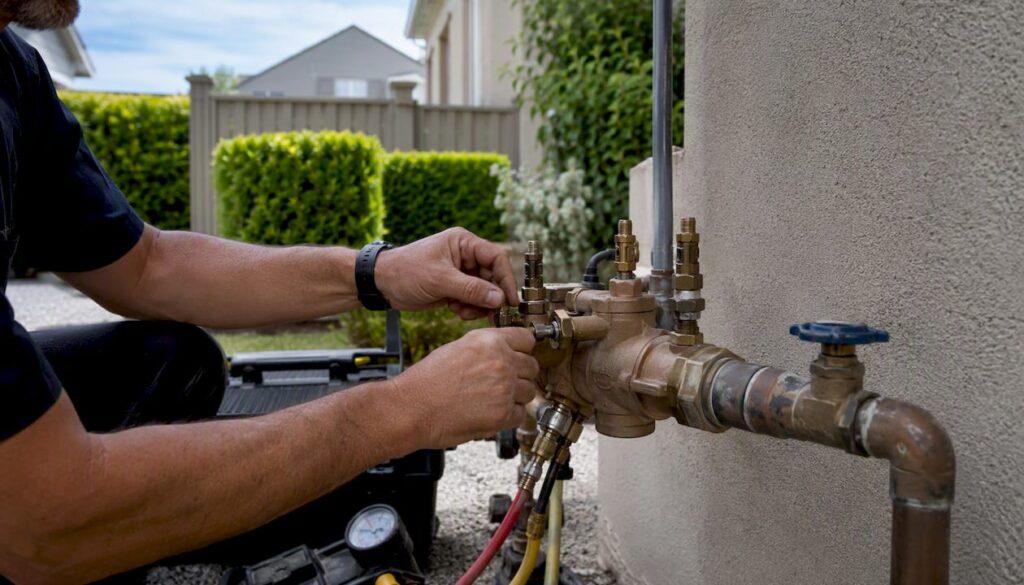
Annual certified backflow testing, a complete test report filed with your water authority, and a current Certificate of Insurance (COI) naming the Authority Having Jurisdiction (AHJ) as additional insured are the three non-negotiable pillars of backflow insurance compliance. The EPA’s Safe Drinking Water Act establishes the federal framework that drives every state and local cross-connection control program, and the CDC identifies waterborne contamination prevention as a public-health priority. Missing any one of these pillars can void a claim, trigger a fine, or get your water shut off.
Your immediate action checklist:
- Schedule a certified backflow tester before your AHJ deadline (most jurisdictions set an annual window)
- Collect the tester’s state or municipal certification number and a current COI before the appointment
- Confirm the COI names your water authority or municipality as additional insured
- Receive the completed test report with device make, model, serial number, test readings, and tester credentials
- File the report with your AHJ (portal, email, or mail per local rules) and retain proof of submission
- Notify your property insurer at renewal or after any repair that required retesting
Key Takeaways
Backflow insurance compliance requires annual certified testing, complete filed documentation, and a current COI naming your AHJ as additional insured — missing any one element can result in claim denial, fines, or water shutoff.
| Point | Details |
|---|---|
| Test annually and after trigger events | Schedule certified testing every year and immediately after installation, repair, or relocation of any device. |
| Verify tester credentials and COI | Confirm certification number, gauge calibration date, and a COI naming your water authority as additional insured before the appointment. |
| Retain reports and submission proof | Keep test reports, gauge calibration certificates, and AHJ filing confirmations for at least five years, backed up digitally. |
| Notify your insurer proactively | Provide current test reports at renewal and after any repair requiring retesting to protect coverage eligibility. |
| Southjerseybackflow handles NJ filing | Southjerseybackflow files test reports directly with New Jersey water authorities and delivers COI documentation as part of its standard service. |
Table of Contents
- Who is legally responsible for backflow testing and compliance?
- How often does backflow testing actually need to happen?
- What credentials and insurance must you require from a backflow tester?
- How does skipping tests or losing documentation affect your insurance?
- What does a compliant test report look like, and how do you file it?
- How to stay compliant: a practical playbook for property owners
- Why documentation is the real product of a backflow test
- Southjerseybackflow makes compliance straightforward for NJ property owners
- Sources
Who is legally responsible for backflow testing and compliance?
The short answer: the property owner or managing agent. Utilities enforce compliance at the point of connection, but the obligation to test, repair, and file belongs to whoever owns or controls the premises. That responsibility does not automatically transfer to tenants, even when a tenant installed the device.
The property type shapes the details. For a multi-tenant retail strip, the landlord typically holds the obligation for shared service lines and fire-line assemblies, while individual tenants may bear responsibility for devices serving only their leased space, depending on the lease language. Apartment buildings follow a similar split: the owner is responsible for building-wide assemblies (irrigation, boiler makeup, fire suppression), and the utility enforces at the meter. Single-family homes with irrigation systems or auxiliary water sources are increasingly subject to local cross-connection ordinances, and the homeowner is the named responsible party.
A few situations genuinely shift responsibility. When a municipality leases a meter or installs a device under a service agreement, the agreement itself defines who tests and files. Tenant-installed irrigation on a commercial property can create shared liability if the lease is silent on the point. Review your lease and service agreements before assuming the obligation sits elsewhere. For a clear picture of how NJ municipal ordinances assign owner obligations, the variation across counties matters more than most owners expect.
Utilities enforce through shutoff authority and fines. Insurers enforce through claim denials and underwriting conditions. Both use the same evidence: your filed test report and COI. The Hendrickson Insurance overview of backflow compliance for retail properties puts it plainly: missed certifications expose property owners to fines, tenant disruption, and coverage friction simultaneously.
How often does backflow testing actually need to happen?
Annual testing is the baseline in most U.S. jurisdictions. Beyond that calendar requirement, specific events trigger immediate retesting regardless of when the last annual test occurred.
- On installation. Every new backflow assembly must be tested before it enters service.
- After any repair or rebuild. A repaired device is treated as unverified until a passing test is on file.
- After relocation. Moving a device to a new location resets its compliance clock.
- At the scheduled annual window. Most AHJs set a specific window, often tied to the installation anniversary or a municipal program calendar. Missing the window by even a few weeks can trigger a notice of violation.
- After a failed test. A device that fails must be repaired and retested before the AHJ considers it compliant. The retest report is a separate filing.
- At high-hazard sites or on fire-line assemblies. Some jurisdictions require semi-annual testing for connections to chemical processes, medical facilities, or high-hazard industrial lines. Fire-line assemblies often carry additional licensing and insurance requirements for testers, and some states restrict who may perform those tests.
To find your local rules, check your water authority’s website for a cross-connection control program page, look for the notice letter your utility mailed when the device was registered, or call the utility’s backflow program coordinator directly. The NYC DEP’s backflow FAQ and Seattle Public Utilities’ testing page are good examples of how large AHJs publish their calendars and requirements online.
Pro Tip: Schedule your annual test at least six weeks before the AHJ deadline. That buffer gives you time to repair a failed device, get it retested, and still file before the window closes without paying rush fees.
What credentials and insurance must you require from a backflow tester?
Hiring an uncertified tester is the single fastest way to produce a test report that neither your AHJ nor your insurer will accept. Before anyone touches your device, verify three things: their certification, their insurance, and their gauge calibration.
Tester credentials to verify
| Credential | What to ask for | Why it matters |
|---|---|---|
| State or municipal backflow tester certification | Certificate number and expiration date | AHJs reject reports signed by uncertified testers |
| Fire-line specific qualification | Separate endorsement or contractor license | Required in many states for fire-suppression assemblies |
| Gauge calibration certificate | NIST-traceable calibration date (within 12 months) | An uncalibrated gauge can produce readings that fail audit |
The AWWA’s cross-connection control resources define industry-standard testing procedures and gauge-calibration expectations. A tester who cannot produce a current calibration certificate is a red flag, not a minor paperwork gap. Insurers commonly question passing readings when calibration proof is absent during a claim review. For more on what NJ certification actually requires, this breakdown of certified backflow tester qualifications covers the state-specific details.
What a compliant COI must show
- General Liability coverage with limits appropriate to your property type (commercial properties often require $1 million per occurrence minimum, though your insurer or AHJ may specify higher)
- Additional Insured endorsement naming your water authority or municipality. The City of Lincoln’s annual tester requirements are a concrete example: they require the COI to name the City of Lincoln and/or Lincoln Water Systems as additional insured under general liability. Many AHJs use identical or similar language.
- Effective dates that cover the date of service
- Professional/Errors & Omissions coverage where the tester performs diagnostic or repair work beyond a pass/fail test
Document checklist before the tester arrives:
- Tester’s certification number and expiration date
- Current COI with additional insured endorsement
- Gauge calibration certificate (NIST-traceable, dated within the past 12 months)
- Proof of any fire-line specific license if applicable
Ask the tester directly: “Will you file the report with the AHJ, or is that my responsibility?” The answer changes your post-test workflow significantly.
How does skipping tests or losing documentation affect your insurance?
Insurers draw a hard line between losses that are “sudden and accidental” and losses that result from deferred maintenance. Backflow failures almost always fall into the second category when there is no test record on file, and that distinction is what drives claim denials.
A contamination event traced to a failed or untested backflow assembly will prompt your insurer to ask for test records immediately. If those records are missing, incomplete, or show a device that failed its last test and was never repaired, the insurer has grounds to deny or substantially reduce the claim. The same logic applies to water damage caused by a failed assembly and to business interruption losses downstream of a contamination event.
Common insurer responses to non-compliance:
- Outright claim denial on the grounds of failure to maintain required safety systems
- Partial payment with a deduction for the portion of loss attributable to deferred maintenance
- Premium surcharge at renewal, sometimes with a compliance certification requirement attached
- Narrower renewal terms, such as a backflow-specific exclusion until proof of testing is provided
- Underwriting questionnaires asking for test dates, device counts, and tester credentials
The Atlas Backflow documentation overview makes the point precisely: documentation proves a device passed, ties the tester to the device, and supports both underwriting and claims eligibility. An unfiled report is treated the same as no test at all.
Beyond insurance, non-compliance carries regulatory consequences. Utilities can issue notices of violation, assess fines, and ultimately shut off water service. For a commercial property, a water shutoff is a business interruption event in itself, often uninsured when the shutoff stems from the owner’s own compliance failure.
Pro Tip: Keep a digital folder for each device containing the last three years of test reports, the tester’s COI for each year, and gauge calibration certificates. When a claim or renewal review arrives, you can produce the full chain in minutes rather than days.
What does a compliant test report look like, and how do you file it?
A test report that satisfies both your AHJ and your insurer is not a one-page form with a checkmark. It is a specific document with device-level detail that creates an auditable record.
Required fields in a compliant test report
| Field | What it must contain |
|---|---|
| Device identification | Make, model, serial number, size, and installation location |
| Line conditions | Inlet pressure, outlet pressure, and differential readings |
| Test results | Pass or fail for each test point; specific readings, not just a conclusion |
| Repairs performed | Description of any parts replaced or adjustments made during the visit |
| Tester information | Full name, certification number, and issuing authority |
| Gauge calibration | Calibration date and NIST-traceable certificate reference |
| Test date | Date the test was performed (not the filing date) |
| Unique report ID | Report or job number for cross-referencing with AHJ records |
Seattle Public Utilities and Philadelphia Water Department both publish their accepted report formats online, and the required fields are nearly identical across major AHJs. If your tester’s report is missing any of these fields, ask for a corrected version before filing.
How to file and what to keep
- Identify your AHJ’s preferred submission method: most large utilities now use an online portal; smaller municipalities may still accept email or mailed forms.
- Submit within the deadline stated in your compliance notice or program calendar.
- Save the portal receipt, email confirmation, or stamped copy as proof of submission. A missing submission receipt is frequently treated by underwriters and municipal inspectors as non-submission.
- Retain all test reports and submission receipts for a minimum of five years. Many insurers request records going back three to five years during a claim review, and some AHJs have their own retention requirements.
- Back up digitally: a PDF copy in cloud storage (Google Drive, Dropbox, or a property management platform) alongside the physical file eliminates the risk of a single-point loss.
For step-by-step guidance on inspection report filing for NJ properties, the process maps directly onto what most New Jersey water authorities expect.
How to stay compliant: a practical playbook for property owners
Compliance is a calendar problem as much as a paperwork problem. The owners who get notices of violation are rarely the ones who forgot what backflow is. They are the ones who let scheduling slip until the deadline passed.
- Inventory every device. Walk the property or pull permit records and list every backflow assembly by location, device type, and serial number. Commercial properties often have more devices than the owner realizes.
- Confirm due dates. Check your water authority’s program calendar or your last compliance notice for the testing window. Add the deadline to your property management calendar with a six-week lead reminder.
- Schedule a certified tester. Book before the reminder fires, not after. Certified testers get booked out during peak compliance windows.
- Verify COI and gauge calibration before the appointment. Do not wait until the tester is on-site to discover the COI expired or the gauge calibration is 14 months old.
- Receive the test report and review it. Check that all required fields are present before the tester leaves. A corrected report takes days; a missing field discovered during a claim takes weeks.
- File with the AHJ and save proof. Submit through the required channel and download or print the confirmation.
- Notify your insurer. At renewal, provide the current test report and COI. After any repair that required retesting, send the updated report proactively.
- Repeat annually and after any trigger event (repair, relocation, installation).
For commercial properties managing multiple devices across multiple locations, a commercial backflow maintenance workflow that assigns each step to a named staff member or vendor prevents the “I thought you handled it” gap.
Questions to ask your tester before booking:
- What is your certification number, and which authority issued it?
- Can you provide a current COI with our water authority named as additional insured?
- When was your test gauge last calibrated, and can you provide the certificate?
- Will you file the report directly with the AHJ, or do I need to submit it?
- What is your retest policy and turnaround time if the device fails?
Red flags that mean pause and escalate: no COI, no gauge calibration certificate, refusal to file with the AHJ, or a report that arrives without device serial numbers or specific test readings.
Pro Tip: Build a simple compliance spreadsheet with one row per device: location, serial number, last test date, next due date, tester name, and filing confirmation number. It takes 20 minutes to set up and saves hours when an insurer or AHJ asks for records.
New Jersey filing notes from Southjerseybackflow
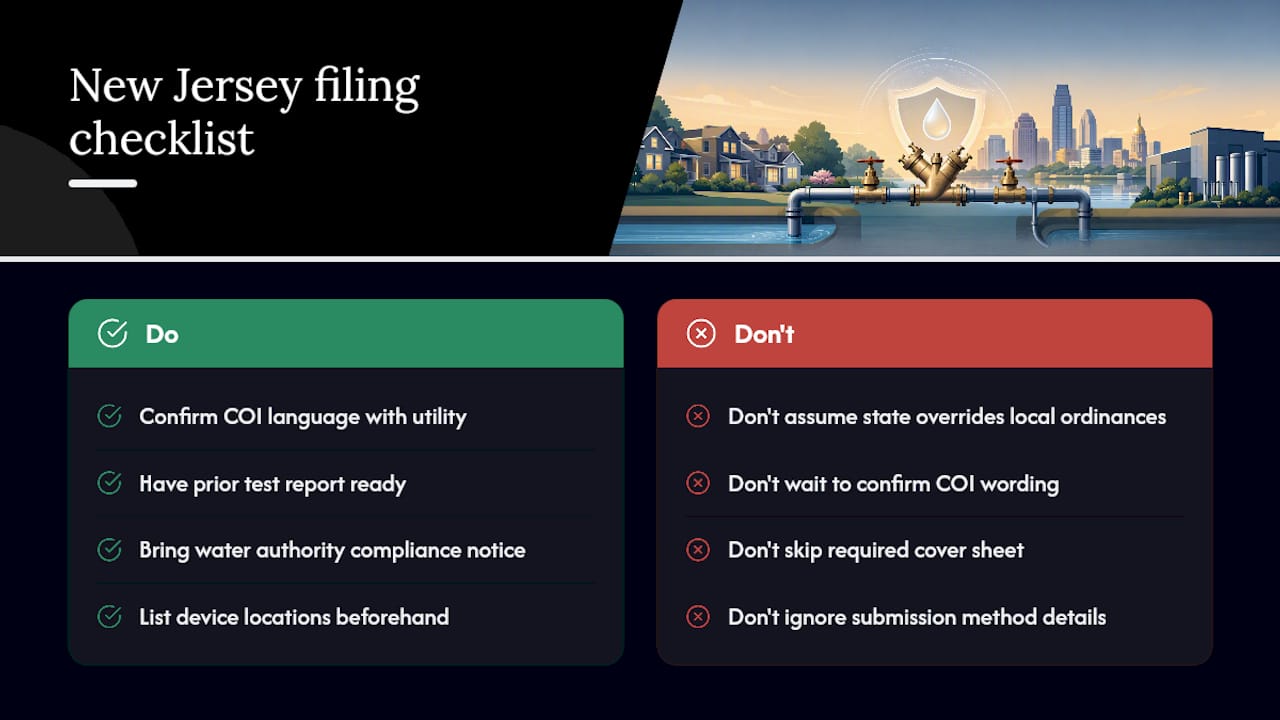
New Jersey water authorities vary in how they accept test reports. Some county and municipal utilities use online portals; others still require mailed or emailed forms with a specific cover sheet. COI phrasing requests also vary: some utilities ask to be named as additional insured, others request certificate holder status. Confirming the exact language your local utility requires before the tester generates the COI prevents a reissuance delay.
Southjerseybackflow handles direct filing with New Jersey water authorities as part of its standard service, which removes the submission step from the property owner’s plate entirely. For retests after a failed device, the company coordinates the repair and retest scheduling so the compliance window stays intact. Before the tester arrives, have your prior test report, the water authority’s compliance notice, and a list of device locations ready. That preparation cuts on-site time and eliminates billing surprises for additional site visits.
For properties operating under NJ backflow codes, the local ordinance layer matters as much as state-level rules, and it changes by municipality.
Pro Tip: If you received a compliance notice from your New Jersey water authority, the notice itself usually contains the filing deadline, the required form number, and the submission address or portal URL. Keep it with your device inventory until the filing confirmation arrives.
Why documentation is the real product of a backflow test
Most property owners think the point of a backflow test is to find out whether the device works. That is true, but it is the secondary benefit. The primary product of a compliant test is a defensible paper trail.

An insurer evaluating a contamination claim does not care whether your device was working last year. They care whether you can prove it was tested, by whom, with what equipment, and that the result was filed with the authority that enforces your water safety program. A passing test with no filed report is, from the insurer’s perspective, indistinguishable from no test at all. That is not a technicality. It is how underwriting actually works.
Property managers who treat compliance as a checkbox often discover this distinction at the worst possible moment: during a claim. The ones who treat it as a documentation system discover it during a renewal conversation, where a clean record translates directly into smoother underwriting and fewer questions. The difference in outcomes is not subtle.
Southjerseybackflow makes compliance straightforward for NJ property owners
Staying current on backflow testing, filing, and COI requirements takes coordination across testers, water authorities, and insurers. Southjerseybackflow handles that coordination as a single-source service for residential, commercial, and multi-unit properties across New Jersey.
The service covers annual testing and certification, repairs and rebuilds, direct filing of test reports with New Jersey water authorities, and COI delivery for your records. Multi-property managers get consolidated billing and a single point of contact for scheduling across locations. If you received a compliance notice from your utility, the response steps are straightforward when you have a certified tester handling the filing. To schedule testing or request a compliance review for your New Jersey property, visit Southjerseybackflow.
Sources
This article is general information, not a substitute for advice from a qualified lawyer. Consult a qualified legal professional about your own circumstances before acting on anything here.
Pingback: 5 Step HOA Backflow Compliance Checklist To Avoid Fines And Shutoffs