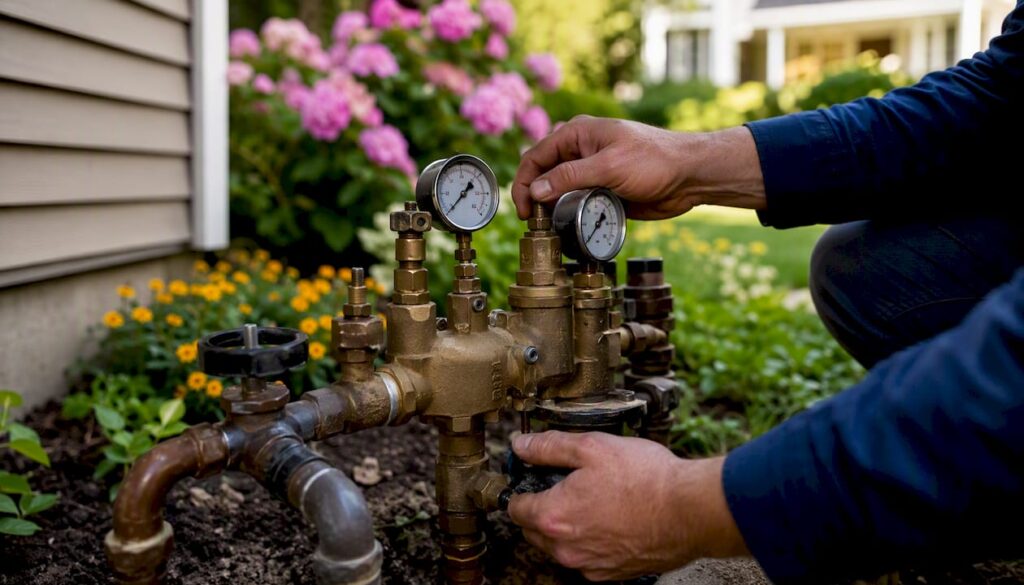
Hire a certified backflow tester who is accepted by your local water purveyor and who files test reports directly with the authority having jurisdiction (AHJ). That single decision covers most of what annual compliance requires. Before you schedule anything, run through these four steps:
- Inventory every device on the property: note the assembly type (RPZ, DCVA, PVB, or fire-line), location, serial number, and the account it’s tied to.
- Confirm certification and acceptance: ask for the tester’s certification number, the issuing program, and written proof that your local water authority accepts their reports.
- Schedule within your local testing window: most New Jersey AHJs set annual deadlines; book 6–8 weeks ahead to avoid the end-of-season crunch.
- Pre-authorize minor repairs: give the tester written permission to replace seats, springs, or O-rings on the spot. One visit instead of two saves time and money.
IAPMO BPI sets the industry standard for testing frequency and professional training. Your local AHJ sets the filing rules. Southjerseybackflow handles both sides for New Jersey properties.
Key Takeaways
Hiring a certified, AHJ-accepted tester who files reports directly with your water authority is the single most effective step a property manager can take to stay compliant and avoid fines.
| Point | Details |
|---|---|
| Hire an accepted, certified tester | Confirm certification number, AHJ acceptance, and gauge calibration before booking anyone. |
| Inventory every device first | Log assembly type, location, serial number, and account for each device before scheduling. |
| File both failed and passing reports | A failed test requires a repair, retest, and confirmed filing of both results with the AHJ. |
| Pre-authorize minor repairs | Written repair authorization prevents a second visit for small parts like seats and springs. |
| Southjerseybackflow for NJ portfolios | Handles testing, repair, rebuilding, and direct AHJ filing for multifamily and commercial properties across New Jersey. |
Table of Contents
- Why annual backflow testing falls on property managers
- What backflow assembly types will you find on your property?
- What does a full annual testing workflow look like?
- How do you verify a certified backflow tester is the real deal?
- What should you budget for backflow testing?
- What happens when a backflow assembly fails?
- Multifamily properties need a different approach to compliance
- What most property managers get wrong about backflow compliance
- Southjerseybackflow makes portfolio compliance straightforward
- Sources
Why annual backflow testing falls on property managers
Legally, the property owner is on the hook. In practice, the property manager schedules the tests, coordinates access, and makes sure reports reach the water authority on time. That split is worth understanding clearly, because the consequences of a missed test land on whoever controls the calendar.
The legal and operational drivers:
- AHJs require annual testing as a condition of water service; non-compliance can trigger fines or water shutoff.
- The account holder of record is liable for backflow events that contaminate the public supply.
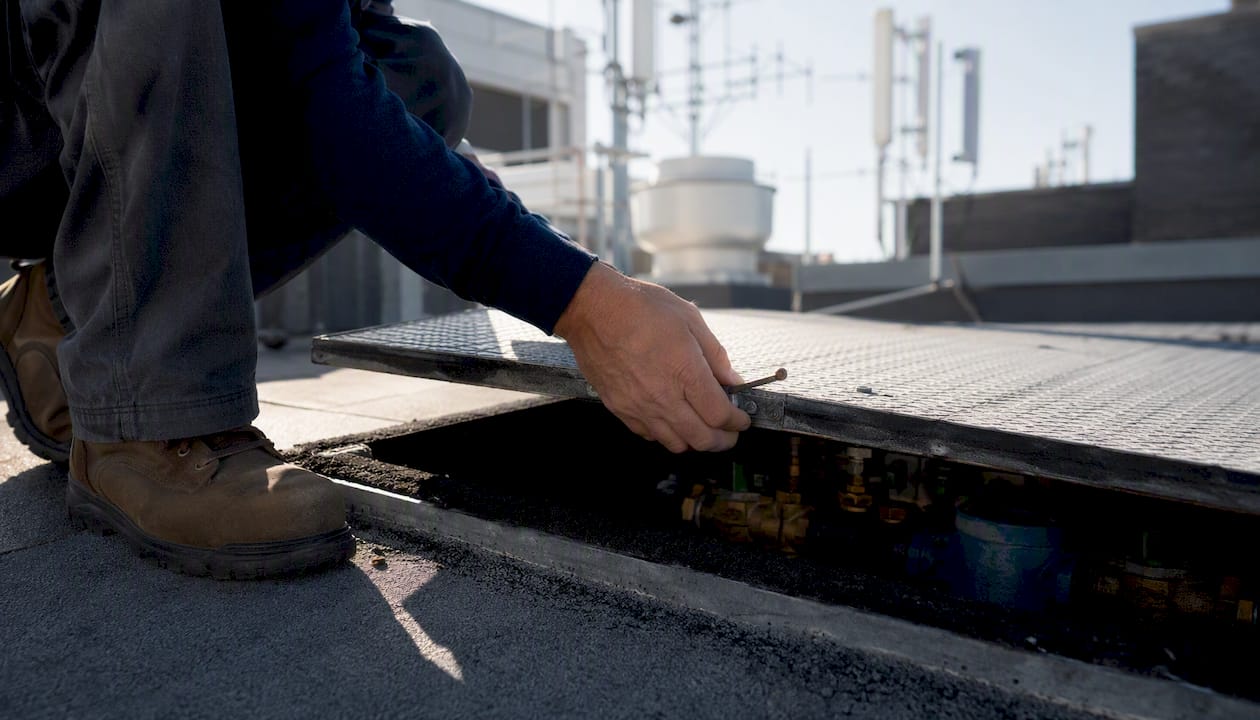
- Tenants control access to mechanical rooms, irrigation shutoffs, and rooftop vaults, so coordination is a manager’s job, not an owner’s.
- Multi-unit properties often carry multiple water accounts, each with its own testing obligation.
Regular testing and organized recordkeeping reduce the risk of fines and service interruptions while protecting water safety. Missing a single annual test can put a property in violation, and some utilities move quickly from notice to shutoff. IAPMO BPI stresses consistent enforcement and professional training as the backbone of any compliant program, which is why the tester’s credentials matter as much as the test itself.
What backflow assembly types will you find on your property?
Most multifamily and commercial properties carry at least two or three different assembly types, and each one has different testing complexity and repair likelihood.
The four types you’ll encounter most often:
- RPZ (Reduced Pressure Zone assembly): The most protective and the most complex. Required on high-hazard connections like boilers, irrigation with fertilizer injection, and commercial kitchens. RPZs have a relief valve that can discharge water if pressure differentials shift, so they need experienced testers and are the most likely to require parts during a test.
- DCVA (Double Check Valve Assembly): Common on low-to-moderate hazard connections, including fire suppression systems in some jurisdictions. Simpler than an RPZ but still requires a certified tester.
- PVB (Pressure Vacuum Breaker): Typically found on outdoor irrigation lines. Straightforward to test but must be installed above the highest downstream outlet, and they fail more often in cold climates if not winterized.
- Fire-line assemblies: Dedicated to fire suppression systems. Testing these requires coordination with the fire marshal and, in some cases, a separate certification. Never lump them into a standard irrigation route without confirming the tester is qualified.
Device tags are your fastest inventory tool. Look for a metal tag or stamped plate on the assembly body listing the manufacturer, model, and serial number. Photograph it. That data goes into your device log and onto every test report.
Pro Tip: RPZs and fire-line assemblies are where inexperienced testers cause the most problems. Ask specifically whether the tester has tested those assembly types at multifamily properties before booking.
What does a full annual testing workflow look like?
Follow a predictable cycle: inventory, verify tester acceptance, schedule, confirm access, test, file, and archive. Running this the same way every year is what keeps a portfolio clean.
Step-by-step workflow:
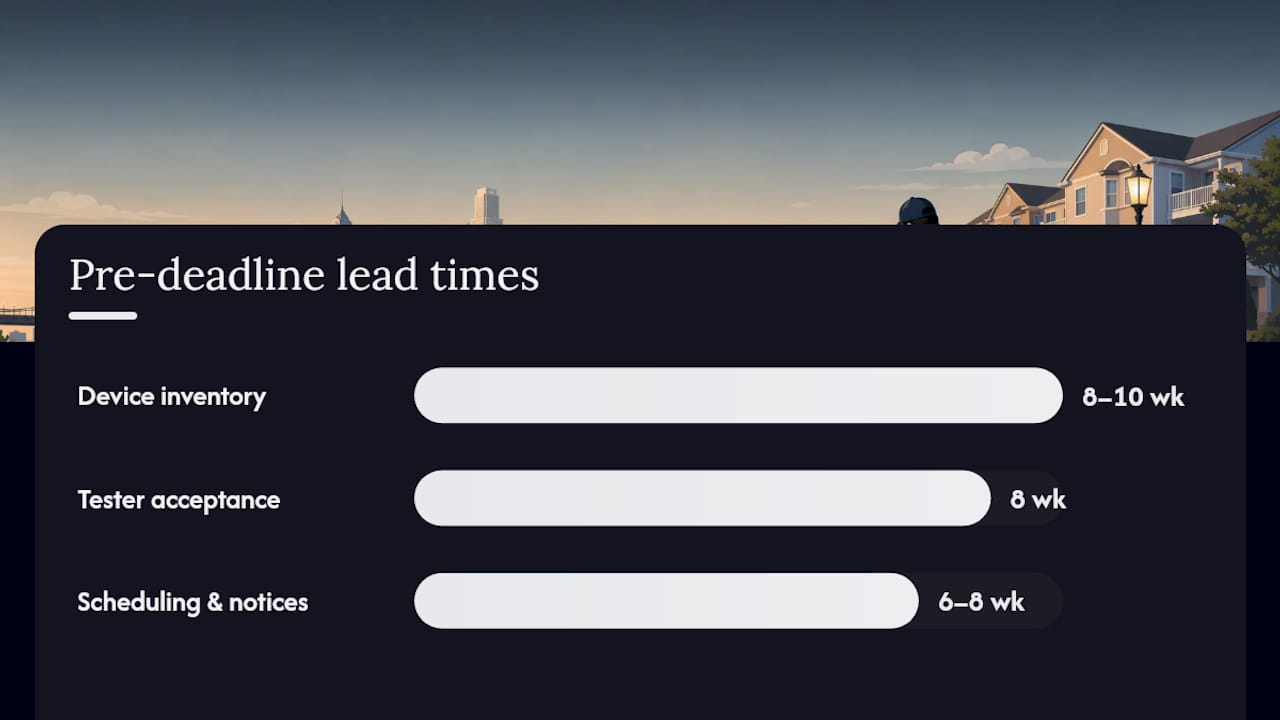
- Pull your device inventory (8–10 weeks before the local deadline): confirm every assembly’s type, location, account number, and last test date. Flag any that were repaired or relocated since the last cycle, since those require testing regardless of the annual window.
- Verify tester acceptance (8 weeks out): contact your AHJ or check their website for an accepted-tester list. Confirm the tester you plan to use is on it. Some AHJs update these lists quarterly.
- Schedule and send access notices (6–8 weeks out): book the testing date, notify tenants in writing, and identify who will escort the tester to locked or restricted areas (mechanical rooms, rooftop vaults, fire riser rooms).
- Day of testing: walk the tester through the property, confirm each device against your inventory list, and stay available for repair decisions. Pre-authorized minor repairs get handled on the spot.
- Review the test report (same day or next business day): check that every device is listed with its serial number, model, assembly type, test result, and tester certification number.
- Confirm filing (within 1–3 business days): get written confirmation that the tester submitted the report to the AHJ. Some utilities accept electronic filing; others require paper. Know which yours requires before test day.
- Archive everything: store the signed test report, any repair invoices, and the filing confirmation in a dedicated folder per property. Keep records for at least three years, or longer if your AHJ requires it.
A commercial backflow maintenance workflow built around route planning cuts repeat visits and keeps filing timelines on track across a portfolio. For New Jersey properties specifically, Southjerseybackflow’s compliance guide walks through local filing formats and what each AHJ typically expects in a submission.
| Workflow Stage | Timing | Key Output |
|---|---|---|
| Device inventory | 8–10 weeks before deadline | Updated device log |
| Tester acceptance check | 8 weeks before deadline | Confirmed AHJ acceptance |
| Scheduling and access notices | 6–8 weeks before deadline | Confirmed test date, tenant notices |
| Testing day | On scheduled date | Completed test report |
| Filing confirmation | Within 1–3 business days | Written filing receipt |
| Archiving | Immediately after filing | Organized compliance folder |
How do you verify a certified backflow tester is the real deal?
Require four things before you book: current certification with a verifiable number, proof the AHJ accepts their reports, a calibration certificate for their test gauge dated within the last 12 months, and proof of liability insurance. Everything else is secondary.
Vetting checklist:
- Certification number and the issuing program (ASSE, ABPA, or state-specific programs accepted by your AHJ)
- Written or verifiable evidence that the local water authority accepts their test reports
- Calibration certificate for their differential pressure gauge, dated within 12 months
- Proof of general liability insurance (ask for a certificate of insurance naming your property)
- A sample completed test report showing device-level detail (serial, model, assembly type, result)
- At least two references from multifamily or commercial properties of similar size
Calibrated differential gauges and professional test kits are required for credible testing; many utilities expect calibration within the last 12 months. A tester who hesitates to share their calibration certificate is a tester to skip.
Six questions to ask before booking:
- “What is your certification number and which program issued it?”
- “Can you confirm that [name of water authority] accepts your test reports, and how do you file them?”
- “How quickly do I receive the signed test report after testing?”
- “What parts do you carry for on-site repairs, and what is your retest policy if a device fails?”
- “Do you have experience testing RPZs and fire-line assemblies at multifamily properties?”
- “Can you provide a sample completed test report before we schedule?”
A vendor selection checklist helps managers verify certification, filing processes, insurance, sample reporting, and multi-site experience in one pass.
Red flags to watch for:
- Reluctance or delay in providing a calibration certificate
- Vague answers about how or when they file with the AHJ
- A price that seems unusually low with no documentation offered
- Paperwork delivered days or weeks after testing
- No experience with multifamily properties or fire-line assemblies
Pro Tip: Ask for same-day PDF delivery of the test report and confirm the tester will tag each device entry with the serial number, model, and assembly type. Reports missing that detail are often rejected by utilities.
What should you budget for backflow testing?
Per-device test fees for standard backflow assemblies at commercial and multifamily properties vary depending on region, device type, and access complexity. Fire-line assemblies often carry a higher fee due to coordination requirements.
Factors that move the price:
- Device type (RPZs and fire-line assemblies cost more to test than DCVAs or PVBs)
- Number of devices (volume discounts are common for portfolios with five or more devices)
- Site accessibility (rooftop vaults, locked mechanical rooms, and after-hours access add cost)
- Repair parts needed on the day (seats, springs, O-rings are usually billed separately)
- Travel distance and route density
Choosing a provider who files results with local water authorities reduces manager workload and is worth paying a modest premium for. Portfolio route planning and consolidated billing materially reduce per-device costs for managers with multiple properties. Pre-authorizing small repairs up to a set dollar threshold (say, $75–$100 per device) eliminates the most common reason for a second visit.
Ask for a repair estimate before the tester starts any work beyond the test itself. A good tester will quote parts and labor before touching anything, not after.
What happens when a backflow assembly fails?
A failed test is not the end of the process. It is the start of a short, documented repair-and-retest sequence. The key is moving quickly, because most AHJs set a repair deadline, and a failed result that sits unresolved is a compliance violation.
Steps after a failed test:
- Get a written repair estimate from the tester on the same day, or within 24 hours.
- Prioritize fire-line assembly failures above all others. A failed fire-line assembly may require immediate notification to the fire marshal and the water authority.
- Authorize the repair. For minor failures (worn seats, failed springs), a qualified tester can often rebuild on the spot. Major failures may require a replacement assembly.
- Get an itemized invoice listing every part replaced, with model numbers and quantities.
- Schedule the retest. Most AHJs expect a retest within 30 days of the failed result, though some set tighter windows.
- Confirm the tester files both the failed test report and the passing retest report with the AHJ. Both documents matter for your compliance record.
If you received a notice from your water authority, Southjerseybackflow’s backflow letter guide explains exactly what the notice means and what to do next.
Recordkeeping after a failure:
- Failed test report (signed, with tester certification number)
- Repair invoice with itemized parts list
- Retest certificate showing a passing result
- Written filing confirmation from the tester
- Any correspondence with the AHJ about the timeline
Keep all four documents together in the property’s compliance folder. If an AHJ audits the account, showing a clean repair-and-retest trail is what demonstrates due diligence.
Multifamily properties need a different approach to compliance
A single-family home has one device and one account. A 40-unit apartment complex might have a dozen assemblies across irrigation, domestic water, fire suppression, and boiler connections, each tied to a different water account with its own testing obligation. That complexity is where most compliance gaps appear.
Annual compliance checklist for multifamily properties:
- [ ] Device inventory complete (type, location, serial number, account number for each assembly)
- [ ] All water accounts identified and matched to their associated devices
- [ ] Tester acceptance confirmed with each relevant AHJ (some properties span multiple jurisdictions)
- [ ] Tenant access notices sent in writing at least 5 business days before testing
- [ ] Escort arranged for locked areas (mechanical rooms, rooftop vaults, fire riser rooms)
- [ ] Minor repair pre-authorization issued in writing to the tester
- [ ] Test reports reviewed for completeness before filing
- [ ] Filing confirmation received for every account
- [ ] All documents archived by property and account
Pro Tip: Route all devices at a single property on the same day whenever possible. Splitting the work across multiple visits multiplies your access coordination effort and increases the chance of a missed device.
A few issues come up repeatedly at multifamily properties. Irrigation assemblies on rooftops or in locked vaults are frequently skipped because no one arranged access. Fire-line assemblies get lumped in with standard irrigation routes when they need separate scheduling. And when a lease assigns maintenance costs to the tenant, the property manager still owns the compliance obligation. The tenant pays; the manager files.
For NJ properties with multiple accounts and complex routing, building a consolidated testing schedule with a single tester who handles the full portfolio is the most reliable way to keep every account current.
What most property managers get wrong about backflow compliance
The certification checkbox gets most of the attention, and it should. But the filing step is where compliance actually breaks down. A tester can be fully certified, show up on time, and run a clean test, and still leave you out of compliance if their report never reaches the water authority in the format the AHJ requires.
Some utilities accept electronic filing through a web portal. Others want a paper form with original signatures. A few require the property owner to submit, not the tester. None of that is standardized nationally, and the AHJ’s website is not always clear about it. The only way to know is to call the water authority directly before you book anyone, confirm the accepted filing format, and then confirm with the tester that they have filed in that format before.
The second thing managers underestimate is the device inventory itself. Most properties have at least one assembly that nobody remembers is there. Irrigation assemblies installed during a landscaping project five years ago. A boiler feed connection in the basement that was never added to the account. A fire-line assembly that the previous manager thought was the fire department’s responsibility. Every untracked device is an unmet obligation. Walking the property with a plumber or a knowledgeable tester before the first annual cycle is worth the time.
Southjerseybackflow makes portfolio compliance straightforward
Annual backflow compliance across a New Jersey portfolio is manageable when you have a tester who handles the full cycle: testing, repair, and direct filing with your local water authority. Southjerseybackflow does exactly that for residential, commercial, and multifamily properties across New Jersey, including Ocean County, Mercer County, Middlesex County, and surrounding areas.
Services include backflow preventer testing, repair, rebuilding, enclosure installation, emergency response, and direct report filing with New Jersey water authorities. Consolidated billing is available for managers with multiple properties, and the team carries parts for on-site repairs to avoid repeat visits. Before you book, request a sample test report and proof of current gauge calibration. Then schedule your portfolio route or contact Southjerseybackflow directly at Southjerseybackflow to get a quote.
Sources
Property managers should verify AHJ requirements directly rather than relying on a tester’s description of them. Rules on accepted filing formats, testing windows, and accepted tester lists change, and the water authority’s own page is the authoritative source.
Where to check:
- Why Do I Need to Have Backflow Prevention Installed, Tested, and Maintained in 2026? | IAPMO BPI
- Findbackflowtesters
When you pull up an AHJ page, look for three things: the list of accepted testers (or the accepted certification programs), the required filing format (electronic portal, paper form, or email), and the annual testing deadline or window. If the page does not answer all three, call the water authority directly and document the conversation with a name, date, and what was confirmed.
Pingback: Property Managers: Night Before Backflow Freeze Checklist & Tech Tips