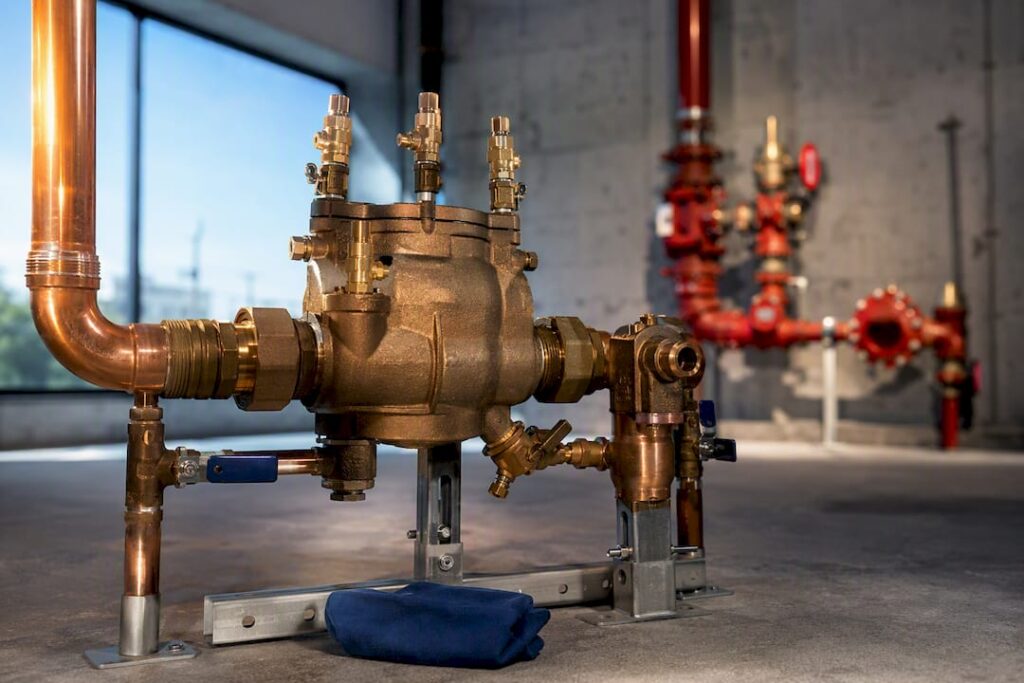
If your backflow assembly is old, keeps failing its annual test, or lacks lead-free certification, you need to upgrade it now, not on your next repair call. Schedule an evaluation with a licensed plumber or certified backflow tester, confirm your local water purveyor’s rules, and budget for on-install testing plus the annual test that follows every year after.
TL;DR:
- Verify that your backflow assembly is lead-free, properly certified, and labeled with approved standards before attempting a replacement.
- Immediate upgrade is necessary if the device fails repair, shows visible corrosion, or if local regulations now require lead-free materials.
- Select the appropriate device type based on hazard level, ensuring it fits your property’s specific needs to avoid rejection or overpaying.
- Schedule permit approval, a licensed plumber, and certified testing before installation, and test the assembly immediately on completion.
- Budget a few weeks for the full process, including permits, installation, and paperwork, to prevent delays and ensure compliance.
Table of Contents
- What Does “Lead-Free” Mean for a Backflow Assembly?
- Do You Need to Upgrade Now or Can It Wait?
- Which Lead-Free Backflow Assembly Fits Your Property?
- How Do You Complete a Compliant Installation?
- What Does a Lead-Free Backflow Upgrade Cost, and How Long Does It Take?
- What Happens After the Upgrade: Testing and Maintenance for Life
- How Southjerseybackflow Handles a Lead-Free Upgrade End to End
- Why Most Upgrade Advice Skips the Part That Actually Causes Delays
- Schedule Your Lead-Free Backflow Upgrade
- Sources
What Does “Lead-Free” Mean for a Backflow Assembly?
“Lead-free” isn’t a marketing term. It’s a material standard: the wetted surfaces of the assembly, meaning any component that contacts drinking water, must meet strict limits on lead content, and the device has to carry documentation proving it. Many states now require backflow assemblies on potable lines to meet these lead-free material rules and to carry approval from a recognized testing body, most commonly the USC Foundation for Cross-Connection Control and Hydraulic Research. Water purveyors enforce these standards because a single non-compliant assembly on a shared main can put an entire neighborhood’s drinking water at risk.
Before you buy or approve a replacement, check for:
- An LF designation stamped or labeled directly on the body of the assembly
- A listing on the USC Foundation’s approved assembly list or your local water purveyor’s own approved list
- Manufacturer documentation confirming compliance with lead-free material standards
- A model number that matches what your water authority has pre-approved for your service size
Skip any of these checks and you risk a rejected installation, which means paying for labor twice.
Do You Need to Upgrade Now or Can It Wait?
Not every property needs an emergency swap. Some triggers demand immediate action; others just mean it’s time to plan ahead.
- Regulatory trigger: Your assembly failed its annual test and can’t be repaired to pass, or your water purveyor issued a compliance notice requiring replacement.
- Code trigger: A local ordinance now requires lead-free materials for your device’s application, and your existing assembly predates that rule.
- Practical trigger: You’ve called for the same repair three times in two years, or you can see visible corrosion, pitting, or mineral buildup on the body.
- Hazard trigger: A hazard assessment shows your connection now qualifies as a health hazard rather than a non-health hazard, which usually calls for a higher-protection assembly.
Combine your last test report with a visual inspection before deciding. A device that passed cosmetically but is chewing through relief-valve seals every eight months is telling you something the paperwork won’t. For a broader diagnostic checklist, our guide on signs your backflow prevention system is failing walks through the warning signs in more depth.
Which Lead-Free Backflow Assembly Fits Your Property?
Device selection comes down to one question: what degree of hazard are you protecting against? Get that wrong and you’ll either overpay for protection you don’t need or install something your inspector rejects outright.
- RP/RPZ (reduced pressure) assemblies protect against both backpressure and backsiphonage and are required for health hazards, meaning the connection could introduce something genuinely dangerous into the potable supply.
- RPDA (reduced pressure detector assemblies) work like an RP but add a bypass meter, common on fire lines where a purveyor wants to detect unauthorized water use.
- Double check assemblies handle non-health hazards, lower-risk connections like irrigation systems without chemical injection.
- PVBs (pressure vacuum breakers) guard against backsiphonage only, and they’re common on outdoor hose bibs and simple irrigation setups, though they can’t be installed under continuous pressure for extended periods.
The EPA’s Cross-Connection Control Manual lays out exactly which device type suits which hazard level, and your local purveyor’s own hazard determination should override any generic assumption.
Beyond hazard level, weigh lay length (how much straight pipe you actually have), test-cock orientation for your technician’s access, and whether the space allows service without shutting down the whole building. Modern lead-free RP assemblies increasingly ship with replaceable seats and separate access covers, which cuts future maintenance costs, and some now include optional flood sensors that alert facility staff the moment a relief valve discharges.
Pro Tip: Don’t size a replacement by the pipe diameter alone. An undersized RP assembly creates enough friction loss to choke water pressure on upper floors, especially in older multi-unit buildings with already-marginal supply pressure.
How Do You Complete a Compliant Installation?
Permits and paperwork trip up more upgrades than the actual plumbing does. Here’s the order that avoids delays.
- Pull the permit first. Most jurisdictions require a plumbing permit before work begins, and upgrades tied to fire sprinkler systems often need hydraulic verification as part of the submittal.
- Confirm friction loss against system demand. A higher-friction-loss assembly can starve a fire sprinkler system of the flow it needs; some authorities require flow calculations before they’ll sign off.
- Hire a licensed plumber for the install and a certified tester for commissioning. These are often the same person, but confirm certification either way.
- Test on install. Water authorities commonly require the new assembly be tested the day it goes in, not weeks later.
- File the report. Submit test results to your water purveyor and keep a copy on file.
Before the crew arrives, have ready:
- Your most recent test report and any compliance notice from the purveyor
- Site access details, including whether the assembly sits in a vault, enclosure, or mechanical room
- Any fire sprinkler system documentation if the backflow device ties into that line
Don’t be surprised if a brand-new assembly needs adjustment right out of the box during commissioning. That’s normal, not a defect, but it’s one more reason to schedule a real testing window instead of assuming a same-day install and pass.
What Does a Lead-Free Backflow Upgrade Cost, and How Long Does It Take?
Budget in four buckets: the assembly itself, labor, permit fees, and anything extra the site demands.
- Unit cost varies by device type and size, with RP assemblies generally running higher than double check or PVB units of the same size.
- Labor depends on access. A basement mechanical room install goes faster than a confined vault requiring excavation.
- Permit and inspection fees are set by your municipality or water authority.
- Enclosure or vault work adds cost if your current setup needs modification to meet freeze protection or access standards.
Timeline typically runs several weeks from permit application to final test, assuming standard equipment is in stock. Add time if your project needs custom hydraulic calculations for a fire system tie-in, if the assembly requires special order lead times, or if the installation space is tight enough to need extra labor hours. Confined installs and specialty piping are the two factors most likely to blow past your original schedule.
What Happens After the Upgrade: Testing and Maintenance for Life
Installing a lead-free assembly isn’t the finish line. It’s the start of an annual obligation.
- Certified testers perform inspections at least once a year, and some jurisdictions require testing on health-hazard assemblies specifically at that minimum annual interval.
- Common repairs include replacing seats, seals, and relief valves, all of which are far cheaper than a full replacement when caught early.
- A test failure doesn’t always mean replacement. Many failures resolve with a seat or seal swap, but repeated failures on the same component within a year or two usually signal it’s time to replace rather than keep patching.
- Retain test records for the period your water authority specifies, and confirm your purveyor received a copy directly, not just your files.
Water districts increasingly maintain lists of approved assemblies and certified testers that they cross-reference against submitted reports, so a mismatch between your device and their approved list can flag your property for follow-up even after a passing test. Our breakdown of common backflow issues and how to fix them covers the repair-versus-replace decision in more detail.
How Southjerseybackflow Handles a Lead-Free Upgrade End to End
A property owner shouldn’t have to become a cross-connection control expert to stay compliant. The workflow that avoids rejected permits and repeat site visits looks like this:
- Site assessment to determine hazard level and confirm what assembly type your connection actually requires
- Device selection from approved lead-free assemblies matched to your space, pressure, and hazard classification
- Permit handling and hydraulic checks for any fire sprinkler tie-ins before work starts
- Installation by licensed plumbers, followed immediately by the required on-install test
- Filing the test report directly with your water authority so the paperwork trail is never left to you
Southjerseybackflow services properties across its New Jersey coverage area, handling everything from single-family evaluations to multi-property portfolios under one consolidated billing arrangement. Working with a service that manages the full sequence, not just the swap, tends to mean fewer rejected filings, less time with water shut off, and no gap between installation and the report landing where it needs to land. Details on the process live on our backflow assembly upgrades page.
Why Most Upgrade Advice Skips the Part That Actually Causes Delays
Most guidance on this topic treats the upgrade as a parts swap: pull the old device, drop in a lead-free one, done. That’s the easy 80%. The part that actually derails projects is the hydraulic and permit layer nobody mentions until the inspector flags it, particularly on properties with fire sprinkler ties, where a device that’s perfectly lead-free compliant can still get rejected for choking system pressure.
If there’s one thing worth prioritizing above device shopping, it’s confirming your friction-loss numbers against your fire system’s demand before you ever order equipment. I’d also push back gently on the idea that lead-free certification alone proves a device is “compliant.” Certification confirms the material. It says nothing about whether that specific model fits your hazard classification, your lay length, or your purveyor’s approved list. Those three things fail projects far more often than material noncompliance does.
The property owners who get through this cleanest are the ones who treat the upgrade as a sequence, permit, hydraulic check, install, test, filing, rather than a single purchase decision. Skip a step and you’re not saving time. You’re just moving the delay to later in the process, usually right when you can least afford it.
— Jordan
Schedule Your Lead-Free Backflow Upgrade
Southjerseybackflow is the direct route to a compliant upgrade without juggling a plumber, a separate tester, and your water authority’s paperwork yourself. We handle the site assessment, select an approved lead-free assembly matched to your hazard classification, manage permit and hydraulic checks where fire systems are involved, complete the installation, run the required on-install test, and file the report with your water purveyor.
Booking starts with an onsite assessment and a straight quote, no guessing about what device you need or what it’ll cost before we’ve actually looked at your connection. From there we schedule the install, handle the paperwork submission, and confirm your water authority has what it needs on file. If you’re not sure whether your current assembly is even compliant, our guide to backflow testing in New Jersey covers what “passing” actually requires. Ready to move forward? Get in touch with Southjerseybackflow to schedule your evaluation.
Sources
- Austin Water — Backflow prevention overview
- Watts — LF919 specification sheet (lead-free RP assemblies)
- EPA — Cross-Connection Control Manual
- Clark County — Backflow preventor upgrade permit guide
- Los Angeles County Waterworks District — Backflow prevention guidance