
Yes, consolidated backflow billing exists, and most established backflow service providers offer it to clients managing multiple devices or properties. It delivers one invoice covering every test, repair, or filing across a portfolio, a single report packet with proof of submission for each water authority, and coordinated scheduling instead of separate service calls. The sections below cover how the process runs, what pricing usually looks like, and the checklist to bring to your first conversation with a provider.
TL;DR:
- Consolidated backflow billing is a separate service from utility fees, bundling testing, repairs, and filings into one invoice per portfolio.
- It typically involves five steps: inventory building, route-based scheduling, on-site testing and tagging, immediate portal filing, and flexible invoicing methods.
- Pricing tiers include per-device rates, volume discounts, and service agreements with bundled repairs, with costs influenced by device size, access difficulty, and failure rates.
- Contract terms should specify invoicing schedule, detailed line items, proof of submission, split-billing, and dispute periods to maximize billing efficiency.
- Consolidation improves bookkeeping by providing one clear invoice, detailed reports for audits, and reducing missed filings, but does not eliminate the need to follow individual municipal deadlines.
Table of Contents
- What Is Consolidated Backflow Billing?
- How Does the Consolidated Billing Process Work?
- What Does Consolidated Backflow Billing Cost?
- What Contract and Invoice Terms Should You Require?
- Implementation Checklist and Timeline
- How Do You Handle Multiple Backflow Service Providers?
- What Are the Limits of Consolidated Backflow Billing?
- Questions to Ask Before You Opt Into Consolidated Billing
- Real-World Examples of Consolidated Billing Arrangements
- How Consolidated Billing Changes Your Bookkeeping
- What South Jersey Backflow Sees Across Portfolio Clients
- Get a Portfolio Quote for Consolidated Backflow Billing
- Sources
What Is Consolidated Backflow Billing?
Consolidated backflow billing is an invoicing arrangement a testing company sets up for you, not a fee your water utility charges. It bundles device testing, certification, repairs, and rebuilds across multiple properties or multiple devices at one property into a single bill, rather than sending you a separate invoice for every visit. This distinction matters because a lot of search results conflate it with utility-side backflow administrative fees, which is a different topic entirely with a different biller.
A properly run consolidated program gives you three things: one invoice with line items or subtotals per device, a combined report packet covering every test performed in that cycle, and confirmation that results were filed with the correct local water authority. Some providers add a dedicated point of contact who tracks your whole portfolio, similar to the single point of contact model enterprise vendors describe for portfolio accounts.
The appeal for property managers comes down to a few concrete gains:
- One accounts-payable entry instead of a dozen scattered invoices from the same vendor
- A predictable annual cost instead of a pile of surprise repair charges throughout the year
- Fewer missed filings because one company, not five separate schedules, tracks every device’s due date
- A cleaner audit trail when an insurer, lender, or municipality asks for proof of compliance
For a portfolio with device counts in the dozens or hundreds, that last point alone can save hours of digging through old email threads every time compliance comes up.
How Does the Consolidated Billing Process Work?
The process usually runs in five stages, and knowing them helps you spot a provider who has actually done this before versus one improvising it for the first time.
- Quote and inventory. If you already track device locations, sizes, and last test dates, the provider quotes off that list. If you don’t, expect the vendor to build the inventory during a walkthrough or from prior water authority records, which adds time up front but pays off in accuracy later.
- Portal filing. Results go to the relevant water authority, usually with same-day proof of submission you can forward to a lender, insurer, or municipal inspector on request.
- Invoicing. You choose the format: one invoice per completed job, a monthly consolidated statement covering everything finished that period, or split billing across ownership entities if your portfolio spans separate LLCs.
Pro Tip: Ask for the portal filing confirmation the same day testing wraps, not weeks later. If a provider can’t produce it quickly, that’s a sign their back-office process hasn’t caught up to their sales pitch.
What Does Consolidated Backflow Billing Cost?
Pricing generally falls into three structures: per-device rates, portfolio or volume pricing tiers, and master service agreements that bundle testing with priority repair response. Per-device pricing works fine for a handful of properties, but once you’re managing a real portfolio, it stops making sense, since every device gets billed and dispatched independently, with no economy of scale passed back to you.
A few factors drive the actual cost per device regardless of structure:
- Device size and type (a 6-inch commercial assembly costs more to test than a residential 3/4-inch unit)
- Access difficulty, particularly devices in mechanical rooms, rooftops, or locked utility closets
- Failure and retest rates, since a device that fails once usually needs at least one more visit
- Emergency or after-hours work, which almost always carries a premium over scheduled testing
Volume pricing is common enough that tiered rates for multi-property portfolios show up as a standard offering among specialized backflow vendors, not an exception you have to negotiate for. The savings come from batching visits so technicians aren’t driving separately to five buildings, locking in a multi-year rate instead of renegotiating annually, and pre-negotiating a flat retest price so a failed device doesn’t turn into a second full-price invoice.
What Contract and Invoice Terms Should You Require?
Before signing anything, put these terms in writing so consolidated billing actually reduces your workload instead of just relabeling the same paperwork.
- Invoicing cadence. Decide whether you want an invoice per completed job, a single monthly statement, or quarterly billing tied to your own accounting cycle. Monthly consolidation tends to work best for portfolios with staggered testing dates throughout the year.
- Required line items. Every invoice should list device ID, property address, tester certification number, pass or fail result, and any parts used for on-site repairs. Without device-level detail, you lose the ability to audit costs by property.
- Report attachments. Every report packet should include tester certifications and gauge calibration records alongside the pass or fail results, since a water authority or inspector may ask for calibration proof independent of the test result itself.
- Proof of submission. Get written confirmation, ideally a portal receipt or timestamped filing confirmation, for every device on every cycle.
- Split-billing mechanics. If separate entities within your portfolio need separate invoices, specify how costs get allocated and whether a purchase order field ties each device to its billing entity.
- Dispute window. Agree on how many days you have to flag a billing discrepancy before it’s considered accepted.
Our guide on backflow testing in New Jersey covers the fail-fix-repeat workflow in more detail if you want to see how repair estimates and retesting typically get documented.
Implementation Checklist and Timeline
Getting consolidated billing set up isn’t complicated, but it does need a lead time longer than most property managers expect.
- Pull together whatever device data you have: addresses, device sizes, last test dates, and current tester of record, even if the list is incomplete.
- Start outreach to providers 30 to 60 days before your compliance deadlines. Proactive scheduling in that window avoids the scramble that hits every provider during peak testing season.
- Decide invoicing cadence and confirm split-billing rules before the first test, not after the first invoice arrives.
- Ask for a sample report and sample invoice up front so you know exactly what documentation you’ll receive.
- Confirm the provider files directly with your water authority and can produce same-day proof of submission.
- Handle the internal side too: notify tenants of scheduled access, assign a purchase order number, and log the contract in your own compliance tracker or a dedicated tracking tool.
Pro Tip: Build your master device list in a shared spreadsheet or portal before your first call with a provider. It cuts the quoting timeline down significantly and prevents devices from getting missed during the first scheduling round.
How Do You Handle Multiple Backflow Service Providers?
If your portfolio currently uses different testers at different properties, consolidation usually means picking one vendor and transitioning the rest over, rather than trying to merge invoices from separate companies. Most billing systems can’t combine line items across vendors into one statement, so “consolidated” almost always means consolidated under a single provider.
The transition works cleaner if you do it in phases instead of all at once. Start with properties whose test dates are coming up soonest, since that gives the new provider a natural entry point without disrupting devices that are already compliant. Ask the incoming vendor to pull historical test records from your water authority rather than starting from zero. This preserves your compliance history and helps them build an accurate device inventory faster.
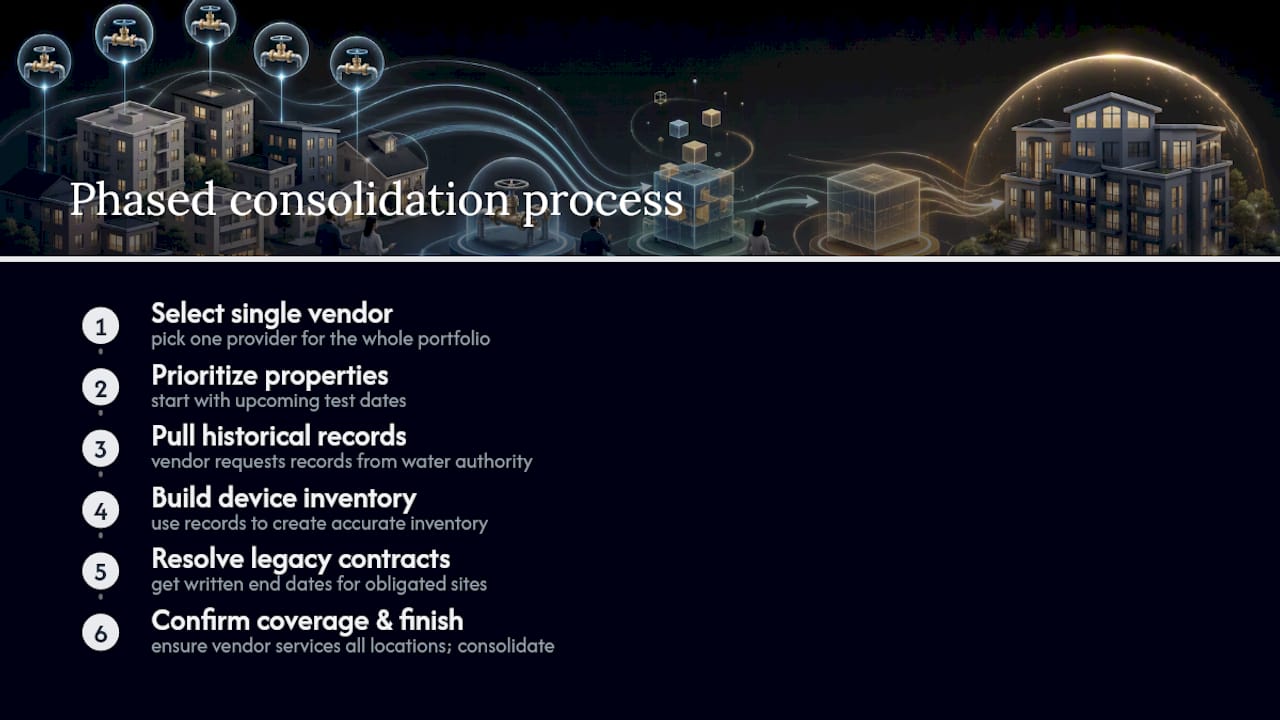
Watch out for one common mistake: keeping a legacy provider on a few properties “just in case” while a new vendor handles the rest. This defeats the entire purpose of consolidation, since you’re back to tracking two schedules, two invoice formats, and two sets of filing confirmations. If you have contractual obligations tying you to a legacy tester at certain sites, get the end date in writing so you know exactly when full consolidation kicks in.
For larger portfolios spanning several counties, confirm the new provider actually services all your locations before committing. A vendor that covers three of your five counties isn’t solving your consolidation problem. It’s just adding a third invoice stream.
What Are the Limits of Consolidated Backflow Billing?
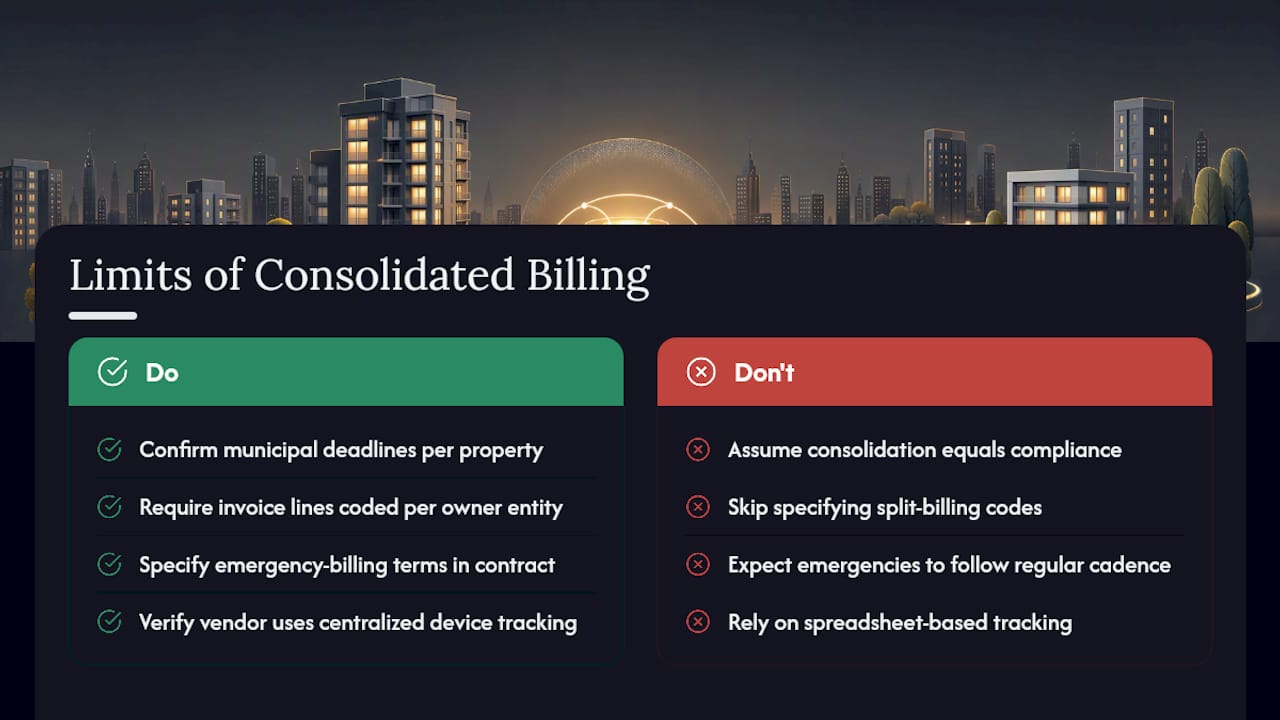
Consolidated billing solves an administrative problem, not a compliance one, and that distinction trips up property managers who assume signing an agreement means they can stop paying attention. Deadlines are still set by individual municipalities, and a provider managing 40 properties across a dozen towns is juggling that many separate regulatory calendars behind your one invoice.
Split billing across ownership entities can also get messy if it wasn’t specified clearly at the contract stage. A management company overseeing properties owned by different LLCs needs the vendor to code each invoice line to the correct entity, and retrofitting that after billing has already started usually means manual corrections on both sides.
Emergency repairs are another gap. A consolidated program handles scheduled testing well, but a device that fails outside the normal cycle, say, a burst assembly in February, often gets billed and dispatched outside the consolidated cadence unless your contract specifically addresses emergency work. Ask upfront whether emergency calls fold into the same invoice stream or arrive separately.
Finally, consolidation depends entirely on the provider’s own systems. A vendor still tracking devices on spreadsheets instead of a centralized system is more likely to miss a filing or send an invoice with incomplete device data, no matter how good their sales pitch sounded. The billing structure is only as reliable as the operations behind it.
Questions to Ask Before You Opt Into Consolidated Billing
A short conversation with a prospective provider tells you almost everything you need to know before signing anything.
Ask how they build and maintain your device inventory, and whether that inventory syncs with a portal you can view directly. Ask what happens when a device fails: is the repair quoted separately, folded into the same invoice, or covered under a flat retest rate already built into your contract? Ask for a sample invoice and a sample report packet before you commit, since seeing the actual format tells you more than any verbal description.
Confirm how proof of submission gets delivered and how quickly. Same-day confirmation should be the standard, not the exception. Ask whether they offer a master service agreement that locks in pricing and includes priority repair response, since that structure tends to produce more predictable costs than year-to-year quoting.
Ask what happens if your portfolio changes mid-contract, whether you add a property or sell one. And ask directly whether they can service every county your portfolio touches. A provider that has to subcontract certain locations to another company undermines the entire point of consolidation.
Real-World Examples of Consolidated Billing Arrangements
Consolidated billing shows up in a few common shapes depending on portfolio type. HOA and community association clients often get a single consolidated quote and invoice covering an entire community after block scheduling, since every device on a shared property gets tested in one coordinated visit rather than unit by unit.
Commercial and multi-property management clients more often see a monthly or per-engagement consolidated statement tied to a master service agreement, with a single point of contact managing the whole account instead of a rotating cast of schedulers. Larger portfolios sometimes get access to a dedicated property-manager portal where every invoice, report, and compliance status across every property sits in one dashboard, which cuts down on the back-and-forth emails asking “did we test this one yet?”
Smaller portfolios, three to ten devices across two or three properties, usually get a simpler version: one invoice per testing cycle rather than a monthly statement, since the volume doesn’t justify the overhead of a full portal system. That’s still consolidated billing. It’s just scaled to fit a smaller operation.
How Consolidated Billing Changes Your Bookkeeping
One invoice instead of a dozen changes more than your inbox. It changes how you code expenses. Instead of reconciling separate line items from separate vendor statements against separate properties, your bookkeeper works from one document that should already break costs down by device and address, assuming you required that level of detail in your contract.
This matters most at tax time and during audits. When a lender or insurer asks for proof of compliance across a portfolio, pulling one consolidated report packet with filing confirmations for every device beats searching through a year of scattered PDFs. Property managers using entity-based accounting, where costs need to trace back to individual ownership structures, should confirm the provider’s invoice format supports that split before the first billing cycle runs, not after.
The chargeback and billing workflows apartment communities use offer a useful parallel: consolidated statements only reduce administrative work when the underlying line items are detailed enough to reallocate costs cleanly. A vague “backflow services, $4,200” entry doesn’t help your bookkeeper any more than five separate vague invoices would.
What South Jersey Backflow Sees Across Portfolio Clients
Running consolidated programs across multiple New Jersey counties has taught us that the operational pieces matter more than the pricing pitch. Building an accurate device inventory upfront, block scheduling by region, filing directly through the water authority’s portal, and following a fail-fix-repeat workflow on the same visit cut down on the callbacks that used to eat up half our schedule. Portfolio clients who switch from scattered single-device billing to a consolidated setup consistently report fewer missed filings and cleaner documentation when an insurer or lender asks for proof of compliance.
— Jordan
Get a Portfolio Quote for Consolidated Backflow Billing
South Jersey Backflow is the direct alternative to juggling separate testers, separate invoices, and separate filing confirmations for every property in your portfolio. We build your device inventory, quote portfolio pricing, and set up a master service agreement that puts every test, repair, and filed report under one invoice and one point of contact.
Reach out with your property list, even an incomplete one, and we’ll put together a proposed testing schedule along with a sample invoice and report packet so you know exactly what you’re getting before anything is scheduled. If you’re currently sorting out compliance across Ocean, Mercer, Salem, Hunterdon, Middlesex, Gloucester, or Cumberland County properties, we already service those areas and can fold them into one consolidated schedule. Check our guide on backflow testing and filing in New Jersey for what to expect, then contact us to start your portfolio quote.