
TL;DR:
- New Jersey property owners must comply with separate backflow installation permits and annual testing regulations to prevent water contamination and avoid penalties. The legal framework involves the NJDEP’s N.J.A.C. 7:10 regulations and the state’s Construction Code, each assigning specific responsibilities for installation, testing, and reporting. Proper device selection depends on hazard classification, and strict adherence to permits, certified testing, and documentation deadlines ensures ongoing compliance.
If you own or manage property in New Jersey, the backflow statute overview you need isn’t buried in a plumbing manual. It lives at the intersection of two separate regulatory frameworks, and missing either one puts you at risk of fines, water service interruption, and liability. Backflow, the reversal of water flow back into the public supply, happens because of backpressure or backsiphonage conditions that pull or push contaminated water the wrong direction. The law requires you to prevent it, document it, and report it, every year.
Table of Contents
- Key Takeaways
- NJ backflow statute basics: legal framework and regulatory authorities
- Types of backflow conditions and approved prevention assemblies
- Installation, permitting, and inspection requirements for NJ backflow devices
- Annual testing, reporting, and compliance management
- Special scenarios and common pitfalls to avoid
- My take on what most property owners get wrong
- Get your NJ backflow compliance handled right
- FAQ
Key Takeaways
| Point | Details |
|---|---|
| Two parallel obligations | NJ property owners must satisfy both installation permitting rules and recurring annual testing requirements separately. |
| NJDEP drives testing rules | N.J.A.C. 7:10 mandates annual testing with results submitted to your water purveyor within 30 days. |
| Device must match hazard | Using the wrong backflow assembly for your hazard class will get your test results rejected administratively. |
| Installers and testers differ | Licensed plumbers install devices; certified backflow testers with ASSE 5000 credentials perform the annual tests. |
| Documentation is compliance | Passing a test without submitting proof on time counts as non-compliance in your water utility’s records. |
NJ backflow statute basics: legal framework and regulatory authorities
New Jersey’s backflow control measures operate under two distinct legal pillars, and you need to understand both to stay compliant.
The first is N.J.A.C. 7:10, the Safe Drinking Water Act regulations administered by the New Jersey Department of Environmental Protection (NJDEP). This is the statute that governs ongoing operational requirements: which assemblies must be installed at public water connections, how often they get tested, and how test results get reported. When your water utility sends you a compliance notice, it traces back to this regulation.
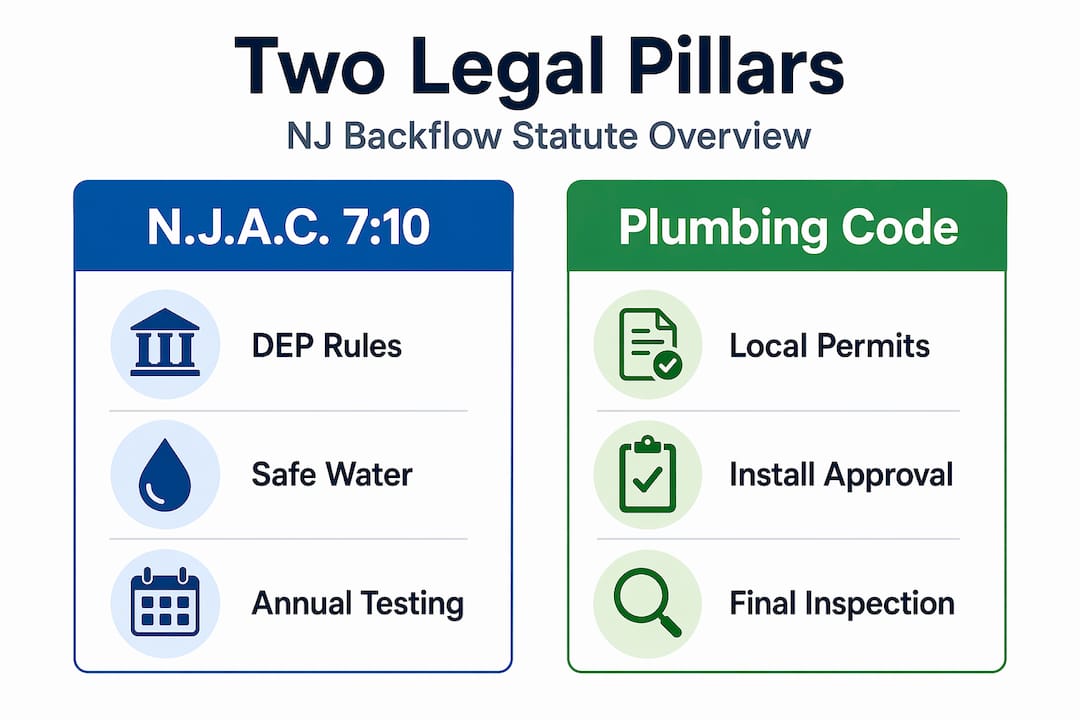
The second pillar is the New Jersey Uniform Construction Code (UCC), administered by the New Jersey Department of Community Affairs (NJDCA). The UCC governs the physical installation of backflow prevention devices through the plumbing subcode. Think of it this way: the UCC controls how and by whom a device gets put in the ground, while NJDEP controls what happens to that device every year after.
These two frameworks intersect in ways that catch property managers off guard. Here is what you need to know about how they divide responsibilities:
- NJDEP and water purveyors set the backflow legal guidelines for which assemblies are required, annual testing mandates, and reporting deadlines.
- NJDCA and local building officials govern permits, approved contractors, and inspections at the time of installation.
- Water utilities enforce compliance by reviewing submitted test documentation and issuing notices when records are missing or late.
- Local plumbing codes can add requirements on top of the state minimums, so your municipality may impose stricter rules than N.J.A.C. 7:10 alone.
Understanding this as two parallel obligations rather than one combined process will change how you plan your compliance calendar.
Types of backflow conditions and approved prevention assemblies
Before you can select the right device, you need to understand what backflow statutes are actually protecting against.
Backpressure occurs when the pressure downstream in your building’s plumbing system exceeds the pressure coming from the public water supply. This can happen with boilers, pressurized systems, or elevated storage tanks. Backsiphonage occurs when a sudden drop in supply pressure, such as during a water main break or heavy firefighting demand, creates a siphon effect that pulls water backward from your property into the main line.
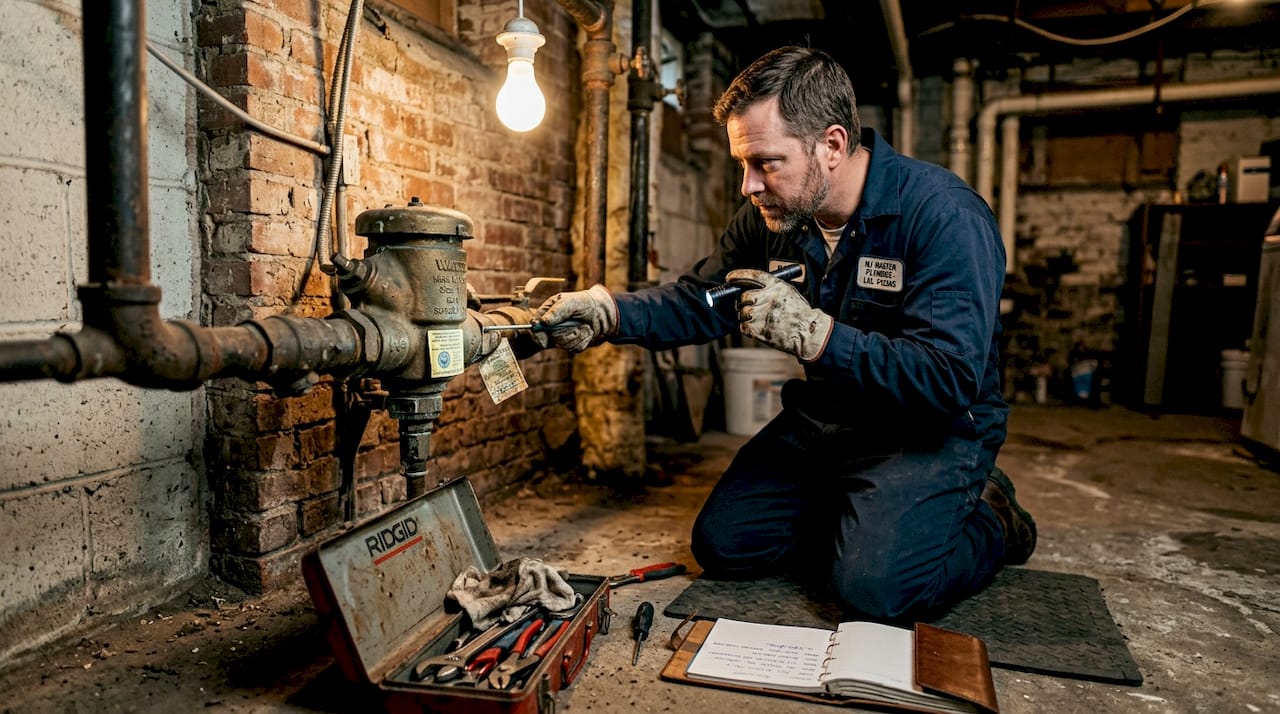
The hazard classification of your connection determines which assembly the statutes require. A low-hazard connection, like a typical domestic water service to an office building, carries different requirements than a high-hazard connection involving chemicals, fertilizers, or boiler feed systems.
Here is a comparison of the main approved backflow prevention assemblies under NJ statutes:
| Assembly | Full Name | Approved Hazard Level | Backpressure Protection |
|---|---|---|---|
| RPZ | Reduced Pressure Zone Assembly | High hazard | Yes |
| DCVA | Double Check Valve Assembly | Low hazard | Yes |
| PVB | Pressure Vacuum Breaker | Low hazard | No |
| AVB | Atmospheric Vacuum Breaker | Low hazard | No |
| Air Gap | Physical separation | High hazard | Yes |
RPZ assemblies are required for high-hazard connections involving backpressure risk, while a DCVA is appropriate for low-hazard lines without backpressure exposure. Getting this match wrong is not just a safety problem. It is an administrative compliance problem that will follow you.
Pro Tip: Before purchasing any backflow prevention device, contact your water purveyor directly and confirm which hazard classification applies to your specific connection type. Do not assume based on neighboring properties.
Installation, permitting, and inspection requirements for NJ backflow devices
Installing a backflow prevention device is not a self-service project. The NJ Uniform Construction Code requires plumbing permits and inspections for any new installation, and the work must be performed by a licensed contractor who pulls the permit before work begins.
Here is the standard installation pathway under the NJ plumbing subcode:
- A licensed plumber applies for a plumbing permit through the local construction office before installation begins.
- The installation is completed according to the NJ plumbing subcode and the manufacturer’s specifications.
- A local building official inspects the completed installation to confirm code compliance.
- Only after the inspection passes does the device enter the operational compliance cycle governed by NJDEP.
What trips up many property managers is the assumption that one professional handles everything. The person who installs your backflow prevention assembly is typically not the same person who tests it going forward. These are separate roles governed by separate credentials.
The installation inspection confirms that the device is correctly placed, properly sized, and code-compliant as built. It does not substitute for the annual operational test required by your water utility. Once the device is in the ground and inspected, the recurring testing obligation begins immediately.
Pro Tip: Keep a copy of your original installation permit and inspection approval on file. If your water utility questions the adequacy of your installed assembly during an administrative review, that paperwork is your first line of defense.
Annual testing, reporting, and compliance management
This is where most property owners fall short. The backflow compliance requirements for ongoing operations under N.J.A.C. 7:10 are specific, time-bound, and non-negotiable.
Here is the compliance cycle you are legally required to follow:
- Schedule annual testing. Every backflow prevention assembly connected to a public water supply must be tested annually under N.J.A.C. 7:10-10.
- Use a certified tester. The testing must be performed by someone holding ASSE Series 5000 certification or an equivalent credential accepted by your water purveyor. A licensed plumber without this certification cannot perform a compliant test.
- Submit results within 30 days. Test results must be submitted to your local water purveyor within 30 days of the test date. Missing this window creates a compliance gap in your utility’s records even if your device passed.
- Retain documentation. Keep copies of every test report, submission confirmation, and correspondence with your water utility. This is your proof of compliance if a dispute arises.
- Build an asset register. Tracking your assembly locations and test dates in one place prevents missed deadlines across multiple devices or buildings.
The consequences of non-compliance range from utility-issued notices to water service interruption. And here is the part most property managers do not realize: timely submission is a separate compliance requirement from the test result itself. Your device can pass perfectly and you can still be out of compliance if the paperwork lands on your utility’s desk on day 31.
Pro Tip: Schedule your annual tests 45 to 60 days before your compliance deadline rather than right at the anniversary date. That buffer gives you time to address any failed test results and retest before the 30-day reporting window closes.
For a step-by-step walkthrough of the full compliance workflow, the NJ water backflow prevention guide at Southjerseybackflow breaks it down clearly.
Special scenarios and common pitfalls to avoid
Not every property has a straightforward single connection with a clear hazard classification. Several situations add complexity to your compliance obligations.
- Chemical feed systems and boilers are automatically classified as high-hazard connections. They require RPZ assemblies regardless of the water pressure conditions present at time of inspection. Property managers who install a DCVA on a boiler line because it was cheaper will face administrative rejection of test results when the utility reviews device type against hazard class.
- Irrigation systems with chemigation (fertilizer or pesticide injection) require the highest level of protection. If you have a lawn irrigation connection and a chemical injection system attached, the hazard classification changes entirely.
- Maintenance tickets versus legal deadlines are not the same thing. A work order to “check the backflow preventer” does not satisfy the statutory testing requirement. Only a certified tester performing a documented differential pressure test with formal submission to the utility closes that compliance loop.
- Municipal variations are real. Some NJ municipalities have adopted requirements that go beyond state minimums. Always verify with your local building department and water utility what applies specifically to your address.
- Multiple devices across one property multiply your compliance obligations. A large commercial property may have separate assemblies for domestic service, fire suppression, and irrigation. Each one carries its own annual testing and reporting deadline.
Working with someone who handles backflow compliance testing in NJ regularly will help you identify all applicable devices and keep each compliance cycle on track.
My take on what most property owners get wrong
I’ve seen the same pattern repeat itself more times than I can count. A property manager receives a compliance notice from their water utility, calls a plumber, the plumber “checks the device,” and the manager files the paperwork away thinking the job is done. Six months later, there’s another notice because the results were never formally submitted, or the wrong tester performed the work, or the device installed three years ago doesn’t match the hazard class on record.
What I’ve learned is that the biggest risk is not a failing backflow device. It’s treating backflow compliance as a maintenance task rather than a legal obligation with hard deadlines and specific credential requirements. The statute does not care that you had good intentions. It cares about certification numbers, submission dates, and device model approvals.
The property managers who stay out of trouble build a system around their obligations rather than reacting to utility notices. They know every device on their property, who tested it last, when it’s due again, and where the submission confirmation is filed. That kind of compliance asset register is not bureaucratic overhead. It’s the only reliable way to prove you met your legal obligations if your utility or a regulator ever asks.
My advice: treat the first utility notice you receive as a signal to build that system now, not after the second one arrives with a penalty attached.
— Jordan
Get your NJ backflow compliance handled right
Southjerseybackflow specializes in backflow testing and certification for property owners and managers throughout New Jersey. Whether you need a certified annual test, help submitting results to your water purveyor on time, or guidance after receiving a compliance notice, the team at Southjerseybackflow has the ASSE certifications and local experience to handle it correctly. If you have already received a utility notice, the received backflow letter guide walks you through exactly what to do next. For full testing and certification service, visit the NJ backflow testing page to see how Southjerseybackflow keeps your property compliant and your records clean.
FAQ
What are backflow statutes in New Jersey?
Backflow statutes in New Jersey are state regulations, primarily under N.J.A.C. 7:10, that require property owners with public water connections to install approved backflow prevention assemblies, test them annually, and submit results to their water utility within 30 days.
How often do NJ backflow devices need to be tested?
Under N.J.A.C. 7:10, backflow prevention assemblies connected to a public water supply must be tested once per year by a certified tester holding ASSE Series 5000 credentials or an equivalent accepted by the local water purveyor.
Who can perform a legally compliant backflow test in NJ?
A licensed plumber alone is not sufficient. The tester must hold a specific backflow testing certification, typically ASSE Series 5000 or an equivalent accepted by your water utility, which is a separate credential from a general plumbing license.
What happens if I miss the 30-day reporting deadline?
Your device may pass its test and you can still be recorded as non-compliant by your water utility if results are not submitted within 30 days of testing. Utilities enforce compliance through documentation review, and late submissions create a gap in your compliance record.
Does one backflow device cover an entire property?
Not necessarily. A property with separate water connections for domestic service, fire suppression, and irrigation may require a distinct approved assembly on each line, each with its own annual testing and reporting obligation under NJ backflow compliance requirements.