
TL;DR:
- In New Jersey, all backflow prevention devices must undergo annual testing by certified technicians, with timely documentation submitted to local water authorities. Recent legislation has shifted enforcement from warnings to violations, emphasizing proper documentation, certification, and compliance tags, especially for high-hazard properties. Property owners should proactively verify deadlines, audit records, and confirm tester credentials to avoid penalties and service interruptions in 2026.
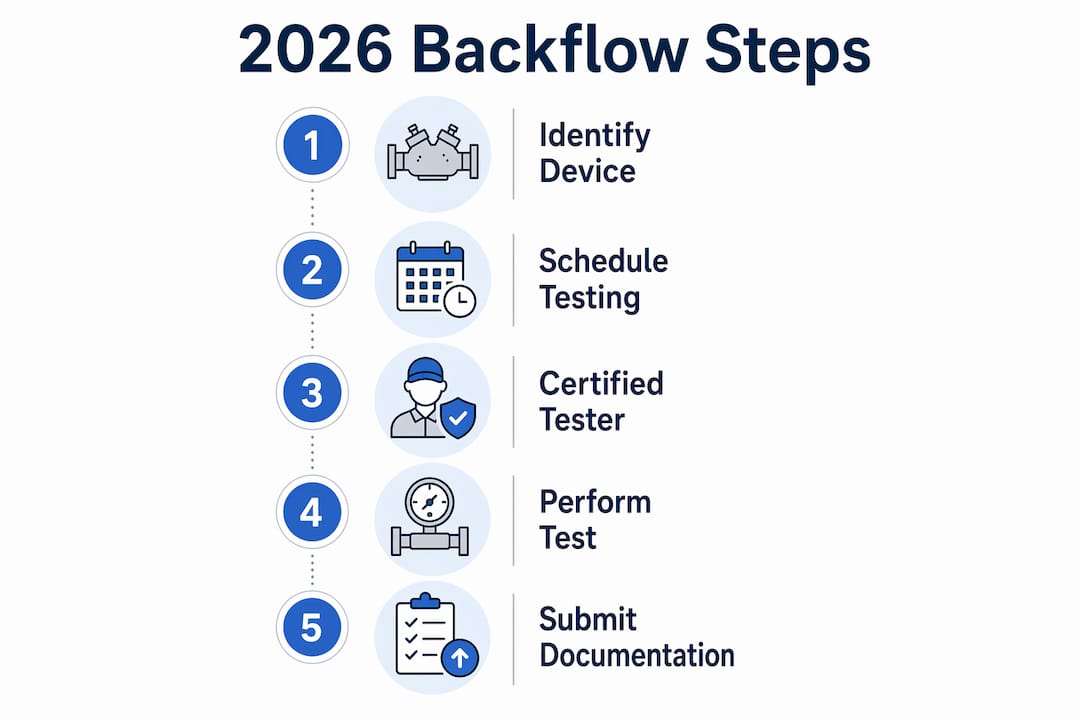
The regulatory deadlines for backflow 2026 require every New Jersey property with a backflow prevention device to complete annual testing by a certified technician and submit documentation to the local water authority. Backflow prevention regulations are not optional guidelines. They carry real penalties, including service interruptions and formal violations on your water account. This guide covers exactly what NJ property owners and managers need to know: the specific deadlines, who can legally perform the testing, how recent legislative changes affect enforcement, and how to stay ahead of your local Authority Having Jurisdiction (AHJ).
What are the specific backflow testing deadlines in New Jersey for 2026?

Annual testing is the national baseline under the Federal Safe Drinking Water Act, but your local water authority sets the exact calendar deadline for your property. Most NJ utilities require testing to be completed within a defined window each year, often tied to your device’s installation anniversary date or a fixed municipal schedule. Missing that window is not a minor oversight. It triggers a formal compliance failure on your account.
The key requirements for meeting 2026 backflow compliance deadlines include:
- Annual testing window: Most NJ water authorities set a 30 to 60 day window for completion. Contact your utility to confirm your specific deadline.
- Submission timeline: Test results submitted electronically to your local water utility are typically due within 30 days of testing. Late submissions count as non-compliance.
- Compliance tag placement: Every tested device must carry a current tag. Compliance tags must identify the technician’s name, ASSE or ABPA certification number, and a description of the work performed.
- High-hazard properties: Medical facilities, chemical processing sites, and irrigation-heavy commercial properties may face more frequent testing requirements than the standard annual cycle.
- Consequences of missing deadlines: Water providers now issue active violations, not warnings, for missed or incomplete testing. These violations appear on your property’s water account and can escalate to service interruption.
Pro Tip: Schedule your backflow test at least 60 days before your utility’s deadline. Certified testers book up fast in spring, especially for properties with irrigation systems coming online after winter.
The compliance tag requirement is where many property owners get caught off guard. A test that was completed on time but documented on an illegible or incomplete tag still counts as a violation. Missing or illegible tags mean automatic non-compliance regardless of when the last test occurred. That detail alone makes tag maintenance a front-line priority for 2026.
Who must perform backflow testing and what certifications are required?
Only certified technicians on your local AHJ’s approved list can legally perform backflow testing in New Jersey. A licensed plumber without backflow certification cannot submit valid test results. Licensing alone is insufficient without the appropriate backflow certification recognized by your water authority.
The two primary certification bodies you will encounter in New Jersey are:
- ASSE (American Society of Sanitary Engineering): ASSE Series 5000 certifications are the most widely recognized across NJ water utilities. ASSE 5110 covers backflow prevention assembly testing.
- ABPA (American Backflow Prevention Association): ABPA certification is accepted by many NJ jurisdictions as an equivalent credential. Always confirm with your specific AHJ.
- AHJ-approved tester lists: Your local water authority maintains a list of approved testers. Using someone not on that list means the test results will not be accepted, even if the technician holds a valid certification elsewhere.
- Verification steps: Ask your tester for their certification number before scheduling. Cross-reference it with your utility’s approved tester database.
Pro Tip: When you call to schedule testing, ask the company directly: “Are you on the approved tester list for [your municipality]?” A reputable tester will answer that question without hesitation.
Uncertified testing creates severe liability if contamination occurs. Beyond the legal exposure, uncertified tests leave gaps in your compliance record that water authorities now treat as violations. The risk is not theoretical. Properties that used uncertified testers during 2024 and 2025 are already dealing with red flags on their accounts heading into 2026. You can learn more about what qualifications to look for by reviewing what a certified backflow tester is required to hold under NJ compliance rules.
How have recent legislative shifts affected backflow compliance enforcement in 2026?
The enforcement environment changed significantly with legislation signed on March 28, 2025. That law restored certified technicians as the recognized professionals for annual backflow inspections and formally established compliance tag requirements after every service. What followed was a shift in how water providers handle non-compliance.
Here is the sequence of changes that now defines the 2026 enforcement climate:
- 2025 legislation clarified technician roles. Certified backflow testers handle annual inspections. Licensed plumbers remain responsible for installations and repairs, not routine testing.
- Compliance tags became mandatory documentation. Every serviced device must carry a tag with the technician’s name, certification number, and work description. No tag means no compliance.
- Enforcement shifted from warnings to violations. Water providers stopped issuing courtesy warnings for missing records. Gaps in inspection records due to skipped inspections or uncertified testers during 2024 and 2025 are now elevated to formal violations.
- Record audits became urgent. Properties entering 2026 with incomplete service histories need to audit those records before peak irrigation season, when water authorities conduct the most active compliance reviews.
“Providers now elevate these gaps to violations rather than warnings, making record audits critical before peak irrigation seasons.” — HB25-1077 Backflow Compliance In 2026
The practical implication is straightforward. If your property had any testing done between 2024 and early 2025 by someone whose certification status is unclear, pull those records now. A gap that looked minor last year is a formal violation in 2026. Understanding NJ backflow ordinances in detail will help you assess where your records stand.
What are the local variations and stricter requirements in New Jersey jurisdictions?
The state sets the floor for backflow prevention regulations, but your local AHJ sets the ceiling. The local AHJ determines testing frequency, approved testers, and documentation protocols, and those standards frequently exceed federal baselines. This is the part of 2026 backflow compliance that trips up property managers who assume one standard applies everywhere in New Jersey.
The table below shows how requirements can differ across property types and jurisdictions:
| Factor | Standard requirement | Stricter local variation |
|---|---|---|
| Testing frequency | Annual | Semi-annual for high-hazard sites |
| Accepted certifications | ASSE 5110 | ASSE plus ABPA, or AHJ-specific list |
| Submission deadline | 30 days after testing | As few as 10 days in some municipalities |
| Documentation format | Paper or electronic | Electronic only in some NJ utilities |
| Tag requirements | Name and cert number | Full work description required |
High-hazard properties, including medical offices, dental practices, car washes, and sites with chemical processing, face the most scrutiny. Some NJ jurisdictions require semi-annual testing for these property types, meaning two full test cycles per year with separate documentation submissions for each. Federal EPA guidance provides the baseline, but utilities impose stricter standards to address localized contamination risks specific to their water systems.
The only reliable way to confirm your exact requirements is to contact your water provider directly and ask for the current backflow testing schedule, the approved tester list, and the documentation submission format they accept. Do not rely on what applied to your property two years ago. Requirements have tightened across multiple NJ municipalities heading into 2026.
How can property owners manage and prepare for 2026 backflow deadlines?
Staying compliant with the backflow inspection schedule for 2026 is a planning problem, not a technical one. Most violations happen because property owners wait too long to schedule testing or assume their tester handled the paperwork. Neither assumption is safe this year.
The most effective preparation steps are:
- Confirm your deadline now. Call your water utility and ask for your specific testing window and submission deadline. Write it down and set a calendar reminder 60 days out.
- Verify tester certification before booking. Ask for the technician’s ASSE or ABPA certification number and confirm they appear on your AHJ’s approved tester list. A home plumbing maintenance checklist can help you track this alongside other annual service requirements.
- Audit your existing compliance records. Pull every backflow test report from 2023 onward. Check that each report includes a valid certification number, a signed compliance tag, and a submission confirmation from your utility.
- Check every compliance tag on every device. Tags must include the installation date, technician certification, and work description. A faded or incomplete tag is a violation waiting to happen.
- Schedule early, not at deadline. Certified testers in NJ book out weeks in advance during spring. Properties with irrigation systems are especially vulnerable to scheduling delays.
Pro Tip: Keep a digital copy of every test report and tag photo in a shared folder accessible to your property management team. If your utility requests documentation during a compliance review, you want it available in minutes, not days.
Managing annual backflow deadlines across multiple properties requires a tracking system, not just good intentions. A simple spreadsheet with each device’s location, last test date, certification number used, and next deadline date is enough to stay ahead of violations.
Key takeaways
New Jersey property owners who miss the 2026 backflow compliance deadlines face formal violations, not warnings, making proactive scheduling and complete documentation the only reliable protection.
| Point | Details |
|---|---|
| Annual testing is mandatory | All NJ backflow devices must be tested yearly by an AHJ-approved certified technician. |
| Compliance tags are non-negotiable | Tags must show the technician’s name, ASSE or ABPA cert number, and work description or the test is invalid. |
| Enforcement is now active | Since 2025 legislation, water providers issue violations for gaps, not courtesy warnings. |
| Local rules often exceed state standards | High-hazard NJ properties may face semi-annual testing and stricter submission timelines. |
| Record audits are urgent | Properties with incomplete 2024 to 2025 records must review and correct those gaps before peak season. |
What I’ve learned from watching NJ property owners get caught off guard
I have seen the same pattern repeat itself every spring in New Jersey. A property manager calls in a panic because their water utility flagged a compliance issue, and when we dig into the records, the test was done. The paperwork exists. But the compliance tag on the device is missing a certification number, or the submission went to the wrong utility contact, or the tester was not on the approved list for that municipality.
The 2025 legislative changes made one thing very clear: the era of grace periods is over. Water providers in New Jersey are not looking for reasons to penalize property owners, but they are no longer absorbing administrative errors on your behalf. The compliance tag requirement, specifically, is the detail that catches people. Most property owners assume that if the test happened and the report was filed, they are covered. They are not. Regulators penalize missing or incomplete tags regardless of the last test date.
My honest recommendation: treat your backflow certification timeline the same way you treat your property tax calendar. Put the deadline in writing, assign someone to own it, and build in a buffer. The properties that never have compliance problems are not the ones with the best backflow devices. They are the ones with the most organized records.
— Jordan
Stay compliant with Southjerseybackflow’s NJ testing services
Southjerseybackflow specializes in annual backflow testing, certification verification, and documentation submission for New Jersey property owners and managers. Every test is performed by ASSE-certified technicians who appear on local AHJ-approved tester lists, and every job includes proper compliance tag placement and electronic report submission to your water utility. If your 2026 deadline is approaching or you have gaps in your service records from prior years, Southjerseybackflow can audit your documentation and get your property back into good standing. Review the full process for passing and submitting your NJ backflow test, or explore NJ testing and certification services directly.
FAQ
What is the 2026 backflow testing deadline in New Jersey?
New Jersey water authorities set individual testing windows, typically tied to your device’s installation date or a municipal schedule. Contact your local water utility directly to confirm your exact 2026 deadline and submission requirements.
Who can legally test backflow preventers in New Jersey?
Only technicians holding ASSE or ABPA certification and listed on your local AHJ’s approved tester roster can submit valid test results. A licensed plumber without backflow certification does not qualify for routine annual inspections.
What happens if I miss the backflow compliance deadline?
Water providers now issue formal violations for missed or incomplete testing, replacing the previous practice of issuing warnings. Violations appear on your property’s water account and can escalate to service interruption.
What must a compliance tag include to be valid?
A valid compliance tag must display the technician’s name, ASSE or ABPA certification number, installation date, and a description of the work performed. Missing or illegible information on the tag constitutes automatic non-compliance.
How do I know if my property needs more frequent than annual testing?
High-hazard properties such as medical offices, car washes, and chemical processing sites may require semi-annual testing under local AHJ rules. Confirm your specific frequency requirement with your water utility, since local standards often exceed the federal annual baseline.