
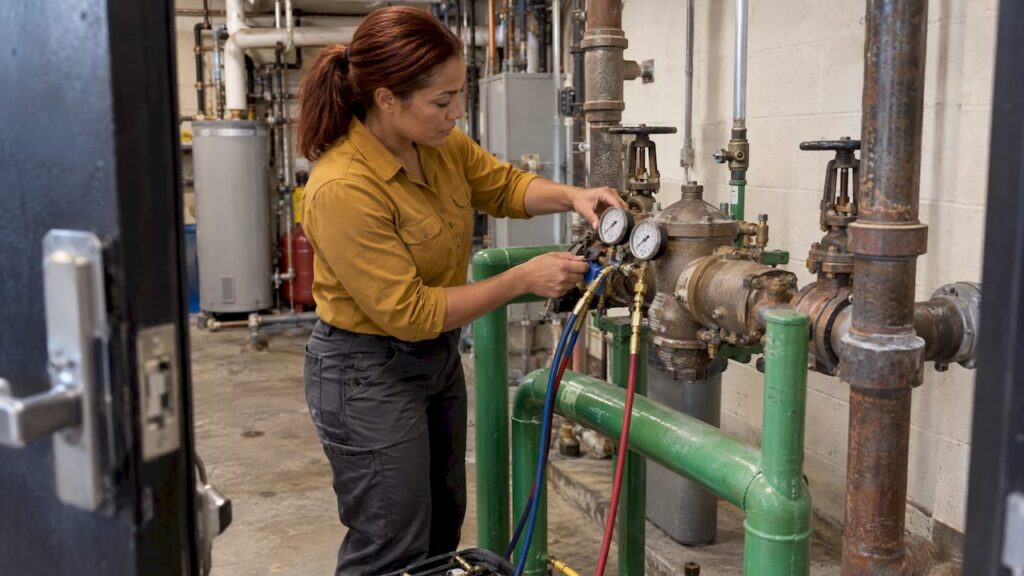
If you own a building in Camden, New Jersey, with a backflow preventer, the rules come from the state, not from a city ordinance. Your device must be tested by a tester certified through an agency the NJDEP approves. The results must reach your water supplier and the administrative authority, and a failed device must be fixed and retested quickly. The exact test schedule depends on your connection type and your water supplier, so confirm it before you book.
This guide is for Camden-area homeowners, landlords and property managers. It walks through what the rule says, who may test, what to do after a failure, and what the work typically costs.
TL;DR
- Camden follows New Jersey’s state rule, N.J.A.C. 7:10-10.6, for testing physical connection installations.
- Owners cannot test their own device. A tester holding a certificate from an NJDEP-approved certifying agency must do it.
- Test results go to the administrative authority and the water supplier within 5 days of the test, and a failed device needs repair and retesting within 30 days.
- Frequency varies: quarterly for many existing physical connection permits, so confirm your schedule with your supplier.
- Budget roughly $150 to $250 for a residential annual test and $200 to $450 per commercial device.
Table of Contents
- Who sets the rules in Camden
- What N.J.A.C. 7:10-10.6 requires
- Who is allowed to test your device
- Why a regular plumber is not enough
- Perspective: what we see in the field
- What it costs
- Your Camden compliance checklist
- Protecting the device between tests
- Book testing with us
- FAQ
- Sources
Who sets the rules in Camden
There is no separate Camden backflow code to look up. The State of New Jersey runs the program through the NJDEP’s physical connection program, and your water supplier enforces it at the meter. In much of Camden that supplier is New Jersey American Water, though some properties are served by other systems, so check your water bill.
Three parties share the work:
- The water supplier monitors the distribution system and receives your test reports.
- The administrative authority receives the same results under the state rule.
- You, the owner, carry the responsibility for having on-site devices tested and maintained. New Jersey American Water’s cross-connection guidance makes the point that unprotected cross-connections are prohibited and that everyone has a part in preventing them.
Do not wait for a notice. Failure to provide compliant results can lead to service disconnection, so the safe habit is to schedule the test yourself.
What N.J.A.C. 7:10-10.6 requires
The rule covers inspection and testing of physical connection installations. In plain terms, it asks for the following.
Testing frequency
For existing physical connection permits, the rule calls for testing at least once every three months. That is why you will see “quarterly” in the paperwork for many high-hazard commercial facilities. Other devices, such as a typical residential lawn irrigation preventer, are often put on an annual schedule through your supplier or local code officials. The state’s Department of Community Affairs also publishes a bulletin on testing backflow preventers under the Uniform Construction Code, which is a separate track from the water supply rule.

Because the schedules differ by device and by setting, ask your supplier in writing which frequency applies to your account. Then keep that answer with your records.
Internal inspection
A pressure test is not the same as an internal inspection. The internal inspection means dismantling the device to check parts such as clappers, discs and facing rings. Under the rule it is generally tied to a six-month cycle before permit renewal, and reduced pressure zone assemblies may be exempt unless the supplier requires it or during routine maintenance. Many managers forget to budget for it and get a surprise non-compliance notice.
Reporting deadline
Under N.J.A.C. 7:10-10.6(b)(3), results must be mailed to the administrative authority and the water supplier within 5 days of the test. A test that is done but never filed counts as a test that never happened. Ask your tester whether they file for you.
Witnessed tests
The administrative authority may require that a representative be present to witness a test. If your supplier asks for this, you arrange the appointment. Tell your tester early so the visit can be scheduled around the witness.
Failed devices
If a device fails, the owner must have it repaired and retested within 30 days, or risk water service disconnection. Thirty days passes fast when parts must be ordered, which is one reason a tester who carries parts matters.
Who is allowed to test your device
You cannot test it yourself, even if you are handy. State rules require inspections, testing and repairs to be done by a person holding a valid backflow prevention device tester certificate. The certificate must come from an agency the NJDEP has approved under N.J.A.C. 7:10-10.8. The NJDEP lists those agencies, which include the New England Water Works Association and the American Society of Sanitary Engineering, along with several regional training centers.
Before you book:
- Ask for the tester’s certification number and the agency that issued it.
- Confirm the certificate is current.
- Ask who files the report and when.
- Ask whether they can repair or rebuild on the same visit.
An unqualified tester can hand you a report that the water authority rejects, and you pay twice.
Why a regular plumber is not enough
A backflow preventer protects the public water supply, so it is held to certification and reporting standards that ordinary plumbing work is not. A plumbing repair receipt does not prove compliance. A signed test report that reached the supplier does. Keep every receipt and signed report for each device, because they are what you show during an inspection.
Perspective: what we see in the field
Most of the trouble we see is not a failed device. It is paperwork. Owners have the test done and assume it is finished, then the supplier never receives the report and a notice arrives weeks later. We treat the filing as part of the job, which is why we file test reports directly with the water authority.

The second pattern is delay after a failure. A rubber part wears out, the 30-day window starts, and the owner waits on a supply order. We stock OEM parts so most repairs and rebuilds happen in the same visit.
Third, property managers with many buildings lose track of which device is on which schedule. A single list of devices, due dates, supplier contacts and last report dates solves most of it. If you manage several properties, we offer consolidated billing, and our property manager compliance page explains how we confirm filing.
— Jordan
What it costs
Prices vary with device size, access and whether repairs are needed. These are our published ranges:
| Service | Published range |
|---|---|
| Annual residential certification test | $150 to $250 |
| Commercial device testing | $200 to $450 per device |
| Rebuild kit service (residential) | $125 to $250 |
| Protective enclosure installation | $200 to $500 |
| Residential installation | $300 to $800 |
You can see the details on our pricing FAQ and on the page about installing, testing and rebuilding costs. For multiple properties, our backflow testing budget guide shows how to plan the year.
A tip for budgeting: add the internal inspection and a contingency for one repair or rebuild per site. It is cheaper than an emergency visit near a disconnection deadline.
Your Camden compliance checklist
- Find your water supplier on your bill and ask which test frequency applies to each device.
- Locate each device and note its type, size and any permit number.
- Hire a tester with a current certificate from an NJDEP-approved agency.
- Be present, or arrange access, and arrange a witness if the authority requires one.
- Make sure the report is filed within 5 days.
- If the device fails, repair and retest inside 30 days.
- File the signed report and receipts where you can find them.
Protecting the device between tests
Outdoor devices can freeze, get damaged or be tampered with. A protective enclosure helps, and some situations raise questions about what the rules say. Our page on backflow enclosure requirements in NJ covers that, and we install custom enclosures across the state. If you receive a notice, read our guide on what to do after a backflow violation notice. Replacing a device usually involves a permit, covered in what to file for a replacement permit.
Book testing with us
We test, certify, repair, rebuild and install enclosures for residential, commercial and multi-unit properties in New Jersey. We are family-owned, licensed and insured, and we offer same-day service and emergency visits. Start with our backflow testing and certification service or contact us to schedule.
FAQ
How often does a backflow preventer in Camden need testing?
The state rule requires testing at least every three months for existing physical connection permits. Other devices may be on an annual schedule set through your supplier or code officials. Ask your water supplier which applies to your device.
Can I test my own backflow preventer?
No. State rules require a tester holding a certificate from an NJDEP-approved certifying agency. Owners may not perform the inspection, testing or repairs themselves.
What happens if my device fails the test?
You must repair and retest it within 30 days. If you do not, your water service can be disconnected. Ask your tester to bring parts so the repair can happen on the same visit.
Who sends the results to the water supplier?
The rule requires results to reach the administrative authority and the water supplier within 5 days of the test. Ask your tester in advance whether they file for you. We file reports directly with the water authority.
Do I need an internal inspection as well as a pressure test?
Often yes for commercial systems. It involves dismantling the device, and the rule generally ties it to a six-month cycle before permit renewal. Reduced pressure zone assemblies may be exempt unless your supplier requires it.
Sources
- NJDEP physical connection program
- NJDEP certified backflow prevention device testers
- N.J.A.C. 7:10-10.6, Legal Information Institute
- New Jersey American Water: Cross Connection and Backflow Prevention
- NJ DCA Bulletin 99-2: Testing of Backflow Preventers