
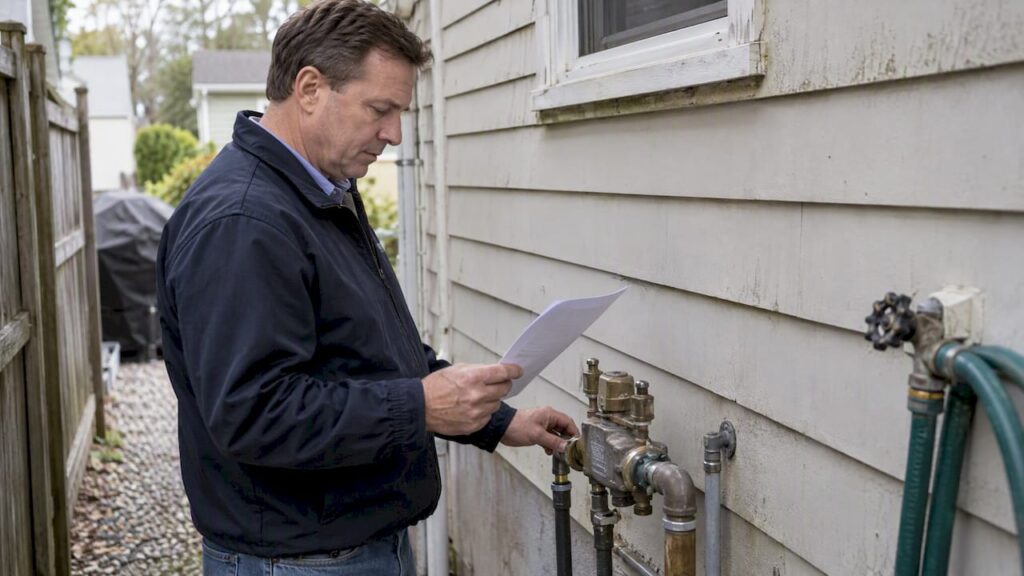
A backflow violation notice in New Jersey almost always means one thing: your municipality or water utility has no current, passing test report on file for your backflow preventer. The fix is usually simple. Hire a tester recognized by the state, have the device tested (and repaired if it fails), and get the paperwork to the right office before the deadline on your letter.
This guide explains what the notice is actually telling you, who is allowed to do the work, what it costs, and how to avoid a repeat next year. It is written for owners of homes and small buildings with a device, and for property managers handling several addresses.
TL;DR
- A violation notice usually means the annual test result was never recorded, not that your device is necessarily broken.
- The test must be done by a tester certified through an agency the NJDEP recognizes, and the result must reach the office named on your notice.
- If the device fails, repair or replacement comes first. A replacement device needs its own permit.
- Read the deadline on your letter and book now. Waiting for a second or formal notice only adds pressure and possible fees.
- Our published ranges: $150 to $250 for an annual residential certification test, $200 to $450 per device for commercial testing.
Table of Contents
- What a backflow violation notice actually means
- First steps in the first week
- Who can legally test your backflow preventer
- What happens during the test
- When the device fails: repair, rebuild or replace
- Special case: private wells and Physical Connection Permits
- What it costs
- Property managers: handling several notices at once
- Perspective: what we see after a notice arrives
- Getting help with your notice
- Mistakes that keep a violation open
- FAQ
- Sources
What a backflow violation notice actually means
A backflow preventer is a valve assembly that keeps water from flowing backward from your plumbing or sprinkler system into the public supply. In New Jersey, devices designed to isolate cross-connections between the water supply and potential contaminants must be tested annually, and each passing test supports a Certificate of Compliance that is valid for one year. The state’s model reminder notice for municipalities is built around exactly that: the annual test has not been recorded, so the certificate has lapsed.
That distinction matters. A notice does not usually say your device is leaking or unsafe. It says the proof of testing is missing. A device that works perfectly but has no filed report is still out of compliance on paper.
The notice can come from two places, and they are not the same:
- Your municipality’s construction office. The plumbing subcode official (or the fire subcode official for dedicated fire lines) tracks Certificates of Compliance under the Uniform Construction Code.
- Your water utility. Many utilities run their own cross-connection programs and send their own letters, with their own forms and deadlines.
Look at the letterhead and the return address. That tells you where the test report must go.
Does your property even need annual testing?
Not every device is on the annual list. The state’s Bulletin 99-2 says testable backflow preventers serving one- and two-family dwellings are not required to be tested annually under the construction code. Many residential owners are still tested annually because their water utility requires it, or because the device is on an irrigation or fire line the utility tracks.
If you own a single-family home and received a notice, do not ignore it and do not assume it is a mistake. Call the office that sent it, ask which rule it relies on, and ask what they need from you. If they confirm a test is required, book it.
Commercial buildings, multi-unit properties, and anything with a fire sprinkler system or an RPZ assembly on a high-hazard connection should assume annual testing applies.
First steps in the first week
- Find the deadline. Notices typically state a response window. Write the date down and work backward.
- Identify the device. Note its location (basement, mechanical room, outside near the meter, irrigation line, fire riser), make, model and serial number. Your tester will need these for the report.
- Find last year’s report. If a prior Certificate of Compliance exists, the expiration date shows how long you have been lapsed.
- Ask for the official form. Municipal offices often provide the test report form with the reminder. Use it. Construction Code Communicator guidance points out that a non-standard form can be rejected if it fails to capture the data points the code requires.
- Book a certified tester. Details on who qualifies are below.
- Tell the office when the test is scheduled. More on that in a moment, because it can save you a second visit.
Who can legally test your backflow preventer
New Jersey does not certify testers directly. The NJDEP recognizes certifying agencies, and a tester must hold a valid certificate from one of them. The NJDEP list of certified backflow prevention device testers names five agencies: the New England Water Works Association, the American Society of Sanitary Engineering, the Plumbers & Pipefitters Local #9 Training Center, Kruger’s Training Academy, and Veterans Training Group.
Before you hire anyone, ask three questions:
- Which of those agencies issued your certificate, and is it current?
- Will you file the report with my municipality or utility, or do I have to?
- If the device fails, can you repair it on the same visit?
A general handyman or a plumber without a tester certificate cannot produce a report your municipality will accept. You can also not do the test yourself and expect it to count. Inspectors are not permitted to perform the test either. Under the state bulletin, their role is to make sure a qualified individual tested the device, either by witnessing it or by receiving a certification with the device type and location, test date, results, and the tester’s name, qualifications and signature.
What happens during the test
A typical test takes a short visit. The tester connects calibrated gauges to the test cocks on the device, checks that the check valves and relief valve hold at the required pressures, and records the readings. The water is shut off briefly while this happens, so tell tenants or staff beforehand.
There are three outcomes:
| Result | What it means | What happens next |
|---|---|---|
| Pass | Device holds as required | Report is completed and filed, Certificate of Compliance can be issued |
| Fail, minor | Worn seat, disc or spring | Rebuild with a repair kit, retest, then file |
| Fail, major | Damaged body or obsolete device | Replacement, with a permit, then test and file |
A retest after repair is normal and is usually done right away when the tester carries the parts. Having common parts on the truck is what turns a three-visit saga into a one-visit fix.
When the device fails: repair, rebuild or replace
A failed test does not clear the violation. The device must be repaired or replaced, then pass a test.

Rebuild. For many failures the internal parts (rubber seats, discs, springs, seals) are worn and a rebuild kit restores the assembly. This is the cheaper path. Our residential rebuild kit service is listed at $125 to $250.
Replacement. If the body is corroded, cracked or no longer serviceable, you replace the device. This is where owners get tripped up. According to Bulletin 99-2, a permit is required for backflow preventer installation. Replacing a device on a dedicated fire-protection line also involves the fire protection subcode, while domestic and combination lines fall under the plumbing subcode. A DIY swap or a non-specialist installer can put you back in violation in a new way.
Freeze and tamper damage. Outdoor devices in New Jersey winters often fail because of freezing. A protective enclosure is the usual prevention. Our protective enclosure installation is listed at $200 to $500.
Water pressure can also play a part in repeated failures and relief valve discharge. If your home has pressure problems, how a pressure reducing valve is set is worth understanding before you speak with your plumber.
Sprinkler systems: check for a forward flow test connection
If your building has an automatic sprinkler system, the backflow preventer needs a way to perform a forward flow test. The Division of Codes and Standards has noted that some sprinkler systems were installed without a means to forward flow test their backflow preventers. If yours is one of them, the annual certification cannot be completed until the piping is modified. Ask your tester to check for this connection early, not on the deadline day.
Special case: private wells and Physical Connection Permits
Some facilities have an unapproved water supply, such as a private well, alongside public water. These need a Physical Connection Permit from the NJDEP, renewed annually, and the backflow device is tested quarterly instead of annually, as described on the NJDEP physical connection page. This applies to specific facilities, not typical private residences. If your letter mentions a Physical Connection Permit, tell your tester at the first call.
What it costs
Prices vary with device type, size, access and whether repairs are needed. These are the ranges we publish:
| Service | Published range |
|---|---|
| Annual residential certification test | $150 to $250 |
| Commercial device testing | $200 to $450 per device |
| Rebuild kit service (residential) | $125 to $250 |
| Protective enclosure installation | $200 to $500 |
| Residential installation | $300 to $800 |
Repairs and rebuilds beyond the residential kit service, and custom enclosures, are quoted case by case. Treat any quote far below these ranges with caution: a cheap test that is rejected by your municipality costs you twice.
Property managers: handling several notices at once
If you manage multiple buildings, a batch of notices can arrive in the same month. A few habits keep this under control:
- Keep a device register. One line per device: address, location, type, size, last test date, certificate expiration.
- Calendar the expiry, not the notice. The state’s reminder logic is that the certificate is valid for a year. Book the test 60 days before it lapses.
- Share the test time with the municipality. Municipal guidance notes that the plumbing subcode official has discretion to witness the performance test. The state municipal procedures manual covers the notice of violation process, and giving the office your scheduled time lets them attend if they wish, which can speed up renewal of the certificate.
- Use one vendor with consolidated billing. One invoice, one set of reports, one contact.
- Check fire lines separately. They may fall under a different subcode official than your domestic lines.
Perspective: what we see after a notice arrives
Most owners who call us after a notice are not negligent. They moved in, bought the building, changed management companies, or never knew the device was on a list. The letter feels like an accusation, and it is really a to-do item with a date on it.
Three things make the difference between a quick fix and a drawn-out one. First, act on the first letter. Second, get the right tester the first time, one recognized by the state and able to file the report directly with the water authority or municipality. Third, have the parts. Much of the delay people complain about comes from a failed test followed by a wait for components and a second visit. We stock OEM parts so most repairs and rebuilds can be done in the same visit, and we handle the filing so you are not left chasing a form.
We are a family-owned, licensed and insured New Jersey company, and we serve homes, commercial properties and multi-unit buildings across the state, including emergency calls.
— Jordan
Getting help with your notice
If you have a notice in hand, we can test the device, rebuild or replace it if it fails, and file the report with your water authority. Same-day service is often possible. Start with our backflow preventer testing and certification page, or see published testing, rebuild and installation costs before you call. If your outdoor device keeps freezing, look at our custom backflow preventer enclosures.
Mistakes that keep a violation open
- Testing but not filing. A passing test that never reaches the office does not clear anything. Get confirmation of receipt.
- Using the wrong form. Use the municipal form when one is provided.
- Hiring an uncertified tester. Check the certifying agency against the NJDEP list.
- Replacing a device without a permit. Replacement is construction work.
- Waiting for the formal notice. The reminder is the easy stage.
- Ignoring the sprinkler test connection. An old system may need modification before it can be certified.
- Forgetting next year. Put the new expiration date in your calendar the day the certificate arrives.
FAQ
Is backflow testing required in NJ?
Yes, for devices designed to isolate cross-connections, annual testing is required under the state’s construction code, and a Certificate of Compliance is valid for one year. The state bulletin exempts testable devices on one- and two-family dwellings from the annual construction code requirement, though a water utility may still require testing. Check your letter for the rule your notice relies on.
Can I do backflow testing myself?
No, not for compliance. The test must be performed by a tester certified through an agency recognized by the NJDEP, and the report must carry their qualifications and signature. A report you produce yourself will not be accepted.
Do I need a permit to install or replace a backflow preventer?
Yes. State guidance says a permit is required for backflow preventer installation, so replacement counts. On a dedicated fire line, the fire protection subcode is involved. Ask your installer to handle the permit.
What if I already tested but still got a notice?
The report may not have been filed, may have been on the wrong form, or may have gone to the wrong office. Contact the office on the notice, ask what they have on record, and have your tester resend the report in the format they require.
Sources
- Model annual backflow testing reminder, NJ Department of Community Affairs
- Bulletin 99-2, Testing of Backflow Preventers (search copy)
- Bulletin 99-2, Testing of Backflow Preventers
- NJDEP certified backflow prevention device testers
- NJDEP Physical Connection Permit Processing
- Construction Code Communicator, Summer 2025
- NJ Municipal Procedures Manual
Pingback: Nursing Home Backflow Testing in NJ: What Operators Must Know
Pingback: Soda Fountain Backflow Requirements in New Jersey