
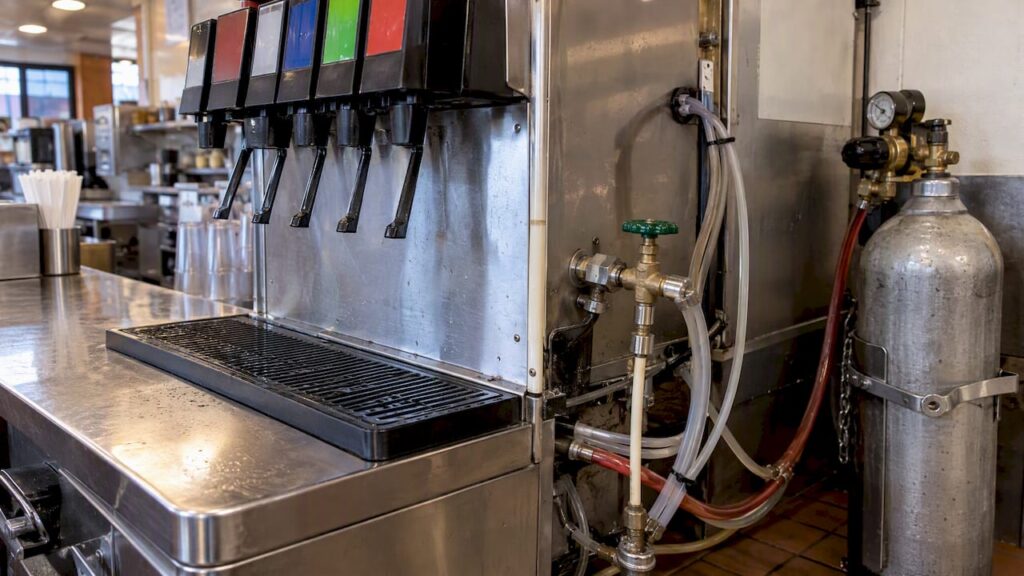
If you run a restaurant, deli, convenience store, or any property with a carbonated beverage dispenser in New Jersey, the water line feeding that machine needs backflow protection. For carbonated drinks, that means an ASSE 1022 backflow preventer (built into the machine or installed on the supply line) or an air gap. A standard dual check valve is not enough. Below we cover how to tell which one you have, what the inspector looks for, and what to budget to keep it compliant.
TL;DR
- Carbonated dispensers need an ASSE 1022 vented backflow preventer or an air gap. Standard dual check valves are not considered adequate because of CO2.
- Check the machine’s nameplate first. If it carries an integral ASSE 1022 device and that device is maintained, you do not need a second one on the line.
- Piping downstream of the device must be acid-resistant. Copper and copper alloys are the wrong material.
- Your local water utility can ask for stricter protection or more frequent testing than the state baseline, so call them before a big build-out.
- Our published commercial device testing runs $200–$450 per device. Rebuild kit service for residential devices runs $125–$250.
Table of Contents
- Why a soda machine is a backflow risk
- What New Jersey requires
- Integral or inline: check the nameplate first
- ASSE 1022 versus ASSE 1024
- Piping and installation details that fail inspections
- Testing and maintenance after install
- What it costs
- Our perspective: treat the soda line as a compliance item, not a fixture
- Book testing, repair, or an enclosure
- FAQ
- Sources
Why a soda machine is a backflow risk
A post-mix soda dispenser mixes syrup with water and injects carbon dioxide under high pressure. That puts a pressurized gas source right next to your drinking water. If the check valves on the supply line fail and nothing vents, CO2 can be pushed backward into the building’s potable lines, and potentially beyond. Industry guidance describes pressurized CO2 forced back into potable water lines as a hazard that can damage pipe and create a public health problem.
There is a second problem. Carbonated water is acidic and attacks copper. In a backflow event, that water can pull copper out of the plumbing and carry it into the supply. The same source notes that regulations call for acid-resistant materials downstream of the preventer, and specifically no copper or copper alloy piping.

This is also why a shared water branch matters. If several beverage outlets hang off the same line, a single failed device can affect all of them.
What New Jersey requires
New Jersey backflow rules sit in two systems, and owners often mix them up.
Inside the building. Everyday cross-connection control in plumbing falls under the Uniform Construction Code’s Plumbing Subcode, N.J.A.C. 5:23-3.15. A soda fountain is normally handled here, through your municipal plumbing inspector. The research behind this article reports that the National Standard Plumbing Code, as used in New Jersey, requires carbonated beverage dispenser supply lines to be protected by an ASSE 1022 device or an air gap. Your inspector has the final say on how that applies to your job, so confirm with your local construction office.
At the property line. The NJDEP regulates “physical connections,” meaning major connections between a public water supply and an unapproved water source such as a private well or an industrial process. Those come with permits and certified testing. An individual soda fountain generally falls outside that permit trigger, but it is still subject to local plumbing inspection. You can read the DEP’s own guidance on physical connection permit triggers.

The state also publishes a technical bulletin on liquid CO2 carbonated beverage systems through the Department of Community Affairs. If your CO2 tank storage is in question, that is a separate document to read alongside the water-side rules.
Your water utility can ask for more
The state baseline is not always the end of it. Under the Water Quality Accountability Act, utilities face growing pressure to keep their systems clean, and the rules for water purveyors include valve and system inspection duties. In practice, a purveyor that views your facility as a cross-connection hazard can require tighter protection or more frequent testing. For a larger commercial property, such as a food court, a stadium concession, or a multi-tenant building, call the utility before you finalize anything.
Integral or inline: check the nameplate first
This is the question that saves owners the most money. Many modern commercial soda machines ship with an integral, built-in ASSE 1022 device. Inspectors look for the label or certification stamp on the device itself.
Here is the practical sequence:
- Find the machine’s nameplate and any marking on the carbonator or water inlet assembly.
- Look for an ASSE 1022 mark or a statement that the unit has an integral backflow preventer.
- If you find it, you generally do not need another device on the supply line, as long as the internal device is maintained.
- If you find no marking, an external inline ASSE 1022 device is required. Do not assume the machine is covered because it is new.
- If you use an air gap instead, it has to be a true physical gap, not a hose that can sag into a drain or sink.
If the nameplate is worn, ask the equipment supplier for the spec sheet and keep a copy with your inspection records.
ASSE 1022 versus ASSE 1024
Owners also get confused about which device belongs where. The difference comes down to the vent.
| ASSE 1022 | ASSE 1024 | |
|---|---|---|
| Type | Dual check with atmospheric vent | Dual check, no vent |
| Typical use | Carbonated beverage dispensers | Non-carbonated machines such as ice makers and coffee equipment |
| Drain needed | Often yes, for vent discharge | Generally no |
| Failure signal | Leaks visibly from the vent port | No built-in visual indicator |
The vent port on an ASSE 1022 device is a safety feature. If the secondary check valve fails, water leaks from the port, which gives you a visible warning. The tradeoff is that the device has to discharge somewhere. Owners often overlook the drain until the inspector asks for one.
For non-carbonated machines, Working Pressure magazine reports that revised standards and the 2024 Uniform Plumbing Code now allow a dual check (ASSE 1024) or an air gap in many cases. That is easier to install where drains are scarce. Do not stretch that to carbonated equipment. If a machine mixes in CO2, it needs the vented device or an air gap.
One more point from model code language: food service equipment connected to potable water is listed in one model code as needing a vented double check valve or equivalent. That list includes coffee machines, iced tea machines, and slush machines. So the soda fountain is not the only machine on your line that may need attention. Which edition your town enforces is a question for your plumbing inspector.
Piping and installation details that fail inspections
Most failed soda fountain inspections come down to details around the device, not the device itself.
- Copper downstream. Any copper or copper alloy between the preventer and the carbonator is a problem. Use acid-resistant materials such as stainless steel or approved plastic tubing.
- No drain for the vent. An ASSE 1022 device with a vent port needs a safe discharge path. Plan this before the machine goes in.
- Wrong orientation or location. Follow the manufacturer’s instructions on mounting and keep the vent port clear and visible. You want to see a leak if one happens.
- Pressure and temperature mismatch. Check the device’s rated range. A typical ASSE 1022 unit is specified for working pressures of 10 to 200 psig and temperatures up to 130°F, but ratings vary by model.
- Shared branches. If several beverage outlets share a branch, a copper reading at multiple outlets can point to a reverse-flow path. Treat that as a reason to have the whole branch evaluated.
Testing and maintenance after install
Many owners assume compliance ends on installation day. It does not. An integral device is only a defense if it still works, and the vent port only warns you if someone is looking at it.
Build these habits into your routine:
- Ask whoever services your soda system to check the vent port for weeping at every visit.
- Keep installation records, spec sheets, and any test or inspection reports in one folder.
- Ask your local construction office and your water utility whether they require periodic testing or reports for your type of device. Requirements differ by town and by purveyor.
- If a device weeps from the vent, stops holding pressure, or was installed backward, stop treating it as protection. Have it repaired or rebuilt.
The Department of Community Affairs keeps a list of code technical bulletins, including one on testing of backflow preventers. It is worth a look when you want the state’s own wording on device testing.
If you got a violation notice, our page on what to do after a backflow violation notice in NJ walks through the next steps.
What it costs
Costs depend on the device type, the access, and whether the work is a test, a rebuild, or a new install. Our published ranges are:
| Service | Published price |
|---|---|
| Commercial device testing | $200–$450 per device |
| Rebuild kit service (residential) | $125–$250 |
| Protective enclosure installation | $200–$500 |
| Residential installation | $300–$800 |
These are published ranges, not quotes. A soda fountain device in a tight back-of-house space can sit differently from an outdoor assembly, so ask for a quote on your actual setup. If you manage several properties, our backflow testing budget guide for property managers shows how to plan per-device costs across a portfolio.
Our perspective: treat the soda line as a compliance item, not a fixture
We test and repair backflow devices across New Jersey, and the pattern we see is consistent. Owners buy the machine, the installer connects it, and nobody puts the device on a calendar again. The first time anyone thinks about it is when an inspector, an insurer, or a water utility asks for paperwork.
Our advice is simple. Know what protects each beverage line. Check the nameplate before you pay for a second device. Keep the vent port visible and the drain clear. And if you manage more than one location, make one person responsible for the records, so a missing report does not become a violation.
What we do not recommend is guessing. A copper reading at several outlets, a weeping vent, or a machine with no marking are all reasons to have a licensed tester look at it the same week. We stock OEM parts so that repairs and rebuilds can often be finished in the same visit, which matters when the device feeds a machine that earns money every hour it is open.
— Jordan
Book testing, repair, or an enclosure
If you need a device tested, rebuilt, or replaced, see our backflow preventer testing and certification service. We are family-owned, licensed, and insured, and we file test reports directly with the water authority so the paperwork is not left to you. For outdoor assemblies that need weather or tamper protection, we also install custom backflow preventer enclosures. When you book, tell us the machine make and whether the nameplate shows an integral ASSE 1022 device, so we can confirm the scope of the visit.
Property managers handling several sites can start with our page on confirming backflow filings.
FAQ
Do soda fountains need a backflow preventer in New Jersey?
Yes. The water supply to a carbonated beverage dispenser must be protected by an ASSE 1022 backflow preventer or an air gap. If the machine has a certified integral device, that can satisfy the requirement. Otherwise you need an inline device on the supply line.
Can I use a regular dual check valve on a soda machine?
Not for carbonated drinks. A standard dual check has no vent, so CO2 can be forced backward if the checks fail. A dual check (ASSE 1024) is generally accepted for non-carbonated machines such as ice makers and coffee equipment.
Does the NJDEP regulate my soda fountain?
Usually the NJDEP’s permit process is aimed at larger physical connections, such as private wells or industrial processes. Individual soda fountains are typically handled by local plumbing inspection. Your water utility can still impose stricter rules if it sees a cross-connection hazard, so ask them.
Why does my backflow device drip?
On an ASSE 1022 device, water from the atmospheric vent port is the signal that the secondary check valve has failed. Have a licensed tester inspect it and rebuild or replace it rather than just routing the drip to a drain and ignoring it.
Sources
- ASSE 1022 backflow preventer data sheet
- Backflow Preventers with Beverage Dispensers, Working Pressure Magazine
- NJDEP regulatory guidance on physical connection permits
- NJDEP Water Quality Accountability Act, Chapter 133
- Liquid CO2 carbonated beverage systems, NJ Department of Community Affairs
- Protection From Equipment in Food Establishments, UpCodes
- NJ Department of Community Affairs code bulletins