
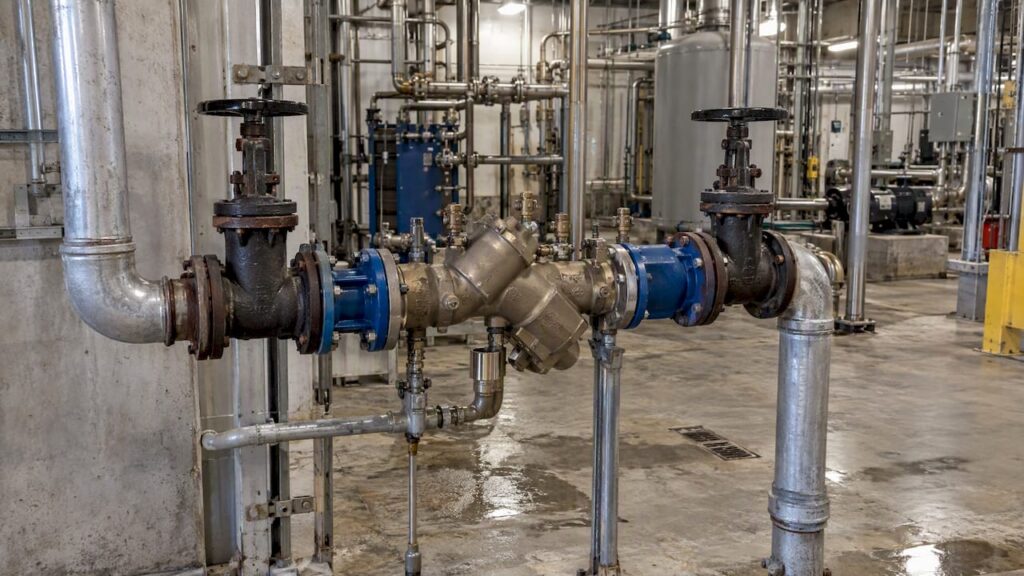
If your New Jersey manufacturing facility has a connection between the public water supply and any other water source or process system, state rules require approved backflow prevention on that connection. You hold a physical connection permit, a certified tester checks each device on a set schedule, and the results go to the right agencies. Fire lines carry their own extra tests. This guide walks through what applies to a plant, what to do each year, and what happens when a device fails.
TL;DR
- Manufacturing and storage facilities are on the NJDEP list of facilities with cross-connection hazards, so a testable, approved device is expected wherever process water can meet the public supply.
- Only a certified backflow prevention device tester may do the testing. Plumbing inspectors and in-house maintenance staff without that certificate cannot sign off.
- A failed device must be repaired and retested within 30 days, so know who stocks parts before it happens.
- Fire-protection assemblies need an annual forward flow test and an internal inspection every five years, on top of the regular device test.
Table of Contents
- Why manufacturing plants are singled out
- The physical connection permit
- Who is allowed to test
- What a test actually checks
- Fire protection lines: forward flow and the five-year inspection
- Annual compliance calendar for a plant
- When a device fails
- Why the Certificate of Compliance matters
- Our perspective
- Costs to plan for
- Protecting devices from the elements
- Book testing for your facility
- FAQ
- Sources
Why manufacturing plants are singled out
A backflow preventer exists to stop water from flowing the wrong way. In a plant, the risk is specific: cooling loops, boilers, wash-down systems, chemical mixing and product lines all sit a few fittings away from the potable supply. If pressure in the street main drops, water from those systems can be pulled back into the public system.
New Jersey treats that risk as a facility-level issue. NJDEP’s guidance on what triggers a physical connection permit includes an appendix of facility types with cross-connection hazards. It names 20 types of commercial manufacturing and storage facilities, among them automotive plants, beverage bottling, chemical plants and metals manufacturing. Where one of these has a connection between the public water system and industrial process water, an approved device such as a double check valve assembly or a reduced pressure zone assembly is required.
That guidance says it does not replace the underlying law, so treat it as a map and not a legal opinion. If your operation is unusual, ask NJDEP or your water purveyor how your specific connections are classified.
The physical connection permit
NJDEP runs the program that governs these connections. According to the department, the owner of a facility with an unapproved water supply and a public community water supply must obtain a physical connection permit. The same page states that private residences are exempt. Two details matter for plant managers:
- The permit is renewed annually.
- Each backflow prevention device covered by the permit must be tested quarterly, according to that NJDEP page.
Many owners assume “annual test” is the whole story, because that is what a water purveyor or a municipal inspector often asks for on ordinary commercial buildings. For a permitted facility, read your own permit conditions and confirm the frequency in writing with NJDEP. If you are unsure which schedule applies to which device, a tester who works with industrial accounts can sort it out in one site visit.
The devices usually sit where the public supply enters the facility, generally near the water meter on domestic lines and before the alarm check and siamese connection on fire lines, per the same NJDEP program page. Where a new or replacement device needs approval, the permit application process adds time, which is one more reason to repair rather than replace when repair is possible.
Who is allowed to test
Testing must be done by someone holding a valid backflow prevention device tester certificate. NJDEP lists the certifying agencies it approves under N.J.A.C. 7:10-10.8, and the current roster of certified testers is kept by those agencies. Before you book, ask for the tester’s certificate number and check it with the issuing agency.
Two misconceptions come up regularly:
“Our plumbing inspector can certify it.” No. The Department of Community Affairs states in Bulletin 99-2 that the inspector’s role is regulatory. The inspector checks that a qualified professional did the work, often by witnessing the test or by requiring a submitted certification before issuing the annual Certificate of Compliance.
“Any licensed plumber can do it.” Not automatically. A plumbing license and a backflow tester certificate are different credentials. Ask for the second one.
If your maintenance team is capable and curious, that is good for daily operations, but it does not replace a certified tester’s signature on the report.
What a test actually checks
The test is a short, procedural check of the device’s internal valves and relief mechanism. NJDEP’s tester procedure sheet starts with identifying the device: manufacturer, type, size, model, serial number and flow direction. The tester then verifies the upstream shutoff valve is open and water pressure is present, and with your permission closes the downstream shutoff valve to begin the sequence.
That last point is the operational one. Testing interrupts water downstream of the device for a short period. In a plant, that means:
- Tell production and maintenance leads the day and window before the tester arrives.
- Schedule around batch runs, CIP cycles, boiler operation and any process that cannot lose water mid-cycle.
- If a line cannot go down at all, discuss it ahead of time. A parallel assembly or a planned shutdown may be needed, and that is a design question to settle before the next test, not at the door.
- Keep the previous year’s report, device serial numbers and permit number at hand so the tester can match records.
Fire protection lines: forward flow and the five-year inspection
Most plants have a fire sprinkler system, and that system usually has its own backflow preventer. These carry additional requirements beyond the standard device test.
NFPA 25 requires that all backflow preventers in fire protection piping be exercised annually by a forward flow test at a minimum flow rate equal to the system demand, including hose stream demand where applicable. The purpose is different from the device test. The device test shows the check valves hold; the forward flow test shows the assembly does not restrict flow when the sprinklers need it.
Contractors often combine the two visits, but, as Brooks Equipment notes, the forward flow requirement is frequently overlooked or misunderstood. If your last report says only that the device passed, check whether a forward flow result is recorded.
The same Brooks article states that backflow preventers also need an internal inspection every five years to confirm all components operate correctly. That inspection is where debris and aging seals get found. The annual test checks function but will rarely reveal internal wear. Stagnant water in sprinkler piping encourages corrosion and bacteria, and over time that can make check valves stick, which is the argument for treating the five-year teardown as maintenance, not an optional extra.

There is also a gray area. The National Fire Sprinkler Association points out that contractors interpret “system demand” differently during forward flow tests. Ask your contractor which demand figure they used and where it is recorded. A documented flow is easier to defend than a cursory one if an insurer or fire official asks. NFPA’s own guide to maintaining a sprinkler system lists the related inspection and testing items by frequency, which makes a useful checklist for your fire protection vendor.
Annual compliance calendar for a plant
| Task | Frequency | Who does it |
|---|---|---|
| Physical connection permit renewal | Annually | Facility owner, with NJDEP |
| Backflow device test, each device on the permit | Quarterly per NJDEP’s program page; confirm against your own permit | Certified tester |
| Fire line forward flow test | Annually | Qualified fire protection or backflow contractor |
| Internal inspection of fire line assemblies | Every 5 years | Qualified contractor |
| Test report filing | After each test | Tester or owner, as your purveyor requires |
| Repair and retest after failure | Within 30 days | Certified tester |
Put these on a shared maintenance calendar, not on one person’s memory. Plants lose compliance most often when the one employee who tracked the dates leaves.
When a device fails
A failed test is routine. It usually means a worn check valve seat, a fouled disc or a relief valve that needs a kit. What matters is the clock. Under N.J.A.C. 7:10-10.6, a device that fails must be repaired and retested within 30 days. If it cannot be repaired, a new device must be installed and approved by NJDEP under a new permit application, which takes far longer than a rebuild.
Practical steps after a fail:
- Get the failed-test report with the readings and the reason for the failure.
- Ask whether a rebuild kit will fix it, and whether the parts are in the truck.
- Schedule the repair and the retest as close together as possible. Ideally the same visit.
- File the passing report and keep the failed one with it.
- If the device is old, discontinued or repeatedly failing, price a replacement against repeated rebuilds before the 30 days run out.
Why the Certificate of Compliance matters
The Department of Community Affairs frames testing as a regulatory compliance mandate, not a service choice. Inspectors rely on your submitted certification from a qualified tester to issue the annual Certificate of Compliance. Without it, a facility can face enforcement. For a plant, that can touch more than water: insurers, lenders and customers’ supplier audits all ask for proof that safety systems are current.
Our perspective
We test and repair backflow devices across New Jersey, and the plants that struggle are rarely the ones with a failing device. They are the ones with a missing paper trail: a permit nobody renewed, a forward flow test that never happened, a report that never reached the water authority.
Three habits separate the calm facilities from the stressed ones. First, they know how many devices they have and where each one is. Second, they book testing early enough that a failure leaves weeks, not days, in the 30-day window. Third, they use a tester who carries common OEM parts, so a failed check valve becomes a same-visit rebuild instead of a second trip and a waiting period.
That is how we work: same-day service where we can, OEM parts on the truck, and we handle the filing with the water authority so the report does not sit in someone’s inbox. If you manage several sites, we can consolidate billing. Our advice is simple: do not wait for the purveyor’s notice. Walk your plant once, list every device, and put the dates on a calendar.
— Jordan
Costs to plan for
Our published ranges, for budgeting only. Your actual price depends on device size, type and access.
- Commercial device testing: $200 to $450 per device, one-off. See our pricing FAQ.
- Protective enclosure installation: $200 to $500, one-off.
- Rebuild and repair work for commercial devices has no published price. Rebuild costs depend on the device, so request a quote after a failed test.
Because testing is per device, a plant with a domestic line, a process line and a fire line should multiply accordingly, and a quarterly schedule multiplies again. Compare that with the cost of an interrupted production day or an enforcement notice, and the budget line is small.
One adjacent note: people sometimes confuse backflow preventers with pressure regulators when they see a valve on the incoming line. They do different jobs. A regulator controls pressure; a backflow assembly protects the supply. If you want a plain-language overview of the other device, this breakdown of what a water pressure regulator costs is a useful reference, though it does not cover permits or testing in New Jersey.
Protecting devices from the elements
Outdoor assemblies at loading docks, yards and building corners get hit by freezing weather, vehicles and tampering. A damaged or frozen device means a failed test and an unplanned repair. A properly sized protective enclosure reduces that risk, and it keeps the assembly accessible for the tester, which also speeds up annual visits. Talk to your tester before building one so the clearances match what the device needs.

Book testing for your facility
We test, certify, repair and rebuild backflow preventers for commercial and multi-unit properties across New Jersey, and we file reports directly with water authorities. If you have a plant, a warehouse or a mixed portfolio, start with our backflow preventer testing and certification service, or see how custom enclosures can protect devices outdoors. For repair pricing context, our rebuild and installation cost page explains what drives the numbers.
FAQ
Is backflow testing required in NJ for a manufacturing facility?
Yes, where the facility has a connection between the public water supply and another water source or process system. NJDEP requires a physical connection permit for these facilities and testing of the devices by a certified tester. Confirm the exact frequency with NJDEP or your water purveyor, since NJDEP’s program page describes quarterly testing under the permit.
Can I test my own backflow preventer?
Not for compliance purposes. NJDEP requires testing by a certified backflow prevention device tester, and inspectors rely on that tester’s certification when issuing the Certificate of Compliance. Your staff can monitor the device and keep records, but the signed test must come from a certified tester.
What are the NFPA 25 requirements for backflow preventers on fire lines?
NFPA 25 requires that backflow preventers on fire protection piping be exercised annually with a forward flow test at the minimum system demand rate. An internal inspection every five years is also recommended by industry guidance such as Brooks Equipment’s technical article. Ask your contractor to document the flow rate used.
Do all plumbers do backflow testing?
No. Testing requires a separate backflow tester certificate issued by an agency NJDEP approves. A plumbing license alone does not cover it, so ask for the certificate number before you hire anyone.
Sources
- NJDEP: What triggers a physical connection permit
- NJDEP: Physical connection permit processing
- NJDEP: Certified backflow prevention device testers
- NJDEP: Backflow tester procedure sheet
- N.J.A.C. 7:10-10.6, inspection and testing requirements
- NJ DCA Bulletin 99-2, testing of backflow preventers
- Brooks Equipment: Backflow inspection, testing and maintenance in fire systems
- National Fire Sprinkler Association: To Flow or Not to Flow
- NFPA: NFPA 25 and properly maintaining a sprinkler system