
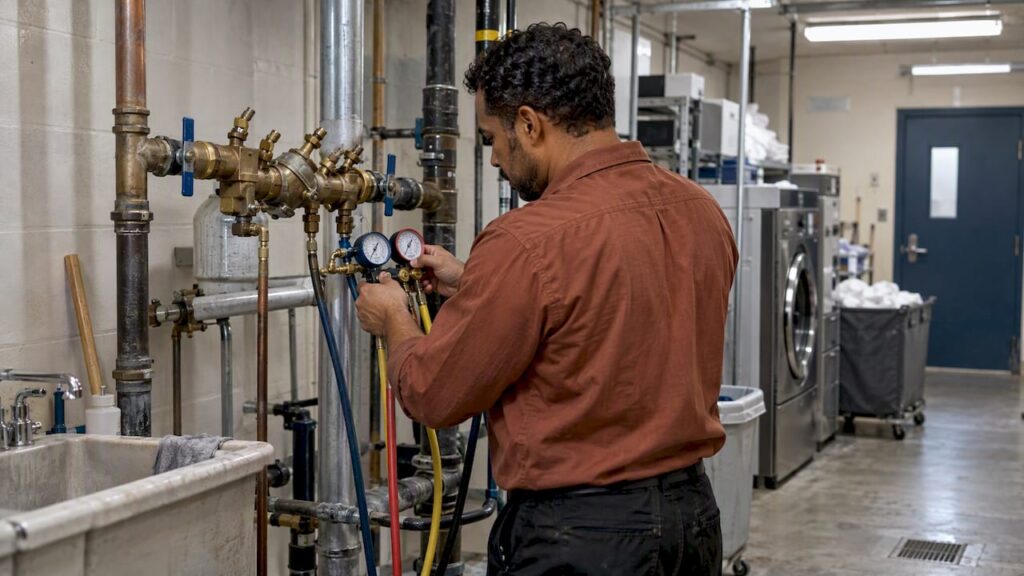
If you run a nursing home in New Jersey, backflow prevention is part of keeping your residents safe and your survey record clean. The devices on your water and fire lines need to be tested by a certified tester, the results need to be on file, and the paperwork needs to reach the right agency. Below we explain which rules apply, what the testing involves, what it costs, and how to avoid the gaps that cause trouble.
TL;DR
- New Jersey’s physical connection program requires a permit for facilities with an unapproved water supply alongside the public supply. The permit renews annually and each covered device is tested quarterly. Whether your building is covered depends on its plumbing, so confirm it with your water purveyor or the NJDEP.
- Testing must be done by a tester holding a valid backflow prevention device tester certificate.
- Fire sprinkler backflow preventers need an annual forward flow test, and the building must be built so that the test is possible.
- Backflow is one piece of a bigger infection control picture. CMS expects long-term care facilities to manage Legionella risk in their water systems.
- Keep every test report. The burden of showing compliance sits with the facility.
Table of Contents
- Why nursing homes get extra attention
- The rules that apply in New Jersey
- Where the devices usually are in a nursing home
- Containment and isolation: two layers
- Backflow is not the whole water safety story
- What testing day looks like
- What it costs
- Records: your file is your defense
- Our perspective
- Getting your facility on schedule
- FAQ
- Sources
Why nursing homes get extra attention
A backflow preventer stops water from flowing backward into the clean public supply, or into your own potable lines, from a source that might be contaminated. In a typical house the risk is a hose or an irrigation system. In a nursing home there are many more places where that can go wrong: boilers, laundry, kitchens, dialysis or therapy equipment, irrigation, and a fire protection system that holds stagnant water for years.
The residents make the difference. The CMS memo on Legionella explains that people at risk include those aged 50 or older, smokers, and people with chronic conditions. That describes much of a nursing home population. The New Jersey Department of Health also lists hospitals and long-term care facilities among the large buildings with complex water systems at higher risk.
So a failed check valve in a nursing home is not just a plumbing defect. It is an infection control issue, and surveyors and water authorities treat it that way.
The rules that apply in New Jersey
Several bodies touch your backflow devices. They overlap, so it helps to separate them.
NJDEP physical connection permits
New Jersey regulations require the owner of a facility that has an unapproved water supply and a public community water supply to get a physical connection permit. The NJDEP program page says the permit renews annually and each backflow device it covers must be tested quarterly. It also says testing must be done by a certified tester with a valid backflow prevention device tester certificate. The devices it describes are double check valve assemblies and reduced pressure zone (RPZ) assemblies, usually installed near the water meter on domestic lines and ahead of the alarm check and siamese connection on fire lines.

The results go on the state’s Certification of Inspection and Testing Results form, which cites N.J.S.A. 58:11-9.4. Your tester completes it and it is submitted as the form instructs.
Not every building is covered by a physical connection permit. The permit applies where there is an unapproved supply, such as a private well or a non-potable source, in addition to the public supply. The NJDEP also states that private residences are exempt. Whether your campus needs one depends on its water sources and connections. Ask your water purveyor or the NJDEP, and do not assume.
Uniform Construction Code testing
Separately, the Department of Community Affairs set out how backflow preventers are to be tested under the Uniform Construction Code in Bulletin 99-2, which references the plumbing subcode. Your local construction official enforces it, and municipal water utilities often add their own testing and reporting rules. Check what your utility asks for, and when.
Fire protection lines
Sprinkler systems have their own requirement. The DCA’s Construction Code Communicator says that backflow preventers on fire protection systems must undergo annual forward flow testing at the minimum flow rate under NFPA 25, documented on a Certificate of Compliance. It also warns that some systems were installed without any means to forward flow test, such as a test header or downstream connection. That can mean non-compliance and costly retrofits.

If your building has an older sprinkler system, ask your tester whether the forward flow test can be done at all before the test date, not on it.
Federal expectations from CMS
CMS does not tell you how often to test a backflow preventer. Its memo does require long-term care facilities to develop and follow policies and procedures that inhibit microbial growth in their water systems, and to perform a facility-wide water risk assessment to find where Legionella can grow. Working backflow prevention is a basic part of a defensible water management program. New Jersey’s health care construction rules also tie into this: N.J.A.C. 5:23-3.1 says construction or rehabilitation of health care facilities follows the code and the national design guidelines for health care facilities.
Where the devices usually are in a nursing home
Walk the building with a list. Most facilities have more devices than the administrator remembers.
| Location | Typical concern | Typical device |
|---|---|---|
| Domestic water service at the meter | Protect the public supply from the building | RPZ or double check valve assembly |
| Fire sprinkler service line | Stagnant, treated or dosed fire water | Double check or RPZ, with forward flow testing |
| Boiler feed and heating loops | Chemical treatment | RPZ |
| Commercial laundry and kitchen | Chemicals, carbonation, cross connections | Point-of-use or isolation devices |
| Irrigation | Fertilizer and ground contact | Backflow assembly on the irrigation line |
| Therapy pools or specialty equipment | Treated or non-potable water | Isolation protection |
The table is a planning aid, not a code list. Which device each location needs depends on your plumbing design and your water purveyor’s rules.
Containment and isolation: two layers
Protection at the meter is called containment. It keeps your building from affecting the public system. NJDEP guidance on physical connection triggers is the starting point for understanding when that is required. Inside a care facility there is a second concern: contamination moving from a high-risk zone, such as laundry or a lab area, into the rest of your own distribution system. Isolation devices at those zones address that. Meter-level protection alone leaves your residents exposed to internal cross connections, so we recommend asking your plumber or tester to review internal zones when the meter devices are tested.
Backflow is not the whole water safety story
The New Jersey Department of Health’s infection control program supports prevention in health care settings. Treat backflow testing as one part of water management, not a replacement for it.
Stagnation is the other half. The state’s guidance on building water systems with reduced operation covers flushing, hot water temperatures and what to do after a building has been shut down or run at low capacity. If you have empty wings or low occupancy, read it with your infection preventionist and your water management team. Questions about temperature setpoints and flushing frequency belong with them and with the Department of Health, not with a backflow tester.
What testing day looks like
- Inventory. List every device, its size, location and last test date. Include fire lines and irrigation.
- Scheduling. Pick a window that does not collide with surveys or major events. Testing shuts the water to the protected line for a short time, so tell the nursing and kitchen staff in advance.
- Testing. The certified tester checks each device against its pass criteria and records readings.
- Repair or rebuild if needed. Failed check valves and relief valves are usually fixed with a rebuild kit. Having parts on the truck avoids a second visit and a second shutdown.
- Reporting. The report goes to the water authority or agency that requires it, and a copy goes in your compliance file.
- Follow-up. Put the next due date on the calendar, quarterly where a physical connection permit applies and annually otherwise.
A failed test is not a violation by itself. A failed test that nobody fixes or reports is the problem. If you have already received a notice, see our guide to what to do after a backflow violation notice in NJ.
What it costs
Our published ranges, from our FAQ page, are $200–$450 per device for commercial device testing, and $125–$250 for a residential rebuild kit service. Protective enclosure installation runs $200–$500. Nursing homes are commercial properties, so the commercial testing range is the relevant one for your devices. Price depends on device type and size, access, and whether repairs are needed. Rebuilds and repairs for larger commercial devices do not have a published price, so we quote them after we see the device.
To budget for a facility with several devices, our backflow testing budget guide for property managers shows how per-device costs add up across a portfolio.
Records: your file is your defense
The state’s position, as reflected in DCA guidance, is that the facility owner carries the burden of showing compliance. Waiting for an inspector to flag a device is a bad plan. In practice that means:
- One binder or digital folder per building with every test report, dated and signed.
- A device register that matches the physical devices, with tags.
- Proof that reports were filed with the water authority, not just done.
- Repair invoices tied to the failed test they resolved.
- A named person responsible for due dates, with a backup.
For operators managing several buildings or a group of facilities, our page on backflow compliance and confirming filing for property managers explains how we handle filing and tracking.
Our perspective
We test devices in New Jersey buildings every week, and the pattern in care facilities is consistent. The device itself is rarely the cause of trouble. The cause is the gap around it: nobody knows how many devices the building has, the last report cannot be found, or the sprinkler line was built with no way to forward flow test.
Our advice is simple. Make one complete inventory, once. Have a certified tester check every device in a single visit, including fire lines, and ask for the forward flow question to be answered before test day. Rebuild failed devices on the spot with the right parts so water is not off twice. Then make sure the report is filed and a copy is in your file before the crew leaves the parking lot.
We are a family-owned, licensed and insured company, we stock OEM parts so most repairs and rebuilds are finished in the same visit, and we file test reports directly with water authorities. For a nursing home, that last part matters most. A passed test that never reached the authority does not help you at a survey.
— Jordan
Getting your facility on schedule
We test, certify, repair and rebuild backflow preventers for commercial and multi-unit properties across New Jersey, and we offer emergency service and consolidated billing for operators with several sites. Start with our backflow preventer testing and certification page, or contact us with your device count and county. Devices outdoors, such as irrigation or meter assemblies, can also be protected with custom backflow preventer enclosures, which is useful for freeze and tamper protection.
If you are buying, selling or changing the use of a property, see how backflow testing fits into a certificate of occupancy in NJ. If a device needs replacing, the backflow replacement permit guide lists what to file.
FAQ
How often does a nursing home in NJ need backflow testing?
Where a facility holds an NJDEP physical connection permit, the permit renews annually and each device is tested quarterly. Fire line backflow preventers need an annual forward flow test under NFPA 25, according to DCA guidance. Your water purveyor may require more, so ask it for the schedule that applies to your building.
Who is allowed to test the devices?
The NJDEP says testing must be completed by a certified tester with a valid backflow prevention device tester certificate. Ask to see the certificate before the work starts. Your staff or general maintenance contractor should not test unless they hold it.
Does fixing backflow also handle Legionella risk?
No. Backflow prevention protects against contamination entering the water system. Legionella control also covers stagnation, temperatures and flushing, and CMS expects a facility-wide water risk assessment. Work out that program with your infection preventionist and your water management team.
What if a device fails the test?
It is repaired or rebuilt and retested, and the passing result is what gets reported. Keep both the failed and passed reports in your file. If the failure is on a fire line or a large commercial device, ask for a written quote before the work, since those prices vary.
Sources
- NJDEP Physical Connection Permit Processing
- NJDEP Certification of Inspection and Testing Results form
- NJDEP regulatory guidance on physical connection permits
- NJ DCA Bulletin 99-2, Testing of Backflow Preventers
- NJ DCA Construction Code Communicator, Summer 2025
- N.J.A.C. 5:23-3.1, Title; scope; intent
- CMS Survey and Certification Letter 17-30, Legionella risks in healthcare
- NJ Department of Health, Maintaining Building Water Management
- NJ Department of Health, building water systems after prolonged shutdown or reduced operation
- NJ Department of Health, Infection Control, Health Care and Environmental Epidemiology Program