
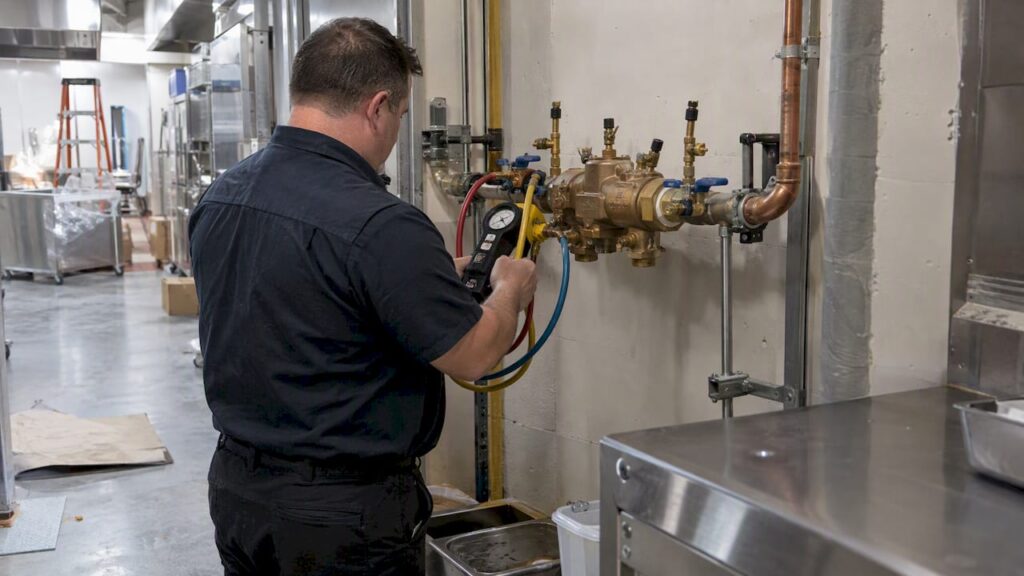
If your New Jersey project includes a testable backflow preventer, plan to have it tested before the final inspection. That test is one of the items your plumbing subcode official looks for before the municipality signs off. New Jersey’s Department of Community Affairs (DCA) tells code officials to make sure these devices are tested prior to final inspection and annually after that. The annual part is handled through a separate document, the Certificate of Compliance, and mixing the two up is where most owners and property managers get stuck.
This guide explains how the backflow test fits into the Certificate of Occupancy (CO) process, what the inspector will and won’t do, which properties are exempt from annual testing, and how to avoid a delayed sign-off.
TL;DR
- A testable backflow preventer that isolates a cross-connection must be tested before the final construction inspection, so schedule the test before you call for that inspection.
- The Certificate of Occupancy is a one-time document for the building. The Certificate of Compliance for a backflow device is a recurring one that needs annual testing.
- Municipal inspectors do not perform the test. You hire a qualified, NJDEP-certified tester and the report goes to the plumbing subcode office.
- One- and two-family dwellings are generally exempt from annual testing, unless a local ordinance or particular conditions require it.
- Some installations also need a separate NJDEP Physical Connection Permit, with quarterly device testing.
Table of Contents
- What a Certificate of Occupancy actually certifies
- Where backflow testing enters the CO process
- Certificate of Occupancy vs. Certificate of Compliance
- Which properties need annual testing, and which don’t
- Fire sprinklers and the forward flow problem
- The separate NJDEP Physical Connection Permit
- Temporary Certificates of Occupancy
- Our perspective
- What this typically costs
- Book the test before your inspection
- A pre-inspection checklist
- Common mistakes that delay a CO
- FAQ
- Sources
What a Certificate of Occupancy actually certifies
A CO is the municipality’s statement that a building, or a finished portion of one, may be occupied. The DCA explains that it is issued by the local construction official once the project has passed all final inspections, the required fees are paid and the conditions of earlier approvals are met.
That last phrase matters for backflow. A new plumbing system, a fire sprinkler system, an irrigation system or a commercial kitchen can each include a device that protects the public water supply from contamination. If the plumbing subcode official needs proof that device works, the CO waits on that proof like it waits on any other open item.
The state timelines are fairly short. According to the same DCA guide, enforcing agencies must release or deny a complete permit application within 20 business days, and final inspections must happen within three business days of your notification that the project is ready. Those clocks are fast, which is exactly why a missing backflow report hurts: a failed or incomplete final inspection means another round of scheduling.
If your CO is tied to construction work such as an addition, deck or finished basement, it helps to understand how the municipality closes out a job. This overview of deck building permits walks through the permit and final inspection sequence that eventually leads to sign-off.
Where backflow testing enters the CO process
New Jersey’s Uniform Construction Code (UCC) puts the testing duty in the plumbing subcode. DCA Bulletin 99-2 cites N.J.A.C. 5:23-2.23(l) and N.J.A.C. 5:23-3.15, Plumbing Subcode, Section 10.5.6. In plain terms, backflow preventers designed to be field tested, which isolate cross-connections between the water supply and contaminants, are tested prior to final inspection and annually.
In practice the sequence looks like this:
- The plumber or contractor installs the device and the rest of the system.
- You hire a certified backflow tester to test it.
- The tester completes a test report with the required details.
- The report goes to the plumbing subcode official before the final plumbing inspection.
- The inspector confirms the paperwork, completes the final inspection and the CO can be released, assuming every other subcode is also satisfied.
Who is allowed to do the test
Owners are often surprised by this one. Inspectors are not permitted to perform the test. Their role is to make sure the facility owner has the device tested by a qualified individual. The inspector can either witness the test or accept a certification from the owner that it was done.
That certification should identify the type and location of the device, the date tested, the results, and the name, qualifications and signature of the tester. A report missing any of those items is an easy reason for an inspector to send you back.

What the test checks
A test confirms the device does its two jobs: the check valves hold and, on a reduced pressure assembly, the relief valve opens at the right pressure. If a device fails, it must be repaired or rebuilt and retested before the report can show a pass. Build that possibility into your schedule rather than booking the test the day before inspection.
Certificate of Occupancy vs. Certificate of Compliance
These two documents are the root of most confusion, including in the search results for this topic. The DCA’s own bulletin and construction publications treat them differently.
| Certificate of Occupancy (CO) | Certificate of Compliance (CC) | |
|---|---|---|
| What it covers | The building or project as a whole | An ongoing hazard-control device such as a backflow preventer |
| When it is issued | After final inspections pass and fees are paid | When the test form or similar proof shows the device passed |
| How often | At project completion, or on a change of use under local rules | Annually, tied to the yearly test |
| Who triggers it | Your notice that the project is ready for inspection | The tester’s report filed with the plumbing subcode office |
| Main risk if missed | You can’t legally occupy the space | Enforcement action by local plumbing officials |
The DCA’s Construction Code Communicator notes that a test form may be used to document backflow preventer tests, and that compliance is issued when the form demonstrates the device is working properly. So the CO gets you in the door, and the CC keeps you in good standing afterward.
For property managers, the practical lesson is to treat annual renewals as a standing operations task, not something you act on when a notice shows up in the mail.
Which properties need annual testing, and which don’t
The DCA bulletin says testable backflow preventers for one- and two-family dwellings are not required to be tested annually. That is a state-level statement about the annual requirement. Two cautions apply:
- Local ordinances. Some municipalities and water purveyors set their own rules, so an exempt single-family home can still be asked for a test.
- Pre-inspection testing. The exemption is about annual testing. If a plumbing inspector requires proof of function at final inspection for new work, ask your subcode office what they expect for your project.
Multi-unit buildings, commercial properties, restaurants, medical offices, irrigation systems on commercial lots and fire sprinkler systems typically fall under the annual cycle. If you manage a portfolio, check each property rather than assuming one rule applies to all of them.
Fire sprinklers and the forward flow problem
If your building has a sprinkler system, the backflow device on the fire line brings an extra design question. The DCA’s Construction Code Communicator highlights that fire protection contractors should be familiar with NFPA 25 requirements and the ability to run forward flow tests. Without a proper test connection, a retrofit can come after installation, which costs money and time.
Two things to confirm with your installer before the walls are closed:
- The device has a serviceable connection that allows testing without modifying the system later.
- A tester can physically reach the device and has room to work with their equipment.
Accessibility is a surprisingly common reason a test gets delayed. A device boxed in behind shelving, in a crawl space or in a tight utility closet can slow a certification visit.
The separate NJDEP Physical Connection Permit
Backflow documentation for a CO is a local, construction-code matter. Some properties also need a state water-supply permit. NJDEP issues Physical Connection Permits that are separate from local construction permits. These permits must be renewed annually, and each backflow prevention device covered by the permit must be tested quarterly.
If your property connects a potable water supply to a secondary or auxiliary source, ask your designer or the water purveyor whether this permit applies. NJDEP’s application form includes a checklist covering the device types, such as reduced pressure zone assemblies and double check valve assemblies.
Temporary Certificates of Occupancy
When a building needs to be occupied before every item is finished, municipalities can sometimes issue a Temporary CO. DCA Bulletin 01-2 covers this topic and was last revised in July 2026. Don’t assume an open backflow test is something a temporary CO can carry. Ask the construction official in writing which items must be closed before a temporary certificate is issued and which can remain open.
Our perspective
We test, repair, rebuild and certify backflow preventers across New Jersey, and the jobs that go wrong at the CO stage tend to look the same.
The test gets booked last. A contractor finishes the plumbing, the final inspection is already on the calendar, and only then does someone ask who is testing the device. By that point a failed check valve means ordering parts and rescheduling, and the inspector has no flexibility, because inspectors can’t test the device themselves.
Our advice is to book the test as soon as the device is installed and the system is pressurized. If the device fails, we stock OEM parts so a repair or rebuild can often happen during the same visit, and then we retest. We also file the report directly with the water authority and can send it to the municipal plumbing subcode office as well, so you aren’t chasing paper.
For property managers, we’d go further: put every device in your portfolio on a single annual calendar, with consolidated billing if you manage multiple sites. A Certificate of Compliance is not something to wait on a notice for.
One more point from the field: leave room. Give the device enough clearance, a reachable shutoff and, if it’s outdoors, a plan for freezing weather. An enclosure installed at the right time costs less than one fitted after a winter repair.
— Jordan
What this typically costs
Prices vary by device, size and access. Our published ranges, as listed on our FAQ page, are:
| Service | Published range |
|---|---|
| Annual residential certification test | $150 to $250 |
| Commercial device testing | $200 to $450 per device |
| Rebuild kit service (residential) | $125 to $250 |
| Residential installation | $300 to $800 |
| Protective enclosure installation | $200 to $500 |
Testing and certification, repairs and rebuilds, and custom enclosures are also described on our service pages, where no price is published. Ask for a quote based on your device list.
Book the test before your inspection
If you have a final inspection coming, we can test and certify your device and submit the report so the paperwork is ready when the inspector arrives. See our backflow preventer testing and certification in New Jersey page to schedule. If a device needs work, our rebuilds, repairs and installation costs page explains what to expect, and a custom enclosure protects an outdoor device from weather and tampering. We are family-owned, licensed and insured, and we handle same-day service when your schedule is tight.
A pre-inspection checklist
Use this list a few weeks before you request the final inspection:
- Identify every backflow preventer on the property: domestic water, irrigation, fire line, boiler feed, and any process equipment.
- Confirm which are testable assemblies and which are not.
- Check that each is installed in a location that is accessible and has working clearance.
- Book a certified tester after the system is pressurized.
- Ask the tester for a report that lists device type, location, test date, results, and the tester’s name, qualifications and signature.
- Send the report to the plumbing subcode office before the inspection, and keep a copy on site.
- If the device failed, repair, retest and replace the report. Don’t submit a failed one.
- Confirm with the construction official whether any NJDEP Physical Connection Permit applies.
Common mistakes that delay a CO
Assuming the plumber’s sign-off covers it. An installer’s work and a certified test are different things. The inspector is looking for the tester’s certification.
Testing too early. If a test happens before the system is complete and later work alters the device, the report may not reflect its final condition.
Sending incomplete forms. Missing tester qualifications or an unsigned form is the simplest reason for a rejection.
Waiting for the renewal notice. After the CO, the CC expires annually. The DCA’s model reminder letter shows that municipalities write to owners based on tax records, so the notice can reach whoever is listed as owner, not necessarily the property manager.
Forgetting the owner is responsible. The responsibility for compliance rests with the owner. Hiring a certified tester early and having the report submitted promptly is the cleanest path.

FAQ
Do I need a backflow test to get a certificate of occupancy in NJ?
If your project has a testable backflow preventer that isolates a cross-connection, the DCA says it should be tested before the final inspection. Your plumbing subcode official will ask for the certification. Confirm the exact requirements for your project with your local construction office.
Is backflow testing required every year in New Jersey?
For most commercial and multi-unit properties, yes, annually. One- and two-family dwellings are generally not required to test annually under the state bulletin, but local ordinances or specific conditions can change that. NJDEP Physical Connection Permits carry their own quarterly testing requirement.
Can the building inspector test my backflow preventer?
No. Inspectors are not permitted to perform the test. They verify that a qualified tester did it, either by witnessing the test or by reviewing your signed certification.
How long does it take to get a certificate of occupancy in NJ?
The state sets 20 business days for the enforcing agency to act on a complete permit application, and final inspections are due within three business days of your notice that the work is ready. The CO follows once all inspections pass and fees are paid, so open items such as a backflow report can extend the timeline.
What’s the difference between a CO and a Certificate of Compliance?
The CO covers the building at completion. The Certificate of Compliance is tied to a backflow device and renewed through annual testing.
Sources
- DCA Bulletin 99-2, Testing of Backflow Preventers
- DCA Uniform Construction Code general information
- DCA Construction Code Communicator, Summer 2025
- NJDEP Physical Connection Permit
- NJDEP application for initial Physical Connection Permit
- DCA Bulletin 01-2, Temporary Certificates of Occupancy
- DCA model backflow preventer reminder letter
Pingback: Nursing Home Backflow Testing in NJ: What Operators Must Know
Pingback: Camden Backflow Testing Requirements: What NJ Owners Must Do