
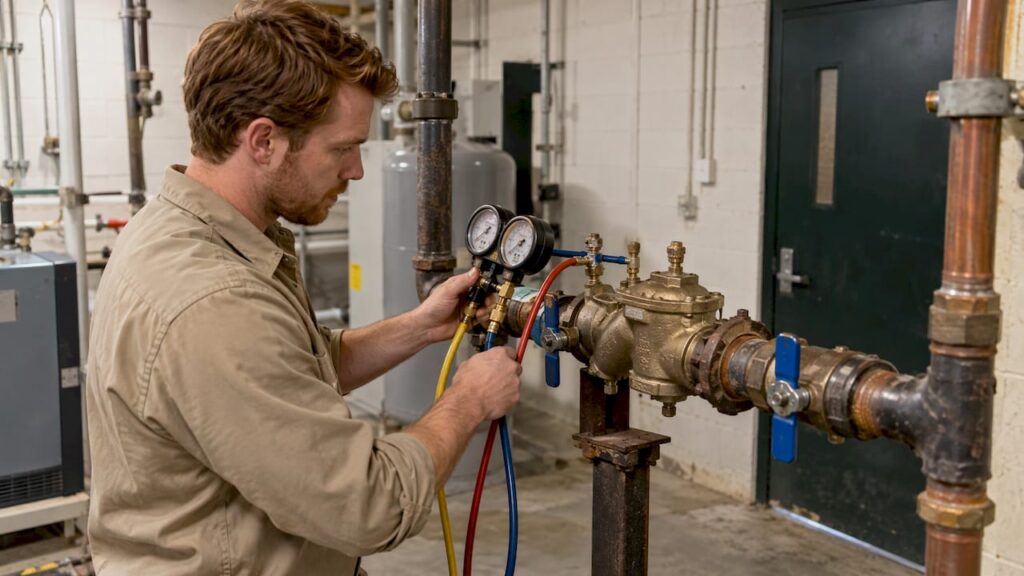
If you own a property in Cherry Hill with a testable backflow preventer, it must be field-tested when it is installed and again every year. A tester certified through an agency the state recognizes has to do the work. The original certification then goes to the Township’s Code Enforcement Office, which issues a Certificate of Compliance for each device. The township’s backflow preventer page sets out that process, and this guide walks through what it means in practice for homeowners, landlords and property managers.
TL;DR
- Testable backflow preventers in Cherry Hill are tested at installation and retested annually, by a tester certified through an NJDEP-recognized agency.
- The original test certification is filed with the Township’s Code Enforcement Office, which issues a one-year Certificate of Compliance for each device. The township lists the fee as $25.
- Irrigation systems, fire-protection lines, boilers and commercial or industrial plumbing are the usual places a device is required.
- Testing is also due after repairs or relocation, and a missed test can eventually put water service at risk.
- We test, certify, repair and rebuild devices across New Jersey and can handle the filing for you.
Table of Contents
- What Cherry Hill requires
- Where backflow prevention is required
- How often testing is required
- Who can test your device
- Filing: who gets the paperwork and when
- Fire-protection systems and NFPA 25
- Installation: height, access and enclosures
- What happens if you miss a test or a device fails
- What testing and repair cost with us
- Our perspective
- Book testing and filing for your Cherry Hill property
- FAQ
- Sources
What Cherry Hill requires
Cherry Hill follows the state plumbing rules and adds a local paper trail. The township states that testable backflow preventers must be field-tested when installed and re-tested annually under N.J.A.C. 5:23-2.23, and that the person testing must be certified by an agency recognized by the NJDEP’s Bureau of Safe Drinking Water (Cherry Hill Township).
The steps look like this:
- A certified tester tests the device.
- The original certification for each device that passed is filed with the Township’s Code Enforcement Office.
- The township issues a Certificate of Compliance for each device. It is valid for one year and renews annually.
- The township lists a fee of $25.00 per Certificate of Compliance. Confirm the current amount on the township page before you file, since fees can change.
The key detail is “each device.” A property with a domestic RPZ, an irrigation backflow assembly and a separate fire-line assembly has three tests, three certifications and three certificates to track.
Where backflow prevention is required
Backflow prevention goes wherever your potable water could be contaminated by something connected to it. The New Jersey Department of Community Affairs lists the usual cross-connection locations: lawn irrigation, fire-protection systems, laboratories, chemical and industrial plants, boilers, hospitals and wastewater-treatment plants (DCA Bulletin 99-2).
In Cherry Hill, that translates to a few common situations:
- Lawn irrigation. An in-ground sprinkler system is the most common reason a house has a device. Sprinkler lines can contain fertilizer, standing water and soil contact.
- Fire sprinkler lines. Commercial buildings, apartment buildings and many office parks have dedicated fire lines with a double-check or RPZ assembly.
- Boilers and heating systems. Chemical treatment in a closed loop makes the feed line a cross-connection.
- Commercial and industrial plumbing. Medical offices, labs, car washes, restaurants and manufacturers often have devices on process lines.
Do residential homes need a backflow preventer?
Often, yes, if the house has a cross-connection such as an irrigation system. A plain home with no irrigation, boiler additive or similar hazard may not have one at all. DCA’s bulletin also draws a line on testing: testable preventers in one- and two-family dwellings are not required to be tested annually under that bulletin, while testable devices protecting other covered cross-connections are tested before final inspection and annually (DCA Bulletin 99-2).
That state rule and the township’s wording are not identical, so do not assume your house is exempt. Cherry Hill’s page speaks of testable preventers being tested annually and certificates being renewed each year. Call Code Enforcement to confirm how your specific device is treated, or ask us and we will tell you what we see on your property.
How often testing is required
The baseline is once a year, plus these trigger events:
| When | What is required |
|---|---|
| New installation | Field test when installed, before the device is relied on |
| Every year | Retest and renew the Certificate of Compliance |
| After repair or rebuild | Retest to confirm the device holds |
| After relocation | Retest in the new position |
| Building shutdown or major plumbing work | Retest before returning the device to service |
The first-row rule, test at installation, and the annual rule come from the township. The “after repair or relocation” rule appears in the testing language other New Jersey authorities use, which calls for testing at installation, immediately after repairs or relocation, and at least annually (Backflow Testing Requirements, PDF is the NJDEP form that governs new, modified and replacement devices). In practice, any time a device is opened, rebuilt, moved or replaced, plan on a fresh certified test. If you have been through a vacancy or closure, our guide to backflow testing after a building shutdown covers it.
State permit devices are a separate track
Some facilities hold an NJDEP physical-connection permit, the stricter category for direct piping connections. Under N.J.A.C. 7:10-10.6, those installations get a tightness test initially and at least quarterly under an existing permit. An internal inspection is required within six months before a permit-renewal application, followed by a tightness test after reassembly. An RPZ is exempt from routine internal inspection except for manufacturer maintenance, malfunction investigation or a supplier requirement (N.J.A.C. 7:10-10.6). Most homes and ordinary commercial buildings do not fall here, but industrial sites may.
Who can test your device
The tester must hold a valid certificate from a Department-approved certifying agency. For physical-connection permits, the facility owner can select only testers on the most current certified-tester list that the certifying agency supplies to NJDEP (N.J.A.C. 7:10-10.6). Before you hire anyone, ask for the tester’s certification and make sure it is current.
Code officials do not do the testing themselves. DCA says inspectors may not perform the test. They verify it by witnessing it or by receiving certification that identifies the device type and location, the test date, the results, and the tester’s name, qualifications and signature (DCA Bulletin 99-2). That list is a good checklist for what your test report should show before you file it.
Filing: who gets the paperwork and when
In Cherry Hill the original certification for each tested device goes to Code Enforcement, which then issues the Certificate of Compliance. Keep the certificate with your property records.
For new, newly permitted, modified or replacement devices under a state permit, NJDEP’s form instructs that initial inspection and testing results be sent to the water supplier and the administrative authority within five days of each certified test. Records must be kept at the facility and shown on request (NJDEP form BWSE-CITR-IQ).

If you are replacing or moving a device, there may be a permit step first. See our guides to the backflow replacement permit in NJ and the backflow relocation permit in NJ.
Fire-protection systems and NFPA 25
Fire lines trip up many owners because two sets of rules seem to overlap. For a dedicated fire-water service line, DCA says the fire official will accept a current Certificate of Compliance issued under Bulletin 99-2 as satisfying NFPA 25’s annual backflow test requirement. That covers the annual backflow test only. It does not say the rest of your fire-system inspection, testing and maintenance duties go away (DCA Bulletin 99-2).
Replacement devices on fire systems need approval for fire-protection service, and the replacement cannot reduce the system’s effectiveness. Dedicated fire services and combined fire and domestic services use different application paths, and combined systems need joint plan review (DCA Bulletin 99-2). If a fire contractor and a plumber both touch your riser, tell your tester up front so the paperwork matches what the fire official expects.
Installation: height, access and enclosures
Installation details such as mounting height, clearances and freeze protection depend on the device type, the manufacturer’s instructions and what the plumbing subcode official approves for your site. We do not give a single number here, because the right answer depends on the assembly. Confirm the specifics with Cherry Hill’s construction and code officials before you set a new device.
Two practical points apply to almost every site. First, the device must stay reachable so a tester can get at the test cocks every year. Second, outdoor assemblies need protection from weather and damage. Our overview of backflow enclosure requirements in NJ goes into the details, and we install custom backflow preventer enclosures for outdoor devices.

A permit also matters at installation. DCA notes that no plumbing permit is issued for some installations until the required testing and paperwork are complete, so plan your timeline with the inspector, not around them.
What happens if you miss a test or a device fails
The responsibility sits with the property owner. New Jersey American Water states that customers have ultimate responsibility for maintaining their plumbing, eliminating unprotected cross-connections and keeping required devices operable, and that repeated failure to comply can result in water-service disconnection (New Jersey American Water).
If a device fails its test, the usual path is:
- Have it repaired or rebuilt, often with a replacement kit or parts.
- Have it retested by a certified tester.
- File the passing certification and renew your Certificate of Compliance.
We stock OEM parts so repairs and rebuilds can often happen during the same visit as the failed test, which keeps the gap between a failure and a passing report short.
What testing and repair cost with us
These are the prices published on our FAQ page:
| Service | Published price |
|---|---|
| Annual residential certification test | $150–$250 |
| Commercial device testing | $200–$450 per device |
| Rebuild kit service (residential) | $125–$250 |
| Protective enclosure installation | $200–$500 |
| Residential installation | $300–$800 |
The township’s Certificate of Compliance fee is separate from our testing price. For multi-building portfolios, see our backflow testing budget guide for property managers.
Our perspective
Most of the trouble we see in Cherry Hill is not a failed device. It is a passed test that never got filed, or a certificate that lapsed because nobody owned the renewal date.
That is why we treat testing, repair and filing as one job. A tester who finds a worn check valve should be able to fix it on the spot with the right OEM part, retest it and send the paperwork to the right office. Splitting that across three vendors is where deadlines slip.
For property managers with several buildings, we offer consolidated billing and compliance management, so every device on every property has a test date, a certificate and a record. We are family-owned, licensed and insured, and we aim for same-day service when a deadline is close.
Jordan
Book testing and filing for your Cherry Hill property
We test, certify, repair and rebuild backflow preventers for residential, commercial and multi-unit properties across New Jersey, and we file test reports directly with the authority that needs them. See our backflow testing and certification service or contact us to schedule.
Managing several properties? Start with our property manager backflow checklist. If you also own property in Camden, our Camden backflow testing requirements guide covers the differences.
FAQ
How often does a backflow preventer need testing in Cherry Hill?
Cherry Hill requires testable backflow preventers to be field-tested at installation and retested annually. The Certificate of Compliance is valid for one year and renews each year. Also plan a test after any repair, rebuild or relocation.
Who can test my backflow preventer?
The tester must be certified by an agency recognized by the NJDEP’s Bureau of Safe Drinking Water. Ask for the tester’s current certificate and make sure the report shows device type, location, test date, results and the tester’s signature.
How much is the Cherry Hill Certificate of Compliance?
The township lists $25.00 per Certificate of Compliance, one per device, valid for one year. Check the township page for the current fee before filing. Our testing price is separate from that fee.
Does a fire sprinkler line need a separate test?
A fire line with a backflow device needs its annual backflow test. For a dedicated fire-water line, the fire official accepts a current Certificate of Compliance under DCA Bulletin 99-2 for NFPA 25’s annual backflow test. Other fire-system inspection duties still apply.
What if my device fails the test?
Have it repaired or rebuilt, then retested by a certified tester, and file the passing report. We carry OEM parts, so many repairs and rebuilds can be completed in the same visit.
Sources
- NJ DCA Bulletin 99-2
- N.J.A.C. 7:10-10.6, Inspection and testing
- NJDEP form BWSE-CITR-IQ
- New Jersey American Water: Cross Connection and Backflow Prevention