
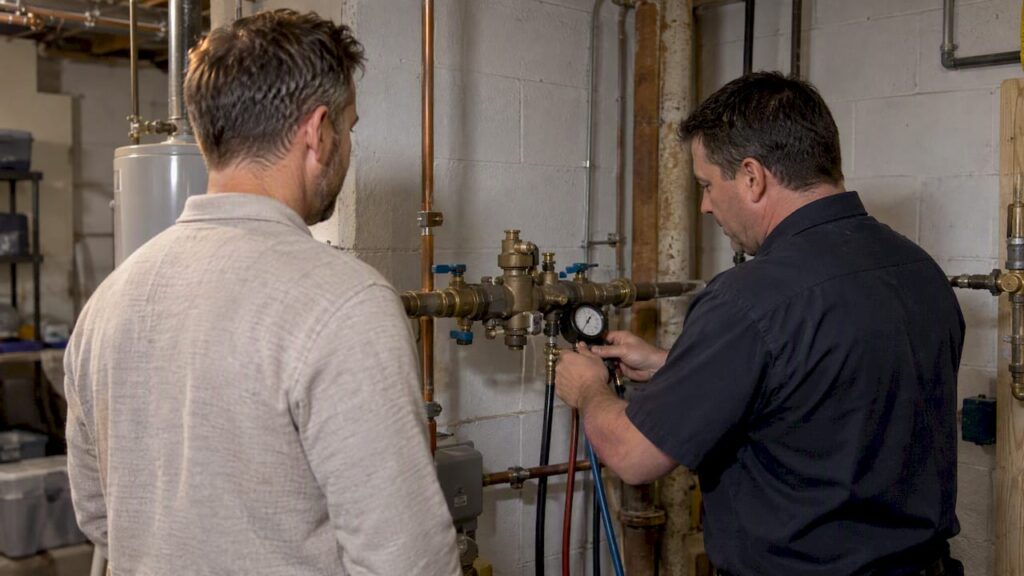
New Jersey has no statewide rule that makes a backflow inspection a standard closing step the way a home inspection or a termite report often is. Backflow testing is a municipal compliance matter. It matters at closing when the property has a testable backflow preventer and the local record shows a missing certificate, an overdue annual test or an open violation. Those problems pass to the new owner. This guide explains which properties are affected, what to check, who can legally do the test and how to keep a sale on schedule.
TL;DR
- Backflow testing is not a automatic closing contingency in NJ. It becomes one when a testable device exists and the municipality’s file is out of date.
- Testable devices on lawn irrigation, fire-protection, boiler and commercial systems are tested annually. Standard one- and two-family homes are generally exempt unless a local ordinance says otherwise.
- Only a tester certified through an agency recognized by the NJDEP can produce a valid report. A plumber without that certification means paying twice.
- A test is not a certificate. The report must be filed with the municipality, which issues the Certificate of Compliance.
- Start early. Testing, a possible repair, a re-test and municipal processing all take time, and each step can slip a closing date.
Table of Contents
- Is a backflow inspection required before closing in NJ?
- Why a missing certificate follows the property
- How to check a property before closing
- What a backflow inspection actually involves
- Who is allowed to test
- Test report versus Certificate of Compliance
- Perspective: what we see before closings
- What it costs
- A timeline that protects the closing
- Special cases to watch for
- Need a test or repair before closing?
- FAQ
- Sources
Is a backflow inspection required before closing in NJ?
Not as a blanket rule. What the state requires is that testable backflow preventers be tested. The Department of Community Affairs bulletin B 99-2 tells plumbing subcode officials to make sure testable devices that isolate cross connections between the water supply and contaminants are tested before final inspection and then annually. The same bulletin says testable devices for one- and two-family dwellings are not required to be tested annually.
So the answer depends on what you are buying or selling:
| Property | Typical backflow situation | Closing risk |
|---|---|---|
| Single-family home, no irrigation or special systems | Usually no annual test requirement | Low, but confirm with the town |
| Single-family home with a lawn irrigation system | Device may exist and local ordinance may require testing | Moderate: check the town’s rules and the device’s history |
| Two-family home | Generally exempt from annual testing under the state bulletin unless the town says otherwise | Low to moderate |
| Multi-unit building, boiler, fire sprinkler or fire-protection system | Testable device, annual test and certificate expected | High: overdue paperwork is common |
| Commercial or mixed-use property | Testable devices, often several | High: each device needs its own test |
The bulletin leaves room for local rules. Some towns require more than the state minimum, so the municipality’s construction or plumbing subcode office is the authority on what applies to a specific address.
Why a missing certificate follows the property
Most buyers assume backflow work is like a home inspection item: found, negotiated, closed out. In practice it is a compliance record kept by the town. If the annual test is overdue or a violation is open, the obligation to fix it does not disappear at closing. It becomes the new owner’s problem.
The state’s guidance also shows why this can surface late. The inspector’s job is not to perform tests. It is to confirm the owner has had them done, either by witnessing a test or by receiving a submitted certification. A buyer who does not look can inherit a notice of violation, or an order to comply by a short deadline, within weeks of taking title.
For sellers, the same logic runs the other way. A device with a clean, current certificate is one less thing for a buyer’s attorney to raise. If the property already has other code issues, this guide to selling New Jersey homes with code violations explains how those problems affect a sale and the options sellers have.
How to check a property before closing
A buyer, an attorney or a seller’s agent can do most of this in a few days.
- Ask whether a device exists. Look at the seller’s disclosure, the irrigation system and the boiler or fire-protection room. A device on a lawn sprinkler line is often installed above ground near the foundation or in a basement.
- Call the municipal construction or plumbing subcode office. Ask whether the address has a testable backflow preventer on file, when the last Certificate of Compliance was issued, and whether any violation or renewal is pending.
- Request the paperwork. Ask the seller for the last test report and the Certificate of Compliance, not only the plumber’s invoice.
- Check the tester’s credentials. The report must come from a person certified through an agency recognized by the state.
- Put the finding in writing. If something is open, the attorney can negotiate a seller-paid test or repair, an escrow or a credit before closing.
To see how towns handle this, look at a local example. Cherry Hill Township explains that testable backflow preventers must be field-tested when installed and then re-tested on a schedule. Each town publishes its own version of this, so search your town’s website or call the office.
What a backflow inspection actually involves
A test is more than a glance at a valve. A certified tester verifies the device’s manufacturer, model and serial number, and checks the test cocks under no-flow conditions, according to the NJDEP permit and test-report instructions. The tester then submits the formal Test and Maintenance report to the local plumbing subcode official.
Two practical points surprise people:
- Water will be off briefly. Testing is done with the flow stopped. The EPA’s Cross-Connection Control Manual recommends getting the owner’s or representative’s permission to shut down the water supply before any test. In a home with a buyer’s walk-through or movers, schedule around that. In a building with tenants, give notice first.
- A failed device cannot be certified. If the device leaks or needs repair, it must be fixed and re-tested before it can pass. Repair or rebuilding is usually a separate step from the test itself.
Who is allowed to test
This is where closings get derailed. In New Jersey the test must be performed by an individual certified through an agency approved by the NJDEP. The NJDEP’s page on certified backflow prevention device testers lists the approved certifying agencies under N.J.A.C. 7:10-10.8. A general plumber without that certification can do good plumbing work and still produce a report the town will reject. You then pay for the test again.
The same state bulletin notes that building inspectors are not permitted to perform the test. And a homeowner doing it personally is not a workable route. Without the certification, the result will not be accepted.
Before booking, ask the tester three questions:
- Which certifying agency issued your backflow certification?
- Will you file the report with my town, or am I responsible for that?
- If the device fails, can you repair or rebuild it on the same visit, or will I need a second appointment?
Test report versus Certificate of Compliance
Many owners treat the tester’s invoice as proof of compliance. It is not. The report must be submitted to the municipality, which processes any fee and issues the official Certificate of Compliance. Fees vary by town: Cherry Hill, for instance, charges $25.00 per certificate, according to the NJDEP page.

For a closing, the document that matters is the certificate, or at minimum proof that the report was filed and accepted. A buyer’s attorney will ask for that. Ask your tester up front whether filing is included.
Perspective: what we see before closings
We test and repair backflow preventers across New Jersey, for homeowners, landlords and property managers. The pattern we see is consistent: the device is rarely the real problem. The paperwork is.
A seller hears about backflow for the first time when the buyer’s attorney asks for a certificate. The device may be fine, but nobody has filed a report in years, or the last test was done by someone the town does not recognize. Then there is a scramble. The fix is simple when there is time: test, file, and get the certificate. It is painful when closing is in four days.
Our advice is plain. If your property has an irrigation line, a boiler, a fire-protection system or any commercial use, find out the status of the device the day you list or the day you sign the contract. If the device fails, we can often handle it on one visit, because we stock OEM parts for repairs and rebuilds. And we file the test reports directly with the water authority so the owner does not chase the paperwork. Buyers should not rely on a seller’s verbal assurance. Ask for the certificate.
— Jordan
What it costs
Our published ranges, as listed on our site, give a realistic picture for budgeting before a closing:
| Service | Published price |
|---|---|
| Annual residential certification test | $150 to $250 |
| Commercial device testing | $200 to $450 per device |
| Rebuild kit service (residential) | $125 to $250 |
| Protective enclosure installation | $200 to $500 |
| Residential installation | $300 to $800 |
The final amount depends on the device, its condition and the property. Municipal certificate fees are separate and set by each town. See our pricing FAQ for detail on what drives the number.
A timeline that protects the closing
The sequence below assumes a standard 30 to 60 day contract. The buyer or the seller can start it.
- Week 1: Attorney or agent calls the municipality about the backflow file and any open violations.
- Week 1 to 2: If a testable device is present, book a certified tester. Confirm whether the water will be shut off and when.
- Week 2 to 3: Test performed. If it passes, the report is filed with the town. If it fails, repair or rebuild and re-test.
- Week 3 to 4: The town processes the filing and issues the Certificate of Compliance.
- Before closing: The attorney confirms the certificate is in the file, or that a credit or escrow covers anything still open.
If the timeline is tight, tell the tester at booking. Same-day or next-day slots are possible in many cases, but the town’s processing is outside anyone’s control, so build in a cushion.
Special cases to watch for
Irrigation systems. These are the most common reason a house has a testable device. Check the basement or the exterior wall near the system’s connection to the water supply. Ask whether the town requires annual testing for residences.
Winterized systems. If a sale happens in cold months and irrigation is shut down, ask the seller when the device was last tested and whether it was drained safely. A freeze can crack a device. A cracked body means a repair or replacement before it can be certified.

Multi-unit and mixed-use buildings. Each testable device needs its own test and its own record. Tenants should be notified before shutoff. Businesses with cooling systems or boiler-fed processes cannot tolerate a surprise interruption, so coordinate the schedule with them.
Exposed devices. A device in a vulnerable spot can be damaged or tampered with. A protective enclosure is a straightforward upgrade that buyers sometimes request in negotiation.
Need a test or repair before closing?
We are a family-owned, licensed and insured New Jersey company. We test and certify backflow preventers, repair and rebuild them, install enclosures and file the test reports with your water authority. For a closing, start with our backflow preventer testing and certification page, or reach us through southjerseybackflow.com to book. Tell us your closing date when you call.
FAQ
Is backflow testing required in NJ?
Yes, for testable backflow preventers that isolate cross connections, such as those on irrigation, fire-protection and boiler systems. They must be tested at installation and annually. Devices serving one- and two-family homes are generally exempt from annual testing unless the municipality requires it, per the state bulletin.
Can I do backflow testing myself?
No, not in a way that counts. The test must be done by someone certified through an agency the NJDEP recognizes. A report from anyone else will be rejected by the local plumbing subcode official.
Will a failed test stop my closing?
It can if the buyer’s attorney requires a certificate. A device that fails cannot be certified until it is repaired and re-tested. Most failures are fixable with a rebuild kit or replacement parts, so the key is to find out early rather than days before closing.
Who is responsible if the certificate is overdue when the property sells?
The obligation attaches to the property, so an overdue test or open violation becomes the new owner’s problem after transfer. That is why attorneys often negotiate a seller-paid test, a credit or an escrow before closing.
Do all houses have a backflow preventer?
No. Many homes have no testable device. A device is most often present where there is an irrigation system, a boiler, a fire-protection system or a commercial use. The municipal office can tell you what is on file for an address.