
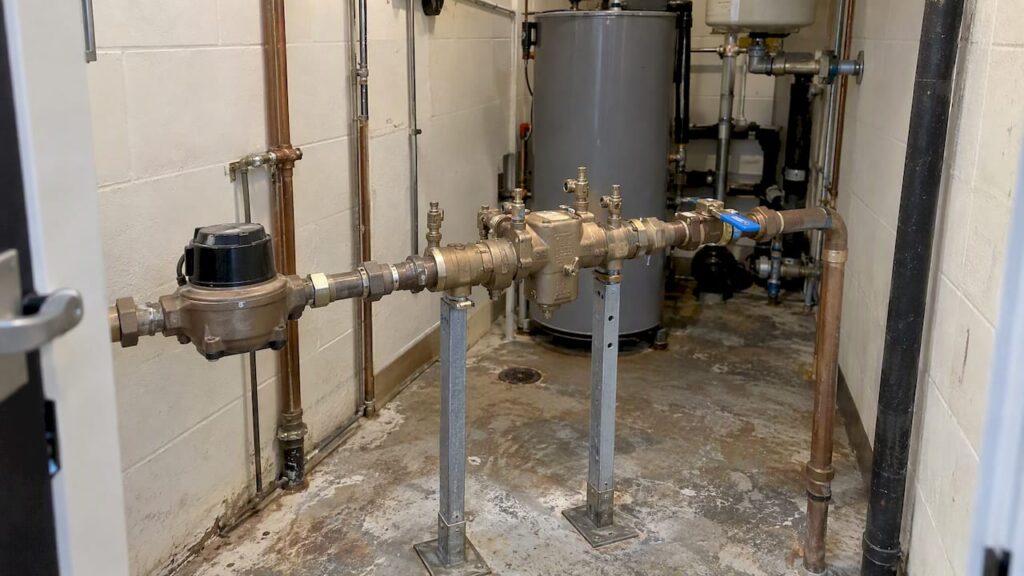
If you own or manage a veterinary clinic in New Jersey, expect to have every testable backflow preventer on your water line tested each year by a certified tester, and expect your local plumbing subcode official to want proof of it. The rules sit in two places: the state’s construction code, enforced by your town, and the NJDEP’s drinking water rules, enforced through your water supplier. Most of the trouble clinics run into comes from treating these as one thing.
This guide explains who sets the requirements, what a passing test paperwork trail looks like, where a device can and cannot be installed, and what to do when a device fails.
TL;DR
- Testable backflow preventers that protect against cross connections in non-residential buildings must be tested before final inspection and annually. A veterinary clinic is a non-residential building, so this applies to you if your water line has such a device.
- The tester must hold an NJDEP-recognized certification. Inspectors do not perform the test; they check that a qualified person did.
- The test report has to carry the device type and location, test date, results, and the tester’s name, qualifications and signature. A passing report earns a one-year Certificate of Compliance.
- Devices must be accessible for testing. Installing one in a pit or vault is a common and expensive mistake.
- Your water supplier decides what level of protection your clinic needs, so ask early rather than after an unplanned mandate.
Table of Contents
- Who sets the rules: your town and your water supplier
- Why veterinary clinics draw attention
- What the annual test involves
- Who can legally test your device
- Where the device can be installed
- What a failed test means
- Costs to plan for
- Perspective: what we see at clinics
- Questions to ask before you book any tester
- Working with us
- FAQ
- Sources
Who sets the rules: your town and your water supplier
New Jersey regulates backflow through two overlapping systems.
The first is the Uniform Construction Code, administered by the Department of Community Affairs (DCA) and enforced by your municipal plumbing subcode official. DCA’s Bulletin 99-2 explains that the plumbing subcode official should make sure testable backflow preventers that isolate cross connections between the water supply and contaminants are tested prior to final inspection and annually. The same bulletin says testable devices on one- and two-family dwellings are not required to be tested annually. That exception does not cover a commercial clinic, even if the building used to be a house.
The second is the NJDEP’s Safe Drinking Water program. NJDEP describes its physical connection program as one that protects the public water system by requiring backflow prevention devices, either double check valve assemblies or reduced pressure zone preventers, generally installed near the water meter on domestic lines. Testing under that program must be done by a certified tester.
Why this matters for a clinic: a test that satisfies one system does not automatically satisfy the other. Your town wants documentation for the Certificate of Compliance. Your water supplier may want its own records. A good tester knows which reports go where.

Why veterinary clinics draw attention
No rule in New Jersey is written specifically for veterinary clinics, and we will not pretend otherwise. What happens in practice is that water suppliers assess each facility for cross-connection hazards, and a clinic has plenty of places where water meets something you would not want in the drinking supply:
- Treatment and surgery areas with sinks and hose connections
- Kennel and boarding wash-down systems with hose bibs and chemical dispensers
- Dental stations, lab equipment and diagnostic areas that use water
- Irrigation, outdoor wash areas and in-building fire sprinkler lines
- Boilers or other equipment that tie into the domestic supply
NJDEP’s guidance on physical connection permits notes that suppliers can require protection based on the hazard a facility poses. The practical consequence is that a clinic’s supplier may require a containment device at the service entrance, commonly a reduced pressure zone (RPZ) assembly, even when the inside plumbing looks fine. If you have not heard from your supplier, call and ask whether your property has been assessed. It is cheaper to plan a device than to react to a notice.
Does a clinic need a physical connection permit?
Probably not, unless you have a second water source. NJDEP states that the permit is required of the owner of a facility containing an unapproved water supply alongside a public community water supply. A private well or an on-site source used for anything alongside municipal water is the typical trigger. If the permit applies, it must be renewed annually and each covered device must be tested quarterly, which is a heavier schedule than the annual test most clinics face. Private residences are not required to hold the permit.

If your clinic is on municipal water only, your obligation is most likely the annual test and Certificate of Compliance under the construction code, plus whatever your supplier requires.
What the annual test involves
The annual cycle is simple when you know the sequence.
- Identify every testable device. Look at the domestic service entrance, any fire line, and any device protecting specific equipment. Note type, size, location and serial number.
- Hire a certified tester. NJDEP keeps a list of approved certifying agencies. A tester needs a valid certificate from one of them and must be qualified for the specific device type.
- Test. The tester follows NJDEP’s pretest setup and test procedures for RPZ and double check assemblies.
- Get the report. It should identify the device type and location, test date, results, and the tester’s name, qualifications and signature, as DCA’s bulletin describes.
- Submit it. Your municipal inspector reviews the results and issues a Certificate of Compliance valid for one year once passing results are received.
- Keep the certificate on site. It is your proof during any building inspection.
Note what the inspector does not do. Per the bulletin, inspectors are not permitted to perform the test. They either witness it or accept the owner’s submitted certification.
Fire lines
If your building has a dedicated fire sprinkler service, the same bulletin says the fire official will accept a current Certificate of Compliance issued under that guidance. Test the fire line device in the same visit as your domestic device and ask for separate reports.
Who can legally test your device
Anyone who tests, installs, inspects or maintains backflow devices in New Jersey needs an NJDEP-recognized certification. The state’s list of certifying agencies includes bodies such as the New England Water Works Association and the American Society of Sanitary Engineering, as well as certain local union training centers, all on NJDEP’s certified tester page.
Before booking, ask for:
- The tester’s current certification and the agency that issued it
- Confirmation that they are qualified on your device type (RPZ, double check, or a fire-line assembly)
- A sample report showing the fields your town requires
- A statement of who files the paperwork, you or them
That last question is where owners get burned. A tester can do a perfect field test and still leave you with a report that your town will not accept because a qualification or signature field is blank. Ask the tester directly whether the report meets your municipality’s standard for issuing a Certificate of Compliance, not just general water authority records.
Where the device can be installed
This is the requirement clinics overlook most. Backflow preventers must be accessible for testing, which rules out pits and vaults. NJDEP’s permit application checklist covers installation conditions including the height of the device above the floor, and the rule it draws from is N.J.A.C. 7:10-10.4. A device installed below grade, or crammed behind equipment where a tester cannot attach gauges, can be impossible to certify as installed.
If your device is in a pit or vault, expect to relocate it. That is a plumbing job requiring a permit, not a tester’s service call. Check before you book a test so you know whether you are paying for a test or a re-pipe.
Outdoor devices have a different problem: freezing, vandalism and landscaping crews. A protective enclosure addresses these, and it keeps the device accessible. Enclosure installation typically runs $200 to $500 with us, and custom enclosures are quoted per site.
What a failed test means
A failed device is not a violation by itself. Failing to deal with it is. The standard path:
- The tester documents the failure.
- The device is repaired, usually by replacing worn internal parts such as seats, springs or check modules (a rebuild), or replaced entirely.
- A new test is conducted and the passing result is submitted.
- The inspector issues the Certificate of Compliance.
When replacement is needed, a permit is required through the local plumbing subcode office, or the fire protection subcode for fire lines. If you are weighing who handles a full replacement, look for a licensed plumbing contractor whose scope covers permits and device swaps. This plumbing company’s service page shows the kind of repair, installation and permit-adjacent work to expect from a full-service contractor, though it serves the San Antonio area, so you would want a New Jersey equivalent.
Under the same bulletin, owners who ignore failed devices risk trouble at routine inspections. Treat failure as a same-week task, not an end-of-year one.
Costs to plan for
Costs vary with device size, type, access and the number of devices. These are the ranges we publish on our FAQ page:
| Service | Published price |
|---|---|
| Commercial device testing | $200-$450 per device |
| Rebuild kit service (residential) | $125-$250 |
| Protective enclosure installation | $200-$500 |
| Residential installation | $300-$800 |
| Annual residential certification test | $150-$250 |
A clinic is a commercial account, so the commercial testing line is the relevant one. Rebuilds and repairs for commercial devices are not priced publicly because size and condition vary too much; see our repair and cost guide for how those are scoped. Multiple devices on one property, such as domestic, fire and a dedicated equipment line, multiply the test count, so ask for a per-device quote and confirm the total before the visit.
Perspective: what we see at clinics
We are a family-owned, licensed and insured backflow company working across New Jersey, and the pattern with clinics is consistent. Nobody refuses to test. The failures happen around the test: a device nobody remembered, a report missing a field, a device in a vault, or a failed check module with a three-week wait for parts.
Three habits prevent most of it. First, keep a written list of every testable device on the property with its location. Second, schedule the test a couple of months before your certificate expires, not the week before. Third, use a tester who stocks parts for the common assemblies, so a failed check valve can be rebuilt in the same visit instead of leaving a clinic with an open compliance gap. That is how we work: we aim for same-day service, carry OEM parts for same-visit rebuilds and repairs, and file test reports directly with the relevant water authority.
One thing we tell every clinic manager: do not wait for the water supplier to tell you what you need. Ask. If a containment device is coming, you want it in the budget, not on a deadline.
— Jordan
Questions to ask before you book any tester
- Are you certified by an NJDEP-recognized agency, and for which device types?
- Does your report include every field the town needs for a Certificate of Compliance?
- Do you file with the town, the water supplier, or both?
- Can you repair on the spot if a device fails, and what parts do you carry?
- Is the price per device, and does it include the report filing?
- If my device is in a pit or hard to reach, will you tell me before the visit?
Working with us
We test, certify, repair, rebuild and enclose backflow preventers for commercial and multi-unit properties across New Jersey, and we handle the filing so the paperwork does not land back on your desk. If you run several clinic locations, consolidated billing is available. Start with our backflow preventer testing and certification page, or see how outdoor devices are protected on our enclosure page.
FAQ
Is backflow testing required for a veterinary clinic in New Jersey?
If your clinic has a testable backflow preventer isolating a cross connection, the construction code calls for testing before final inspection and annually. Your water supplier can also require protection based on the hazards at your facility. Call your plumbing subcode office to confirm what applies to your building.
Can my own staff or my plumber test the device?
Only someone holding a valid NJDEP-recognized tester certification, and qualified for your device type, can test it. A general plumbing license alone does not satisfy this. Ask to see the certificate before the visit.
What paperwork do I need after the test?
The report must show the device type and location, test date, results, and the tester’s name, qualifications and signature. Once your inspector receives passing results, they issue a Certificate of Compliance valid for one year. Keep it on site for inspections.
Does my clinic need a physical connection permit?
Only if the property has an unapproved water supply, such as a private well, in addition to the public supply, according to NJDEP. In that case the permit is renewed yearly and devices are tested quarterly. Clinics on municipal water alone usually are not in this category, but your supplier can confirm.
What happens if the device fails?
It must be repaired or replaced and retested, with passing results submitted before the Certificate of Compliance is issued. A replacement needs a permit from your local plumbing subcode office. A tester who carries parts can often rebuild a device during the same visit.
Sources
- NJ DCA Bulletin 99-2: Testing of Backflow Preventers
- NJDEP: Physical Connection Permit Processing
- NJDEP: Certified Backflow Prevention Device Testers
- NJDEP: Backflow device pretest setup and test procedures
- NJDEP: Application Form for Initial Physical Connection Permit