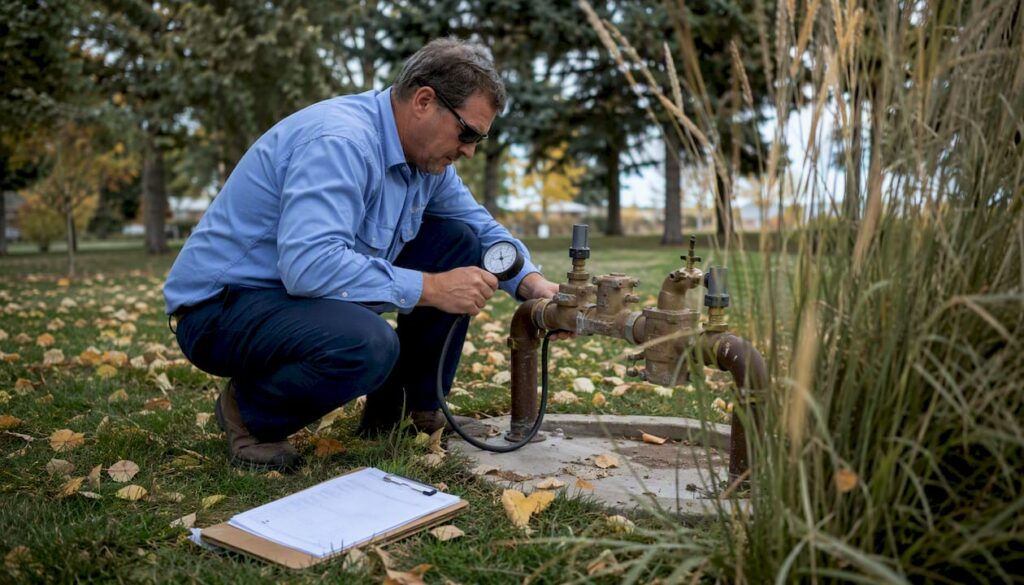
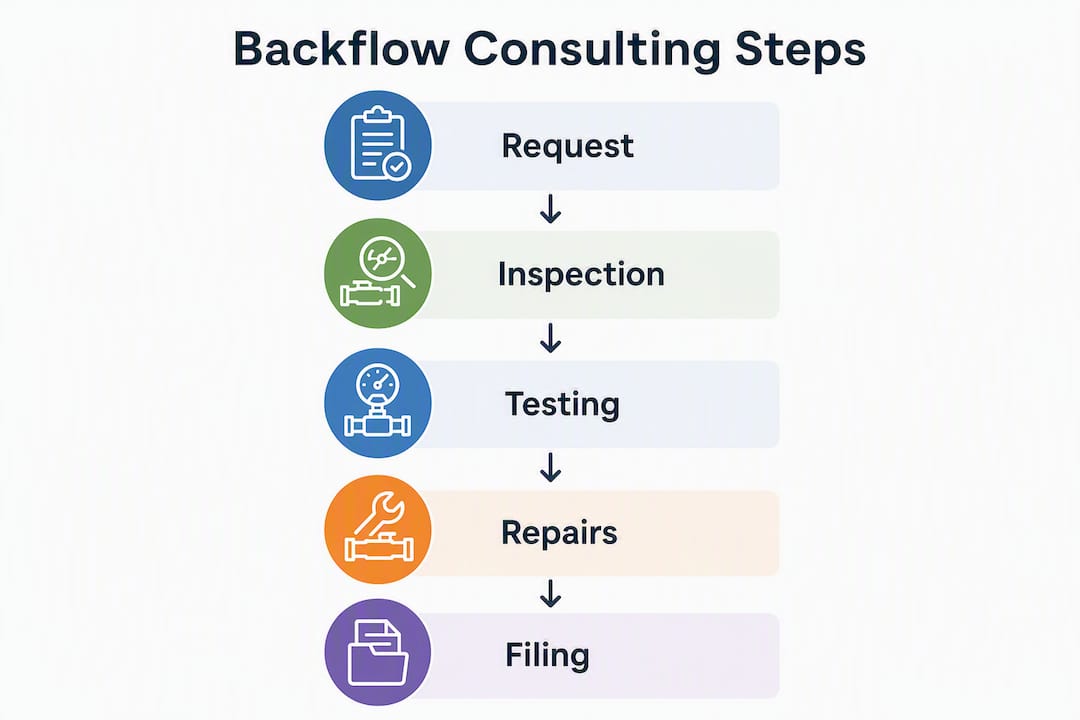
If your Colorado property received a water-district backflow notice, hire a certified backflow consultant right now. That consultant should test your assembly, repair it if needed, and file the compliance report directly with your water district before the deadline on that letter.
Three steps to take immediately:
- Locate the water-district notice and note the deadline, account number, and assembly type listed on it.
- Confirm where your backflow assembly is installed and whether it is accessible (no locked enclosures, no obstructions).
- Schedule a certified test with a licensed tester before the notice deadline, not after.
Pro Tip: Hand the exact water-district letter to your service provider. District notices contain the account and assembly data that testers need to file your report correctly — a missing account number is the most common reason a test report gets rejected.
Before you book, confirm the tester holds a current ABPA or ASSE certification and can file results directly with your water district. Those two things separate a compliant filing from a paperwork problem.
Table of Contents
- What does backflow consulting actually include?
- How does compliance work in Colorado?
- How do you choose and vet a backflow consultant in Colorado?
- What do backflow testing and repairs typically cost?
- What happens during a backflow test and after?
- Can you handle backflow testing in-house?
- Key Takeaways
- What technicians actually find when they show up
- Where to check local requirements and find official guidance
- Southjerseybackflow handles the compliance work for you
- What technicians actually see in the field
What does backflow consulting actually include?
Backflow consulting covers far more than showing up with a test kit. A full-service provider handles the entire compliance cycle: certified annual testing, repairs and rebuilds, parts sourcing, enclosure installation, report filing, cross-connection surveys, and ongoing program management for multi-property portfolios. For commercial and multi-unit properties, the EPA’s cross-connection control manual identifies ordinance review and long-term compliance planning as standard deliverables.

| Service | Single-Family | Multi-Unit | Commercial | Fire Line |
|---|---|---|---|---|
| Annual certified testing | ✓ | ✓ | ✓ | ✓ |
| Repair and rebuild | ✓ | ✓ | ✓ | ✓ |
| Parts sourcing | Occasional | Regular | Regular | Specialized |
| Enclosure installation | Sometimes | Sometimes | Often required | Often required |
| Report filing with water district | ✓ | ✓ | ✓ | ✓ |
| Cross-connection survey | Rarely | Sometimes | Recommended | Recommended |
| Program management | Rarely | Sometimes | Common | Common |
Testing is almost always billed per assembly. Program management for multi-property portfolios is typically structured differently, covering scheduling, filing coordination, and deadline tracking across all your locations. Parts availability and technician scheduling can affect lead times, especially for larger assemblies or specialty rebuild kits, so ask your provider about parts inventory before you commit to a timeline.
How does compliance work in Colorado?
Colorado water utilities follow municipal backflow requirements that typically mandate annual certified testing, timely report submission, and consequences for missed deadlines up to and including water service termination. The specific rules vary by district, so the checklist below is a starting point, not a substitute for calling your utility directly.
Confirm these items with your water district before scheduling:
- Which test form does the district accept, and must it be submitted electronically or by mail?
- Does the district require ABPA or ASSE certification specifically, or will a state-equivalent credential satisfy the requirement?
- Are there enclosure, height, or accessibility rules for your assembly type? Assemblies are commonly required to sit at an accessible height above grade and remain accessible for testing.
- What is the exact deadline on your notice, and what happens if you miss it?
Pro Tip: Send the water-district letter to your service provider before the appointment. The letter often contains the assembly ID and account number the tester needs to file your report. Without it, the filing can be rejected even when the test itself passes.
Check your water district’s portal or call their cross-connection control department directly. Municipal codes set the rules on enclosure types, assembly placement, and acceptable certifications. A provider who files reports regularly with your district will already know these requirements — that familiarity is worth asking about when you vet candidates.
Tracking annual deadlines is one of the most practical things a property manager can do to avoid a last-minute scramble. Schedule tests well before the expiration date; waiting until the final week leaves no room for a failed test, a required repair, or a retest.
How do you choose and vet a backflow consultant in Colorado?
Start here: prioritize testers who hold a current ABPA or ASSE certification and will file results directly with your water district. Certified testers follow established programs that municipal utilities use to confirm tester qualifications — a credential number you can verify is the baseline.
Beyond certification, ask these questions before you sign anything:
- What assembly types have you tested and rebuilt? (DCVA, RPZ, PVB, SVB, fire lines each require different skills.)
- Do you carry parts on the truck, or do you order them after diagnosis?
- Who files the report with the water district, and how quickly after the test?
- Can you provide proof of general liability insurance and a current business license?
Red flags worth walking away from: a provider who cannot produce a certification number, one who asks you to file the report yourself, vague answers about their reporting process, or a written proposal that omits insurance details. A good consultant acts as a compliance liaison — handling the paperwork, not just the wrench work.
For multi-property managers, proactive program management with a single service partner reduces the risk of missed deadlines and eliminates the coordination overhead of managing multiple vendors across locations.
What do backflow testing and repairs typically cost?
Testing is billed per assembly. Repairs, rebuilds, and enclosure installations are separate line items, and the cost of each depends on several variables.
Primary cost drivers:
- Assembly type and size (a residential ¾" DCVA costs less to test and rebuild than a 4" commercial RPZ)
- Access difficulty (a vault below grade or a locked mechanical room adds time)
- Parts required for repair or rebuild (specialty kits for older or discontinued assemblies can carry longer lead times)
- Emergency or off-hours labor (same-day or after-hours calls typically carry a premium)
- Filing or permit fees charged by the water district
Frame your budget around the full cycle, not just the test fee. A test that reveals a failed assembly triggers a repair, a retest, and a second filing. Knowing your assembly type and age before you call lets a provider give you a realistic written estimate upfront — ask for one before any work begins.
The typical timeline runs like this: schedule the test (allow a few days to a couple of weeks depending on provider availability), perform the onsite test (30–60 minutes per assembly for most types), complete any required repairs, retest if the district requires it, then file the final report. For multi-assembly commercial properties, the scheduling window is the longest variable. Coordinating water meter and site access logistics with your utility early can prevent delays on test day.
What happens during a backflow test and after?
The test itself is a documented set of valve checks and differential pressure measurements performed by a certified tester. Results are recorded on a standardized form and filed with the water district. Here is the sequence from arrival to closeout:
- Tester arrives and locates the assembly. Confirm access is clear — locked enclosures, overgrown vegetation, or missing tags all add time.
- Tester attaches a differential pressure gauge kit to the test cocks on the assembly.
- Valves are closed and opened in sequence to measure pressure differentials across each check valve or relief valve.
- Results are recorded on the district’s required test form, noting pass or fail for each component.
- If the assembly passes, the tester files the report with the water district, typically within a few business days.
- If the assembly fails, the tester documents the failure, performs or schedules a repair or rebuild, and retests before filing.
- Final filing and closeout. The water district receives the completed report and updates your compliance record.
Property owners should have the water-district letter on hand, provide clear access to the assembly location, and confirm any enclosure keys or lock combinations are available before the tester arrives. Post-test, ask for a copy of the filed report for your own records. For commercial properties, a structured maintenance workflow that tracks each assembly’s test date and filing status keeps multi-unit portfolios from falling out of compliance.
Can you handle backflow testing in-house?
Yes, but certification is required. No one can legally test and certify a backflow assembly without completing an approved training program. The two most widely recognized programs are ABPA and ASSE 5110, and most Colorado water districts accept either.
What in-house certification involves:
- Completing a classroom and hands-on training course covering hydraulics, assembly types, and test procedures
- Passing a written and practical exam
- Recertifying on a schedule set by the certifying body (typically every few years)
- Maintaining calibrated test equipment and a parts inventory for repairs
In-house programs make financial sense for large portfolios where the per-test savings accumulate quickly. The trade-off is real: you absorb the cost of training, tools, parts stock, and record-keeping. You also take on the responsibility of staying current with each water district’s filing requirements.
For smaller portfolios, complex hydraulics, or any situation where you need a compliance liaison who already has a working relationship with your water district, outsourcing to a certified consultant is the cleaner path. The backflow prevention services a dedicated provider offers typically include direct filing, which removes the single biggest administrative burden from your plate.
Key Takeaways
Compliant backflow consulting in Colorado requires a certified tester, a direct filing relationship with your water district, and a clear process from test to report closeout.
| Point | Details |
|---|---|
| Certification is non-negotiable | Hire only ABPA or ASSE-certified testers; verify the credential number before booking. |
| The district letter drives the filing | Give your exact water-district notice to the provider — it contains the account and assembly data needed for a valid report submission. |
| Cost follows the full cycle | Budget for testing, potential repairs, retest, and filing — not just the initial test fee. |
| In-house testing suits large portfolios | Certification, tools, and parts inventory make in-house programs worthwhile only at high assembly counts. |
| Southjerseybackflow | Offers certified testing, repairs, rebuilds, and direct report filing — a managed compliance option for property owners who want the paperwork handled. |
What technicians actually find when they show up
The most common on-site surprise is an assembly that does not match what the water-district notice says. A property changes hands, a plumber swaps a device, and nobody updates the district’s records. The tester shows up expecting a ¾" DCVA and finds a 1" RPZ in a locked vault with no key on site. That situation costs time and can push the filing past the deadline.
Inaccessible assemblies are the second most frequent issue. Enclosures bolted shut, vegetation grown over the device, or a mechanical room that requires a separate key nobody thought to mention. Clearing access before the tester arrives is one of the simplest ways to keep the appointment on schedule.
Pro Tip: Schedule your test at least three to four weeks before the notice deadline. That buffer covers a failed test, a repair, and a retest without putting you in shutoff territory.
For emergencies — a failed assembly discovered the day before a deadline, or a water-district shutoff notice — quick-response availability matters. Multi-property managers who consolidate all their assemblies with one provider tend to get faster response times because the provider already knows the portfolio.
Where to check local requirements and find official guidance
- Your water district’s website or cross-connection control department is the primary source for required test forms, submission deadlines, acceptable certifications, and enclosure rules. Search your district name plus “cross-connection control” or “backflow prevention program.”
- Colorado Department of Public Health and Environment (CDPHE) publishes state-level drinking water rules that set the framework local utilities operate within.
- EPA Cross-Connection Control Manual (epa.gov) covers national standards for program management, survey requirements, and acceptable assembly types — useful background for property managers setting up an in-house program.
- ABPA (abpa.org) maintains a directory of certified testers and publishes training and recertification standards.
- ASSE International sets the 5110 standard for backflow tester certification and publishes assembly performance standards referenced by many utilities.
- Your water-district notice is itself a compliance document. Keep every letter you receive; it contains the assembly ID, account number, and deadline your tester needs.
For enclosure specifications, certified enclosures must be sized to the specific assembly and allow testing access while protecting against freezing and tampering. Your water district or a licensed installer can confirm which enclosure types meet local code.
This article is general information, not legal or regulatory advice. Confirm current requirements with your water district or a qualified professional for your specific property.
Southjerseybackflow handles the compliance work for you
Staying compliant with backflow regulations means coordinating tests, repairs, and filings on a fixed deadline — and the paperwork alone trips up plenty of property managers. Southjerseybackflow offers certified backflow testing, repair, and report filing as a single managed service, so you hand over the water-district letter and get back a filed compliance report.
Every job includes the test, any required repairs or rebuilds, and direct submission to the water authority. No chasing paperwork, no wondering whether the report landed. For property managers with multiple assemblies, consolidated scheduling and billing keeps the whole portfolio on track without the overhead of managing multiple vendors. If you received a backflow notice and want the compliance handled start to finish, contact Southjerseybackflow to schedule your certified test.
What technicians actually see in the field
The gap between what a compliance guide says and what a tester finds on-site is wider than most property owners expect. Water-district records are often months or years out of date. An assembly gets replaced during a renovation, the new device never gets registered, and the notice arrives with the wrong assembly type. The tester has to stop, verify, and sometimes reschedule — all of which burns time against a hard deadline.
The fix is straightforward: pull the water-district letter, walk the property yourself to confirm the assembly location and type, and send both pieces of information to your provider before the appointment. That single step eliminates the majority of on-site delays. For multi-property portfolios, a provider who already knows your assemblies from prior visits will catch discrepancies before they become compliance problems.