TL;DR:
- Missing a backflow report filing deadline in New Jersey can lead to penalties, water service interruptions, and costly remediation cycles. Properly verifying device information, submitting reports within 30 days, and maintaining thorough records are essential steps to ensure compliance and avoid delays. Managing filing deadlines proactively and relying on qualified testers streamline the process, reducing risks of rejection and regulatory penalties.
Missing a backflow report filing deadline in New Jersey is not a minor oversight. It can trigger administrative penalties, water service interruption warnings, and a compliance remediation cycle that costs far more time and money than the original test. Every property with a backflow prevention assembly is required to file test results annually, and the backflow report filing guide below exists to walk you through exactly what to do, in what order, and how to avoid the mistakes that routinely catch property owners and managers off guard.
Table of Contents
- What you need before filing your backflow test report
- Step-by-step guide to filing your backflow test report in New Jersey
- Common mistakes to avoid when filing your backflow report
- What happens after you file your backflow test report
- Why a proactive backflow report filing process is your best compliance insurance
- How South Jersey Backflow simplifies your compliance filing
- Frequently asked questions
Key Takeaways
| Point | Details |
|---|---|
| Annual testing requirement | Backflow devices in New Jersey must be tested annually and the test results submitted within 30 days to comply. |
| Verify filing responsibility | Confirm who must file the report—tester or property manager—to ensure timely submission and avoid violations. |
| Accurate report details | Ensure all device and address information matches official records to prevent rejections or delays. |
| Keep submission proof | Always obtain and store proof of report submission to defend against compliance audits or disputes. |
| Use professional services | Hiring certified professionals can simplify testing and filing, reducing compliance risks for property owners. |
What you need before filing your backflow test report
The single biggest reason backflow reports get rejected or delayed is mismatched information. Your water authority compares every field on the report against their existing records. If the device serial number, location description, or service address does not match exactly, the report comes back or sits unprocessed.
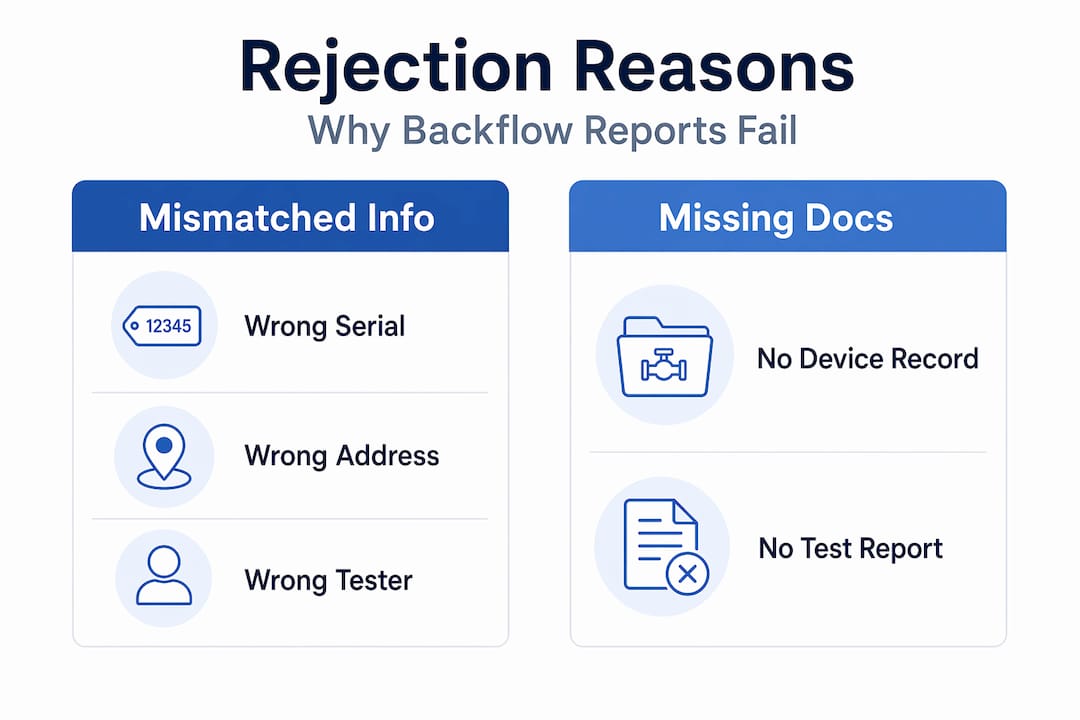
Before the tester even arrives, pre-verify your backflow assemblies are correctly identified in your building’s records, including device type, location, and serial number. Pull up whatever records your water provider has on file. If you have access to a customer portal, use it. If not, call and ask.
Here is what you need to gather before testing day:
- Device information: Type of assembly (RPZ, DC, PVB, etc.), serial number, manufacturer, model, and physical location on the property
- Service address: The exact billing or service address your water provider has on file, not necessarily your mailing address
- Property account number: Your water provider account number, which many jurisdictions require on the form
- Tester credentials: Your certified tester’s license number, expiration date, and calibration records for their test kit
Understanding which device you have matters more than most property managers realize. A reduced pressure zone assembly and a double check valve are tested differently and reported differently. Filing the wrong device type on your report is a clean rejection.
| Document | Why it matters |
|---|---|
| Device serial number | Must match water authority database exactly |
| Tester license number | Required for report validity |
| Test kit calibration date | Expired calibration voids the report |
| Exact service address | Mismatch causes delays or rejections |
| Water account number | Many authorities require it on the form |
Pro Tip: Request a copy of your water provider’s backflow assembly database record before scheduling the test. Comparing it against your physical device eliminates most rejection causes before they happen.
Now that you know what documentation is crucial, let’s discuss the step-by-step process to file your report properly.
Step-by-step guide to filing your backflow test report in New Jersey
New Jersey regulations under N.J.A.C. 7:10 require that backflow assemblies be tested at installation and then re-tested annually, with results submitted to the water purveyor within 30 days of the test date. That 30-day window is not a soft guideline. Treat it as a hard deadline.
Here is the complete filing workflow:
-
Schedule a certified tester. Only a tester holding a valid New Jersey certification may perform the test. Confirm their license is current and their test kit calibration is up to date before the appointment.
-
Complete the test. The tester inspects the assembly, runs the required pressure tests, and records all readings on the official report form. Every field must be filled in, including hazard classification, test results for each check valve, and the relief valve opening point if applicable.
-
Review the form before submission. Check device type, serial number, service address, and tester information against your verified records. One wrong digit in a serial number causes a rejection.
-
Submit within 30 days. Depending on your local water authority, submission methods may include mail, fax, email, or an online portal. The filing obligation may rest with the tester, the property owner, or both, so confirm responsibility before testing day, not after.
-
Obtain confirmation. Whether it is a portal confirmation number, a fax transmission receipt, or an email acknowledgment, get something in writing that proves your report was received.
-
Handle failures immediately. If the device fails, it must be repaired or replaced. A retest is then required, and that passing report must also be filed to close out the compliance cycle. Filing a failing report and doing nothing is not compliant.
The table below shows the most common submission methods and what confirmation you should expect from each:
| Submission method | Expected confirmation |
|---|---|
| Online portal | Submission ID and confirmation screen |
| Auto-reply or manual receipt from authority | |
| Fax | Transmission confirmation page |
| Certified mail receipt |
Pro Tip: If your water authority uses an online portal, screenshots of the confirmation screen are worth more than your word in a dispute. Save them as PDF files with the date in the filename.
For a deeper look at what NJ backflow inspection entails beyond the report, including site access requirements and device placement rules, it helps to understand the full compliance picture for your property type.
With a clear filing workflow, you will want to be mindful of the typical challenges that cause filing errors or delays.
Common mistakes to avoid when filing your backflow report
Most compliance failures in the backflow report submission process are not caused by failed devices. They are caused by process gaps. Here are the ones that show up most often.
Address mismatches are the top rejection cause. Incorrect service address or device location mismatches commonly cause rejected or delayed report acceptance. Your water provider may have an address on file that differs slightly from how you normally write it. Even abbreviation differences like “St.” versus “Street” have caused issues.
Assuming your tester files the report automatically. Most managers assume the tester files, but confirming who transmits the report before the test prevents paperwork from not being delivered to the authority. Some testers file directly. Others hand you the completed form and expect you to submit it. Know which situation you are in.
Additional mistakes to watch for:
- Letting the 30-day deadline pass while waiting for the tester to send you the form
- Filing with the wrong jurisdiction (some properties serve multiple utility boundaries)
- Using an outdated report form that the authority no longer accepts
- Failing to follow up when no confirmation arrives within a week of submission
- Not keeping copies of past reports, which matters when a utility questions your compliance history
“The compliance cycle is not complete until the report is received and logged by the authority, not just tested in the field.”
Staying current on NJ backflow codes is one of the more underrated parts of managing backflow compliance. Reporting forms and submission methods do change, and using last year’s process on this year’s deadline is a real risk.
Pro Tip: Create a shared folder in your property management system for each device. Store the test report, confirmation receipt, and tester credentials together. When an audit happens, you pull one folder, not a stack of emails.
What happens after you file your backflow test report
Filing is not the finish line. It starts a review process on the water authority’s end that directly affects your compliance standing going forward.
The water authority logs the report, verifies tester credentials, updates compliance records, and issues confirmations or notices. That credential verification step matters because if your tester’s license was expired at the time of the test, the report may be invalidated even if the test itself was performed correctly.
Here is what typically follows your submission:
- Compliance record update: Your filing resets the clock on your next annual test requirement. The date of this test becomes the baseline for next year’s cycle.
- Tester verification: The authority checks that the tester’s license was active on the date of the test. Expired credentials can void the report.
- Failure remediation tracking: If you submitted a failing report, the authority opens a remediation record. You will typically have a defined cure period to repair the device and submit a passing retest report.
- Fee or service warning issuance: Late or missing reports often trigger administrative fees or formal warnings. In some jurisdictions, repeated non-compliance leads to water service suspension.
- Confirmation notice: Many utilities send a confirmation by mail or update your portal status once the report is accepted. If you do not see this within two to three weeks of submission, follow up.
For property managers overseeing multiple units or commercial properties, tracking the compliance status of each device separately is essential. NJ commercial backflow compliance has additional layers worth reviewing if you manage more than one building.

Why a proactive backflow report filing process is your best compliance insurance
Here is where most property managers get the mental model wrong: they think compliance equals testing. It does not. The compliance unit is the tested-and-submitted documentation cycle, not just testing, so managing filing deadlines is as critical as scheduling the test itself.
A device can pass the test perfectly on March 1st and still put you out of compliance by April 2nd if the report was never submitted. The water authority does not know what happened in your mechanical room. They know only what lands in their system.
The property managers we see navigate this cleanest are the ones who treat filing as a separate task with its own deadline, not an automatic byproduct of scheduling a tester. They build internal calendars that start with the test date and work backward to ensure the report is submitted with at least a week of buffer before the 30-day window closes.
Assign one person on your team to own this. That person confirms who files in your jurisdiction before every test cycle, requests confirmation of submission the same day the test is completed, and builds a process that captures submission confirmation immediately to prevent last-minute compliance gaps. If that person changes roles, the process transfers with documentation, not institutional memory.
Maintaining copies of every report and every confirmation matters more than people realize until they need them. Water authorities do make errors. Compliance records get lost in system migrations. Having your own clean archive of reports going back several years is what separates a ten-minute dispute resolution from a multi-month remediation nightmare.
The NJ backflow compliance roadmap lays out the regulatory framework clearly. But the day-to-day discipline of managing filing deadlines is purely internal. No regulator is going to remind you that the 30-day window is closing. That responsibility sits with you.
How South Jersey Backflow simplifies your compliance filing
Staying on top of backflow testing compliance is genuinely time-consuming when you are managing it across multiple devices, jurisdictions, and annual cycles. Most property managers are not in the business of tracking water authority submission portals. We are.
At South Jersey Backflow, our certified testers handle every step of backflow testing in New Jersey, from calibrated equipment testing through direct report submission to your water authority, all within the required 30-day window. You receive submission confirmation so you always have proof on file. If a device fails, we coordinate repairs, retesting, and the follow-up report submission to close the compliance cycle completely. If you have received a backflow letter from your utility and are not sure what it means or what to do next, we help you respond correctly and on time. Explore our full backflow testing and certification services to see how we keep New Jersey properties compliant without the paperwork headache.
Frequently asked questions
Who is responsible for filing the backflow test report in New Jersey?
Filing responsibility varies by jurisdiction: some require the certified tester to submit directly, while others place that duty on the property owner or manager. Confirm with your local water authority before the test takes place.
What is the required timeframe to submit backflow test reports in New Jersey?
Results must be submitted to the water purveyor within 30 days of the test date under New Jersey regulations. Missing that window can trigger fees or formal notices.
What should I do if my backflow device fails the test?
Arrange for repairs or replacement promptly, have the device retested by a certified tester, and then file the passing retest report with the water authority to officially close the remediation record.
How can I confirm my backflow test report was properly filed?
Request a submission confirmation in the form of an email receipt or portal submission ID immediately after filing. If your water authority uses a portal, check the status there and follow up if it does not update within two weeks.